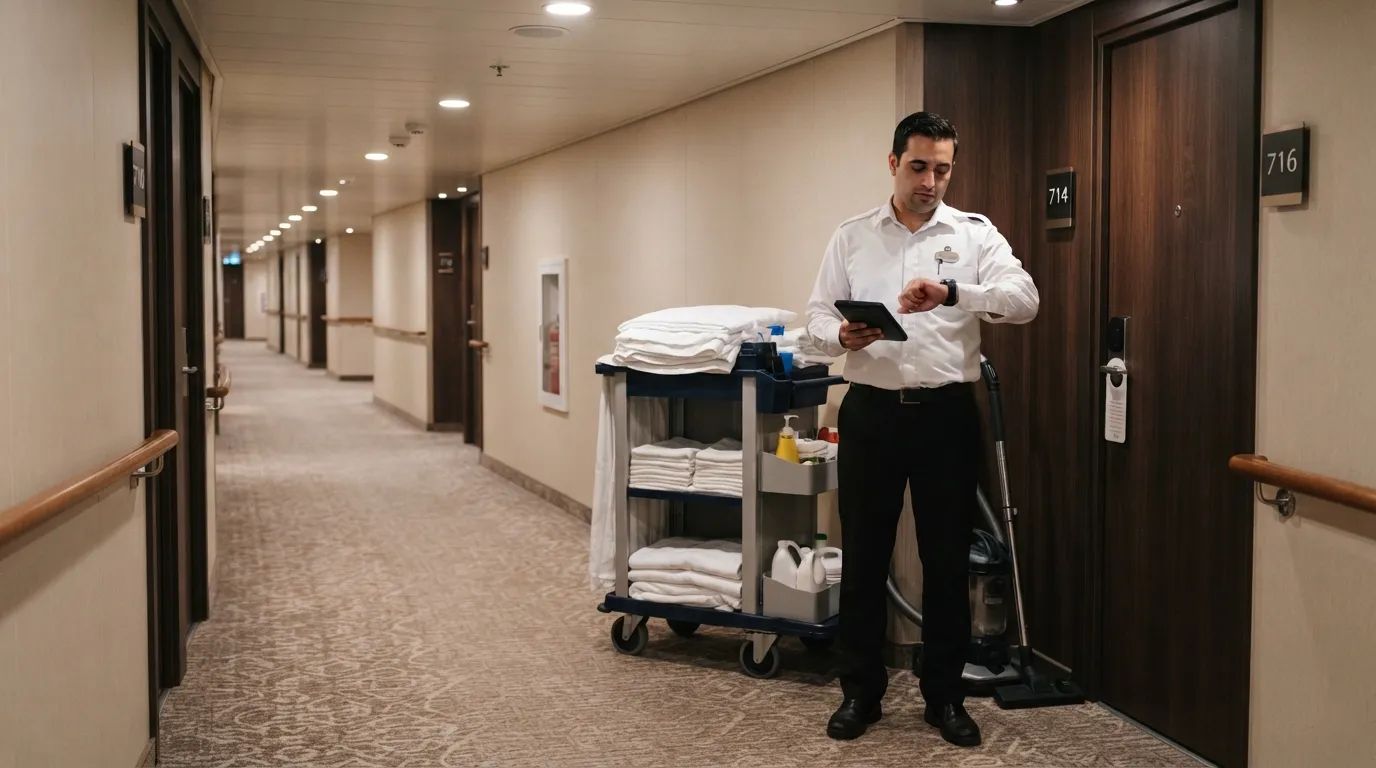
Most passengers assume cabin stewards are simply there to fold towels and swap out toiletries. They’re not – by the time you’ve even opened your suitcase, they’ve already read you like a book.
The things they clock before you ever say “Good morning” would genuinely unsettle you. Here’s the exact list, ranked from subtle to impossible to hide, of what a steward notices before you’ve said a single word.
#17 – Your Name, Long Before You’ve Introduced Yourself
Your cabin steward already has a mental profile building before they’ve met you in person – they don’t need to. By the time you crack open your luggage, more information has passed through their hands than most passengers ever realize.
Your cabin steward will make a concerted effort all week to call you by your name – and that’s not a coincidence. They receive your details before embarkation day.
The twist most passengers miss: they already know who’s in the group, what cabin tier you booked, and any pre-noted preferences – all before you turn the door handle.
This front-loaded knowledge is what separates a cruise steward from a hotel housekeeper. They’re not reacting to you – they’re already ahead of you.
Your name is just the beginning of what they’ve already logged. And #16 gets far more personal.
#16 – Whether You Pre-Requested a Bed Configuration (Or Didn’t Bother)
You can make certain cabin requests before you cruise, during online check-in or on your reservation. Bed configuration – two beds together as a queen, or two singles – is one of the easiest things to lock in ahead of time.
When guests don’t pre-request anything, stewards notice – and mentally flag it as a likely first-day ask.
Guests who skip this step tend to board and immediately ask the steward to rearrange furniture mid-setup – the most disruptive moment of their entire shift. Experienced cruisers know better.
Stewards absolutely remember who made their embarkation run smoothly. Up next: something stewards spot the moment they scan your balcony.
#15 – Anything Left on the Balcony That Shouldn’t Be There
Cabin stewards are required to bring items in from the balcony for safety reasons. This is non-negotiable, and it’s one of the first things they check when entering a cabin that’s been occupied.
Loose items on a balcony – towels, bags, even shoes – can become a serious hazard at sea speed.
Stewards are trained to scan the balcony space immediately, and anything sitting out there gets noted and moved.
This isn’t about being fussy. It’s a ship-safety protocol they enforce every single service.
Guests who habitually leave things outside signal to the steward that they’ll need extra attention during the sailing. And what’s sitting out on your bathroom counter tells them just as much – which brings us to #14.
#14 – The State of Your Bathroom Counter on Day One
Stewards inspect cabins daily for maintenance concerns such as broken fixtures or plumbing issues, and when something isn’t working properly, they report it promptly to the ship’s maintenance team.
But what they also clock instantly is how a guest has already organized – or demolished – the bathroom counter.
Toiletries spread across every surface? The steward mentally marks this as a cabin that needs extra time on the turnaround.
Minor cabin issues are best reported right away – things like burned out light bulbs, slow draining showers, or TV remotes that aren’t working. Cabin stewards can often fix these things quickly or get the right person to handle the job.
Fast Facts
- Stewards clean and reset staterooms at least once daily, often twice on mainstream and luxury ships.
- Every visit doubles as a mini inspection for leaks, broken fixtures, or anything that needs a maintenance call.
- Reported issues are typically flagged to the ship’s maintenance team the same day, not the same week.
The bathroom is where most unreported issues quietly fester – and stewards know it. Wait until you hear what they notice about your luggage.
#13 – Whether Your Luggage Is Still Unpacked by Day Two
Rather than living out of your suitcase for the whole cruise, unpacking and utilizing the wardrobe and shelving space is far better practice.
Stewards walk into a cabin with an open, undisturbed suitcase in the middle of the floor and immediately know the cleaning run will take longer. They have to navigate around it every single visit.
Keeping your things organized will earn you major points with your cabin steward. They’ve had to deal with some very messy cabins in their time.
Guests who unpack fully on day one are silently coded as “easy” cabins – and that reputation pays off all week. What they spot on the nightstand, though, tells an even richer story.
#12 – Whether You’ve Put Out a Do Not Disturb Signal (And When)
Those in standard cabins may select whether they want their stateroom attended to in the morning or evening. Cruise ships also have a magnet, sign, or button that lets stewards know you’re resting.
Stewards track the DND pattern across the whole voyage. A cabin that runs DND until noon every day is noted – it means the steward must rearrange their entire deck schedule around your sleep routine.
The guests who silently disrupt an entire hallway’s cleaning schedule are almost always the ones who never realize they’re doing it.
Quick Compare
- Once-daily service: Common now on Royal Caribbean, Norwegian, and Carnival – one cleaning window, usually mid-morning.
- Twice-daily service: Still standard on many luxury lines – a morning tidy plus an evening turndown.
- Either way: A well-timed DND sign helps your steward plan around you instead of guessing.
If one cabin runs late, it can delay operations for the whole deck – and unlike other days, they can’t just come back later. The next one goes even deeper into the steward’s powers of observation.
#11 – Your Special Occasion Notes Flagged Before You Boarded
Special-occasion notes get attached to a booking long before a guest ever reaches the gangway, and stewards receive that information before they even meet you. Those notes get flagged, and stewards will sometimes decorate a cabin, arrange towel art, or make sure a bottle of bubbly is waiting on ice without being asked twice.
Most guests have no idea this information flows directly to the steward’s pre-sailing briefing. Anniversary, birthday, honeymoon – it’s all in the system, and a good steward acts on it before you’ve even unpacked.
This is one of the clearest examples of how personalized cruise service actually works behind the scenes. The cabin isn’t just cleaned – it’s quietly curated.
And what they notice about how you treat them on day one shapes everything that follows.
#10 – Whether You Acknowledge Them in the Hallway
A quick hello, a “thanks” in passing, or even a smile when you cross paths lets your cabin steward know you still notice their work.
Guests who actually use a steward’s name instead of treating them as invisible stand out instantly on a ship where most passengers barely make eye contact.
This is the detail that most passengers wildly underestimate.
Stewards are professionals with years of training, but they’re also human – and the guests who acknowledge them get noticed in the best possible way.
This rapport is something unique to cruising; you rarely see it develop with cleaning staff in a hotel. What they overhear through the routine, though, is something else entirely.
#9 – Maintenance Problems You Haven’t Reported Yet
Stewards are often the first to notice maintenance or cleanliness issues in your cabin, and a positive relationship makes it easier to report concerns early and have them addressed quickly.
A dripping tap, a flickering light, a shower drain that’s half-blocked – stewards spot all of it during their routine clean, often before the guest has consciously registered the problem.
When something isn’t working, they quietly report it to maintenance before you even ask.
Unreported problems that stewards silently fix are far more common than guests realize. Most cruisers never know how close they came to a miserable night.
But one particular thing tells stewards everything about your travel style from a single glance.
#8 – How Many People Are Actually Sleeping in the Cabin
Your restroom will be clean and stocked with towels for your party – and if you need additional towels, don’t be afraid to ask.
Here’s the thing: stewards count toothbrushes, towel usage, the number of beds in use, and the quantity of toiletries being consumed. They know within one service visit whether the occupancy matches what’s on the booking.
An experienced steward can tell if there’s an extra guest in the cabin almost immediately – and they’re required to flag it if it presents a safety concern.
It’s not about catching anyone out; it’s about life vest counts and muster requirements. Cabin stewards are responsible for making sure each cabin has the required number of life vests in storage.
That’s not a small detail – it’s maritime law. And #7 is something most guests would be genuinely surprised to know.
#7 – Whether You’re a Solo Traveler (And How You’re Holding Up)
Stewards often check in on solo travelers more frequently during the first two days, a habit that never shows up on any survey. Many solo guests say a steward’s quick daily hello becomes one of the most memorable parts of the whole sailing.
A single set of toiletries, one pillow used, one side of the bed untouched – stewards piece it together fast. And rather than ignoring it, a good steward quietly adjusts their service style.
Solo travelers are the guests most likely to receive an unprompted extra level of attentiveness – not because of a policy, but because experienced stewards develop a professional instinct for it.
What’s silently noticed about your tipping habits, though, is the one that surprises people most.
#6 – Whether You’ve Left Cash Out (And Where)
Crew members prefer cash because cash is king – they’re often sending money back home to their families. Tips in cash are always best.
An envelope left on the desk, a bill tucked under a glass – stewards notice these gestures immediately, and they remember them.
It’s not purely about the money. It signals the kind of guest you are.
Worth Knowing
- Standard daily gratuities on major lines in 2026 run roughly $17 to $20 per person, per day.
- Carnival charges $17/day for standard cabins; Royal Caribbean runs about $18.50/day.
- Celebrity sits near $19.50/day for standard staterooms, with Norwegian typically the highest among mainstream lines.
- That daily charge is pooled among crew – cash on top of it is what stewards actually notice as personal.
Most cruisers think that tipping big on day one locks in the best service. They’re wrong.
Talk to any steward and they’ll say money’s nice, but there are things they value more – and you don’t have to spend a dime to get on your steward’s radar for all the right reasons.
The guests who tip mid-cruise or tip with a genuine thank-you note often get more than the ones who simply front-load cash.
And what comes next is the thing stewards notice that you genuinely cannot fake.
#5 – Your Preferred Cleaning Window (Even If You Never Said It)

Cabin stewards make a point of greeting all guests on the first day, and during this first meeting they may ask if you’d like your room cleaned once or twice per day.
But experienced stewards also pick up on behavioral cues. Guests who are always in the cabin at 9 a.m. are mentally filed under “afternoon service.”
Guests who leave at 7:30 for the buffet are pegged as “morning cleans.”
Your room steward visits your cabin at least once daily, often twice on mainstream and luxury ships.
The best stewards sync their schedule to yours without you ever realizing it – they work around your rhythm, not the other way around.
What they figure out about your habits from the minibar alone is equally revealing.
#4 – What You’re Consuming (And What That Signals)
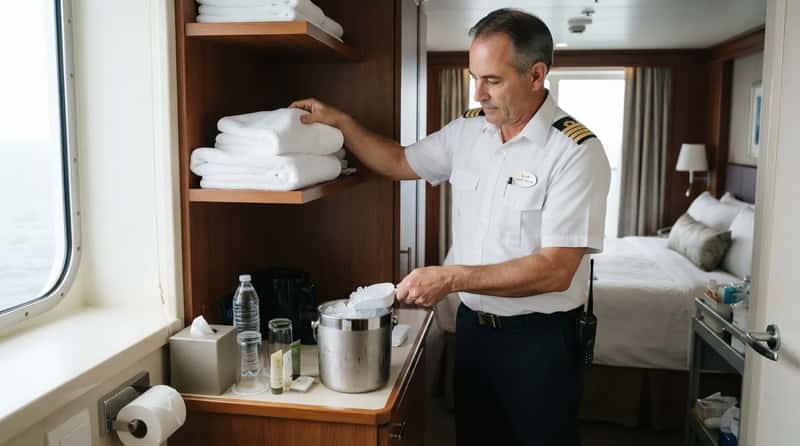
Cabin stewards regularly replenish essentials, including towels, toilet paper, tissues, toiletries, ice buckets, and drinking glasses.
But they also track what’s being used and at what rate. An ice bucket emptied twice before noon, room service trays at odd hours, extra glasses requested repeatedly – each tells a small story about what a guest is likely to need next.
A steward who anticipates your consumption patterns before you ask is the gold standard of cabin service – and it starts from the very first clean.
Stewards act as the ship’s unofficial fixers because they know exactly who to call – the plumber, the laundry team, the handyman nobody else knows exists.
Most guests never think to ask, assuming it’s outside a steward’s job. And the thing they notice about your balcony behavior on port days is one most passengers never consider.
#3 – Whether You Have Medical Needs You Haven’t Mentioned

Passengers managing medical needs often don’t realize stewards can quietly help behind the scenes. Sharps containers, extra robes for comfort, and similar needs get handled without any awkward conversation at guest services.
This is one of the more overlooked accommodations because cruise lines rarely spell it out anywhere.
A medical bag left on the counter, specific items in the bathroom, accessibility equipment in the room – stewards absorb this information without comment and adjust their service accordingly.
From extra pillows and blankets to hypoallergenic bedding or accessibility-related requests, cabin stewards respond quickly and discreetly.
They are often the first point of contact for guests, so flexibility and a friendly attitude are key.
The stewards who proactively source what you need before you ask are the ones who’ve been reading the room since day one. But what they notice about guest behavior at disembarkation might be the sharpest signal of all.
#2 – How You Handle Disembarkation Day
Cruise Critic and Facebook groups are packed with comments from stewards about how late passengers disrupt their entire cleaning schedule. If one cabin runs late, it can delay ship operations for the whole deck – and they can’t just come back later.
By then, the next guests are already boarding.
Stewards remember who lingered past their departure window. Not angrily – professionally.
It’s a workload issue that compounds across an entire deck.
At a Glance
- Cruisers on forums like Cruise Critic have described stewards handling as many as 24 cabins a day under once-daily cleaning schedules.
- That’s roughly double the workload some stewards managed under older twice-daily service models.
- A single late departure doesn’t just affect one cabin – it can push back turnover for dozens of incoming guests.
Many passengers wait until the morning of departure to say thank you or leave a tip. Unfortunately, you may not see your cabin steward at all during that window because they’re buried in cabin turnover.
If you want to thank them personally, do it on your last full day.
The guests who exit gracefully and say goodbye properly are genuinely remembered – often by name, on the next sailing.
And the #1 thing cabin stewards notice? It’s the one thing almost no one expects.
#1 – Whether You Treated Them Like a Person From Day One

Address your cabin steward by name. Sounds simple, and it is.
It’s also common courtesy.
This is the single biggest factor that shapes your entire cruise experience, and virtually nobody talks about it.
Ice buckets get magically refilled, extra towels appear without asking, and your room is always cleaned at just the right time – not because of a tip, but because of how you treated someone from the first moment.
Cruise cabin stewards are some of the hardest working people on board – they clean dozens of cabins, remember your name, and somehow make it all look effortless.
The guests who are genuinely kind from the start don’t just get good service. They get the best service on the ship.
And that calculation happens before a single word is exchanged.
The Bottom Line
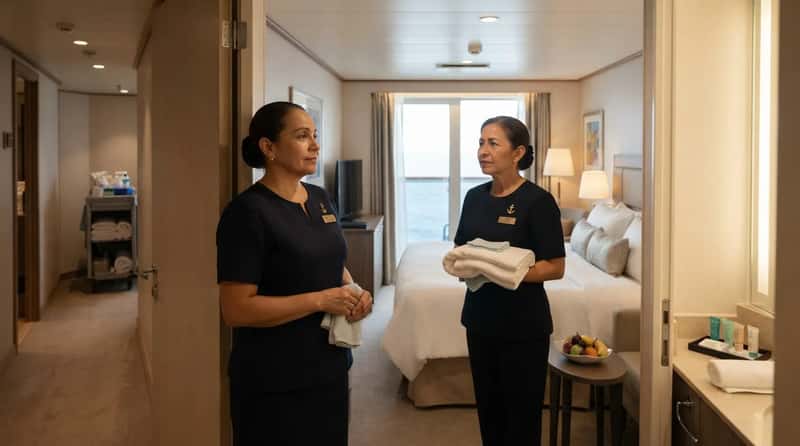
Cabin stewards are not just cleaning staff. They’re trained observers who read your room, your booking notes, your habits, and your personality long before you’ve introduced yourself.
From the state of your bathroom counter to whether you use their name in the hallway, every detail feeds into the service you’ll receive all week.
The guests who understand this don’t try to work the system. They simply show up with basic human decency – and the ship quietly rewards them for it.
By the time you say your first “good morning,” the verdict is already in – and it was never about the tip.
#18 – The Comment Card Trick That Actually Helps Your Steward

Here’s the one move almost no guest ever makes: naming your steward directly, by full name, in the mid-cruise or end-of-cruise guest satisfaction survey.
Many cruise lines weigh those written comments – not just the star rating – when deciding on contract renewals, promotions, and performance bonuses.
- Grab your steward’s full name early – it’s usually on the info card inside your closet or on the daily planner.
- When the survey appears (paper or app), add one short sentence naming them and one specific thing they did well.
- Submit it before disembarkation morning, while it’s still fresh and before the survey window closes.
A five-second write-in like this can matter more to your steward’s career than any cash you leave on the desk – and it costs you nothing.