Ask someone what a yacht deckhand actually does and they’ll say ropes, tenders, washdowns. Ask a deckhand who’s spent five seasons on charter, and they’ll tell you the real job is reading people.
Within the first five minutes of boarding, a good deckhand already knows whether a guest has been on a yacht before. Not from a guest list, but from a string of tiny, unconscious habits the guest has no idea they’re broadcasting – and the list of tells is longer, and stranger, than you’d expect.
#17 – They Walk the Deck Like They Own It
A first-timer tiptoes. A repeat guest strides.
They know exactly when to clear out of a zone – cabins being made up, the breakfast area mid-service – without anyone saying a word. That spatial awareness isn’t taught in a briefing; it’s earned over multiple charters.
They don’t ask which way the bow is. Their feet find the swim platform by instinct.
It’s one of the first things a deckhand clocks, often before the guest has said a single word. But the way they walk is just the opener – what they do with their hands next tells the real story.
#16 – They Greet the Crew by Role, Not Name
First-timers say “excuse me.” Repeat guests say “morning, deck crew.”
Every yacht runs on a clear hierarchy – deckhand, stew, chef, captain – and a guest who instinctively asks the right person for the right thing has done this before. Someone who learned that hierarchy from living it, not from a preference form, moves differently.
Repeat guests almost never interrupt a crew member mid-task. They wait, they read the moment, and that patience registers instantly with whoever’s doing the work.
Some even remember a deckhand’s name from last season – even when the deckhand has forgotten theirs. That always gets noticed.
Next up: the one thing they do at embarkation that separates them immediately from first-timers.
#15 – They Bring the Right Luggage
Soft-sided. Compact. No wheels.
A duffel that folds flat under the berth is second nature to repeat guests. First-timers show up dragging hard-shell rollers that won’t fit in any cabin locker.
The luggage alone is one of the fastest tells a deckhand uses to size up new arrivals. It signals whether the guest has done the groundwork, and whether the week ahead involves a lot of hand-holding.
Repeat guests also know not to underpack, mistaking minimalism for sophistication. The right bag, the right amount of gear – it takes a charter or two to learn, and the deck crew always notices.
Fast Facts
- Soft-sided duffel bags collapse flat and fit under most berths.
- Hard-shell suitcases often don’t fit through narrow interior doorways or lockers.
- Cabin storage on most yachts is limited, so lighter packing beats formal packing.
- Crew typically stow luggage before the welcome tour even begins.
This habit connects directly to the next one, which happens about thirty seconds after the bags hit the dock.
#14 – They Skip the Full Tour
A first-timer follows the welcome walkthrough like a museum tour. A repeat guest politely declines half of it.
They already know where the master cabin is, which head is theirs, and where the life jackets live. First impressions on a charter form fast, and embarkation sets the tone for the entire week – so a repeat guest saves everyone that time.
What they do pay close attention to is anything new: a different toy, an updated safety protocol. That selective attention is a dead giveaway that they’ve done this before.
And speaking of water toys – here’s how they handle that in a way that tips off the crew immediately.
#13 – They Already Know the Toy Box
First-timers stare at the SeaBob like alien technology. Repeat guests ask if you’ve got the new model.
A returning guest approaches the swim platform with their wetsuit already half on, and asks about conditions before requesting the jet ski, not after. They treat the water toys as familiar gear, not a novelty.
They know the hand signals for the towable tube, and they check with the deckhand before jumping in near the anchor chain. That calm, unprompted safety awareness is one of the clearest signals of experience a deckhand sees all charter.
What they do when they return from a water session is just as revealing.
#12 – They Rinse Off Without Being Told
Salt water. Sunscreen. Teak deck.
First-timers drip sunscreen everywhere, sit on cushions in wet swimwear, and track sand across the aft deck without a second thought. Repeat guests hit the transom shower before their feet even touch the teak – every single time, without prompting.
That habit alone tells a deckhand everything about how much respect this guest has developed for the boat, and for the crew that maintains it. It’s not formally taught; it’s absorbed through repeated exposure to a crew that cares.
This respect for the vessel carries into one of the most polarising behaviours the crew watches for, coming up next.
#11 – They Tip at the Start, Not Just the End
Not all repeat guests do this – but the ones who do get flagged instantly as seasoned returnees.
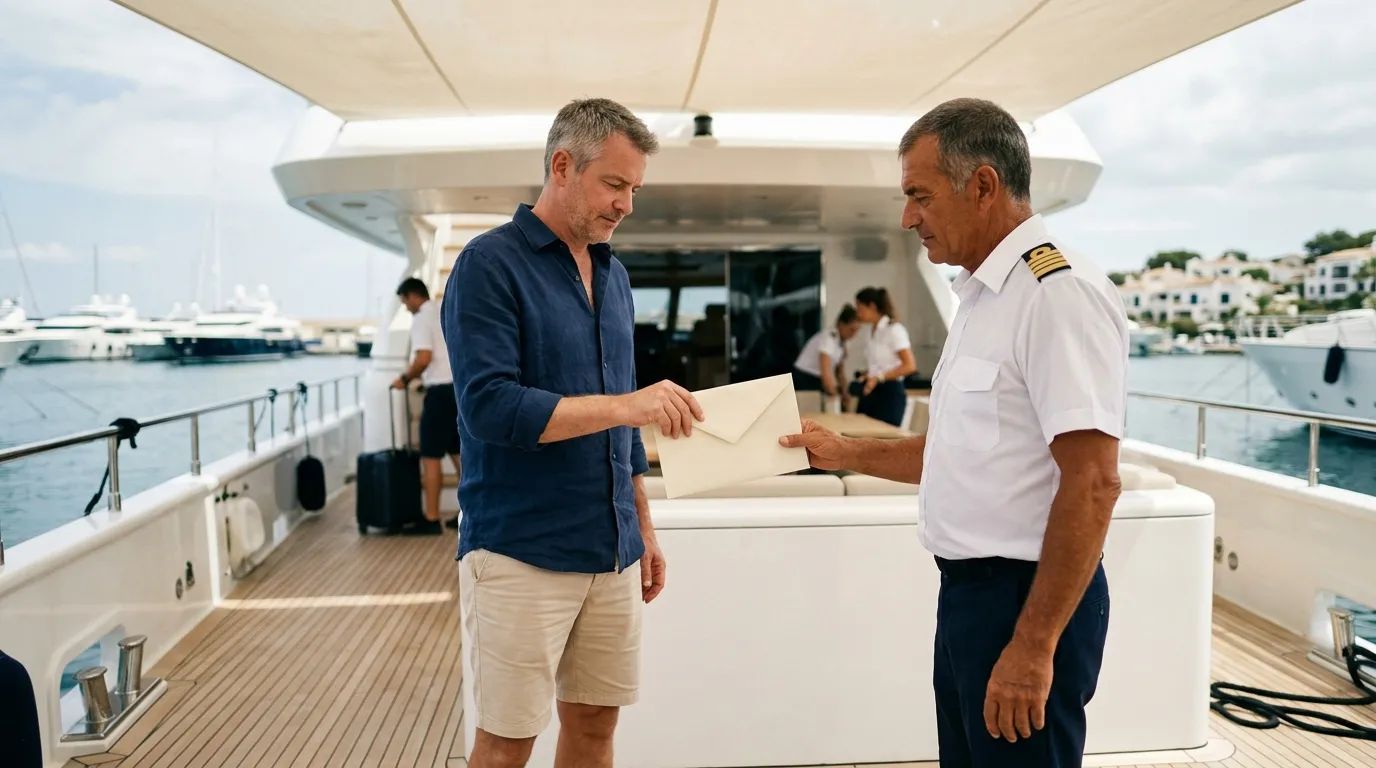
Industry standard is to tip at the end of a charter. But guests who’ve been around long enough know a small early gesture – a handshake with something in it, a quiet word to the captain – sets a different tone for the whole week.
It’s not about buying better service; professionalism doesn’t bend that way. It’s a signal: I understand how this works.
First-timers rarely know this is even an option. Repeat guests who do it have usually been coached by someone with serious charter time behind them.
But money isn’t the only currency on board. The next habit is completely free, and it matters just as much.
#10 – They Watch the Weather Without Asking About It
First-timers check forecasts constantly and announce every update out loud. Repeat guests do the opposite.
They glance at the horizon, notice the wind shift, and quietly adjust their own plans instead of turning it into group drama. They’ve learned the captain already knows about the 15-knot forecast, and asking twice won’t change it.
Experienced guests also read crew body language around weather in a way first-timers never do. A deckhand stowing extra lines at anchor? A returning guest clocks it and quietly moves their things inside – nobody has to say a word.
Quick Compare
- First-timer: checks the forecast repeatedly and narrates every update out loud.
- Repeat guest: reads the horizon and adjusts plans without saying a word.
- First-timer: asks the captain to confirm conditions more than once.
- Repeat guest: trusts the call has already been made.
That kind of quiet situational awareness leads directly into the next tell.
#9 – They Know When to Disappear
Repeat guests instinctively know when the crew needs space to work, and they remove themselves from the aft deck without being asked.
A docking manoeuvre underway? They’re already inside or on the bow, watching quietly. The crew re-rigging the tender lift? They find a sun lounger on the far side of the boat and open a book.
This ability to read operational moments and vanish tactfully is one of the rarest, most appreciated behaviours a deckhand encounters. Most guests don’t develop it until their third or fourth charter – some never do at all.
The next sign is subtler still, and it happens at the dinner table, of all places.
#8 – Their Dietary Notes Are Already in the System
First-timers fill out the preference sheet vaguely, or forget key details entirely. Repeat guests submit it early, and update it with precision.
Beyond the paperwork, they’ve learned to communicate the same way in the moment. A first-timer says “I don’t really like this.” A repeat guest says “next time, I’d love more lemon – just so you know.”
That proactive, forward-thinking phrasing tells the crew this guest has given feedback before and watched it get implemented. They trust the process, because they helped build it last time.
The preference sheet habit connects directly to the next one, which deckhands see every morning before most guests are even awake.
#7 – They’re Up Before the Sun
Not always, but often – and when they are, they don’t ring for service.
The early-rising repeat guest disrupts nothing. They find the coffee station without waking the stew, pour their own cup, and sit quietly on the bow watching the anchor light flicker off at dawn.
First-time guests who wake early tend to activate the entire service crew within minutes. A repeat guest self-manages in a way that’s genuinely rare, because it takes real experience to be comfortable on a boat without anyone serving you.
Worth Knowing
- Crew days often start before sunrise, long before most guests are awake.
- A quiet, self-serve coffee habit is one of the clearest signs of charter experience.
- Early risers who wait on service can unintentionally pull the whole crew into work mode too soon.
But what happens mid-morning, when the group reconvenes, reveals the next layer.
#6 – They Brief Their Own Guests
If a repeat guest brings new friends aboard, watch the first thirty minutes.
They become an unofficial ambassador – explaining the barefoot rule, pointing out the sunscreen bucket, quietly telling a friend not to put a glass on the teak rail. It saves the deck crew an enormous amount of corrective work, and it’s spotted immediately.
The crew repays this instinctively. The guest who coaches their friends tends to get quieter, warmer, faster service all week – not favouritism, just the natural result of mutual respect.
Now here’s the one that genuinely surprises most people outside the industry.
#5 – They Know Exactly How Long a Tender Run Takes
Not five minutes early. Not fifteen minutes late. Right on time.
Tender schedules are the operational backbone of any charter day, and nothing derails them faster than a guest with no sense of distance or turnaround time. A repeat guest asks what time the tender leaves, then is standing at the swim platform two minutes before that.
They’ve been left at a dock once, maybe twice – they didn’t make that mistake a third time. That same rhythm shows up in sunset cocktails, dinner service, every time-based moment of the day.
And they show that rhythm in how they handle the next thing on the list, which is quietly controversial among charter veterans.
#4 – They Don’t Over-Request the Itinerary
Here’s the controversial one. Most brokers tell guests to ask for everything – experienced crew will quietly tell you that repeat guests ask for less, and get more.
A repeat guest has learned to trust the captain’s local knowledge. When the captain suggests a different anchorage because the planned one is crowded, the first-timer pushes back; the repeat guest says “you know best.”
That trust, extended freely, almost always produces a better outcome, and the crew bends over backwards to reward it. The guests who try to plan every hour are often the most disappointed; the ones who leave room for the unexpected get the best stories.
The next sign plays out across multiple days, and it’s one of the most emotionally significant for the crew.
#3 – They Remember a Crew Member’s Story From Last Time
“How’s your sister? Didn’t she get into that marine biology program?”
Crew are trained to stay professional and avoid personal conversation unless invited, but in the natural rhythm of a week at sea, small details surface anyway. A first-timer forgets them by the time they clear customs; a repeat guest files them away and asks next season.
That single act of remembered humanity is one of the most powerful bonds a repeat guest can build with crew. It’s not flattery or strategy, it’s just paying attention, and it means more to a deckhand than almost any tip.
Ask crew why guests come back year after year, and the answer is rarely the itinerary – it’s almost always each other.
What comes right before the number-one sign is one final habit that plays out in the last hour of every charter.
#2 – They Thank the Deck Crew Separately
Most guests thank “the crew” as a group. Repeat guests shake the deckhand’s hand individually, and mean it.
The deck crew can feel overshadowed next to the stews, chef, and captain, who get more direct guest interaction. A repeat guest has figured this out, and knows the deckhand was the one who launched the jet ski at 7am, secured the tender in a chop, and kept the swim platform safe all week.
Naming the deckhand specifically – in a tip envelope, or just a handshake – is something crew talk about for the rest of the season. It cements that guest’s reputation across the whole boat, and often the whole fleet.
Why It Stands Out
- Deckhands often work the most physical, least visible role on board.
- A direct thank-you or named tip carries extra weight because it rarely happens.
- Crew remember specific guests for entire seasons after a gesture like this.
This kind of targeted acknowledgment sets up the number-one sign perfectly, because the final tell happens before the guest even steps on board.
#1 – They Contact the Captain Directly Before the Charter
Not the broker. The captain.
The guests who truly understand how a charter works bypass every layer of middlemen and send the captain a personal note before embarkation. Something simple: Looking forward to being back. Same preferences as last time, but we’ve got one new guest with a shellfish allergy – let me know if you need anything from me.
That message, sent before the charter even starts, signals everything. It tells the crew this guest respects the chain of command, has done the homework, and is already thinking about making their job easier, not harder.
A repeat guest who contacts the captain directly has figured out the single most important dynamic in the entire charter relationship: the crew isn’t there to react. They’re there to lead, and the best guests let them.
The Bottom Line
Deckhands are trained observers, and these patterns repeat on almost every charter – catalogued consciously or not.
The guests who get the best version of that attentive service aren’t just filling out forms. They’re showing up with situational awareness, earned respect for the vessel, and a real relationship with the people running it.
The signs are everywhere – from the luggage at the dock to the early-morning coffee self-pour to the handshake on departure. They’re quiet signals, but crew never miss them.
Have you spotted any of these yourself, or is there a tell we missed? Drop it in the comments.
Bonus: The Tipping Formula Repeat Guests Actually Use
Bonus: The Tipping Formula Repeat Guests Actually Use (Image Credits: Gemini)Every deckhand notices tipping habits, but almost none of them will explain the actual math to a first-timer. Here’s the real structure seasoned charter guests follow.
- The baseline is roughly 15-20% of the base charter fee (not including expenses like fuel or dockage), pooled and split among the whole crew.
- The full amount goes to the captain in one envelope or transfer, who then divides it by role and hours worked – guests never hand out uneven amounts themselves.
- It’s handed over on the last morning, before disembarkation, not slipped to individual crew members throughout the week.
- If a guest wants to recognise one crew member specifically – like a deckhand who went above and beyond – they add a separate, named envelope on top of the pooled tip, with a short note.
Guests who follow this exact structure are instantly read as experienced, because it shows they understand the crew works as one team, not a collection of individual service providers competing for attention.
Get this right once, and every future charter with that same crew starts on a completely different footing.