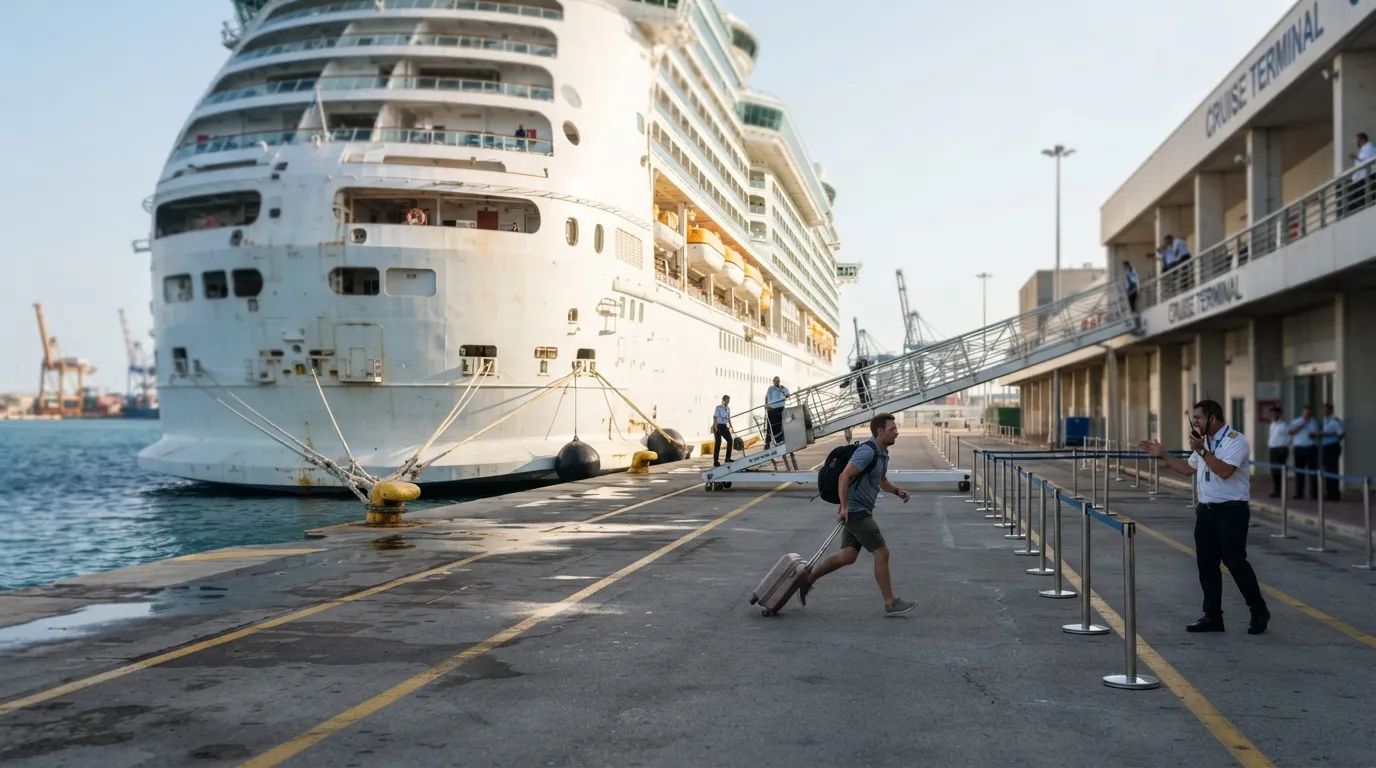
Embarkation day looks like luggage carts, slow lines, and a sprint toward the buffet. That’s the version passengers see. Behind a polished counter, a small team is quietly handling government data, cabin puzzles, cash, and safety records before the ship ever leaves the dock.
Some of these jobs touch your cabin, your wallet, and your safety, and almost none of them get announced. One traces back to a real shipwreck, and you’ve probably grumbled through it yourself. Here’s the countdown, starting with the part everyone gets wrong.
#17 – The Person You Call the Purser Probably Has a Different Title Now

The desk you picture as the purser’s office is likely labeled something else. Aboard many ships the sign reads guest services, guest relations, or reception. Traditionally, the purser is the person principally responsible for handling money on board. On modern merchant ships, the role stretches to all administration, including passenger manifests.
That makes the desk much more than a complaint window. The chief purser is often promoted to hotel manager, a rank equal to the staff captain and chief engineer on many vessels. So the person fixing your billing glitch may sit in the same part of the ship’s hierarchy as the officers who keep the engines running.
Fast Facts
- Common desk signs: guest services, guest relations, or reception
- The traditional purser is the person in charge of money on board
- On modern ships, the job covers all administration, including passenger manifests
- A chief purser may be promoted to hotel manager
And that’s the calm part. The next job starts with your name crossing a border before you do.
#16 – Your Name Reaches Border Officials Before You Find Your Cabin
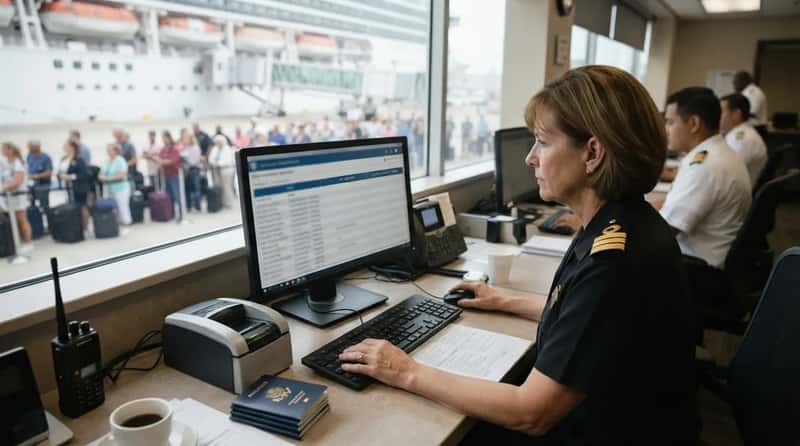
The guest list is a government document long before it’s a party list. A job listing for an assistant purser (guest services supervisor) lays out the work. It includes preparing and sending APIS and Landing Order files to U.S. Customs and Border Protection, the Coast Guard, and other authorities.
That’s a lot of responsibility for a team passengers mostly see handing out Band-Aids. The same listing says the team must protect the confidentiality of passengers’ personally identifiable information at all times. Your passport details are being handled with care, even if the line outside the terminal feels like chaos.
Now picture what happens when that paperwork has a hole in it, right there in the terminal.
#15 – Missing Passport Details Get Chased Down Before You Board

Some paperwork problems get solved while you’re still standing in line. The same listing says purser staff meet shoreside embarkation teams beforehand to give documentation guidance and reference materials. They’re also expected to be in the terminal during embarkation and disembarkation to help check-in supervisors.
Gaps in guest data get handled there too. Missing guest information is entered into the line’s check-in app, and the required documents are collected. Details vary by cruise line, but the idea is the same: catch the gap at the terminal, not at a foreign port.
- Documentation guidance goes to terminal staff
- Missing details get entered and documents collected
It gets trickier when not everyone on board is taking the same trip.
#14 – Guests Who Join or Leave Mid-Trip Need Their Own Paper Trail

Not everyone on a ship is on the same itinerary. Purser staff coordinate transfers with port agents and make sure documents are right for guests breaking their voyage or joining at wayports. One cruise can carry several separate paper trails at once.
That takes real legal knowledge. The purser works with the home-port immigration office and has to understand the rules of many nations. One office, one ship, and a stack of different national rules to keep straight.
Meanwhile, a very different kind of record is being started in your name.
#13 – Your Onboard Account Gets Built Before You Order a Single Drink

The bill you see on your last night has a long backstory. Chief purser duties include passenger billing and managing accounts. Assistant pursers handle passenger accounts and credits on the hotel accounting system.
Exact setups differ by cruise line. A purser’s duties include preparing preliminary and final statements for passengers and collecting the funds. So when you ask about a mystery charge, you’re talking to the department that builds the numbers in the first place.
Then there’s the little plastic card in your pocket, which is more complicated than it looks.
#12 – The Cabin Key Desk Is Quietly Solving a Puzzle

That card sits on top of a long chain of decisions. An assistant purser’s duties include cabin assignments and changes, following instructions and company policy. Cabin keys are on the reception list too.
Moves aren’t random. Cabin changes and assignments are meant to be reported to the chief purser. That’s why the answer is rarely instant when you walk up and ask to switch.
Speaking of cabins, there’s a window for fixing a bad one, and it closes fast.
#11 – The Noisy-Cabin Fix Has an Expiration Window

Hallway thumps and engine rumble are easier to fix on day one. One travel site advises passengers to ask the purser on embarkation day, before the ship finalizes its arrangements. Its reasoning is that unsold cabins are still empty and the purser has the most flexibility.
That’s advice from a travel site, not a published policy, so results vary by ship. The logic is still simple: the fuller the ship gets, the fewer options anyone has. Waiting until night three usually means fewer choices and a lot more sleepless thumping.
If you’re already at the desk, there’s one more question worth knowing about.
#10 – The Upgrade Question Almost Nobody Asks

Plenty of cruisers think asking about upgrades is pushy. Some cruise writers say it’s the most overlooked move on boarding day. One travel site suggests walking to the purser’s desk and asking whether any higher-category cabins are going unsold. It notes that most guests never do, and most stay in the cabin they booked.
Expect no promises. Guest services handles immediate requests, while hotel directors oversee cabin assignments and can approve bigger moves. Being polite and specific helps, but a “no” is a real possibility.
Quick Compare
- Guest services: handles immediate requests at the desk
- Hotel director: oversees cabin assignments and can approve bigger moves
- Best ask: whether any higher-category cabins are going unsold
Not every request at that counter is about luxury, though. Some are about feeling human.
#9 – Seasickness Help Can Be a Desk Visit Away

Nobody mentions the motion until it hits. Travel sites report that guest services often keep seasickness remedies on hand. One advises asking on embarkation day, before you feel rough, especially if night one is in open ocean.
Availability and cost vary by line, so treat it as a question rather than a guarantee. One site says the real mistake is waiting until day three, when you’re already miserable. A thirty-second question on day one beats a rough night.
The next one is about a single sentence and what it can do for a big occasion.
#8 – A Celebration Flag Can Change How the Crew Treats You

Birthdays, anniversaries, and big milestones can be mentioned at the desk. One travel site says telling the purser on embarkation day puts you in a different category for surprise gestures from the crew. That could mean a small extra touch somewhere along the trip.
That’s a claim from a travel blog, not a promise from a cruise line. Nothing about it is guaranteed, and it depends on the ship. Still, the crew can’t plan around something they don’t know.
Now for the part of the desk that looks the least like a hotel counter.
#7 – The Ship Has to Make Sure It Has Enough Cash on Board
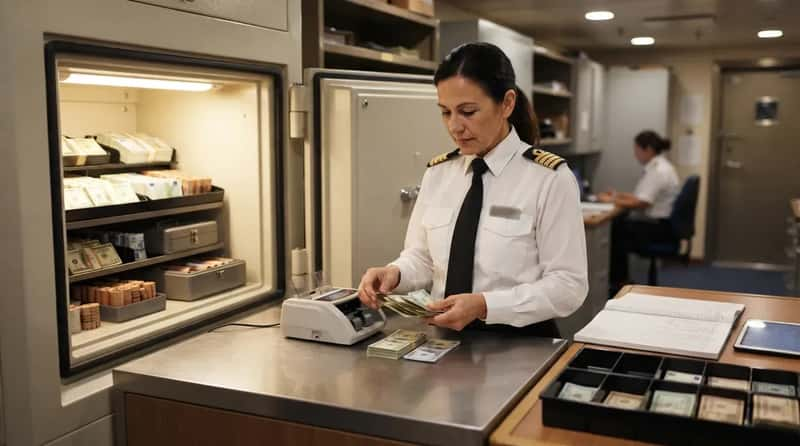
Behind the desk is a small bank. A purser’s duties include auditing and supplying cash floats for the reception desk. Pursers also oversee onboard banking and currency exchange.
That cash has to come from somewhere. A chief purser orders cash, maintains the safe’s contents, and makes sure enough cash is on board. So the “boring” desk is also the ship’s cash planner, long before anyone asks for change.
At a Glance
- Reception desk cash floats are audited and supplied
- Onboard banking and currency exchange fall under the purser
- The chief purser orders cash and keeps the safe stocked
Planning doesn’t stop at money. It reaches all the way to what language your paperwork is printed in.
#6 – Guests Who Speak Other Languages Get Planned For in Advance
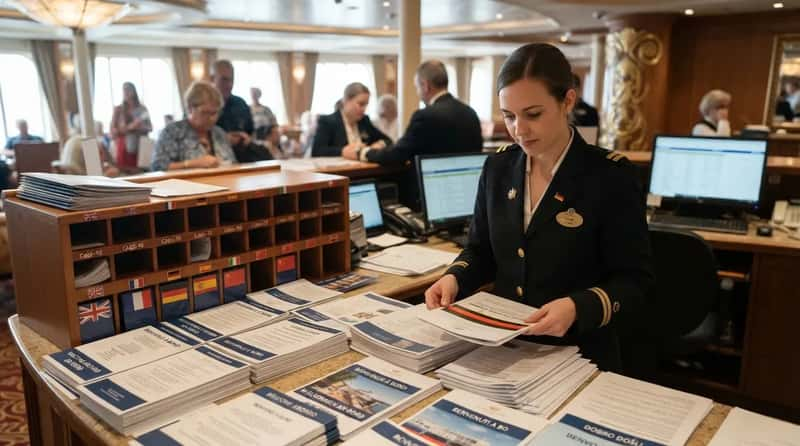
Embarkation day includes headcounts that never reach the passengers. The assistant purser listing says staff advise onboard and shore teams on guest and crew counts before sailing. It also covers international guest details that require translated materials.
So the ship starts preparing for language needs before you board. Your nationality can shape what printed information is waiting for you. The goal is that nobody gets key information in a language they can’t read.
Speaking of printed materials, someone is racing a clock to get them into your hands.
#5 – The Daily Program Is a Deadline, Not Just a Leaflet
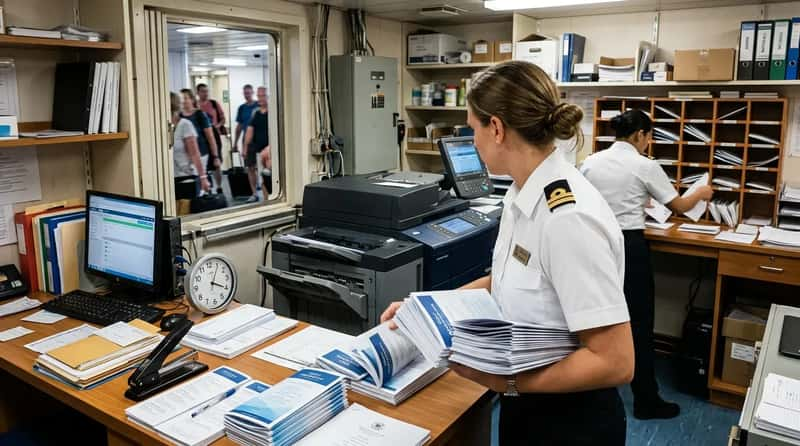
That folded schedule outside your door didn’t appear by magic. A chief purser’s duties include making sure passenger information materials, such as the daily program and menus, are printed on time. Somewhere on the ship, someone is watching the clock.
The desk also handles messages and mail. Assistant pursers promptly pass along mail, telegrams, and phone messages and check that they were received. That job description is dated, but it shows how many small communication jobs have landed on this one desk.
While all that happens, there’s a changeover going on that you’re walking straight through.
#4 – Crew Are Signing On and Off While You Drag Your Suitcase
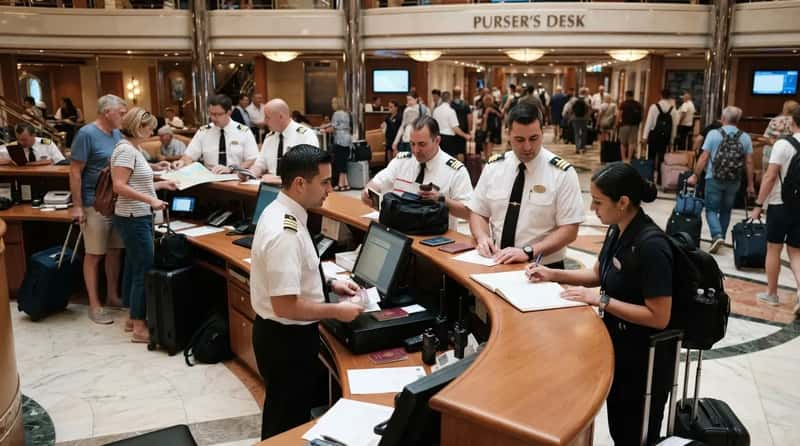
Embarkation day is a changeover for staff, too. Pursers coordinate crew sign-offs and sign-ons. The same people who answer your questions are managing who is leaving and who is arriving.
It goes beyond staffing. The same listing covers coordinating crew payroll and preparing cash advances for crew. Another listing says the office works with managers so that non-revenue guests meet customs and immigration requirements.
Why It Stands Out
- The desk handles crew sign-ons and sign-offs on the same day it greets guests
- Crew payroll and cash advances land on the same team
- Non-revenue guests need customs and immigration clearance too
And all of it runs on a schedule that doesn’t wait for anyone, including the guest sprinting down the pier.
#3 – Late Arrivals Set Off a Quiet Scramble Between Ship and Port
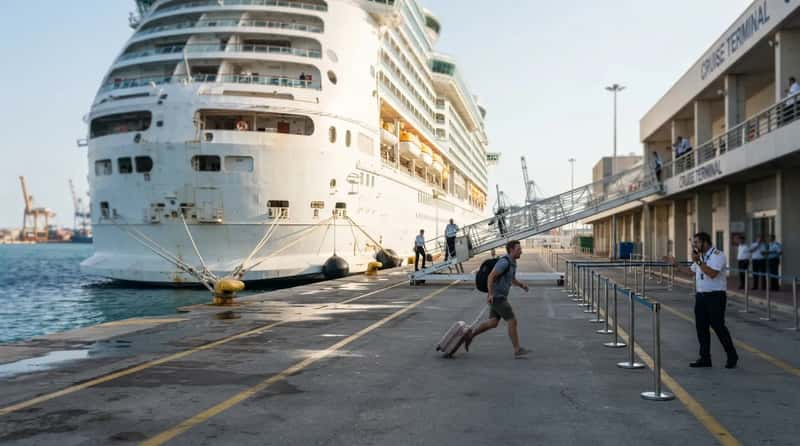
A traveler racing down the pier is a logistics problem, not just a drama. Pursers coordinate embarkation and debarkation with shoreside agents for ship’s clearance purposes. That includes the headcounts mentioned in #6.
Guests who miss the drill still get covered. Royal Caribbean says guests arriving after the muster get individual or group safety briefings that meet SOLAS requirements. Other lines handle it in their own way.
Whether you’re early or late, one record gets kept about you either way.
#2 – Everyone’s Muster Attendance Gets Written Down
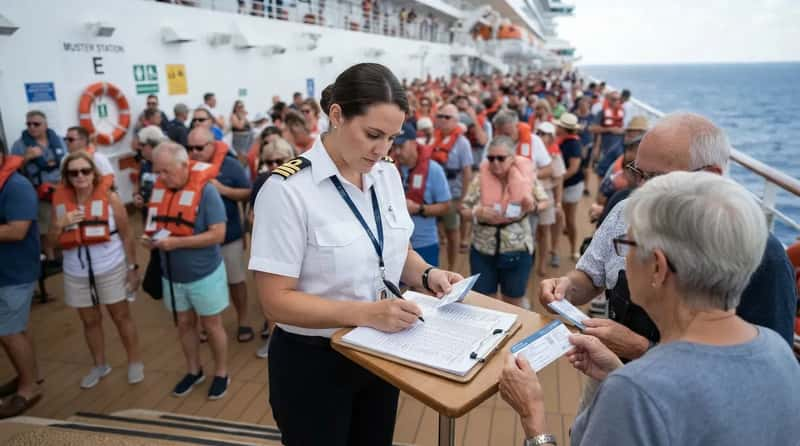
Many passengers roll their eyes at the safety drill and call it a wasted hour. The ship doesn’t see it that way. Ships record every passenger’s participation, creating an official compliance log.
Skipping has consequences. Passengers who miss it can have their names and cabin numbers reported to the ship’s officers, and may be paged over the PA system. Some lines now let passengers complete the drill virtually in the cruise company’s app. On a big ship, a drill often lasts about 30 minutes.
But the rule behind that log has a story most people have never heard, and it’s the biggest one on the list.
#1 – The Drill Rule That Exists Because of a Shipwreck

The timing of the drill wasn’t always like this. The requirement was strengthened after the Costa Concordia disaster, replacing an older rule that gave cruise lines up to 24 hours. When the Concordia sank off Italy in 2012, about 600 guests still hadn’t completed the drill.
The current rule is stricter. SOLAS regulation III/19 was amended to require musters of newly embarked passengers before or immediately upon departure. That is why you’re pulled into a drill with a bag still half unpacked.
So the one chore you grumble about is the one most directly shaped by a real disaster.
The purser’s desk isn’t just where you go when the bill looks wrong. On embarkation day it handles border data, missing documents, cabin changes, cash, crew changeovers, late arrivals, and a safety log, often all at once. The most surprising part is how many of these jobs connect.
Next time you’re dragging a suitcase up the gangway, remember that the real boarding is happening somewhere you can’t see. Which of these surprised you most, and what would you ask the desk on day one?