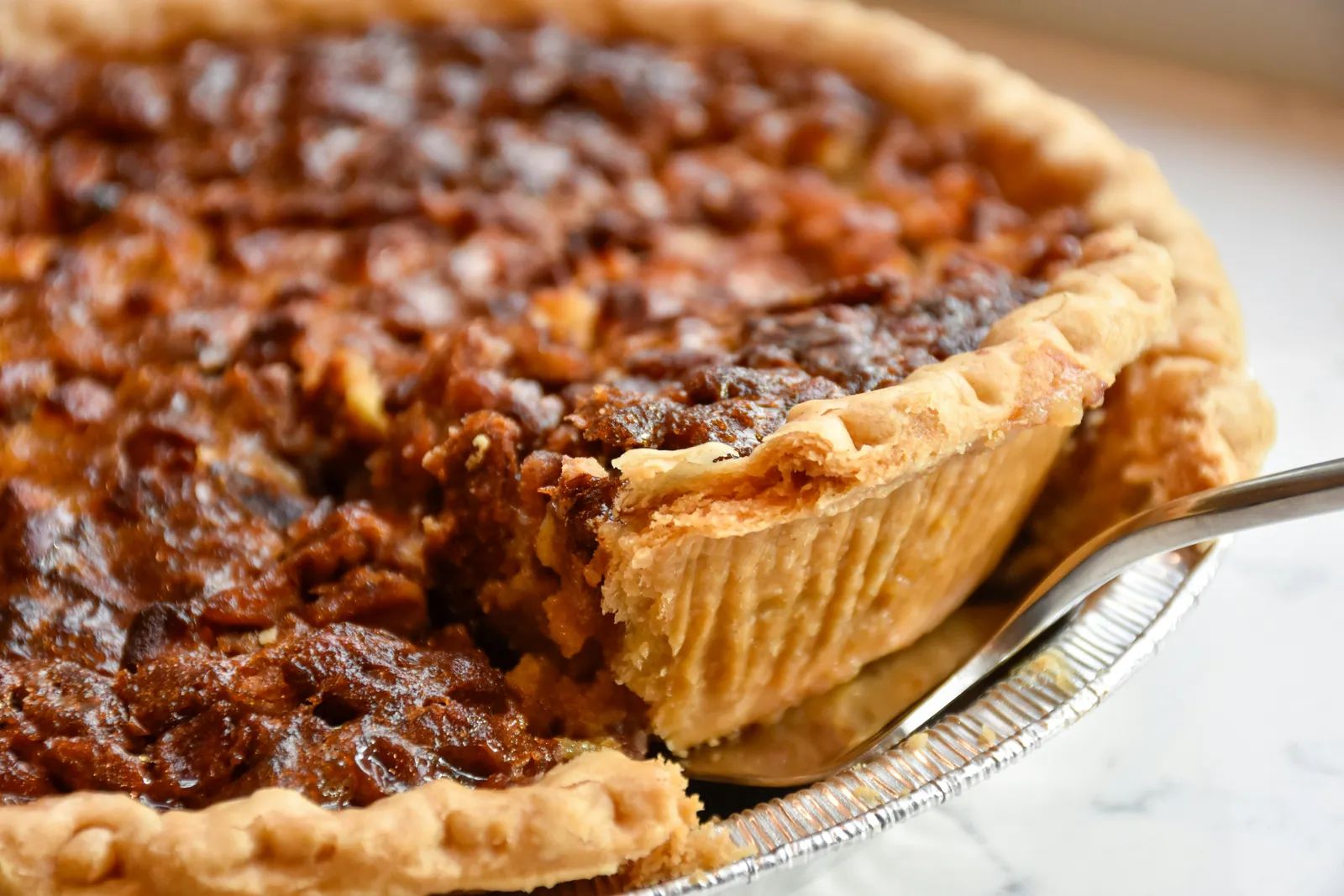
Thanksgiving leftovers often outlast the guests, and a half-eaten pecan pie can end up crowding the refrigerator shelf for days. Freezing is a practical way to keep it, and the short answer is yes. A Better Living guide to freezing pecan pie [1] gathers guidance from several university extension services and federal food safety sources, but those sources give different freezer times and different thawing advice. Knowing which figure applies to your pie makes the difference between a dessert that tastes fresh and one that has lost its texture. ([1])
How long the freezer keeps it
The numbers depend on which agency you ask. FoodSafety.gov lists pecan pie at 1 to 2 months in the freezer after baking. Iowa State Extension says pecan pies can be frozen with some success for up to two months, and the University of Maine Extension recommends using a frozen pie within the same window for best quality.
The National Center for Home Food Preservation takes a longer view. Its guidance says a frozen pecan pie stored at 0°F is expected to last three to four months. Clemson and Missouri extension materials give the same three-to-four-month range for baked and unbaked nut pies, though neither names pecan specifically.
Each of these figures measures quality, not safety. FoodSafety.gov says its freezer times are for quality only, and that food held continuously at 0°F or below can be kept indefinitely. A conservative home cook can still treat two months as the practical target.
Baked or unbaked: what the sources favor
Most of the pecan-specific guidance assumes a finished pie. FoodSafety.gov and the National Center for Home Food Preservation both describe freezing a baked pie. Extension guidance for unbaked nut pies exists, but it covers nut pies as a group and does not name pecan.
For a holiday pie that has already been baked, that is the clearer path. NDSU and Missouri do describe baking an unbaked nut pie straight from the freezer, at 450°F for 15 to 20 minutes and then at 375°F for 20 to 30 minutes. Still, no source gives a pecan-specific bake-from-frozen time, so treat that method as a general nut-pie approach rather than a tested pecan recipe.
Cooling and wrapping before the freezer
The order of steps matters more than many cooks expect. The National Center for Home Food Preservation says to cool the pie rapidly and freeze it briefly before packaging, because a partly frozen pie is easier to wrap without damaging the top. NDSU and Clemson give the same instruction for baked nut pies.
Timing matters on the refrigerator side too. Illinois Extension says a pie containing eggs or dairy should not sit out of the refrigerator for more than two hours. FoodSafety.gov gives three to four days in the refrigerator after baking, so a pie that is headed for the freezer should go in promptly. Wisconsin Extension allows two to four hours for cooling, but the more cautious two-hour limit is the safer rule to follow.
Iowa State recommends wrapping the chilled pie tightly in plastic wrap and foil, or placing it in an airtight freezer bag. Air is the enemy here, since loose wrapping invites freezer burn and dries the surface of the filling.
Thawing without ruining the crust
This is where the sources part ways. Iowa State and the University of Maine Extension both say to thaw frozen pecan pie in the refrigerator. The University of Illinois notes that pies containing eggs and dairy need consistent cold handling, and Wisconsin Extension says pecan pies typically contain eggs, which supports the refrigerator route.
Other nut-pie guidance from NDSU and Missouri suggests about 15 minutes at room temperature, followed by a 350°F oven for roughly 30 minutes. Clemson allows either the refrigerator or that short rest. The USDA’s freezing guidance, however, warns against thawing food on the kitchen counter, so a pie left out overnight should be discarded.
Texture is the trade-off. Iowa State warns that the filling may separate a bit and the crust may get soggy after freezing. Wisconsin Extension takes a more favorable view, saying pecan pies generally hold up well to freezing for longer-term storage. No test the sources cite settles which view fits a typical home freezer.
Related Stories From Travelbinger



Getting a frozen pie through the holiday
For readers who plan to carry leftover pie on a road trip or to a second family gathering, a few habits help. Keep the pie frozen until the day it will be eaten, and move it to the refrigerator the night before. Pack it in a cooler only if it stays cold and out of direct sun, and remember that the two-hour rule from Illinois applies to time spent out of the refrigerator.
If you are reheating a pie in its glass dish, Missouri Extension cautions that cold glass can break in a preheated oven unless the manufacturer says the dish is freezer-to-oven safe. Check the dish before the pie goes in the oven.
Whole pies remain the best-documented option. The sources offer little guidance on individual slices, toppings or refreezing, so a cautious approach is to freeze slices on a tray, wrap each one separately and avoid refreezing anything that has fully thawed. Writing the freezing date on the foil keeps track of which pie is nearing its limit.
A pecan pie that goes into the freezer this week and comes out in January should still be safe, provided the freezer stayed at 0°F. Its best flavor, though, belongs to the first couple of months.