Picture a coach on day three. One traveler is stuck in the back row, queasy and counting the miles. Another is waiting in a hotel lobby for help that was never arranged. The director didn’t ignore either of them. Nobody said a word.
That silence has a price: a hard morning on your feet, a rushed plate at dinner, a tip bill nobody warned you about. The fifteen requests below are ones directors and operators can often handle for travelers who speak up. None needs a special card or a birthday, only a clear ask at the right moment.
Stay for #1. It’s the largest money item on the list, and it has to be raised before you ever meet your director. First, the cheapest one: where you sit.
#15 – A Fixed Seat Near the Front of the Coach
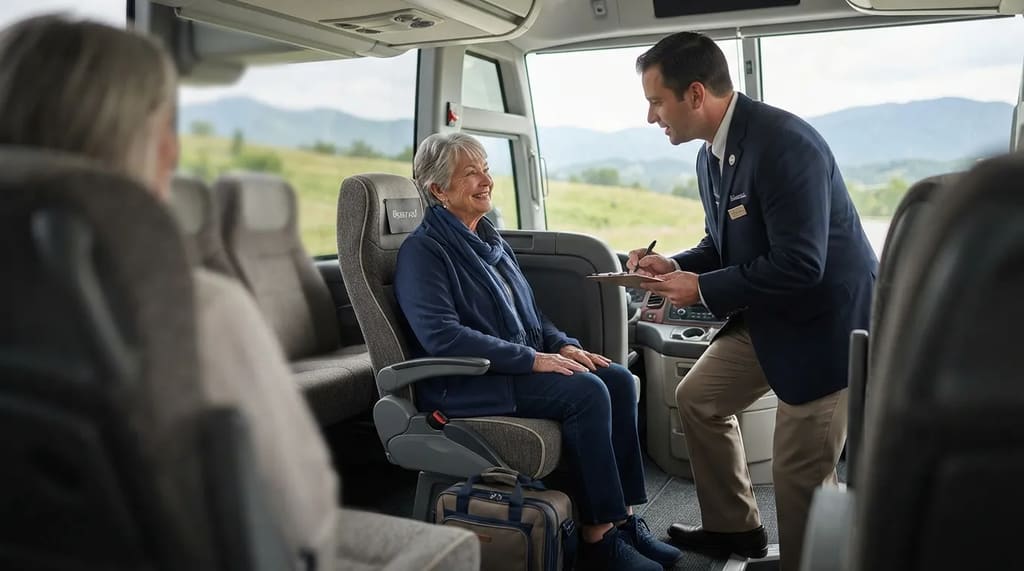
Seat rotation is sold as the fair way to share a coach, and on most days it is. It also quietly hurts the traveler who needs the front for motion sickness, leg room, or an easier walk to the door.
Many guides argue the front third is the best seat for anyone with balance or stomach concerns. Ask the director on day one for a fixed seat if you need one. Do it before the coach is loaded, because a request made mid-route means moving other people.
My view: a real need should outrank the rotation. If you say so early, most guides will hold a seat for you without announcing why. Whether the answer is yes depends on the company’s policy.
Once you’re in the right seat, the next question comes the moment you step off the coach.
#14 – The Nearest Bench and Restroom at Every Stop
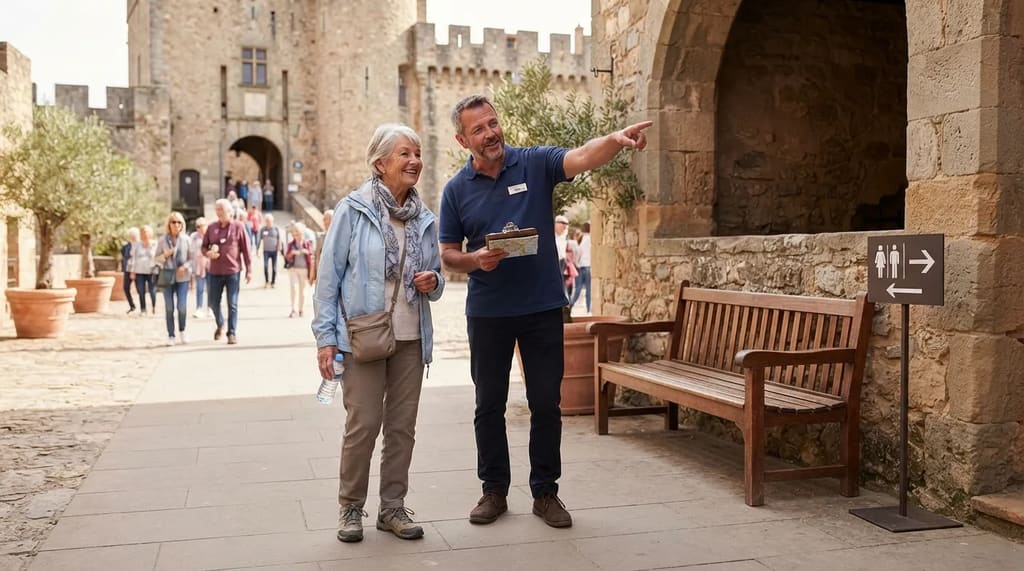
Before the wheels turn, the director has been studying maps. Tour directors use routes, satellite maps and street views to find meal and rest breaks, looking for clean restrooms, easy parking and flat walking paths.
The same planning covers tickets. Directors make sure they have the right number and type of tickets for each site, so the group isn’t standing in line. The time you save is time you can spend sitting down inside.
So the question is small and specific. Ask where the nearest bench and restroom are as soon as you enter a site. Do it before the group fans out, while the person who knows the answer is still beside you.
Use the same habit with the driver on long highway days. Ask about rest stops before a long stretch begins, not after it’s started.
The day’s stops are planned in advance. So is the morning, and the plan gets read aloud the night before.
#13 – How Many Stairs a Typical Day Holds
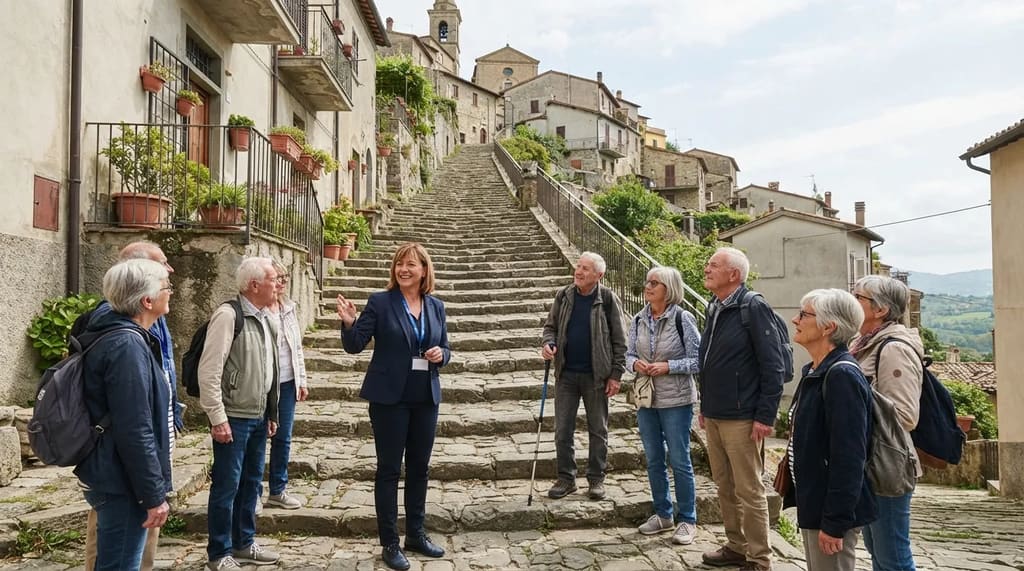
The brochure tells you what you’ll see. The number that matters to your knees is how much walking and how many stairs each day involves.
Ask at booking how much walking and how many stairs a typical day involves. A tour that sounds relaxed can still pack a hill into every afternoon. A straight answer lets you compare two tours on effort as well as price.
Tour directors brief guests on the schedule, the weather and the activity level. Day one gives you a second chance to hear the same plan and check it against what you were told.
If the answer is more than you want, you’ve learned it before you commit rather than on day six. And on tours with optional experiences, you may opt out and choose to do something else or just relax.
Tomorrow morning has its own numbers, and the director states them aloud the night before.
#12 – Tomorrow’s Wake-Up and Departure Time
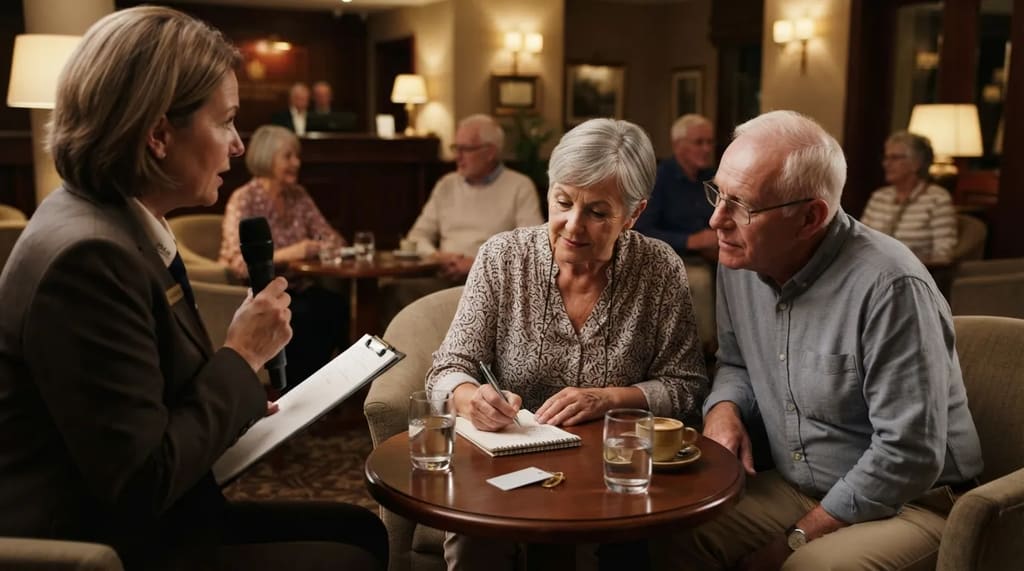
The phone that rings in your room at dawn was arranged before you asked. On many escorted tours, wake-up and departure times are set with the hotel the night before.
The tour director then repeats the plan at the evening briefing so nobody is left guessing. That makes the briefing your checkpoint, the one moment each day when the next morning is spoken out loud.
Write down tomorrow’s departure time as it’s announced. Then set it beside the wake-up call you’ve been given. If the two leave you less time than your routine needs, say so to the director that evening instead of at the coach door.
At a Glance
- Night before: wake-up and departure times are set with the hotel.
- Evening briefing: the director repeats tomorrow’s plan out loud.
- Your move: write the departure time down and compare it to your wake-up call.
- If it’s tight: tell the director that evening, not at the coach door.
#11 – A Paper Card With the Director’s Number
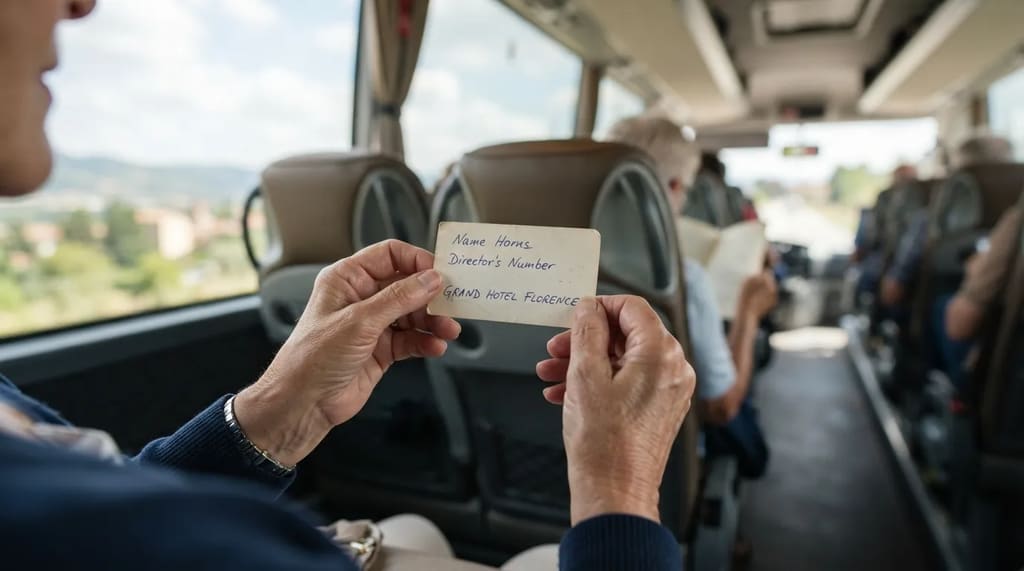
Phones die, get lost and end up in the wrong pocket. A card in your wallet does none of that.
Save the tour director’s number on paper, not only in your phone. Carry the director’s number and your hotel’s name on a paper card. Ask for the number on day one, before there’s any reason to need it.
On a tour that moves from hotel to hotel, rewrite the hotel line whenever you change beds. A card with last night’s hotel on it is worse than no card, because it points you to the wrong lobby.
The card keeps you found. The next request keeps you from paying twice, because one word on the itinerary means a fee.
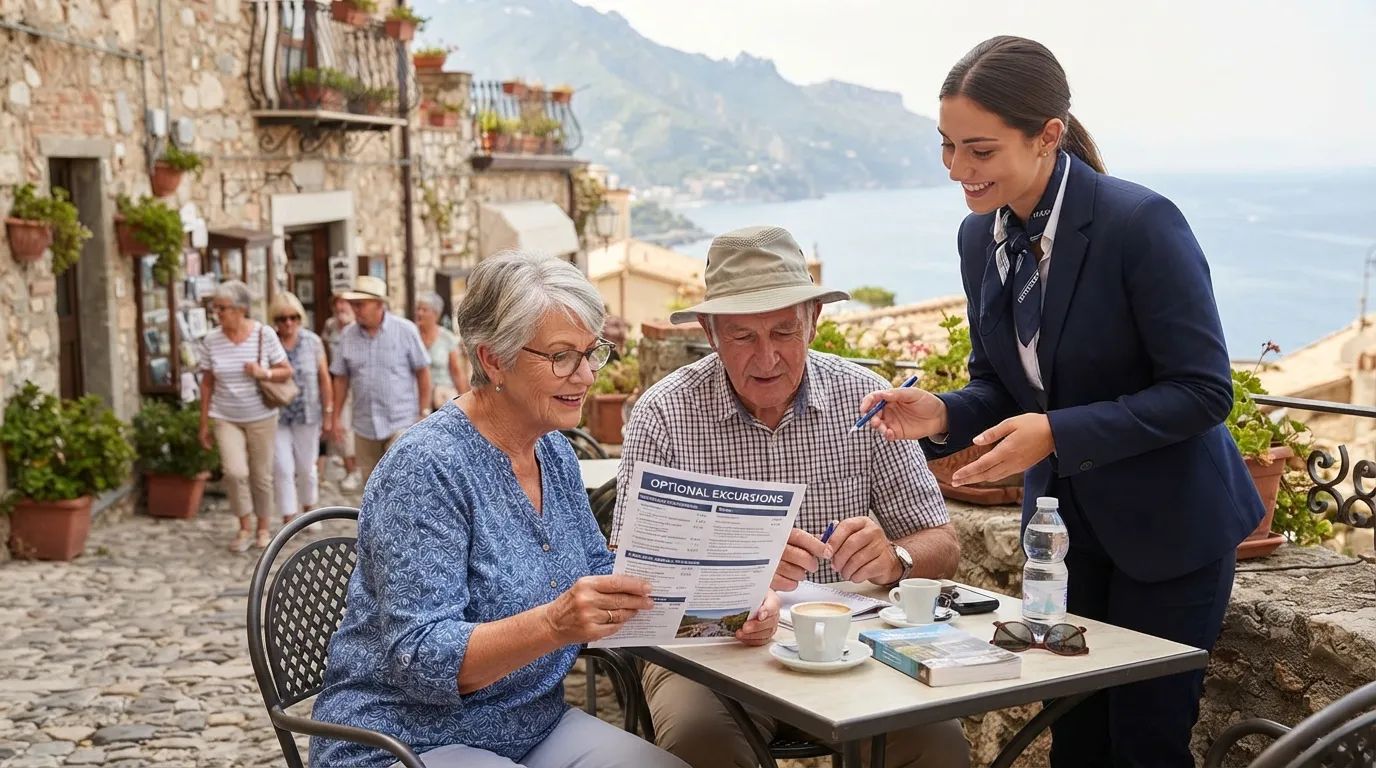
#10 – The Optional Excursion Price List
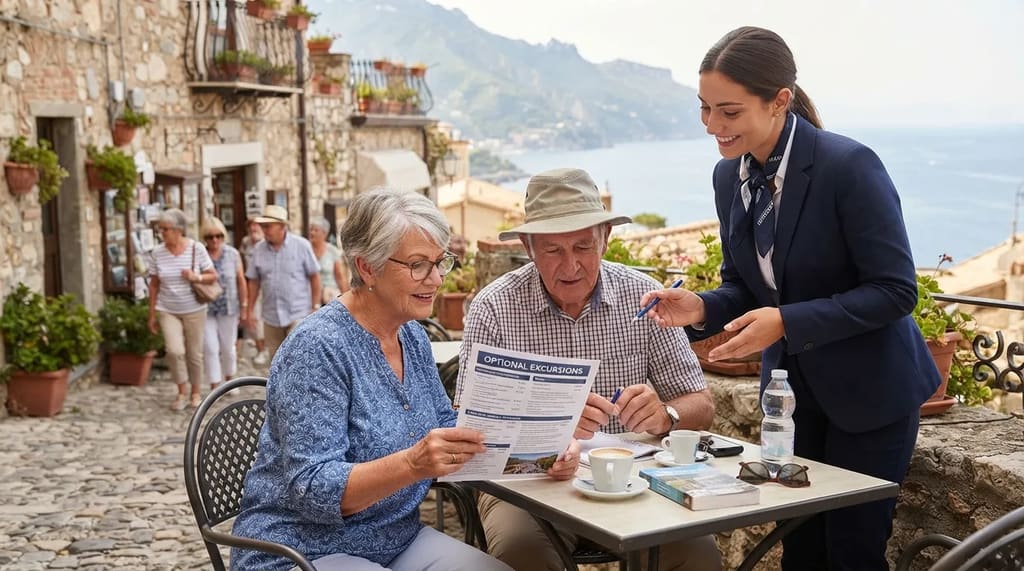
On a coach tour, “optional” means “extra fee.” During free time, the company offers excursions for added fees, and the tour director pitches them to anyone without other plans.
The sensible default is to ask first and pay second. Ask for the price list of excursions before you pay the deposit. Then add the optional list to each tour’s headline price before comparing prices.
Here’s a verdict you can argue with: a free afternoon spent sitting down is a fair trade for a skipped add-on. If the morning already came with the stairs you asked about in #13, the excursion can wait. Nothing on the itinerary says you owe the director a yes.
Fast Facts
- “Optional” on a coach itinerary means an added fee.
- The director pitches excursions during free time.
- Ask for the price list before the deposit, not after.
- Add the extras to the headline price when comparing two tours.
Excursions are the extras printed on a list. Meals are the ones that fall between the lines of the itinerary.
#9 – Which Meals Are On Your Own

Where you eat matters as much as how often. Coach stops tend to sit near major attractions, and dining at tourist-oriented restaurants there typically costs more than eating in local neighborhoods.
The itinerary tells you which meals you don’t have to buy. On many multi-day tours, included meals are marked with a letter code at the end of each day. A day with a missing letter is a meal you’re paying for yourself.
On the first morning, ask which meals are on your own, and set a daily food figure from the answer. The director knows the stops and the neighborhoods, so the same conversation can also get you a recommendation away from the busiest door.
Your own meals are your call. The included ones are set menus prepared in advance, and a late allergy mention gets a rushed plate.
#8 – A Dietary Note That Reaches the Kitchen in Time

Restaurants on group itineraries aren’t cooking to order. They often prep set menus in advance, so early notice gives the kitchen time to adjust.
Mention an allergy after the plates are out, and you get a rushed substitute, or a cold plate while everyone else finishes dessert.
The director is the link between you and the kitchen. Insight Vacations describes how its Travel Directors receive dietary information in their paperwork before the tour and pass it to restaurants well in advance, so the kitchen has time to prepare acceptable alternatives.1
Tell the operator about allergies and dietary needs at booking, then repeat it to the director before the first group dinner. On tours that reach remote areas, certain dietary requests can be harder to fill, so ask about those itineraries early.
Medication comes up again in the next ask, and it has nothing to do with food. It’s about what goes in your carry-on.
#7 – A Day-One Heads-Up About a Health Condition

A need raised on day one becomes something the director can plan for. The same need raised on day four sounds like a complaint.
Give the tour director a quick heads-up about any condition on day one. You don’t need to tell the whole story, only what changes the plan: a pace, a rest, a meal time.
This is also where the walking answer from #13 pays off. If a typical day holds more stairs than your heart or your knees like, the director can adjust expectations from the first morning.
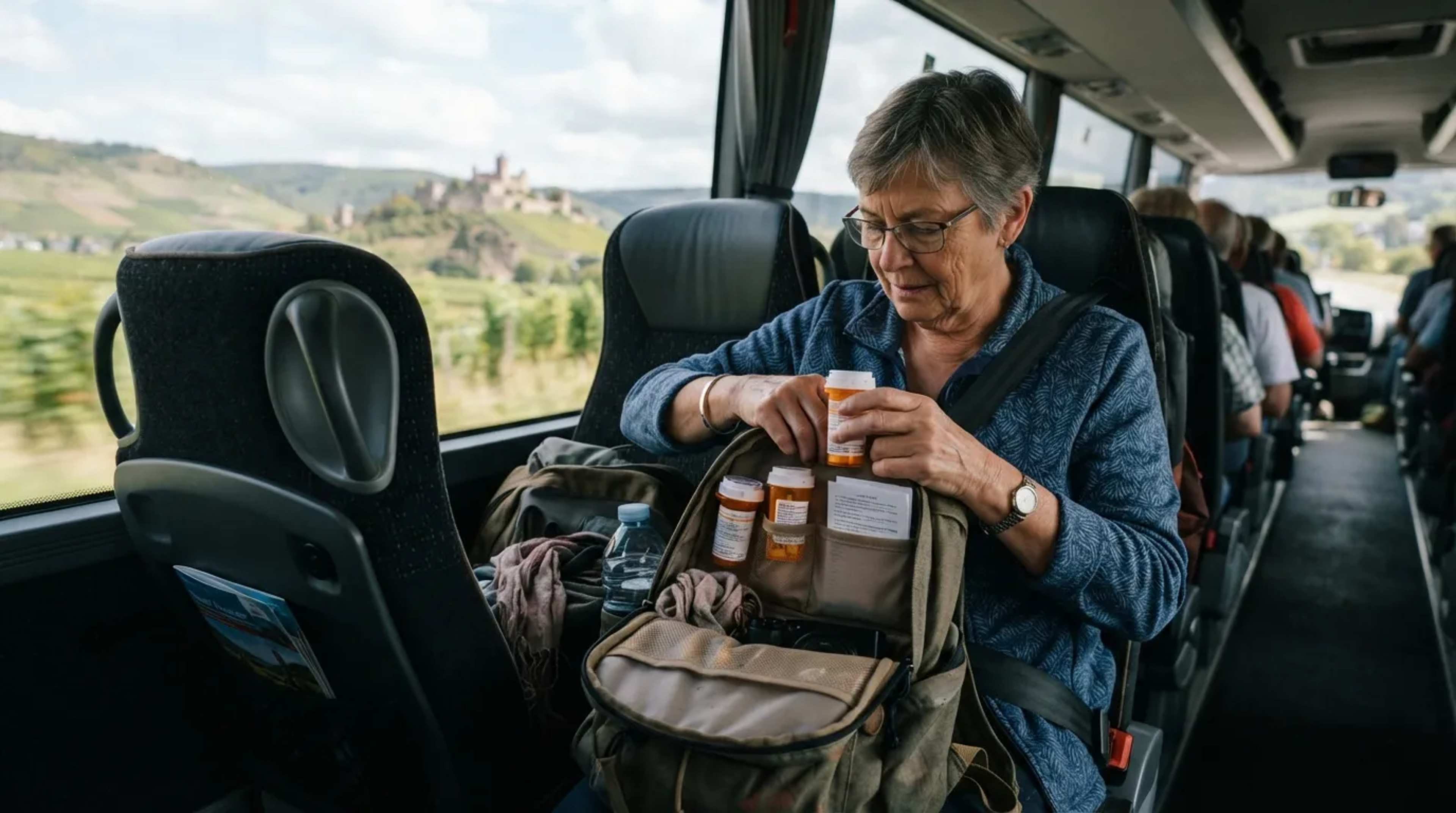
Medication deserves its own preparation. Good tour managers remind travelers to pack extra days’ worth of medication, plus a printed list with generic names, since brand names can differ abroad. Pack extra days of medication and a printed list of generic names.
Worth Knowing
- Share only what changes the plan: pace, rests or meal times.
- Say it on day one, while the director can still adjust the schedule.
- Pack extra days of medication beyond the trip length.
- Carry a printed list with generic drug names, since brand names can differ abroad.
A heads-up covers a condition. A wheelchair, walker or scooter is different, because it involves a lift and a deadline.
#6 – Mobility Devices and the Notice They Need
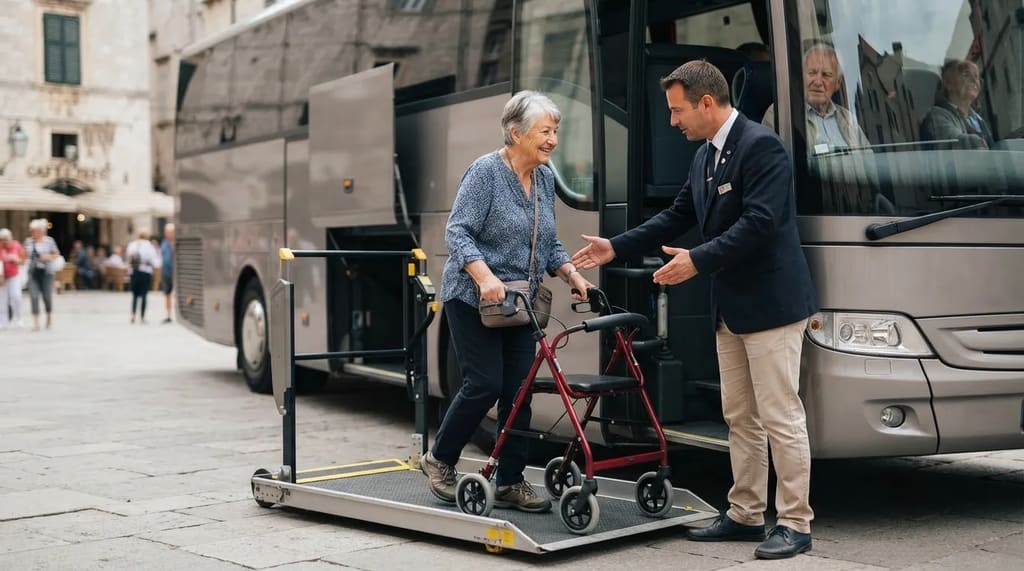
Federal rules generally require large motorcoach operators to provide accessible service, usually with advance notice.2
That puts the timing on you. A wheelchair or walker user should tell the operator when booking, not on departure morning, so the guide can arrange the lift, the seating and the route.
Tell the company about any mobility device or step difficulty when you book, in writing. Then confirm again with the tour director on day one.
#5 – A Room Near the Elevator or on a Low Floor
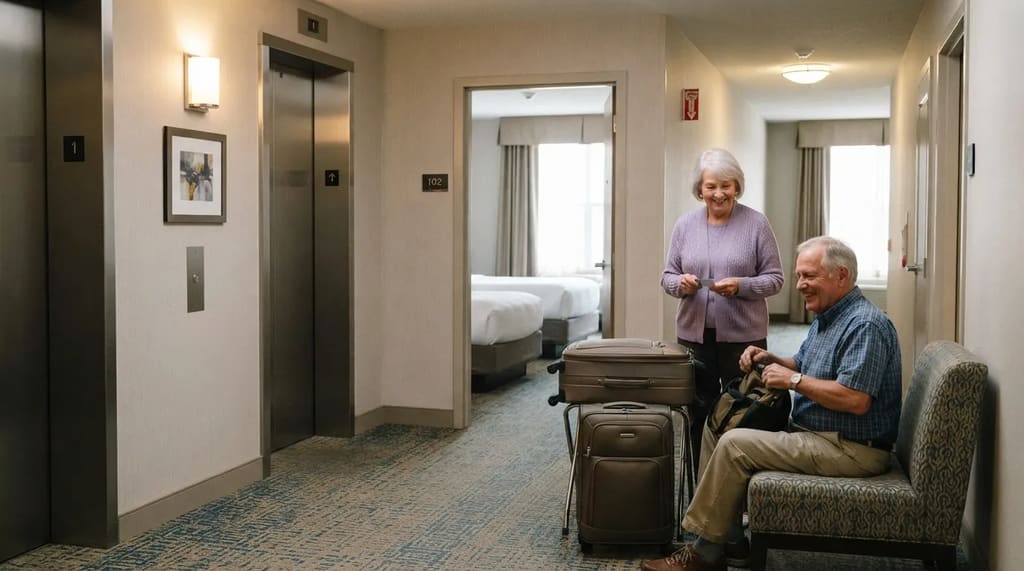
Hotels check a group’s list before the group walks in. One hotel standard has staff go through it line by line 48 hours before arrival, covering names, room types, bed set-ups, shares, access needs and dietary notes.
So a request for a room near the elevator or a ground-floor room is a booking-time request. Ask for it at the desk after the list has been checked, and you are asking a hotel to undo planning it considers finished.
Directors do make these requests. Tour managers often request rooms near the elevator and on lower floors, and a polite, specific request works better than a complaint.
My verdict: the front desk is the wrong place to start. Ask for the elevator or lower-floor room at booking, then mention it to the director too, so that two people are working from the same note.
Rooms are settled on paper before you arrive. So, often, is the dinner table, and solo travelers get a say in it.
#4 – A Seatmate or Shared Table for Solo Travelers

A director can seat you beside someone only if you’ve said you’d like company. Guides can only match what they know.
Solo travelers should mention if they’d like a seatmate or shared table, and ask about single supplements at booking. The request costs one sentence and may change how your dinners feel for a week or two.
It pairs well with the meals question from #9. On nights when dinner is on your own, a director who knows you travel alone can point you toward a shared table instead of a corner for one.
The table costs nothing. The next ask involves envelopes of cash, and handing one to the wrong person is easy.
#3 – Who Gets Which Envelope
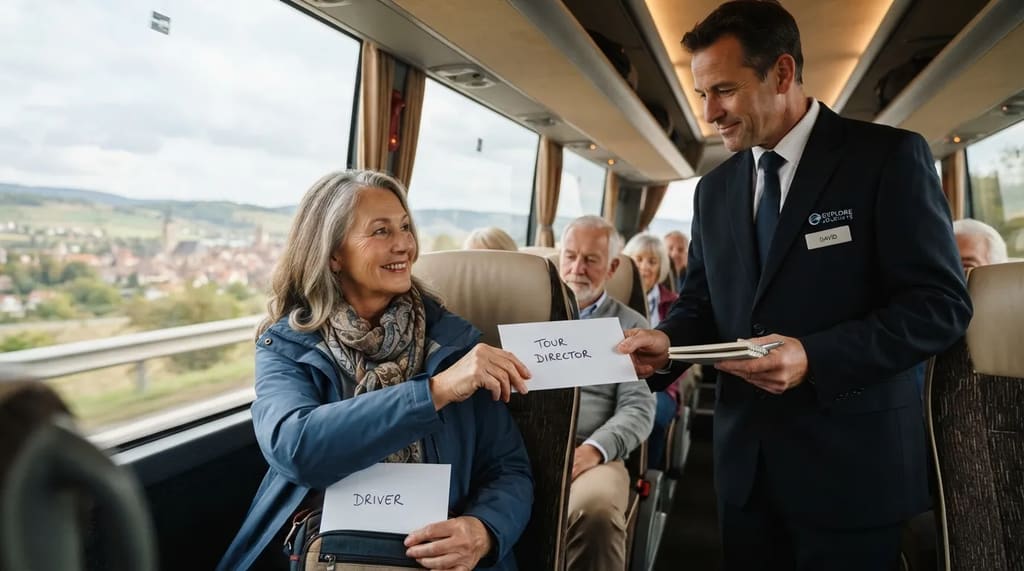
Some travelers hand their envelope to a local step-on guide who showed up for one afternoon. Meanwhile the tour director who’s been with the group since departure ends up with nothing.
Tipping the tour director, the driver and any local guides is customary on most coach tours, even though it isn’t required.3 That’s three possible recipients, and the right envelope depends on how your company runs things.
Ask on day one who gets tips, when, and whether they’re pooled. Also ask whether the envelope covers the driver. On some tours you have the same driver throughout, in which case you’d tip more regularly.
Related Stories From Travelbinger



Knowing who gets the envelope settles half the question. The amount decides how much cash you bring, and the suggested figures vary more than you’d expect.
#2 – The Suggested Tip, in Writing, Before You Pay

Tour operators don’t agree on the number. Explorica calls $4 to $5 per person per day a minimum for the director on U.S. and Canada tours, and $6 to $8 on international ones.4 Go Ahead Tours suggests $10 to $12 per person per day for the director and $4 for the driver.3
Now do the multiplication. At $10 to $12 a day on a 14-day tour, that’s $140 to $168 per person, or $280 to $336 for a couple, before the driver and local guides.
That’s why the figure belongs in your price comparison. Ask for the suggested daily amount in writing before you pay, and add it to the price you are comparing.
Quick Compare
- Explorica, U.S. and Canada: $4 to $5 per person per day, director minimum.
- Explorica, international: $6 to $8 per person per day, director minimum.
- Go Ahead Tours: $10 to $12 per person per day for the director, plus $4 for the driver.
Tips are usually handed over in person, so plan to carry cash in small bills. If your tour spans multiple countries, ask your director which currency they prefer.3
Cash tips are small next to the one charge that can raise a tour’s price by half or more. It applies only if you’re traveling alone, and the person to ask isn’t the director.
#1 – The Single Supplement You Can Ask to Lose
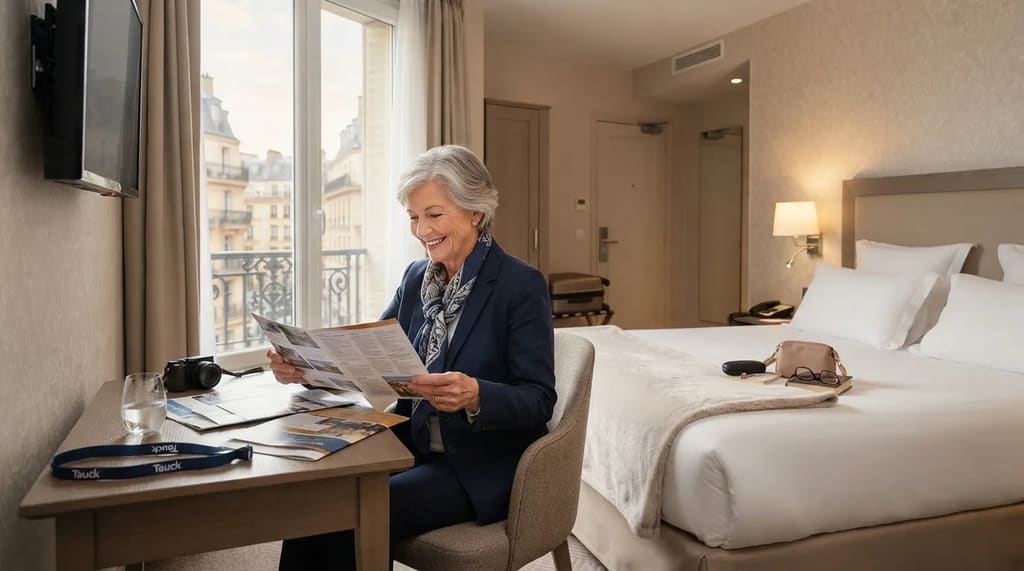
Advertised tour prices are normally per person for two sharing a room. Travel alone and you pay a single supplement, which can raise the cost by 50% or more.5 6
The charge starts with the hotels. It’s levied by suppliers to cover the extra cost of one person in a room, and it isn’t related to meals, attractions or transportation. So the director can’t waive it, but the company that sold you the trip sometimes can.
Some operators offer single-friendly trips with a no-cost or low-cost supplement, and others match you with a roommate. Tauck reduces or eliminates its single supplement on select itineraries.
Ask which specific departures waive the single supplement. Waivers are tied to particular departures, so a question about dates finds them and a question about the tour in general doesn’t.6
Read the wording closely. Shearings’ 2023 cuts at 27 UK hotels applied only where single rooms were available, and anyone booking a double or twin alone still paid. A supplement doesn’t buy you two seats on the tour bus, so the front-seat request from #15 still goes through the director.
My verdict: if you’re a light sleeper, pay for the private room rather than accept a roommate. A waived charge is a bargain only if the room it buys lets you sleep.
Look back over the list and a pattern shows up in the timing. Seats and benches can be settled on the coach. Rooms, meals, lifts and the single supplement have to be settled before you leave home, because hotels, kitchens and operators finalize their lists weeks ahead.
So think of your tour director as a very capable planner who can only work from what you hand over. Give it early, give it in writing where you can, and say it once more in person on the first morning.
What’s the one thing you’d want your tour director to know about you on day one?
#16 – The Bonus Ask Nobody Makes: The Insurance Deadline

The single most valuable question on this list is one you ask the operator on the day you pay your deposit: “By what date must I buy travel insurance to be eligible for the pre-existing condition waiver?”
Many travel insurance policies only offer that waiver, and any “cancel for any reason” upgrade, if you buy within a short window after your first trip payment. That window is often measured in a couple of weeks, and it varies by insurer. Miss it and the same policy can leave out the health problems most likely to make a senior traveler cancel.
- Step 1: At deposit, ask the operator for the purchase deadline in writing, and put it on your calendar the same day.
- Step 2: Read the policy’s pre-existing condition wording and its “look-back” period before you buy, not after.
- Step 3: Insure the full prepaid cost, including any single supplement and prepaid excursions from #1 and #10, since an under-insured trip is only partly refunded.
- Step 4: If you want cancel-for-any-reason coverage, confirm the cancellation cutoff before departure. It usually reimburses only a portion of the cost, so check the percentage.
Ask the operator, not the director. Directors work the trip once it is running, but the insurance clock starts at booking.
- Insight Vacations Dietary Needs: https://www.insightvacations.com/blog/dietary-requirements/
- FMCSA Bus Accessibility Requirements: https://www.fmcsa.dot.gov/regulations/americans-disabilities-act-reporting-and-other-requirements-over-road-bus-companies
- Go Ahead Tipping Recommendations: https://support.goaheadtours.com/hc/en-us/articles/9127665989915-Tipping-recommendations-on-tour
- Explorica Tipping on Tour: https://www.explorica.com/get-ready/tipping-on-tour.aspx
- Single Supplement Explained: https://gotravelyourself.com/why-solo-travelers-often-pay-the-single-supplement/
- TourRadar Single Supplement Guide: https://www.tourradar.com/tg/single-supplement