
A first deposit on a group tour, usually paid months before departure, also starts a clock on one kind of insurance protection. The mistakes below cost older travelers money, comfort and sometimes the trip itself, and most of them can be settled at home before the coach pulls out.
Some are small, like the wrong container for a pill, and others run to five or six figures. The cheapest fix on the list is tied to the largest possible bill, and the connection only becomes clear at the end.
Start with the page most travelers skim: the daily schedule printed in the itinerary.
#14 – A Daily Schedule Skimmed Instead of Read

A brochure sells the destination, but the daily schedule tells you what the week will feel like. Pace, walking requirements, hotel changes, free time and how much of each day is scheduled matter alongside the destination itself.
Hotel changes deserve the closest look, since each one means repacking, handing over a suitcase and usually an early start. A tour that sleeps three nights in each city asks far less of your energy than one that moves every morning, even when the sights are the same.
A schedule worth reading in full lists the walking, stairs, terrain, daily start times, luggage handling, included meals and cancellation terms. Going through it with a pencil takes one evening and shows you the problems while a refund is still possible.
The schedule shows where your suitcase sleeps each night, though it says nothing about whether your passport and policy papers are traveling with you.
#13 – Paperwork Kept in a Single Bag

Policy numbers, plan cards and passport details are easy to lose track of once you are moving between hotels. Carry a copy of your Medicare card, your Medigap card and your travel insurance policy documents.
If your health insurance is accepted abroad, the State Department advises taking your insurance card and claim forms with you. A policy that exists only in an email at home is no help at a clinic desk late in the evening.
Your passport deserves a check of its own, because many countries require it to stay valid for months beyond your arrival date and to have blank pages. The entry rules for each country are on the State Department’s website, and looking them up takes minutes compared with being refused at the airport.
Keep paper copies of each document in a different bag from the originals, and leave a set with someone at home. A phone photo helps, but a dead battery takes it away at the worst moment.
#12 – A Price That Leaves Out Tips and Excursions

A low headline price can look generous until you list what it leaves out. Review what is included in accommodations, meals, tips and excursions, and note which activities are optional.
Optional excursions are where totals tend to drift, because they are offered once you are already there and already tired. A tour that puts its main sights in the base price can cost less in the end than a cheaper one that sells each sight separately.
Write the totals for two tours side by side: base price, meals not covered, tips and the excursions you would really want. I would take the tour that shows the bigger number up front over the one that shows a smaller number and a list of extras.
Put the cancellation terms on the same page, since they decide how much of that total you can get back if plans change.
Even a fully priced tour assumes you can keep up with the group, and the size of that group has a lot to do with how fast it moves.
#11 – A Group Size Left Unasked

Group size affects transportation, restaurant seating, access to the guide, bathroom stops and how quickly the group can move. Those are the small frictions that fill a day on tour, and each one grows with every added traveler.
Smaller groups get more attention from tour leaders and move more efficiently through attractions. One directory of senior tours treats groups of under 24 travelers as a sign of a good fit.
A large coach group is not wrong for everyone, and it can suit you if the program is mostly sightseeing from the bus with short, flat stops. If you walk slowly or need frequent rest breaks, a smaller group is worth the higher price, because waiting for a full coach to reload is where a day gets long.
Ask the operator for the typical and the maximum group size, since the two can differ. A tour sold as a small group should be able to give you that number in writing.
#10 – The Word Easy Standing In for Mileage

Activity ratings turn into numbers once you read the fine print. The Cal Alumni Association’s Level 1 expects you to climb one flight of stairs without handrails or help and to walk comfortably up to two miles, or 4,600 steps, a day.
Quick Compare
- Level 1: up to 2 miles (about 4,600 steps) a day, plus one flight of stairs without handrails
- Level 2: 2 to 4 miles a day
- Level 3: 4 to 6 miles a day
- Catch: these are one organization’s tiers, and other operators draw the lines differently
A label on one brochure does not carry over to another, since Smithsonian’s four activity levels run somewhat more demanding than Road Scholar’s.
Ask for specific walking distances and terrain rather than relying on words such as easy or moderate. I would not book a tour on the word easy alone.
Age is a poor guide here, since plenty of 78-year-olds comfortably manage a Level 2 itinerary while plenty of 62-year-olds would find a Level 3 tour demanding. What matters is how you walk today, not how you walked ten years ago.
A single level can hide a good deal. AAA’s Level 3 involves stairs and standing for more than two hours at a time, and it is not recommended for travelers who use a cane, walker or wheelchair.1
A rating can only be matched to you if the operator knows how you get around, and the time to say so is before the deposit.
#9 – Mobility Needs Mentioned Only at the Airport

Tell the tour operator about any mobility limitation at booking, not on departure day. AAA’s group travel program asks travelers who need mobility help to say so before booking, so it can judge whether a tour is a good fit.
The reason is staffing. AAA states that travelers needing personal assistance must bring a capable companion, because tour hosts and staff cannot give one-on-one mobility support.2
Telling the operator early opens options that disappear later. The operator can help identify alternative tours if a particular itinerary’s activity level is not right for you.
Ask directly about stairs, walking distances and whether scooters or walking aids are allowed, and ask about elevator access, grab bars and room layout at the hotels. Giving the operator this information early is routine, and the staff can only plan around what they know.
#8 – Joining Every Excursion to Keep Up

Every group trip involves group activities, so one traveler’s preparedness and ability affect the other participants. That applies most to walking pace, since a group moves at the speed of its slowest walkers and a guide who stops for one person stops for everyone.
It is tempting to push through an afternoon you know is too much, because sitting out feels like letting the others down. A fall on cobblestones or a day of exhaustion can cost you the rest of the week’s excursions, which makes one skipped afternoon the cheaper choice.
The mileage figures in the activity ratings are daily numbers, so a day near the top of your range deserves a quiet afternoon after it. Plan the quiet part before you leave rather than negotiating it when you are already tired.
Tell the guide in the morning which stops you plan to skip. A guide can only arrange a coffee stop or a ride back for a traveler who has said so.
Energy is one thing to ration on a long trip, and the daily medication is another, with its own rules for how it travels.
#7 – A Weekly Pillbox Replacing the Original Bottles
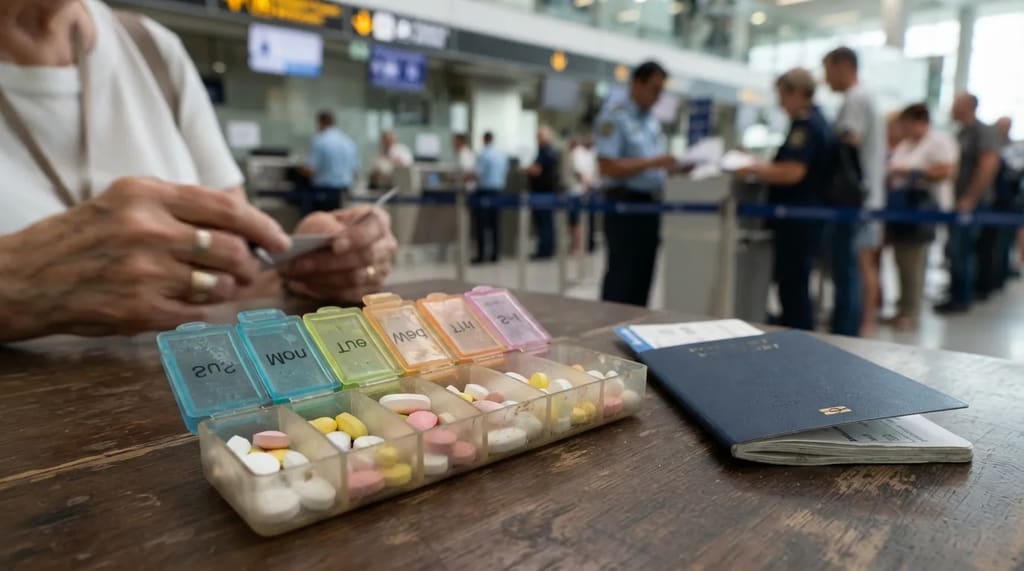
The CDC’s Yellow Book tells clinicians to instruct international travelers to carry medications in original containers with labels that identify the contents, the patient’s name and the dosing.3 A pillbox shows none of that, so a loaded weekly box is hard for anyone else to identify.
Travelers may prefer pillboxes or daily-dose containers, but officials at ports of entry might require the original prescription containers.3 On a group tour, a delay at passport control holds up the coach for everyone.
Inside the United States the rule is looser, since TSA does not require prescription medicines to be in original bottles, although state labeling laws may apply. For a domestic coach tour a pillbox is fine, and I would still keep the bottles in the same bag.
Worth Knowing
- Abroad: labeled original containers showing the contents, your name and the dosing
- At ports of entry: officials might ask to see the original prescription containers
- Within the U.S.: TSA does not require original bottles, though state labeling laws may apply
- Either way: keep the bottles in the same bag as the pillbox
For a trip abroad, a fair rule is to use the pillbox at the hotel if you like and carry the labeled bottles as well. The box saves you time each morning, and the bottles can save you an hour with an officer.
Labeled bottles solve the identification problem, though they do nothing if the suitcase holding them stays in the hold.
#6 – Prescriptions Packed in the Checked Suitcase
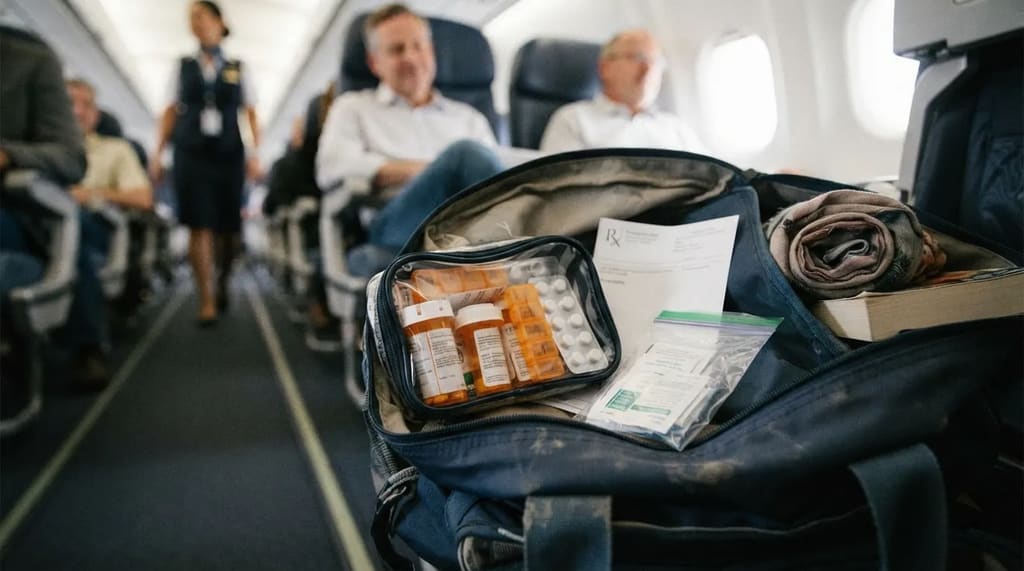
The CDC says to pack medications in a carry-on in case your luggage is lost or delayed.4 On a group tour the risk is wider than the airline, because your suitcase may be collected from outside your room in the morning and reach the next hotel hours after you do.
The Yellow Book’s guidance is to carry all prescription medicines, a copy of the prescription and any needed medical supplies in the carry-on. Pack enough for the whole trip, plus extra in case of delays.5
A small, organized pouch works better than a half-open tote, since it can stay with you even if your carry-on suitcase has to be checked at the gate. A health kit also needs sorting before you pack, because sharp objects such as scissors must go in checked luggage.3
#5 – Destination Medicine Rules Left Unchecked

Each country has its own laws on medicines, and drugs prescribed or sold over the counter in the United States may be unlicensed or controlled elsewhere. The checking falls to you, and it is worth doing for every country on the route, including countries where you only change flights.
Many countries allow a 30-day supply of certain medicines but require a prescription or a medical certificate from your provider. For controlled substances and injectable medications, the Yellow Book advises carrying a note on letterhead from the prescribing clinician.3
Two other details deserve a call to your doctor before you go. Ask whether your doses should change across time zones, and whether any medicine needs refrigeration.
Counterfeit drugs are common in some countries, so the CDC advises using only medicine you bring from home. That is why the advice to bring extra has to be balanced against personal-use quantities, which a doctor’s letter can help explain.
Medicine that is packed correctly and allowed everywhere still cannot pay a hospital, and the card many travelers assume will do that is the Medicare card.
#4 – Medicare Expected to Pay for Care Abroad

The State Department states plainly that Medicare does not cover medical costs outside the United States. The U.S. government does not pay medical bills abroad either, and you are responsible for all hospital and medical costs.6
Original Medicare covers you anywhere within the United States, including the District of Columbia and U.S. territories. Travel to Europe, Latin America, Canada or any other place outside the U.S., and traditional Medicare will not cover you.
Medicare Advantage needs a closer look. The law requires Advantage plans to cover the same limited travel situations as Original Medicare, though some plans carry worldwide benefits of their own, so the answer depends on the plan in your wallet.
Check your plan’s Evidence of Coverage for the section on emergency care outside the United States. Medicare itself points out that, because its coverage abroad is limited, you can buy a travel insurance policy for more protection.
Some Medigap plans do add a foreign emergency benefit, though it is narrower than the name suggests.
#3 – A Medigap Benefit Trusted Too Far

Medigap plans C, D, F, G, M and N must provide some level of emergency foreign travel coverage. These policies must pay 80% of the billed charges for certain medically necessary emergency care outside the U.S.
Related Stories From Travelbinger



That sounds generous until you consider what the other 20 percent amounts to on a large hospital bill. The benefit also carries a $250 deductible and a lifetime limit of $50,000, shared across every trip you ever take.7
There is a clock built in, too. The emergency care has to begin during the first 60 days of a trip, so a long tour with an extension can outlast the window.7
Fast Facts
- Plans with the benefit: C, D, F, G, M and N
- What it pays: 80% of billed charges for certain emergency care
- Deductible: $250
- Lifetime cap: $50,000, across all trips
- Time limit: care must begin within the first 60 days of a trip
Call your Medigap insurer and confirm which letter plan you hold and whether the foreign benefit is attached. Ask in so many words whether it covers medical evacuation, because the standard benefit is written around emergency care.
A capped benefit and a bill with no ceiling lead to the single cost that dwarfs everything else on this list.
#2 – A Travel Policy Nobody Checked for Medical Evacuation

The State Department warns that a medical evacuation can cost $100,000 or more.6 That is the price of an air ambulance, a medical crew and the logistics of moving a patient across borders, and nobody sends a discount version.
Medicare will not pay it, and the Medigap foreign travel benefit tops out at $50,000 for everything combined. For many travelers over 65, the only thing standing between that flight and their savings is a line in a travel policy they never read closely.
Read the evacuation benefit as carefully as you read the itinerary. Limits vary widely between policies, and the wording differs on whether you are moved to the nearest adequate hospital or flown back toward home.
Most policies also expect the call to go through the insurer’s assistance line, so the company can approve and arrange the transport. That is the number you wrote on the first page of your paper copies, and it is why a relative at home should have a set.
Even the best evacuation limit can be worth less than it looks, depending on when you bought the policy.
#1 – Buying Travel Insurance After the Window Has Closed

Many travel insurers offer a waiver of the pre-existing condition exclusion only if you buy within a set number of days after your first trip payment. That window is commonly somewhere between 10 and 21 days, and it varies by insurer and by state.
Buy later, and a condition you already have can be excluded when a policy looks back over your recent medical history. That means a flare-up of a heart or lung problem could land on the one list of things the policy will not pay for.
The window often comes with conditions. Insurers typically ask you to insure the full prepaid cost of the trip and to be medically able to travel on the day you buy.
At a Glance
- Waiver window: commonly 10 to 21 days after your first trip payment
- Trip cost: typically the full prepaid amount must be insured
- Your health: you usually must be medically able to travel when you buy
- Varies by: insurer and by state, so read the exact dates
Cancel-for-any-reason coverage works the same way, with a short purchase window after the first deposit and, typically, a refund of only part of your costs. Read the exact dates in the policy before you pay, because the clock started the day you sent in your deposit.
This is the cheapest fix on the list, since the price is usually a modest share of the trip cost, though it rises with age. It is also tied to the largest possible bill, because the same policy that carries the evacuation benefit may treat a condition you already have very differently depending on the date you bought it.
The guides who watch the coach load each morning rarely see any of this, since it happened months earlier at a kitchen table. Most of the mistakes on this list are quiet, and every one of them was fixable on the day the deposit went in.
So when the confirmation arrives, put the policy date next to the departure date on the calendar. The trip that goes smoothly is often the one where somebody made that phone call in the first week.
- AAA Group Travel Terms: https://westerncentralnyaaa.com/group-travel-terms-and-conditions
- AAA Travel FAQs: https://www.minneapolis.aaa.com/travel/faq
- CDC Yellow Book Travel Health Kits: https://wwwnc.cdc.gov/travel/yellowbook/2024/preparing/travel-health-kits
- CDC Obtaining Health Care Abroad: https://wwwnc.cdc.gov/travel/yellowbook/2024/health-care-abroad/health-care-abroad
- CDC Yellow Book Chronic Illnesses: https://www.cdc.gov/yellow-book/hcp/travelers-with-additional-considerations/travelers-with-chronic-illnesses.html
- State Department Medicine and Health: https://travel.state.gov/en/international-travel/planning/guidance/medicine-health.html?rc=1
- Medigap Foreign Travel Benefit: https://www.moneytalksnews.com/medicare-wont-pay-if-you-get-sick-abroad-ways-to-protect-yourself/