


A single air ambulance flight can cost $30,000 to over $250,000, and Original Medicare generally doesn’t include evacuation.1 Travel insurance is built for that kind of bill, yet a policy can still fall short because of a deadline you missed weeks before you packed.
The fifteen mistakes below run from small slips that cost you a refund to big ones that leave you paying a foreign hospital yourself. Stay for the last one, because it involves a clock that starts with your first deposit and can’t be restarted.
First, a mistake that sounds too small to matter.
#15 – Skipping the List of Covered Reasons

A standard cancellation policy covers only the specific reasons listed in your plan. That’s narrower than the word “cancellation” suggests.
A travel companion who pulls out is covered only if the policy names that situation, and standard comprehensive policies don’t cover fear of travel. So the list matters more than the brochure’s headline number.
Read the covered-reasons section before you pay, then ask in plain words about your own case: if my travel partner cancels, do I get paid?
When a listed reason does apply, standard cancellation coverage typically reimburses 100% of prepaid, non-refundable costs. That’s a better rate than any upgrade you’ll meet later.
But even a covered claim stalls without paperwork, and one phone call can decide whether a hospital bill gets paid.
#14 – Forgetting the Assistance Call and the Receipts

An insurer can pay only what you can document. Most policies come with an emergency assistance phone line, and calling it early, ideally before major treatment, is the usual first step.
Keep itemized receipts, medical reports and proof of any cancellation date. For cancellation claims, dated proof of when you cancelled is what shows you acted early enough.
Save the assistance number in your phone and keep every receipt. Do both before you leave home, because you won’t want to search for them from a hospital bed.
The paperwork is easy compared with packing medication, because the drug plan that works at home stops at the border.
#13 – Packing Prescriptions Without Checking Part D
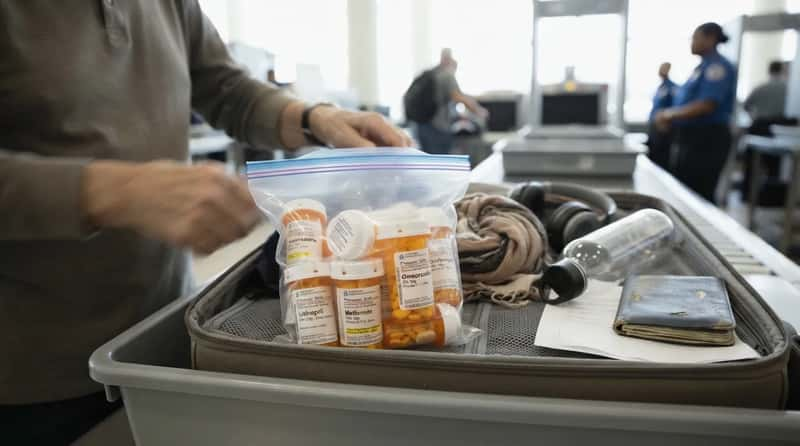
Medicare Part D prescription drug plans don’t cover drugs purchased outside the United States.2 3 A lost bottle or a delayed flight can turn into an out-of-pocket purchase, if the pharmacy abroad stocks your drug at all.
Pack the full length of the trip plus a few spare days for delays. Keep everything in original labeled containers in your carry-on, never in checked luggage.
Part D won’t pay for medication you buy outside the country.
A trip within the U.S. settles the medical question but leaves the money you’ve already paid exposed.
#12 – Treating a U.S. Trip as Risk Free

Medicare coverage extends throughout the 50 states and the District of Columbia, so a broken wrist in Branson is a different problem from a broken wrist in Bruges. That’s exactly why domestic travelers relax.
The exposure is prepaid money. A tour deposit, a nonrefundable cabin or a week at a resort doesn’t come back because Medicare covers your hospital stay.
Medicare covers care at home, but it never refunds a prepaid deposit. Trip cancellation coverage protects the prepaid part, and it works the same way whether the trip is in Maine or Madrid.
Fast Facts
- Covered: hospital care across the 50 states and D.C.
- Not covered: tour deposits, nonrefundable cabins and resort weeks.
- What protects prepaid money: trip cancellation coverage.
Next comes a mistake born from the opposite belief: that a birthday can shut you out entirely.
#11 – Assuming Age 80 Closes the Door

Plans are written for travelers over 80. They exist in volume, and they carry real limits.
The catch is that benefits can change with age. One senior-focused plan lists $1,000,000 in medical coverage up to age 79 but $100,000 for travelers 80 and older.
Ask whether medical limits drop when you cross a birthday. Quote the trip with your true age and your true trip cost, since both move the price.
Age isn’t the only variable, since a ship at sea changes both the medical picture and the evacuation bill.
#10 – Leaving the Cruise Out of the Plan

Emergency evacuation can be extremely expensive, especially from remote locations or cruise ships. A medical problem on a ship can mean a helicopter or a diversion, and you pay for it unless the policy does.
Medicare is a shaky thing to count on here. Its cruise coverage depends on where the ship is, which means the answer can change during a single sailing.
Plans marketed to older travelers commonly list evacuation limits of $500,000. Check the evacuation limit before you book any cruise coverage.
That limit matters more here than almost anywhere else, as mistake #3 will show.
The cards already in your wallet might seem to solve this, though their travel language varies widely.
#9 – Leaning on a Plan Perk You Haven’t Read

Standard Medicare Advantage plans don’t cover care outside the U.S. beyond the narrow exceptions that apply to Original Medicare. Some plans offer optional travel add-ons, but coverage varies significantly.
Check your plan’s Evidence of Coverage and find the “Emergency Care Outside the United States” section. That’s where the real answer lives.
Credit cards and airlines come with their own protection, but third-party insurance specialists typically offer higher coverage limits and better benefits. Read the foreign-emergency section of your plan before assuming it counts.
Supplement holders get a better deal on paper, but it comes with a clock that long trips run straight past.
#8 – Letting a Long Trip Outrun the 60 Days

Medigap plans C, D, F, G, M and N generally include a foreign travel emergency benefit. The catch is a time limit: coverage begins during the first 60 days of each trip.4
Even inside that window, the benefit generally pays 80% after a $250 deductible, up to a $50,000 lifetime cap.4 That’s a thinner safety net than most people picture.
At a Glance
- Plans: C, D, F, G, M and N generally
- Window: first 60 days of each trip
- Pays: 80% after a $250 deductible
- Cap: $50,000 over your lifetime
It’s a bigger problem for long stays. If you’re spending three months in Portugal, Medigap alone may leave you without foreign emergency coverage after day 60.
Medigap’s foreign emergency benefit applies only during the first 60 days of a trip. Long-term travelers may need an extended-stay medical policy or international health insurance.
My verdict: if you winter abroad, relying on Medigap alone is a bet you shouldn’t make.
Overstaying that window is one risk. Leaving early, or never leaving, is another, and the upgrade built for it pays less than its name suggests.
#7 – Reading “Cancel for Any Reason” Too Literally

The phrase suggests a full refund. In practice, it lets you recover 50 to 75 percent of non-refundable trip cost.5
There’s a deadline on your side too. You must cancel at least 48 hours before your scheduled departure, and some plans require 72 hours.
Squaremouth’s quote and sales data show the add-on raises the overall premium by 40% to 60%.5 In its sample, a $446 policy became $669 with the add-on.
CFAR pays 50% to 75%, and only if you cancel 48 hours ahead.
My verdict: on a trip costing a few hundred dollars, the add-on costs more than the risk it covers, so save it for big prepaid trips.
Buying the add-on is only one deadline, and another rule decides how much of your spending the policy will even look at.
#6 – Insuring Only the Flight

You can generally get a pre-existing condition waiver only if you insure the full nonrefundable cost of the trip. Insure the airfare alone and leave out the prepaid hotel or tour, and you may lose the waiver.6
You usually must insure 100% of your prepaid, nonrefundable trip costs. That includes pieces you book later, so ask before buying how the insurer handles added payments.
Insure every prepaid, nonrefundable dollar to keep the waiver. The extra premium is small next to what you’d forfeit.
Insuring the whole trip gets you to a question about your health, and its answer depends on a calendar.
#5 – Misjudging the Look-Back Period

Insurers apply a look-back window. It’s a time frame, usually between 60 and 180 days, when a pre-existing condition is considered stable.7
A condition that changes inside that window can fall outside the coverage. Many policies define “stable” in the fine print, so read that definition before a medication change, not after.
You can qualify for the waiver if you’re physically fit to travel when you buy the insurance. Give accurate, complete information about your medical history, because a claim review will look at it.
Find your policy’s look-back length and its definition of stable.
Health history is one trap, but price is another, and it tempts even careful shoppers.
#4 – Choosing the Plan With the Lowest Price

Two plans for the same trip can look alike until you read the limits. One comparison site quoted a retired couple on an $8,000 Italy trip, and the gap between two plans was striking.
Quick Compare
- $378: $100,000 of primary medical
- $538: $500,000 of primary medical
That’s $160 more for five times the medical coverage. In one sample quote, $160 more bought five times the medical limit.
My verdict: for a retired traveler heading to a foreign hospital system, that difference is some of the best money on the trip. A low limit is fine only when the rest of your coverage is strong, and abroad it usually isn’t.
Whatever you pay, the number that matters most isn’t the premium. It’s the limit on the line that covers your flight home.
#3 – Setting the Evacuation Limit Too Low

The CDC reports that medical evacuations, especially when repatriation is required, can often cost over $250,000.8 A limit of $100,000 can sound generous and still fall short.
Some senior-focused lists use $100,000 of medical evacuation as a minimum. Many travelers choose at least $250,000, and some opt for $500,000 or higher.
Treat $250,000 in evacuation coverage as your floor for trips abroad.1 The premium difference between limits is usually modest next to the potential bill.
The cruise and remote-trip mistakes earlier show where the higher figure matters most.
Evacuation only matters because of what happens first: a hospital abroad, and a health card that may pay none of it.
#2 – Assuming Medicare Travels With You

Anywhere outside the U.S. and its territories is considered outside the country for Medicare purposes.4 The rare exceptions are emergencies near Canadian or Mexican borders, or travel between Alaska and the lower 48.
Advantage plans don’t change that. The law requires them to cover the same limited travel situations as Original Medicare.
The Medigap benefit from earlier is the one real exception, and it carries its own 60-day clock. Original Medicare generally pays nothing for care outside the United States.
Buy travel medical coverage for every international trip, because the card in your wallet doesn’t work there.
All of this rests on a deadline that starts before you’ve picked a seat, and it’s the one mistake on this list you can’t repair later.
#1 – Waiting Until the Final Payment

The waiver window usually lasts 14 to 21 days after your initial trip deposit, which can include hotel accommodations, airline tickets and tour bookings.7 Travel Guard generally requires purchase within 15 days.
You need to buy the policy shortly after making your first trip payment, not when the final balance is due. That’s the trap: the clock starts when the trip is still just a deposit.
You can’t restart it by rebooking. Many insurers require the initial deposit to be the first-and-only booking for that destination and date, which prevents cancel-and-rebook tricks.
Buy within 14 to 21 days of your first deposit, not your final payment. The full-cost and look-back rules sit on top of it.
Worth Knowing
- Waiver window: usually 14 to 21 days after your first deposit
- Travel Guard: generally within 15 days
- Cancel-for-any-reason add-on: usually 10 to 21 days
- Rebooking: doesn’t restart the clock
Most standard policies exclude pre-existing conditions unless you select and qualify for a waiver. My verdict: waiting to see whether the trip is “real” feels frugal and costs you the benefit an older traveler is most likely to need.
Most of the mistakes above come from treating insurance as the last purchase, a form you fill out at the end. The better habit is to put it on the calendar the day the first deposit goes out.
Pull up the quote with your real age, your full prepaid costs and your own medications in mind. Then read the waiver window, the evacuation limit and the covered-reasons list before you pay.
When you booked your last trip, how many days passed between your first deposit and the day you looked at insurance?
- CoverTrip Medical Evacuation Guide: https://covertrip.com/guide/medical-evacuation-insurance
- Medicare Travel Insurance Guide: https://www.medicarefaq.com/faqs/travel-insurance-for-seniors-with-medicare/
- Aetna Part D Formulary FAQ: https://www.aetna.com/medicare/faq/prescription-drug-formulary.html
- Medicare Coverage Outside U.S.: https://www.medicare.gov/publications/11037-medicare-coverage-outside-the-united-states.pdf
- Squaremouth CFAR Explained: https://www.squaremouth.com/travel-insurance-benefits/cancel-for-any-reason
- Forbes Advisor Pre-Existing Conditions: https://www.forbes.com/advisor/travel-insurance/pre-existing-conditions/
- Insurance Business Pre-Existing Conditions: https://www.insurancebusinessmag.com/us/guides/what-are-travel-insurance-pre-existing-conditions-450380.aspx
- Squaremouth Evacuation Plans: https://www.squaremouth.com/resources/best-travel-insurance/evacuation
