


Anyone traveling more than four hours by air, car or bus can be at risk for blood clots, the Centers for Disease Control and Prevention says, and the risk rises after age 40. Yet that’s only the first problem a long-haul trip can create.
Most of the costly mistakes are set up at home, weeks before takeoff. Some cost you comfort, some your health, and one can cost more than a new car.
Stay with the list to the final item, because it holds the largest dollar figure on the page and one line to check in your insurance before you pay for anything. First, a mistake that costs only a long walk.
#15 – Waiting Until the Curb to Ask for a Wheelchair

Airport wheelchair help is free, and you’re allowed to ask for it before you leave home. Under Department of Transportation rules, airlines must provide wheelchair and guided assistance to passengers who request it.1
Add the request when you book, or later through the airline’s website, app or reservations line. Ask when you book, or at least 48 hours before departure.
Ask even if you can walk. American Airlines lists help with long distances at the airport as a reason to request it.
Fast Facts
- The assistance itself is free
- Airlines must provide it when you request it
- Best timing: at booking, or 48+ hours before departure
- You can ask online, in the app or by phone
Saving your legs for a flight that has you sitting for hours is sensible, not lazy. But a request in your reservation is only half the job, since airport staff won’t know it’s yours until you say so.
#14 – Trusting the Reservation Note to Do the Work

Even with the request in your reservation, airline staff won’t know you’re the person who made it unless you tell them.2 The note can sit unread while you stand at the counter.
Call a day or two before departure and ask the agent to read back the assistance codes for each flight. Confirm assistance with every airline on your itinerary, flight by flight.
If you realize mid-flight that you’ll need help on arrival, tell a flight attendant so the crew can arrange it. Crews help with the transfer between seat and wheelchair, but they generally won’t lift or carry passengers.
Once you’re on board, the seat you picked decides how often you’ll get up, and the popular choice works against you.
#13 – Booking the Window Seat for the View

On a ten-hour flight, the seat with the best view is the one that makes standing up hardest. The CDC’s advice is to pick an aisle seat where possible so you can walk around every two to three hours.3
Give up the window. The scenery is worth little against ten hours of being boxed in, and the aisle is what lets you get up every couple of hours.
The aisle only helps if you use it, and the CDC puts a specific number of hours on when sitting starts to count against you.
#12 – Sitting Still Past the Four-Hour Mark

Four hours is the line. Prolonged, cramped sitting interferes with blood flow in the leg veins, and a long-haul flight can run two or three times past that mark.
That’s why the aisle seat from the last item matters. CDC guidance on walking ranges from every one to two hours to every two to three hours, so once a flight passes four hours, plan to stand and walk every couple of hours.
When the seat-belt sign keeps you down, extend your legs straight out and flex your ankles. The CDC also suggests exercising your calf muscles.
Walking is the baseline for every passenger, but travelers with specific risk factors get one more item to consider, and it’s something you wear.
#11 – Wearing Ordinary Socks When Your Risk Is Higher

The CDC’s Yellow Book, its health guide for international travel, advises travelers at increased risk of blood clots to consider properly fitted, below-knee graduated compression stockings on long flights. The stockings appear to reduce symptomless clots and are generally well tolerated.3
They put pressure on the leg muscles and help blood flow from the legs back to the heart. The guidance says “properly fitted,” so a loose or wrong-size pair grabbed off a rack misses the point.
If you’re in a higher-risk group, such as older age, obesity, surgery within three months of travel, or a family history of blood clots, ask your doctor first. Below-knee, properly fitted, graduated stockings are for travelers with clot risk factors.
Worth Knowing
- Higher-risk groups include older travelers and people with obesity
- Surgery within three months of travel counts too
- So does a family history of blood clots
- Fit matters: below-knee, graduated and properly sized
#10 – Taking an Aspirin as Clot Insurance

Aspirin is not a clot shield. The CDC specifically says taking aspirin solely to prevent travel-related blood clots isn’t recommended.3
Leave the bottle in the cabinet unless your doctor has told you to take it for another reason. For high-risk travelers, preventive medication is decided case by case, which means a conversation with your doctor, not a guess in the pharmacy aisle.
The CDC doesn’t recommend aspirin just to prevent travel clots.
Prevention does most of the work, yet a clot that forms anyway can give no warning at all.
#9 – Brushing Off a Swollen Calf After Landing

About half of the people with a deep vein clot (DVT) have no symptoms at all, according to Scripps Health. So a calf that feels fine on landing isn’t proof of anything.
New swelling or pain in one leg in the days after a long flight is worth a call to your doctor. New leg pain or swelling after a long flight is worth a call.
A piece of a clot can break off and travel to the lungs, causing a blockage. Sudden shortness of breath or chest pain means emergency care, not waiting.
Keep it in proportion. Most travel-associated clots occur in travelers with preexisting risk factors, and the risk is low for those without them.
The mistake that sets up a bad trip often happens earlier, at the baggage counter, with the pills you take every day.
#8 – Packing Your Pills in the Checked Bag
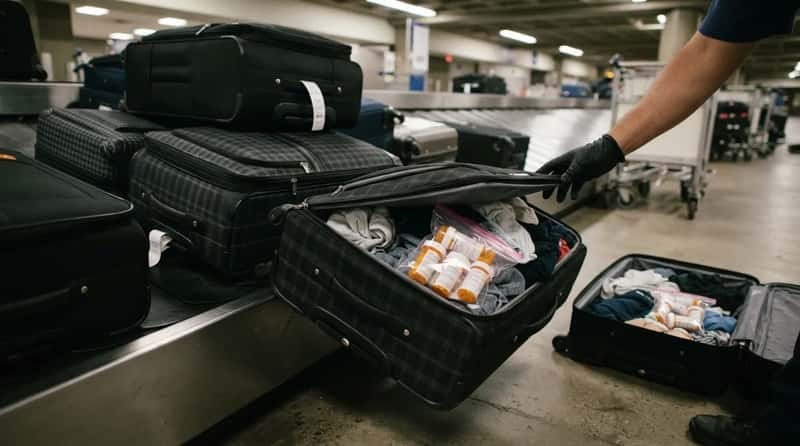
A checked bag can be delayed or lost, and essentials such as medications should never be in checked luggage. A delayed bag with your prescriptions inside can turn a long trip into a medical problem.
TSA strongly recommends placing medication in your carry-on in case you need immediate access.4 That includes delays and layovers, when a dose can come due hours before your suitcase reappears.
Solid medications such as pills, tablets and capsules aren’t subject to the liquids rule at all, so screening gives you no reason to check them. Every prescription and critical over-the-counter drug belongs in your carry-on.
Quick Compare
- Pills, tablets, capsules: exempt from the liquids rule, carry-on
- Liquid medicine: allowed over 3.4 ounces, but declare it, carry-on
Pills are simple at the checkpoint, but anything that pours, drips or injects comes with one extra step.
#7 – Letting Liquid Medicine Surprise the TSA Officer
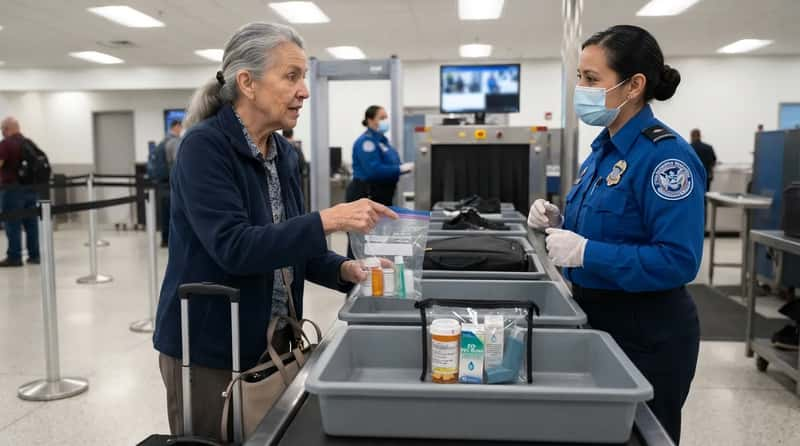
You can bring liquid medication over 3.4 ounces, but only if you speak up first. TSA allows it in reasonable quantities for the flight, and it doesn’t have to go in the zip-top bag.4
Tell the officer about liquid medication at the start of screening. Medically required liquids get additional screening, which may include being asked to open containers.
The exemption covers more than prescriptions:
- Insulin and other injectables
- Eye drops and cough syrup
- Medical creams and gels
TSA’s rules end at American checkpoints, and the country you land in keeps its own list.
#6 – Assuming a US Prescription Works Everywhere
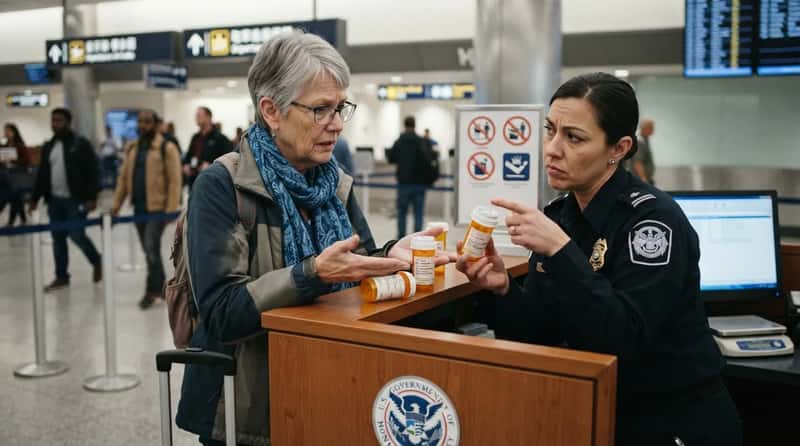
A prescription label doesn’t make a medicine legal in every country. Import rules belong to the destination and transit countries.
Long-haul itineraries often connect through a third country, so check that stop too. Use original containers and bring documentation for anything questionable, especially controlled substances, large liquids and syringes.
A signed note from your doctor is a sensible addition. The State Department’s travel health guidance lists verifying prescription medication rules as a step before you go.
Check the rules for your destination and every country you connect through.
#5 – Bringing Just Enough Medicine for the Trip

The CDC’s advice for older travelers is plain: bring enough medicine for the entire trip. Then go further.
Add a few extra days of supply, because delays and missed connections stretch a trip that was planned to the hour. Ask your doctor or pharmacist how to space doses across time zones before you leave.
Carry the full trip’s supply plus a few extra days.
The CDC also recommends that older travelers keep a paper or electronic record of their medical history with them.
All that preparation covers what’s in your bag, but none of it helps with the bill if you land in a foreign hospital. That’s where a common Medicare assumption runs out.
#4 – Believing Medicare Flies With You

Your Medicare card feels like coverage anywhere, and outside the United States it usually isn’t. The State Department says Medicare does not cover medical costs outside the United States.5 6
The department adds that the US government doesn’t pay medical bills abroad and you are responsible for all hospital and medical costs.5 That’s a hard sentence to read after paying Medicare premiums for years.
Exceptions are rare: emergencies near the Canadian or Mexican border, or travel between Alaska and the lower 48. On a long-haul trip, none of those will apply, so Original Medicare usually pays nothing for care outside the United States.
If you’re on a Medicare Advantage plan or carry a Medigap policy, the picture changes a little, though not as far as the brochure suggests.
#3 – Counting on Medigap or Advantage Abroad

Which plan you hold changes the answer. Many Medicare Advantage plans cover emergency and urgent care abroad, but the benefits vary by plan.6
Call yours and ask, “Do I have emergency coverage outside the U.S.?” Then ask for the answer in writing.
Medigap is narrower. Certain plans cover 80% of eligible foreign travel emergency care, up to a lifetime limit.
Certain Medigap plans pay 80% of foreign emergency care, up to a lifetime limit.
That makes Medigap’s foreign benefit a patch, not a travel policy. A lifetime cap is a ceiling you carry across every trip you’ll ever take.
At a Glance
- Original Medicare: usually nothing outside the U.S.
- Medicare Advantage: varies by plan, so ask and get it in writing
- Medigap: certain plans pay 80%, up to a lifetime limit
Whichever plan you hold, a separate travel policy is the usual answer, and the date you buy it can change what it covers.
#2 – Buying Travel Insurance the Week Before

The date you buy can matter as much as the price. You usually have to buy within a few weeks of your first trip deposit to get a particular waiver.
If you have an existing health condition, ask what that waiver covers before you pay. A last-minute purchase can miss that window entirely.
The policy is worth the effort because a good one can cover medical evacuation, trip cancellation and major medical emergencies that Medicare misses. Buy within a few weeks of your first trip deposit, not the week before.
The costliest line in any policy is easy to skim past, and it carries a six-figure price tag.
#1 – Skipping Cover for the Flight Home

Medical evacuation by air ambulance back to the United States can cost from $20,000 to $200,000, depending on where you are and your health condition, according to the State Department.5 That’s the number to keep in mind when a policy looks too pricey.
Most health plans don’t pay to bring you back to the United States by air ambulance. Original Medicare doesn’t, and Medicare Advantage and Medigap usually don’t either.5 6
So the Medicare and Medigap assumptions earlier on this list stop short of the one bill that can reach six figures. Air ambulance home can cost $20,000 to $200,000, and Medicare won’t pay.
Look for evacuation by name in your travel policy, and ask whether it covers transport to the nearest appropriate medical facility or all the way back to the U.S. Those can be different benefits, so have your insurer or a licensed agent put the limit in writing.
Look back at the list and you’ll see how little of it happens in the air. The wheelchair request, the pill count, the insurance date and the evacuation limit are all decisions you make at a kitchen table.
Treat your departure date as the last deadline, not the first. A month before you fly, make one call to your doctor and one to your insurer, and the flight itself gets easier.
If you’ve flown long-haul with a medical condition or a Medicare plan, what’s the one thing you’d arrange a month earlier next time?
Bonus: The Insider Step Most Travelers Learn Too Late

Owning the right policy is only half the job. Many travel policies expect you to contact their 24/7 assistance line before you agree to a hospital transfer or an evacuation flight, and skipping that call can put a claim at risk.
Set this up before you leave, while you’re calm and near a printer:
- Find the assistance number. It’s usually on your policy documents or insurance card, separate from the claims line. Ask the insurer to confirm which number to call in an emergency.
- Store it three ways. Save it in your phone, keep a paper copy in your wallet, and give a copy to your travel companion and one family member at home.
- Ask one question in advance. "Do I need your approval before an evacuation or hospital transfer?" Get the answer in writing.
- Enroll in STEP. The State Department’s Smart Traveler Enrollment Program is free, and it connects the U.S. embassy to you if there’s an emergency where you’re traveling.
If you’re ever the patient, let a companion or a hospital staff member make that call right away. It takes minutes, and it can protect a bill that could otherwise run to six figures.
- DOT Wheelchair Assistance Enforcement: https://www.transportation.gov/briefing-room/dot-fines-us-airways-failure-provide-wheelchair-assistance-passengers-disabilities
- DOT Disability Bill of Rights: https://www.transportation.gov/airconsumer/disabilitybillofrights
- CDC Yellow Book DVT Chapter: https://wwwnc.cdc.gov/travel/yellowbook/2020/travel-by-air-land-sea/deep-vein-thrombosis-and-pulmonary-embolism
- TSA Travel Tips: https://www.tsa.gov/travel/travel-tips
- State Department Medicine and Health: https://travel.state.gov/en/international-travel/planning/guidance/medicine-health.html?utm_slc=NEUR%2CNEUR%2CNEUR%2CNEUR%2CNEUR%2CNEUR%2CNEUR%2CNEUR
- CDC Yellow Book Travel Insurance: https://www.cdc.gov/yellow-book/hcp/health-care-abroad/travel-insurance.html
