


A cruise ship feels like a floating hotel with a hospital tucked inside. Crew members watch travelers over 65 run into the same avoidable problems, trip after trip. The data back them up: 35% of senior cruisers buy less than the recommended $250,000 in evacuation coverage.1
Some of these mistakes just make the buffet line longer. Others can drain a retirement account.
The one crew wish you’d check first is waiting at #1, and it catches almost everyone off guard.
#15 – Treating the Fare Like It’s All-Inclusive
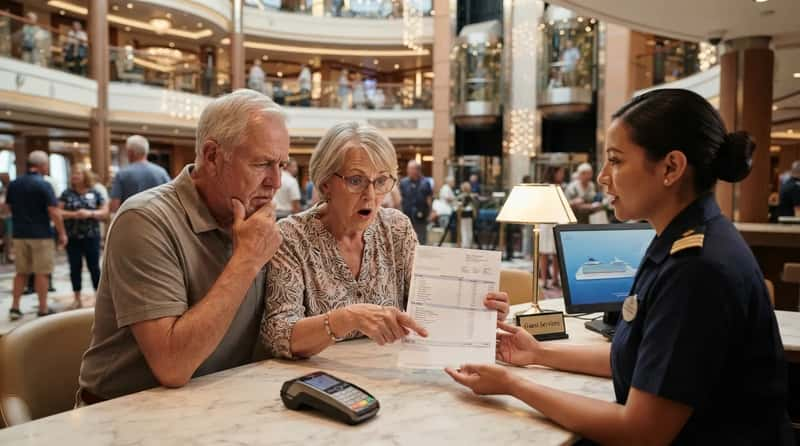
The final-day bill is where the sticker shock lands. The crew are the ones who have to watch it happen.
The fare covers more than a standard hotel stay, but it isn’t all-inclusive. Specialty dining, drink packages, spa treatments and internet access add up fast.
Gratuities are tips for crew members, charged daily. The amount varies by cruise line and cabin category, and guest services desks tend to see the sticker shock on the final day.
- Specialty restaurants
- Drink packages
- Spa and internet
But that’s small change next to the briefing crew say too many guests skip in #14…
#14 – Skipping the Safety Drill
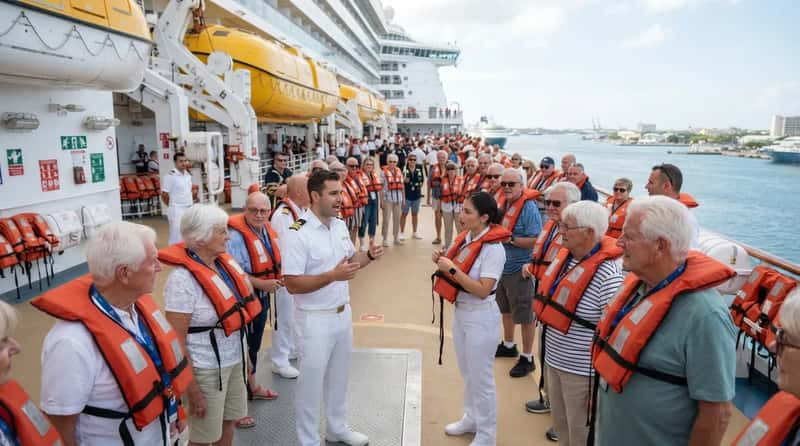
Crew say this is the habit they understand least.
On embarkation day, the pull to skip the “boring” meeting and head for the pool bar is strong. Crew members call it one of the most common and most reckless habits.
One crew member says the last thing they want in an emergency is a crowd running around panicked because nobody listened to the briefing. Veterans are the likeliest to wave it off, assuming they’ve heard it all.
The drill is the one moment when the vacation mood pauses and the ship’s real job comes into focus.
Next is a mistake that sounds like a virtue, and one captain says it ruins trips in #13…
#13 – Trying to Do Everything

The biggest mistake isn’t laziness. It’s overscheduling.
Captain Kate McCue, the first American woman to captain a mega cruise ship for Celebrity Cruises, calls it the biggest mistake first-time cruisers make. Her advice is to leave room to enjoy the ship and be spontaneous.2
Many travelers treat a packed port schedule as getting their money’s worth. The captain argues the opposite: a vacation can quietly become a to-do list.
And sometimes the schedule isn’t even yours to control, as #12 shows…
#12 – Assuming the Itinerary Is Set in Stone

Your ports are a plan, not a promise.
Cruise itineraries can change at any time, so passengers need to be flexible too. One Norwegian passenger arrived in Manhattan expecting a Caribbean sail. Hurricanes were heading for the ship’s path, and the trip became a fall foliage voyage.
That’s a big deal if you plan around mobility, medications, or a family event at a specific port. Know your plan B before you sail.
Worth Knowing
- Weather, safety concerns and port problems are common reasons ships change course.
- Your booking terms usually spell out what the cruise line will and won’t do when plans change.
- Anything tied to a specific port, like a family visit or a pre-booked tour, deserves a backup plan.
- Ask about change and cancellation rules before you pay, not after the ship turns.
Next comes a problem that can end the trip before it begins, in #11…
#11 – Showing Up With the Wrong Paperwork

The cruise can be over before you reach the gangway.
A missing document at the terminal can end a trip before it starts. Some cruisers show up with only a Real ID or driver’s license, as one Baltimore couple did, and learn the truth at the port.
Requirements vary by cruise line and itinerary. Check your own sailing, not a friend’s.
But the item that decides whether your cabin feels like home is in #10…
#10 – Putting Your Essentials in the Wrong Bag

Your suitcase and your cabin don’t arrive together.
Large luggage usually goes to crew or terminal staff and reaches your cabin later in the day. Your big bag can trail you by hours.
A crew member advises keeping anything you’ll want right away in a backpack. For many travelers, that means medications, glasses, chargers, and a swimsuit.2
The mistake is assuming the ship runs like a hotel with a bellhop on your schedule.
Speaking of schedules, the last morning of the cruise sets up the next mistake, in #9…
#9 – Waiting Until the Last Morning to Dispute Your Bill
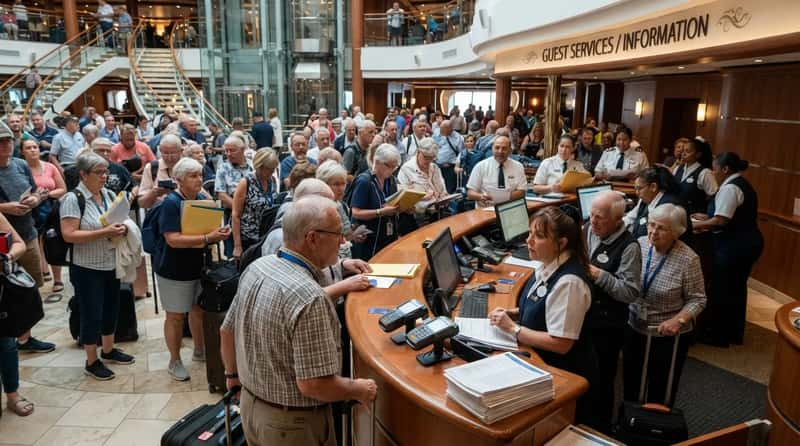
Debarkation day is the worst time to fix a charge.
The crew has to get everyone off quickly to prepare for thousands of new passengers. Meanwhile, lines form at guest services as people argue over specific charges.
It’s nearly impossible to get cruise line land staff to fix onboard billing mistakes. A problem you find at home can be a problem you keep.
Even a clean bill can’t help you if you make the mistake in #8…
#8 – Cutting It Close in Port
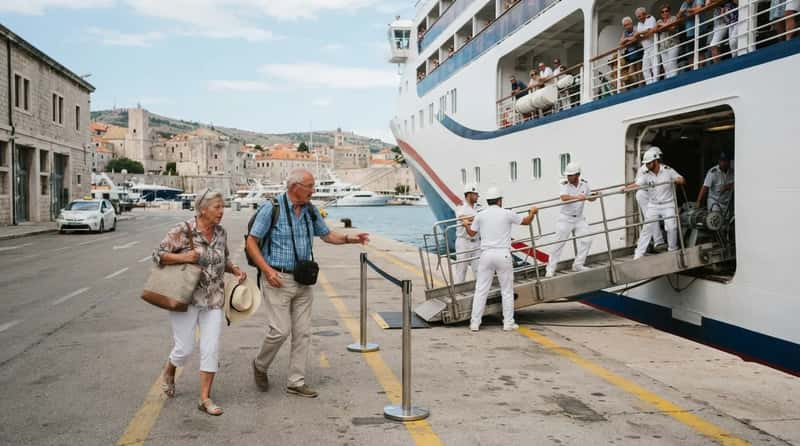
The ship does not wait for your lunch.
One traveler’s taxi story shows how thin the margin can be. The passengers drew pictures of a small ship and a larger one to show a driver who spoke little English where they needed to go.
They reached the terminal just as the gangways were being pulled in. The lesson from that traveler: always get the port’s written address before you leave the ship.
Fast Facts
- Check the all-aboard time on your daily schedule before you step off.
- Carry the port’s written address, in case a driver doesn’t speak your language.
- Keep your cabin card and ID on you at all times.
- Build in a generous buffer for traffic, lines and slow walking.
The next mistake could make you sick, and crew say it’s easy to fix, in #7…
#7 – Trusting Hand Sanitizer Alone
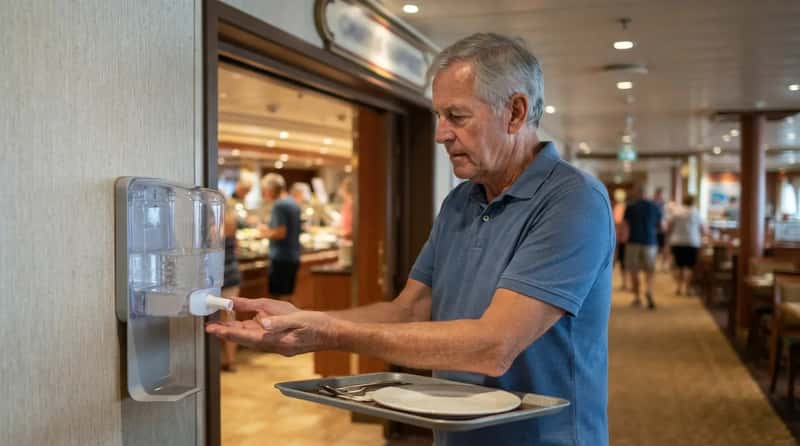
That dispenser by the buffet is not a shield.
The CDC says the best defense against norovirus is washing with soap and water for at least 20 seconds. Sanitizer isn’t a substitute for proper handwashing when it comes to norovirus.3
The numbers are mixed. The CDC reported 16 gastrointestinal outbreaks on cruises in 2024, up from 10 in 2019.
A CDC spokesperson said it isn’t yet known whether that is a new trend.
And the place where all that handwashing matters most is #6…
#6 – Behaving Badly at the Buffet

The buffet is where crew patience gets tested.
Every time someone grabs a pastry with bare hands, they contaminate what’s around it. On a ship, thousands of hands touch the same railings, elevator buttons, and serving spoons.
Plenty of guests defend lingering at a prime window table. But crew find it hard to ask someone sitting 45 extra minutes over cleared plates to move without making a scene.
- Use the tongs
- Skip the wet swimsuit, which leaves crew mopping water trails
- Don’t stack plates as if the food is running out
Now the real money mistakes begin, starting with timing, in #5…
#5 – Buying Insurance Too Late

The best coverage has a deadline most travelers miss.
Cruise Critic advises buying travel insurance soon after your first payment, especially if you need pre-existing condition coverage or evacuation protection. Pre-existing condition waivers often must be purchased within 14 to 21 days of the initial deposit.4
Squaremouth found that 23.9% of seniors skip cancellation and interruption coverage and choose medical-only protection. That can leave a roughly $7,000 trip unprotected.
But buying early means little if you buy the wrong policy, as #4 shows…
#4 – Defaulting to the Cruise Line’s Policy
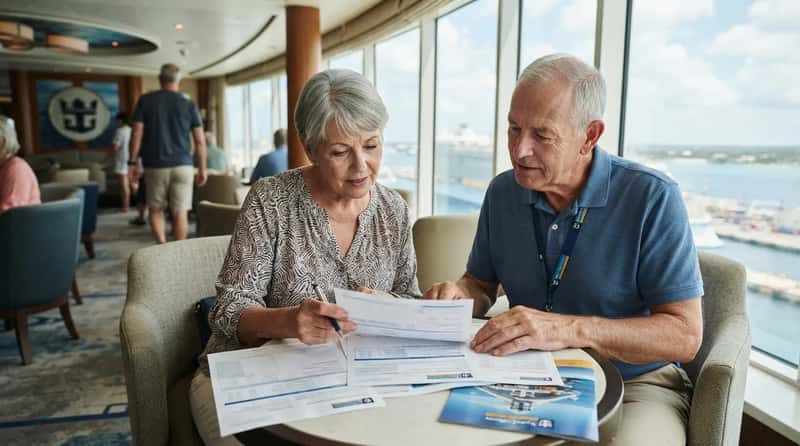
It’s the easiest checkbox to tick, and often the weakest.
Royal Caribbean’s standard policy shows how thin the built-in coverage can be. It sits far below what experts recommend.
Quick Compare
- Emergency medical: up to $25,000 on the standard policy vs. $100,000 recommended
- Evacuation: $50,000 on the standard policy vs. $250,000 recommended5
Cruise line policies may be extremely limited, especially with a pre-existing condition. The plans are pitched as the simple option, but AAA’s magazine notes that experts advise against them.
And even a good policy fails if the limits are too low, which is #3…
#3 – Underinsuring Against an Evacuation
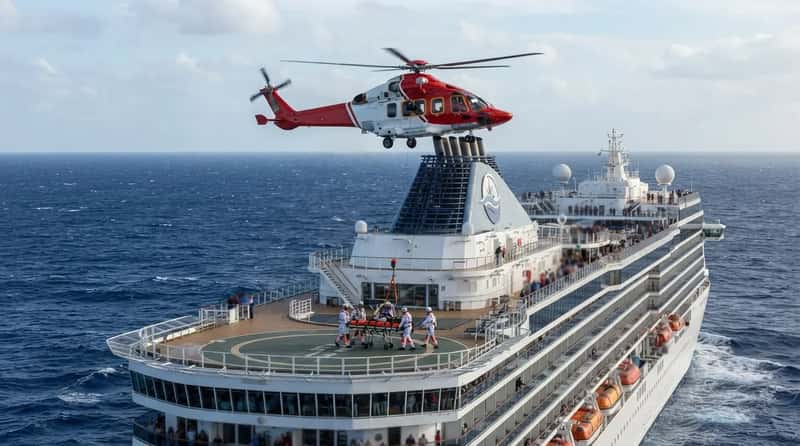
A helicopter off open water isn’t priced like an ambulance.
The CDC says medical evacuations can cost upward of $250,000. Yet 35% of senior cruisers buy less than $250,000 of evacuation coverage.1 5
Estimates vary. One insurer puts evacuation from open water or remote ports at $50,000 to $300,000, and if you’re underinsured, you cover the rest yourself.
But the mistake in #2 happens long before anyone mentions an evacuation…
#2 – Expecting the Ship’s Doctor to Bill Your Insurer

Every ship has a clinic, but it doesn’t take your card.
Every cruise ship has a medical clinic with a doctor and nurse on call 24 hours a day. Ship doctors don’t accept standard health insurance, so visits can be costly.
You typically pay out of pocket at the time of service and file for reimbursement afterward, if your policy covers it at all. On a fixed income, that cash-flow gap matters.
And the assumption behind all of this, the most common of all, is #1…
#1 – Assuming Medicare Goes to Sea With You
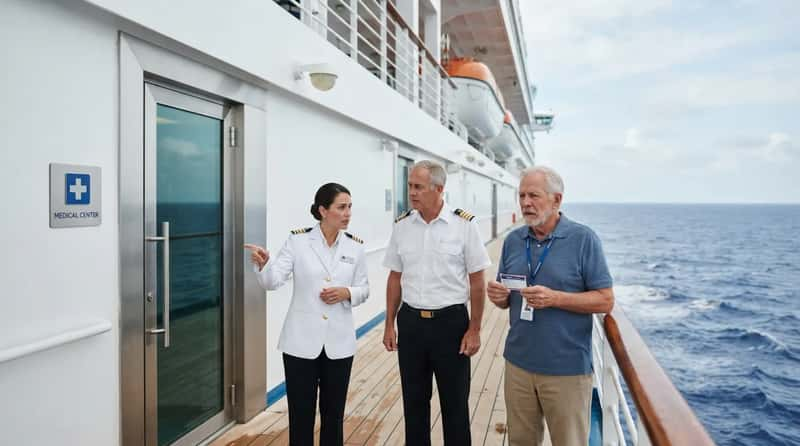
This is the one that should make you check your plan tonight.
Medicare may cover medically necessary services if the doctor is authorized to treat on the ship and the ship is in a U.S. port or within six hours of one. Beyond six hours from a U.S. port, Medicare doesn’t cover those services.6 7
If the ship is docked in a foreign port like Cozumel or Nassau, Original Medicare won’t cover you either.7 Most itineraries spend much of their time beyond that line.
Look back over all 15 and a pattern shows up. The small mistakes irritate the crew: skipping the drill, cutting it close in port, and treating the buffet like a free-for-all.
The big ones cost you money. Medicare’s six-hour rule, thin cruise-line limits, and a missed insurance deadline can leave you paying out of pocket for a $250,000-plus evacuation.
The good news is that the fix is mostly paperwork, not luck. Buy the right policy early, carry your essentials, and read the fine print before you sail.
Then the only thing left to worry about is the buffet line.
Bonus: The Insider Step Nobody Mentions Until It’s Too Late

A good policy only helps if you use it the right way when something goes wrong. Many policies include a 24-hour assistance line, and some require you to call it before arranging an evacuation or major treatment.
Do this before you leave home, and it takes about 15 minutes:
- Put the assistance number in three places. Save it in your phone, write it on a card in your wallet, and give a copy to your travel companion or a family member at home.
- Call your insurer and ask three questions. Does the policy cover care on the ship and at sea? Is evacuation to the nearest adequate hospital, or to a hospital near your home? Do I need to call the assistance line before treatment or transport?
- Ask for the answers by email. A written reply gives you something to point to if a claim is questioned later.
- Check how the ship’s phone and internet work. Confirm that you can reach the assistance line from your cabin or the medical center without a surprise charge.
The point: a $250,000 evacuation limit means little if nobody knows who to call in the first hour. Make sure at least one other person does.
- Squaremouth Senior Cruise Report: https://www.squaremouth.com/travel-advice/senior-cruise-travel-data
- Yahoo Cruise Mistakes Experts: https://travel.yahoo.com/cruises/article/most-common-cruise-mistakes-225813697.html
- CDC Yellow Book Norovirus: https://www.cdc.gov/yellow-book/hcp/travel-associated-infections-diseases/norovirus.html
- Squaremouth Pre-Existing Conditions Coverage: https://www.squaremouth.com/travel-insurance-benefits/pre-existing-condition
- Royal Caribbean Blog Insurance: https://www.royalcaribbeanblog.com/2026/02/20/how-old-too-old-to-cruise
- Kiplinger Medicare Six-Hour Rule: https://www.kiplinger.com/retirement/medicare/medicare-and-cruises-the-6-hour-rule
- Medicare Cruise Coverage Guide: https://wecanhelpyou.org/the-ultimate-guide-to-medicare-coverage-while-traveling/
