


When the Danube and Rhine ran low in summer 2026, some river cruise passengers ended up on coaches instead of ships. For travelers over 65, hours on a bus, a steep gangway or an unplanned medical bill can sour a trip that cost thousands of dollars.
These 15 mistakes run from small comfort-killers to one that can cost more than the whole cruise. The biggest dollar figure waits at #1, but first, look at your suitcase.
#15 – Packing a Suitcase Too Big for the Cabin
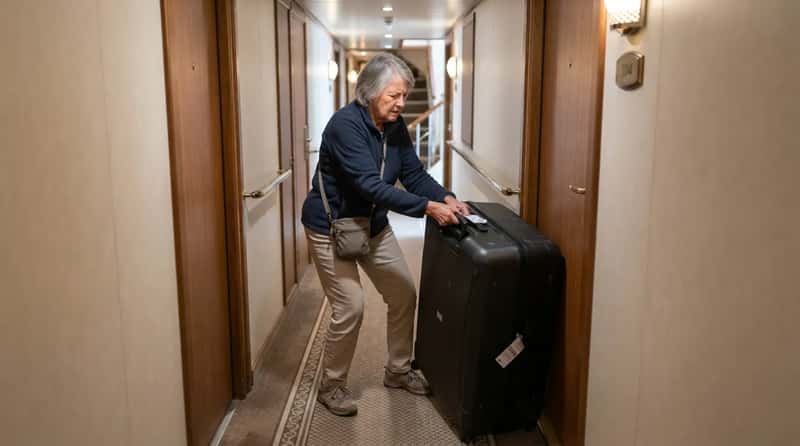
River ships have narrower hallways than ocean ships, and the cabins are smaller to match. An oversized hard case turns every doorway into a negotiation.
Pack one case you can lift yourself, plus a small day bag. Your bags will go up and down stairs and on and off coaches, and if the river forces a ship swap, onto a different vessel.
Walking tours are the main event, so three or four mixable tops beat a fresh outfit for every dinner.
The suitcase is the easy fix. The fare itself can hide things you’ll pay for onboard.
#14 – Choosing the Cheapest Fare Without Reading What’s Included

The headline price on a river cruise rarely tells you what the week will cost. Lines differ on airport transfers, optional excursions, drinks and gratuities.
A sound review covers what’s included, transfers, cancellation terms and river conditions. Run the same checklist on every cruise you’re considering.
Ask for a written list of what’s included and what costs extra. One planning guide for older travelers warns against choosing a cruise by price alone, and that advice holds for river ships too.
No fare covers the next item. It’s a conversation about your diet and health that has to happen before you board.
#13 – Keeping Your Dietary and Health Needs to Yourself
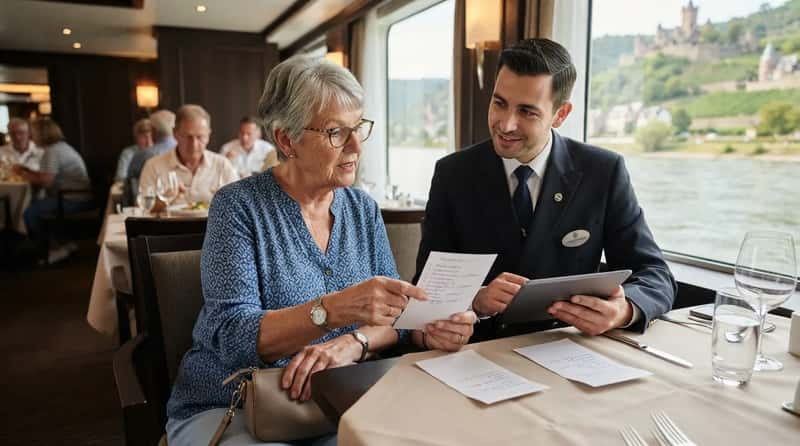
A river ship’s galley is small, and the staff can only plan around what they know. Mentioning your allergy at the first dinner is already late.
Tell the line at booking, then tell the cruise manager on day one. Repeat any allergy, mobility limit or condition you want the crew to know about.
Carry a written list of your medications, conditions and an emergency contact, with a copy in your day bag. A short list on paper is faster than an explanation in the middle of a gangway.
At a Glance
- At booking: tell the line about allergies, mobility limits and conditions.
- Day one: repeat it all to the cruise manager.
- On paper: medications, conditions and an emergency contact.
- Backup: keep a second copy in your day bag.
Even a perfect health briefing won’t help if you never make it to the ship. That risk is highest if you land and board on the same day.
#12 – Flying In on Embarkation Day

If your flight runs late, the itinerary doesn’t wait for you. A river ship’s schedule is built around its stops, and boarding day is where it starts.
Arrive at least one day before sailing. Low water adds another reason, since passengers can face ship swaps, changed embarkation points, coach transfers and sometimes hotel stays.1
In one case, an Avalon Danube cruise boarded in Passau instead of Nuremberg. A flexible arrival absorbs a changed boarding city far better than a tight one.
Once you’re aboard, the cabin you picked decides how far you walk every day.
#11 – Picking a Cabin Far From the Elevator

A cabin that looks like a bargain on the price list can sit at the far end of the ship. That’s a long trek to breakfast, and a longer one back.
Trace the walk from your cabin to the elevator, dining room and gangway on the deck plan. It takes ten minutes, and one senior cruise guide specifically advises travelers over 80 to avoid cabins far from elevators.
Elevators on a river ship connect the interior decks, but the sun deck is often reached by steps. Hold onto that detail, because it matters again two items from now.
A well-placed cabin doesn’t shorten the walk once you step ashore. Out there, cobblestones set the pace.
#10 – Underestimating the Walk Ashore

Many river excursions are on foot. Expect cobblestones in many European towns, stairs in castles and cathedrals, and gentle hills in certain ports.
Choose the gentle-walking group if the line offers one. AmaWaterways, for example, runs gentle-walking groups that move slowly and take more breaks.
Joining the fast group out of pride is a poor trade. You’ll see the same cathedral either way, and you’ll have energy left for dinner.
Wear shoes with real grip, since wet cobblestones are slick.
Worth Knowing
- Cobblestones are common in many European river towns.
- Castles and cathedrals often mean stairs.
- Some ports have gentle hills.
- Gentle-walking groups trade speed for extra breaks.
And back at the ship, the walking isn’t over, because reaching the pier can mean crossing other vessels.
#9 – Treating the Gangway as a Simple Ramp
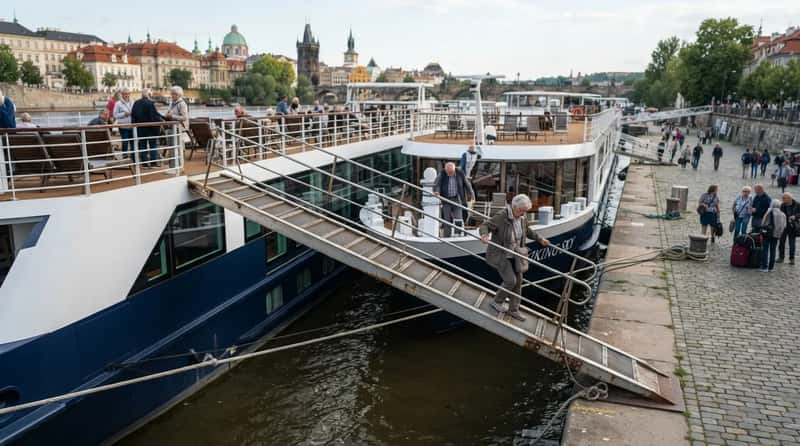
Your ship may not touch the pier at all. River ships can dock several vessels deep, so you sometimes walk through other ships to reach land.
Ships often dock in parallel, and you cross over from the sundecks. That’s the sun-deck stairway the cabin tip warned about.
Ask the line how you’ll get ashore when ships are docked side by side. Some river ports also have gangways that turn steep when the water is low.
If you use a scooter or wheelchair, the question changes from how steep to whether you can board at all.
#8 – Assuming Your Wheelchair or Scooter Will Fit
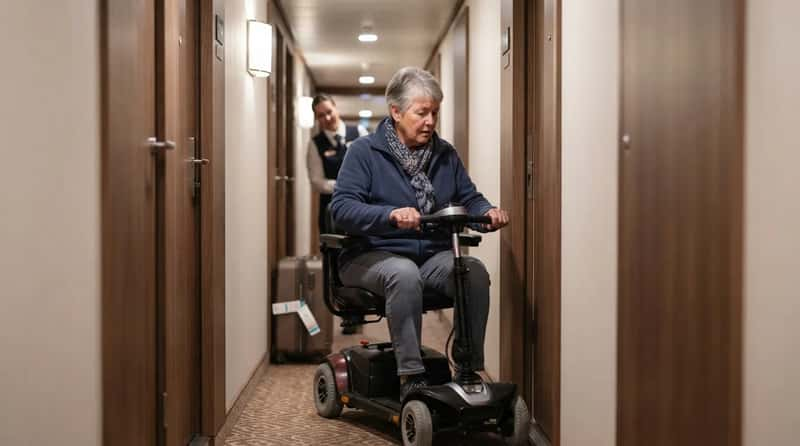
River ships avoid tender boats, which removes one obstacle that ocean cruisers with mobility aids face. But smaller ships mean tighter doorways and cabins, so the answer depends on the vessel.
If you use a rollator or cane, river cruising is very doable. If you use a scooter or wheelchair, plan early so the right ship and itinerary can be chosen.
Call the line’s accessibility team and get cabin and shore-access details before you pay. Viking, AmaWaterways and Avalon all have specific accessible cabin configurations, and the general reservations desk may not know the specifics.
Once the practical details are settled, the last night brings an envelope question that varies by line.
#7 – Guessing at Tipping Rules

Tipping policies differ widely, and some lines build gratuities into the fare. Cruise Critic’s roundup lists American Cruise Lines, APT, Emerald, Scenic and Tauck among those that include them.2
On other lines, you pay by the night. One 2025 guide puts Viking’s European suggestion at $20 per guest, per day, and a 2026 guide says AmaWaterways doesn’t add its suggested amount automatically.
Quick Compare
- Built into the fare: American Cruise Lines, APT, Emerald, Scenic, Tauck.
- Suggested per night: Viking, at $20 per guest, per day in Europe (2025 guide).
- Left to you: AmaWaterways doesn’t add its suggested amount automatically (2026 guide).
Ask your line whether gratuities are included, auto-added or left to you. Suggested amounts change over time, so confirm the current figure.
Cash is easy to replace on the road. A prescription isn’t, and your drug plan may stop working at the border.
#6 – Counting on Your Drug Plan Abroad
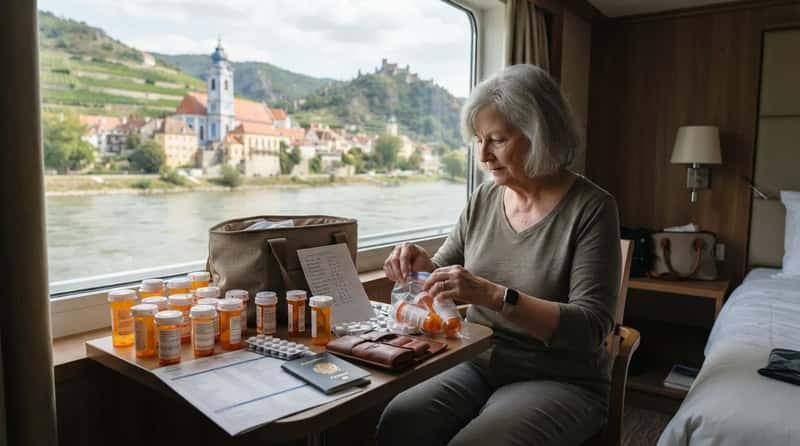
Medicare Part D drug coverage almost certainly doesn’t travel with you. A prescription filled abroad may be entirely out of pocket.3
Carry every medication in your hand luggage, in original containers, with spare days built in. Those extra days cover the transfer delays described later on this list.
Add a list of generic names, because brand names differ between countries. Then ask your doctor or pharmacist about refill timing, since insurers often limit early refills and you’ll want to ask weeks before you leave.
Medicines are a small part of the picture. The larger risk comes from the calendar, because river levels fall at a predictable time.
#5 – Booking Late-Summer Sailings Without Checking River Levels
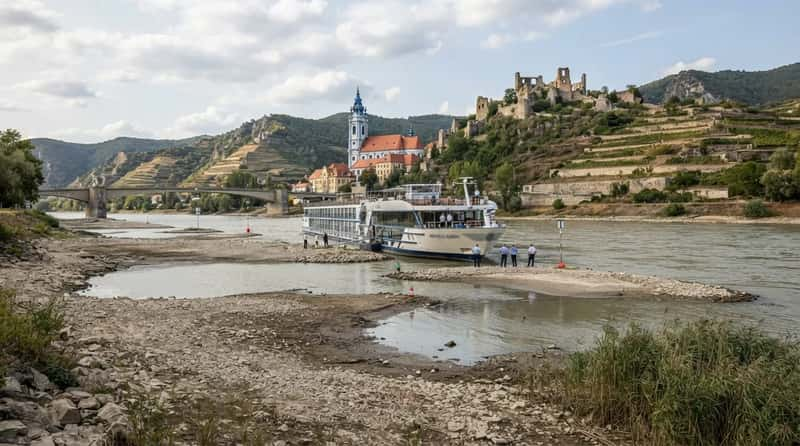
Prolonged heat and dry conditions pushed European river levels to historic lows in summer 2026, disrupting Danube and Rhine sailings. Trouble spots included Regensburg to Passau, the area around Dürnstein and Melk, and Vienna to Budapest.1
Because low water is a greater concern in late summer, Afar suggests booking in spring or early summer. On the Rhine and Danube, that can be worth it even when the late-summer fare is lower.
Favor spring or early summer sailings on the Rhine and Danube. Not every river is hit equally, and in an earlier low-water year the Seine, Rhône and Douro were generally fine.
Even a well-chosen month can still put a coach on your schedule. And that’s a question about your body more than your itinerary.
#4 – Not Planning for Hours on a Coach

When a ship can’t pass, the line moves you by land. That can mean a bus between ports, or a ship swap where passengers disembark, ride to another ship and continue.4
One traveler quoted by Fox News described about five hours on a bus to reach a new ship. That’s a long day at any age.
Ask what the line’s plan is for coach transfers, including seating, rest stops and luggage handling. If you have limited mobility, ask whether the vehicles can take your equipment, and remember the one-lift suitcase from #15 earns its place here.
You can plan for the ride. Whether you get money back is a question to settle before you pay.
#3 – Skipping the Line’s Policy on Itinerary Changes
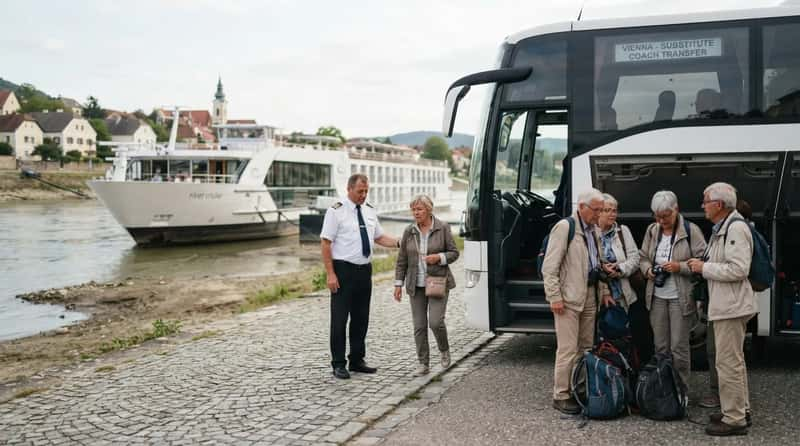
Forbes reports that lines are rerouting rather than canceling where possible. A week spent mostly on coaches may therefore not trigger a refund.1
Reuters reported in July 2026 that Avalon canceled a small number of Danube and Rhine departures because of low water.1 Lines differ on how they respond, which is why the policy matters before you book.
Get the line’s low-water and itinerary-change policy in writing before paying the deposit. Ask about both rerouting and outright cancellation.
That’s the trip money. The next item concerns a bill that can dwarf the whole fare, and it starts with a belief about Medicare.
#2 – Believing Medicare Follows You Overseas

The State Department says Medicare does not cover medical costs outside the United States.5 A river cruise in Europe is outside the United States for the whole trip.
Medicare Advantage plans usually don’t cover treatment abroad, though some include emergency care. Some Medigap plans cover limited emergency care abroad.6
Fast Facts
- Original Medicare: no coverage for medical costs outside the U.S., per the State Department.
- Medicare Advantage: usually no coverage abroad, though some plans include emergency care.
- Medigap: some plans cover limited emergency care abroad.
Call your plan and ask what it pays for emergency care in Europe. Ask in those words, and get the answer in writing.
Knowing your coverage still leaves a gap in the policy you may already own. The most expensive mistake on this list hides in a single line item that buyers skim past.
#1 – Buying Travel Insurance Without Medical Evacuation
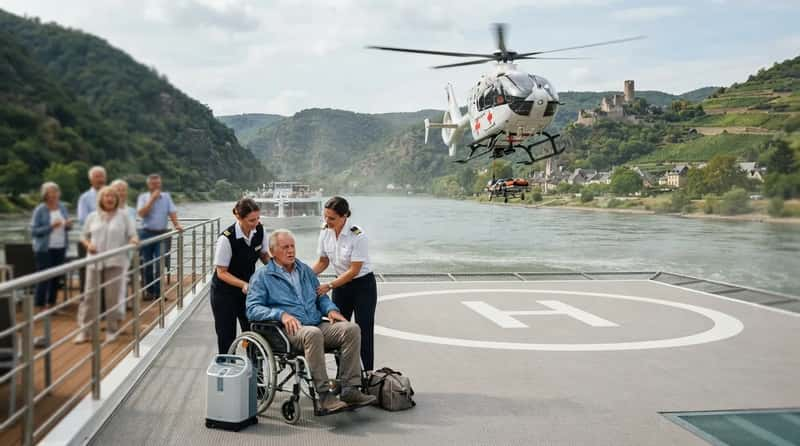
Medjet Assist, an air-evacuation company, has put international medical transports at more than $75,000. Every earlier item costs you comfort or a few hundred euros, but this one can cost more than the cruise itself.
The CDC notes that trip insurance may not cover medical costs or evacuation. A cancellation-only policy can leave you exposed, and cruise line protection plans may offer limited evacuation coverage.7
Evacuation and medical coverage are different products. Evacuation pays for transport to the nearest adequate facility, while your medical bills need travel medical coverage.
If you have to rank them, medical and evacuation come before cancellation. A lost deposit has a ceiling, and an emergency abroad doesn’t.
Confirm the policy names medical evacuation and repatriation, then check the dollar limit. Read the “Emergency Evacuation” section, not just the summary, and ask the insurer about pre-existing condition rules before you buy.
The brochure shows calm water and a short walk to town. The trouble on this list starts where the brochure stops: the river level, the stairs between docked ships and the fine print in a policy.
Treat each item as a question for the line or your insurer before you pay. What happens when the river drops, how do I reach shore, and who pays if I need a hospital?
If you’ve sailed on a river ship before, which question about the gangway, the docking or the insurance do you wish you’d asked before booking?
Bonus: The Insider Trick Nobody Tells You

Watch the river gauge yourself, and set your decision dates before you pay the final balance. Crew members see water-level trouble coming days before most passengers hear about it.
Here is how to do the same from your living room:
- Find your river’s gauge. For the Rhine, the gauge at Kaub is the one widely watched as the bottleneck. Search for it on the German federal waterways site, Pegelonline, and note the trend.
- Check it twice a week starting about a month before sailing. A steady slide with no rain in the forecast is your early warning.
- Call the line 7 to 10 days out and ask: "If the water drops, will you reroute, swap ships or cancel, and where would I board?" Write down the name of the person who answers.
- Keep your arrival flexible. Book a refundable hotel for the night before sailing, and avoid non-refundable add-on tours until the ship is confirmed.
One more catch: standard travel insurance often won’t pay for low-water changes. If you want a "cancel for any reason" upgrade, it generally has to be bought soon after your first trip deposit, and it typically reimburses only part of your cost. Ask the insurer for both rules in writing before you pay.
- Forbes Low-Water Disruptions: https://www.forbes.com/sites/emesemaczko/2026/08/11/low-water-levels-are-still-disrupting-european-river-cruises-from-ship-swaps-to-evacuation/
- Cruise Critic River Tipping: https://www.cruisecritic.com/articles/cruise-line-tipping-policies-river-and-barge-lines
- Medicare Part D Abroad: https://www.medicarefaq.com/faqs/travel-insurance-for-seniors-with-medicare/
- River Cruise Advisor Low Water: https://rivercruiseadvisor.com/2026/08/low-water-on-the-rhine-danube-what-you-should-know/
- State Department Medicine and Health: https://travel.state.gov/en/international-travel/planning/guidance/medicine-health.html?c=TFOBE
- Humana Medigap Abroad: https://www.humana.com/medicare/medicare-resources/medicare-and-traveling-abroad
- CDC Yellow Book Travel Insurance: https://www.cdc.gov/yellow-book/hcp/health-care-abroad/travel-insurance.html
