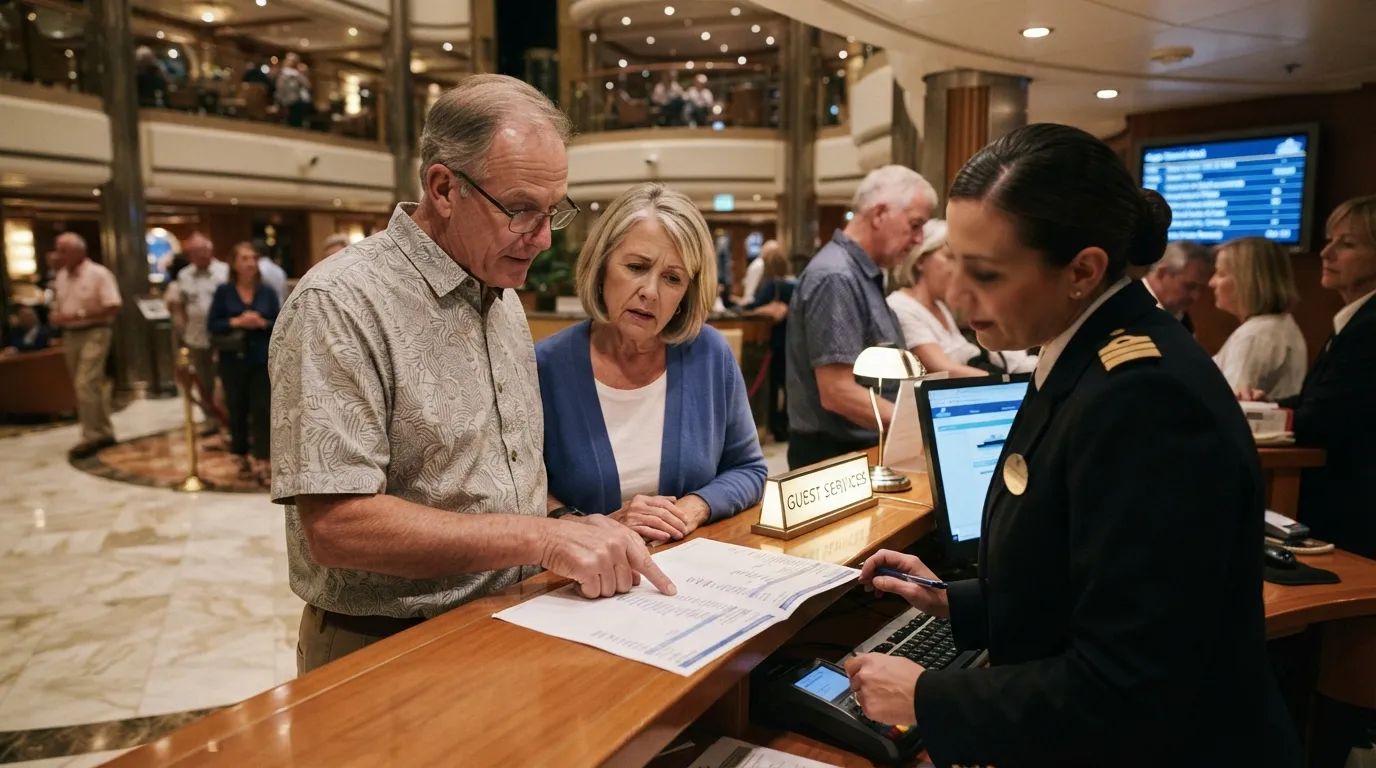
The charge you don’t question is the one that stays on your bill. A week-long cruise can generate dozens of line items, and some of them are duplicates, misapplied packages, or prices that don’t match what you were quoted.
Here’s the twist: most of these charges don’t disappear because you’re over 60. They disappear because experienced cruisers walk up to the purser’s desk and ask, and the biggest payoff sits at #1, a charge most passengers treat as untouchable.
#15 – The Seasickness Remedy You Can Get Free at the Desk

The ship’s pharmacy will happily sell you a fix for the nausea you feel on day one. The purser’s desk on many ships keeps seasickness tablets or ginger candies on hand, often free.
Ask in your first hour aboard, even if you feel fine. A choppy first night is the worst time to go hunting for the pharmacy in unfamiliar corridors.
Ask at the purser’s desk on boarding day, before you need it.
A free remedy is a small but clean win. The next one is free too, and plenty of travelers assume it comes with a fee or a form.
#14 – Wheelchair Assistance and the Accessible Cabin Premium That Isn’t There
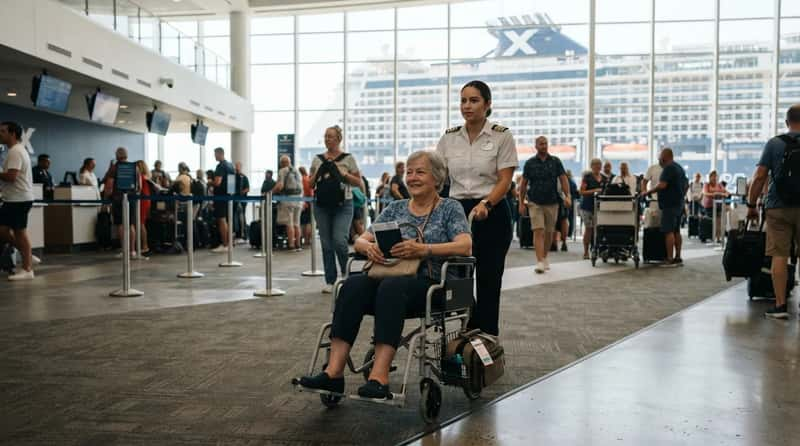
Getting through a busy embarkation terminal with luggage is the part of cruising nobody photographs. Wheelchair assistance on and off the ship is free, but many passengers never ask because they assume there’s a charge.1
Ask for wheelchair assistance at check-in; there is no charge and no forms required. You can also have the request noted in your booking before you reach the pier, so you’re not explaining it at the counter while juggling bags.
Celebrity can also arrange accessible transportation between airport and pier at no extra charge for air/sea guests, or for those who bought cruise-only transfers, if you ask in advance.2
The same assumption trips people up on cabins. Many travelers think a roomier accessible stateroom with a roll-in shower or wider doorways costs extra, but on major lines it’s generally priced like a standard cabin in the same category.
The catch is supply, not price. Accessible rooms are limited and go early, and some lines may ask for a physician’s letter, so book well ahead.1
The terminal is behind you. Once you’re aboard, the first drinks you order can trigger a billing glitch most passengers never think to check.
#13 – The Day-One Gap in Your Beverage Package
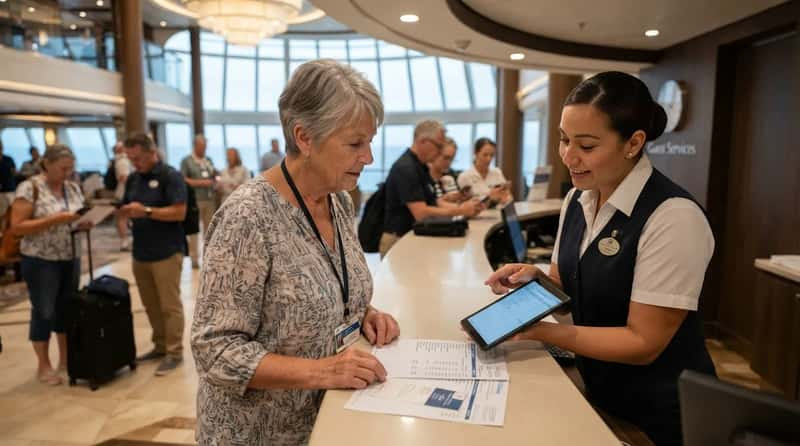
You paid for the drink package before you sailed, so every drink on embarkation day should be covered. The package says it starts at embarkation, but the folio can tell a different story.
Those first sail-away drinks, ordered while everyone is still hauling carry-ons, are where a gap or duplicate charge tends to slip in.
Check your folio on day two and look specifically at embarkation-day drink charges. A five-minute chat at the purser’s desk can remove a charge that should never have been there, and the desk usually fixes it without a fight because the error isn’t yours.
Wi-Fi packages have the same weakness, and it’s easier to get hit twice.
#12 – The Duplicate Wi-Fi Plan on a Single Account

Booking internet access is easy. Getting charged for it twice is easier.
It often happens when someone books a plan at home, finds it isn’t active right away on boarding, and buys it again at the ship’s kiosk. Compare every Wi-Fi charge with what you actually booked.
If your account shows two Wi-Fi charges, ask the desk to remove the one you didn’t intend to keep. The transaction record makes the error visible, so the fix is usually straightforward.
Double charges don’t stop at Wi-Fi. Your third-night steakhouse reservation can carry the same risk.
#11 – The Specialty Dining Cover Charge Billed Twice
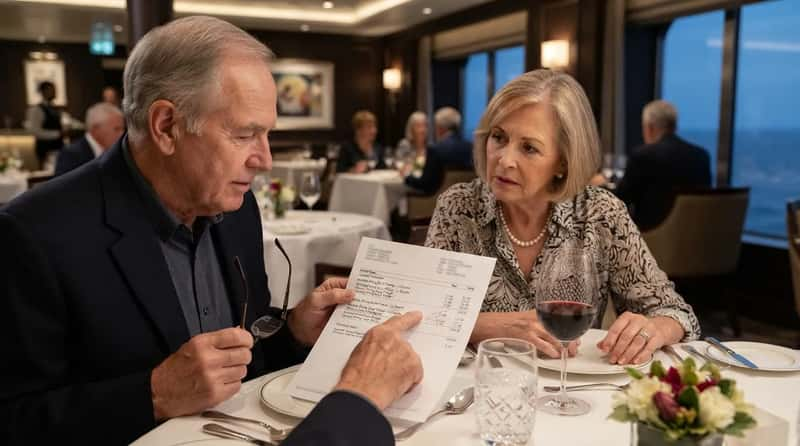
Passengers expect a cover charge at a specialty restaurant, so they rarely look at it twice. That’s exactly why a doubled one can sail right through.
It’s most likely when you changed a reservation time instead of canceling and rebooking. The original booking can post a charge before the system registers the change.
If you changed a dining reservation time, check your folio for two cover charges at the same restaurant. The purser’s desk can pull both transactions and clear the duplicate.
Worth Knowing
- Changing a reservation time is the riskiest move, because it can leave the original booking live in the system.
- Scan your folio for the same restaurant name appearing twice on the same night.
- The desk can pull both transactions side by side, so you don’t need to argue your case.
- Canceling and rebooking, rather than editing the time, may lower the odds of a duplicate.
Some venues also add a separate gratuity on top of the cover charge, beyond the daily automatic gratuity. That’s a different issue, so for now, hunt for the duplicate on a single meal.
#10 – The Corkage Fee Applied at the Wrong Rate

Many lines allow you to bring a bottle of wine aboard and charge a corkage fee when it’s opened in the dining room. The rate varies by cruise line, and that variation is where errors creep in.
Corkage is rarely audited, so it can be applied incorrectly or duplicated without anyone noticing.
Before you board, look up your line’s current corkage rate and write it down. If the folio doesn’t match, the purser’s desk can verify the correct figure and adjust it.
Dining charges get skimmed quickly. The next item comes from a part of the ship where charges get skimmed even faster.
#9 – The Spa Charge That Doesn’t Match Your Quote

Spa prices are often quoted out loud during a consultation, then entered into a system by someone who’s also juggling appointments. What you were told and what posts to your account can be two different numbers.
The purser’s desk can pull the original transaction and compare it against the posted amount.
Before you leave the spa, take a photo of your signed receipt. If the folio differs from what you signed, that photo is your evidence, and it takes about fifteen seconds in the treatment room.
Spa charges are often among the larger single lines on a cruise bill, so a mismatch here means real money. The next item is a perk many passengers over 60 have already earned without knowing it.
#8 – The Loyalty Tier You’re Already In but Never Claimed

Passengers who’ve sailed with the same line for years rack up points that move them up a loyalty tier. Many have no idea which tier they’ve reached.
On some lines, Platinum members get 10% off spa treatments and photos, while Elite members get extras like complimentary mini-bar setup, laundry service, and even shoe polishing. Plenty of guests over 60 have logged enough sailings to qualify without realizing it.
On embarkation day, ask the purser’s desk to confirm your loyalty tier and list what comes with it. Higher tiers on some lines can also bring special access or onboard credit.
At a Glance
- Platinum (on some lines): 10% off spa treatments and photos.
- Elite (on some lines): complimentary mini-bar setup, laundry service, and shoe polishing.
- Higher tiers: may add special access or onboard credit.
- Your move: ask the desk for a printed or on-screen list of what your tier includes.
This isn’t a negotiation. It’s a lookup, and what it unlocks was already yours.
#7 – Onboard Credit Sitting Unused in Your Account

Onboard credit can arrive from several directions at once: a travel agent promotion, a loyalty reward, a booking incentive. It doesn’t always show up automatically, and it often expires at the end of the cruise.
Unused credit that expires is money handed back to the cruise line for free. Ask at the purser’s desk on day one for a full account summary, then ask again on the second-to-last evening to make sure everything has been used.
On some lines, credit can be applied to shore excursions booked onboard if you ask specifically.
Credit you can’t see is credit you can’t spend. The next item is the opposite: a charge that shouldn’t be there at all.
#6 – The Shore Excursion You Canceled but Were Billed For
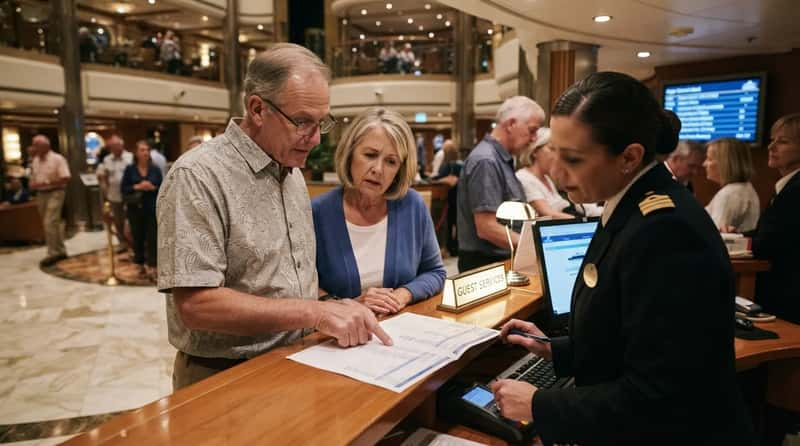
A shore excursion canceled through the ship’s desk is supposed to drop off your account. Sometimes it doesn’t.
The last-night account check is where people find a canceled specialty dinner, an excursion they never booked, or a package they thought they’d removed. By then, it’s the worst possible moment to discover it.
The Points Guy reports that many cruisers wait for the paper bill the night before disembarkation, which creates long queues at guest services that night and the next morning. Check your excursion charges the same day you cancel, not at the end of the voyage.3
A canceled excursion that still shows as charged is a one-minute fix on day three. On disembarkation morning, it’s a thirty-minute line.
#5 – The Minibar You Never Opened
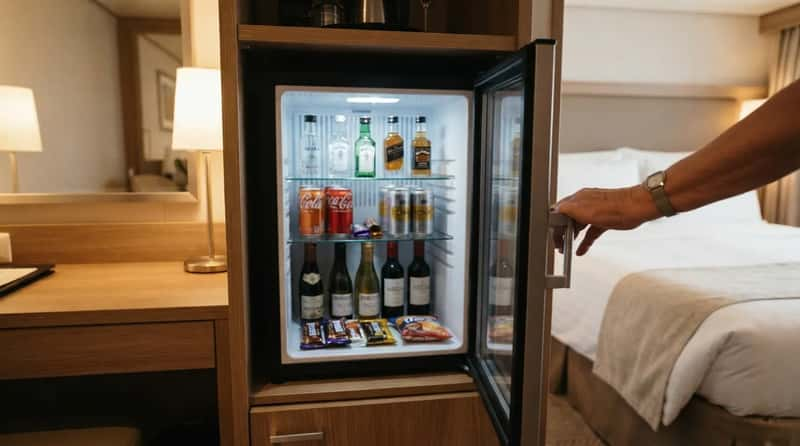
Minibar charges have a reputation on ships: they appear without warning and often shrink when contested. Many lines pre-stock the minibar and bill you for items removed, whether you removed them or not.
Don’t assume prepaid packages mean your final bill will be zero. Savvy cruisers check their onboard account daily for wrong charges, duplicates, missing credits, and family spending.3
If you don’t intend to use the minibar, ask the purser’s desk on embarkation day to have it cleared and noted on your account. Some lines will empty it on request, which removes the chance of a dispute entirely.
Minibar disputes are small in dollars but big in frustration. The next item is about stopping surprise bills before they exist.
#4 – The Spending Limit That Protects Against Surprise Bills

This one isn’t a charge to dispute. It’s a tool to keep charges from ambushing you at the end.
The purser’s desk can often set limits on what a card spends, which matters most when grandchildren or other family members are linked to your onboard account. Their spending draws against your card, and totals climb faster than anyone expects.3
Ask the purser’s desk on day one about setting a daily cap on any secondary cardholder on your account. A cap won’t erase anything, but it can stop a small habit from turning into a big final bill.
#3 – The Compensation for a Genuine Cabin Problem
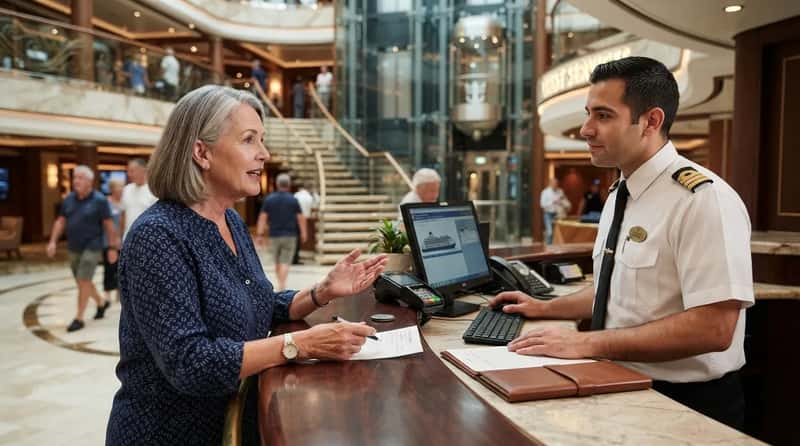
This is where the purser’s desk shifts from bookkeeping to advocacy. Think of a noisy deck overhead, an air conditioner that still fails after one repair attempt, or a plumbing problem that disrupts several nights.
The right move is a formal report to the desk, not just a word to your cabin steward. When a real problem is reported politely and clearly, the ship sometimes offers something extra, like a bottle of wine, a specialty dinner, or onboard credit.
Report a persistent cabin problem in writing at the purser’s desk; a verbal complaint to the steward creates no record. A complaint logged on day two gives the ship time to respond, and a reason to.
Keep that written record in mind. The next charge hits your account automatically, and it’s the one repeat cruisers swear shouldn’t happen.
#2 – The Prepaid Gratuity That Posted to Your Account Twice
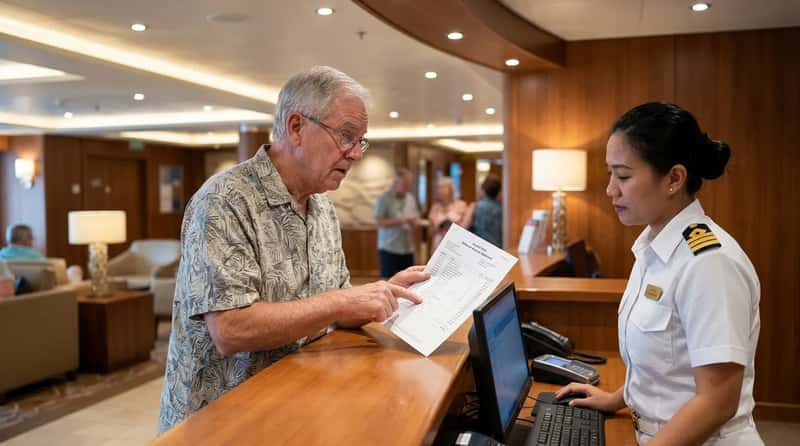
You prepaid gratuities before you sailed, so that charge is settled. Then your onboard account shows a daily gratuity charge anyway.
Gratuity systems are partly automated, and a prepaid tip in your booking record can occasionally fail to register as paid onboard. The purser’s desk is where that gets corrected.
If you prepaid gratuities, check your folio by day two and ask the desk specifically whether the prepayment is showing as applied. The Royal Caribbean Blog advises prepaid cruisers to make sure no daily gratuity fees are also showing onboard, noting it has happened.4
It’s easy to verify and fixed in minutes when caught early. The last item goes further, and it surprises even experienced cruisers who think they know the rules.
#1 – The Daily Gratuity Itself, on Lines Where You Can Adjust It

This is the charge most passengers treat as untouchable. It lands on your account automatically, adds up across a week-long voyage, and almost nobody questions it.
Cruise gratuities typically run roughly $14 to $25 per person per day, added to your account to compensate the crew who look after you.
Here’s what the brochure doesn’t say clearly: on several mainstream lines, that daily charge can be adjusted. Royal Caribbean’s published policy makes clear the charge isn’t compulsory, even though it’s added automatically. At Carnival Cruise Line, the charge on your onboard account can be changed without giving a reason, and Disney Cruise Line also allows adjustments without requiring you to prove a deficiency.5
On Royal Caribbean, you must visit the Guest Relations desk onboard, and requests must be completed before the morning of disembarkation.6 Norwegian Cruise Line is the exception passengers most often learn about the hard way: you can’t remove the daily gratuity onboard, and any refund requires a written request after the cruise.7
Quick Compare
- Royal Caribbean: visit Guest Relations onboard, and finish before the morning of disembarkation.
- Carnival: the charge can be changed on your onboard account without giving a reason.
- Disney: adjustments are allowed without proving a deficiency.
- Norwegian: no onboard removal; refunds need a written request after the cruise.
Now the honest part. An adjustment makes sense when you had a genuine service problem, raised it during the voyage, and gave the ship a chance to fix it.
Asking to waive the fee just to save money is considered a faux pas in cruising, because the money comes from cabin stewards and dining staff, not the cruise line’s corporate account. If the voyage was fine, leave it.
But if it wasn’t, and you documented the problem as described in #3, the purser’s desk is where the final conversation happens. It’s one you’re entitled to have.
The pattern across all 15 is quieter than any single discount: the passengers who read every line and ask at the desk are the ones who watch charges vanish. The purser’s desk isn’t a complaint counter. It’s an account management desk, a loyalty lookup, a billing audit, and a compensation channel in one place, staffed all day and free to use.
These charges don’t disappear because you’re over 60. They disappear because you asked before the ship docked and the queue formed, and the window closes the morning you disembark.
Which of these charges have you caught on a past cruise, and what did the desk say when you raised it?
Bonus: The Safety Net That Still Works After You Disembark

Most passengers treat the final folio as the finish line. It isn’t, because an unresolved or late-posting charge can still reach your card after you’ve left the ship.
Build a paper trail before the last night, and know your card’s dispute window.
- Second-to-last evening: ask the desk for a printed, itemized folio and keep a copy. Screenshot the version in the cruise app too.
- Anything unresolved: note the staff member’s name, the date, and what they said they would fix. Ask for it in writing or by email if possible.
- If a charge posts after you get home: write to the cruise line first and attach your folio copy and any receipt photos.
- If that goes nowhere: dispute the charge in writing with your credit card issuer. Under the federal Fair Credit Billing Act, you generally have 60 days from the date of the statement showing the error to do so.
Paying your final balance with a credit card rather than a debit card matters here, since those federal billing-error protections apply to credit cards. Check your issuer’s instructions for where to send the written dispute.
- Celebrity Special Needs Overview: https://www.cruise.com/cruise-information/special-needs/celebrity-cruises/
- Celebrity Accessible Cruising: https://www.celebritycruises.com/special-needs/accessibility
- The Points Guy Daily Bill: https://thepointsguy.com/cruise/check-onboard-cruise-bill-daily/
- Royal Caribbean Prepaid Gratuities: https://www.royalcaribbeanblog.com/boards/index.php?%2Ftopic%2F37696-prepay-gratuities%2F=
- Global Gulls Gratuity Guide: https://www.globalgulls.com/guides/cruise-gratuities-explained
- Royal Caribbean Blog Gratuity Policy: https://www.royalcaribbeanblog.com/2026/10/21/royal-caribbean-cruisers-are-being-fooled-fake-gratuity-policy-change
- CruiseClarify Gratuities Explained: https://cruiseclarify.com/cruise-gratuities-explained