
Most passengers walk straight past the purser’s desk, and that’s the first costly mistake. Behind that counter sits the one team on the ship that can move your cabin, chase down a missing passport, fix a wrong charge, and hand you a seasickness remedy before the ship clears the harbor.
None of this is in the brochure, and none of it makes the daily newsletter. The last item on this list is the most valuable move on the entire ship, and it only works if you show up on one specific evening.
#15 – Your Embarkation Morning Is the Upgrade Window

The desk goes by “guest services,” “guest relations,” or “reception,” depending on the ship. The name changes; the authority doesn’t.1
It can issue onboard credit, reassign service staff, move guests to different cabins, and escalate problems to senior officers. Most passengers treat it like a lost-and-found window.
Now for the part that rewards early birds. Right at embarkation, unsold higher-category cabins may still be sitting empty, and the desk has the most flexibility it will have all week.
Ask about unsold higher-category cabins on embarkation morning, before the ship finalizes its arrangements. By that evening, those rooms are usually gone, either assigned or held for operational use.
If the cabin disappoints you on day two or three, it’s still worth returning to the desk. Just know your odds drop sharply after that first morning.
#14 – Noisy Cabin Complaints Get Results That Never Get Announced
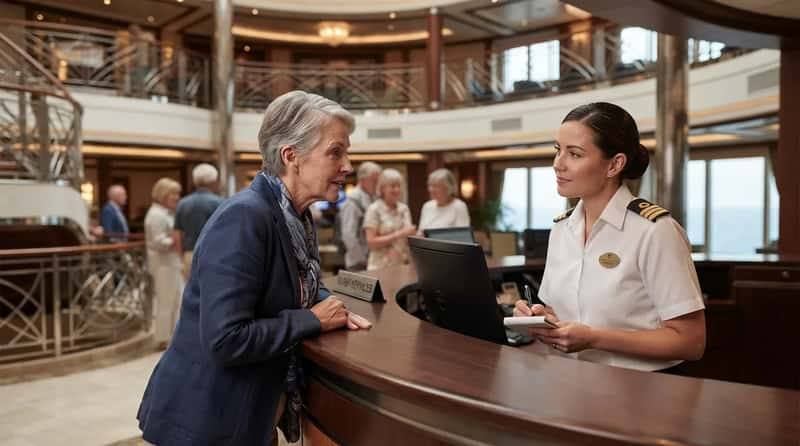
Some cabins sit above or below a dance floor or theater, and passengers in those rooms who complain often get moved. Even when the ship is “sailing full,” a few rooms are sometimes held back for exactly this kind of problem.
The key is to be early and specific. “Chairs dragging on the deck above at 6 a.m.” gives staff something to act on, while a vague complaint gets a sympathetic nod.
Report a noise problem on day one, not day five. By midweek, a full ship has far fewer open rooms to offer.
Cabins can be fixed in ways most passengers never try. The bigger financial problem may be sitting unread on your onboard account.
#13 – Free Seasickness Remedies Are Waiting Behind the Desk

When you’re queasy, room service can bring green apples and plain crackers. Many ships also keep seasickness tablets or ginger candies at the purser’s desk, often free.2
Most passengers either tough it out or pay medical center prices for something that may cost nothing.
Ask for seasickness tablets or ginger candies before you feel sick, ideally within your first hour aboard. Supplies can run low, and remedies work better when you take them early.
Some desks will send you to the medical center instead. That’s the better stop if you take other medications or the tablets don’t settle things, which matters for anyone already managing prescriptions.
Quick Compare
- Purser’s desk: Often free tablets or ginger candies, best asked for in your first hour aboard.
- Room service: Green apples and plain crackers to settle a queasy stomach.
- Medical center: The right call if you take other medications or the basics don’t help.
#12 – Your Passenger Profile Can Be Updated Onboard

Here’s a quiet power move: the desk can note preferences on your passenger profile that ripple through other departments. Dietary needs, mobility requirements, or a celebration you want acknowledged can be added or corrected, even if you missed them at booking.
Sailing for a birthday, anniversary, or honeymoon? Cruise lines do read those notes, and they may lead to small surprises.
Mention any celebration or special need at the purser’s desk on embarkation day. That note reaches departments you’ll never walk into yourself, which is a different level of service than asking your cabin steward.
The profile update costs nothing and takes two minutes. What costs money is the billing error you don’t catch until it hits your credit card at home.
#11 – Billing Errors Are Easy to Miss Until You’re Back Home

Onboard bills can hide duplicate charges, misapplied packages, spa prices that don’t match what you were quoted, and gratuities applied at the wrong rate. These errors aren’t dramatic, which is exactly why they slip by.
Sometimes a drink gets charged to the wrong cabin, especially on ships that rely on card systems that occasionally misread.
Check your onboard account every two or three days, at the desk or on the cabin TV, not just on the last night. Many lines now show the running total on stateroom TVs or mobile apps, so there’s little excuse not to peek.
It’s far easier to fix a mistake while you’re aboard. Lines at the desk are also shorter mid-cruise than on the final evening and morning.
Catching a wrong charge mid-cruise is a five-minute conversation. Catching it after you disembark pulls in your credit card company and the line’s shoreside team.
#10 – Onboard Credit You Forgot About Can Vanish at the Gangway
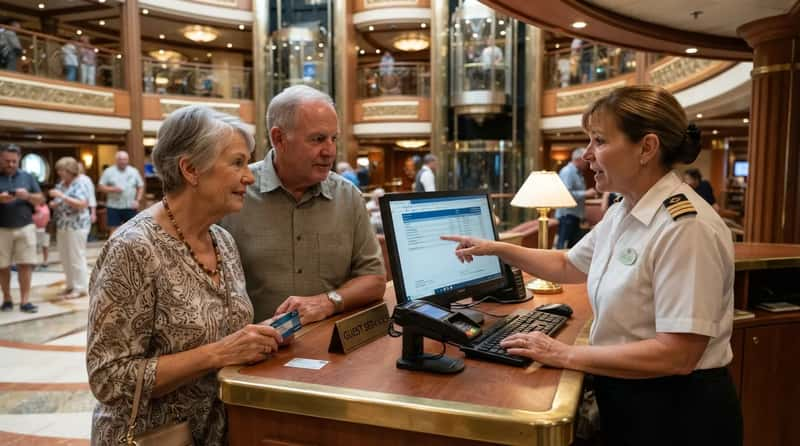
The purser’s desk can pull up your full account and show every credit applied. Unused credit that expires is money you simply hand back to the cruise line.
That credit can come from a travel agent, a credit card promotion, a loyalty tier, or a price-match request made before sailing. It’s usually added on the first day, and if you have more than one cabin, each one should show its share.
Verify your onboard credit balance on day one and again on the second-to-last evening. Use it before you disembark, because it often expires when the cruise ends.3
Fast Facts
- Credit can come from a travel agent, card promotion, loyalty tier, or price match.
- It’s usually posted on the first day of the cruise.
- Multiple cabins should each show their own share.
- Unused credit often expires when the cruise ends.3
#9 – Gratuity Charges Can Be Adjusted at the Desk
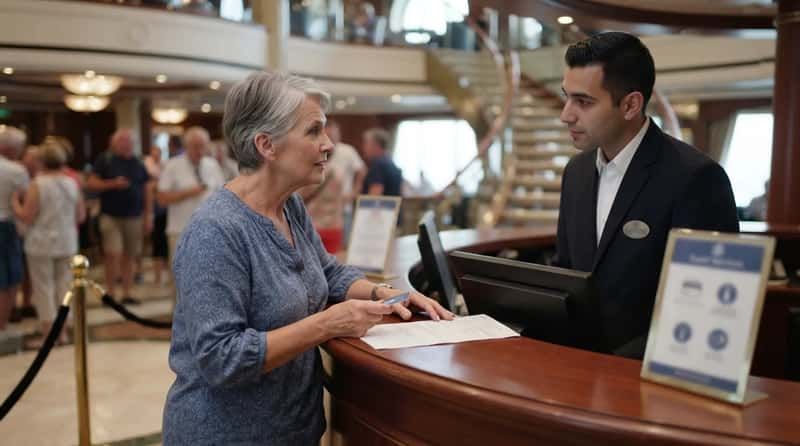
The automatic daily gratuity is real, it adds up, and many passengers don’t realize it can be adjusted. Many lines add it to your account automatically, and some add separate percentages to drinks, dining, and spa purchases.
Plenty of lines let you adjust or remove those charges at guest services.4 Pulling tips entirely after decent service isn’t fair to crew who depend on that pooled income.
But if you had a genuine service failure and raised it at the desk first, an adjustment is a reasonable outcome, not an aggressive move.
If you prepaid gratuities before boarding, check your account to confirm you weren’t also charged the daily rate. Double charges do happen, and they’re easy to fix on the spot.
The desk handles gratuity questions every sailing. What it gets asked about far less often is the next item.
#8 – Lost Items Go to the Purser First, Not to Housekeeping
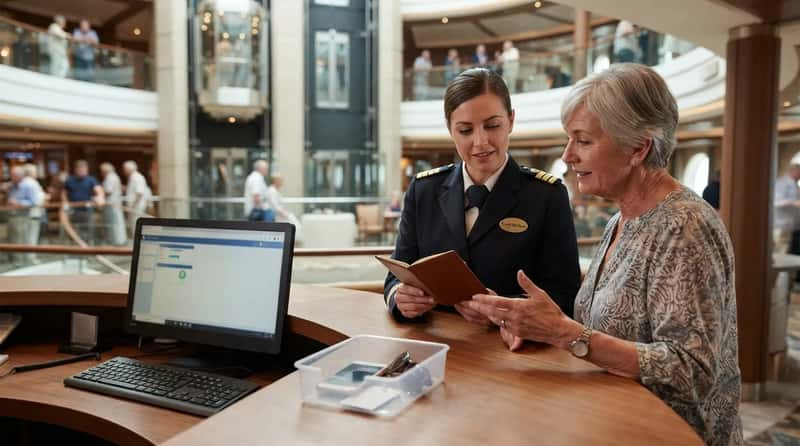
When something goes missing, such as a phone, a prescription bag, or a passport left in a shore excursion jacket, the desk is the right first stop. It connects to every department at once in a way no single crew member can.
Report any missing item to the purser’s desk before the ship reaches the next port. If a passport turns up, the desk can coordinate with the ship’s agent so it’s waiting when you reach the pier.
A report made only to your cabin steward may never travel that far.
This matters even more if the missing item is medication. The purser can track it across departments while the ship is still at sea.
#7 – Wi-Fi Problems Are Often Fixed in Two Minutes at the Desk
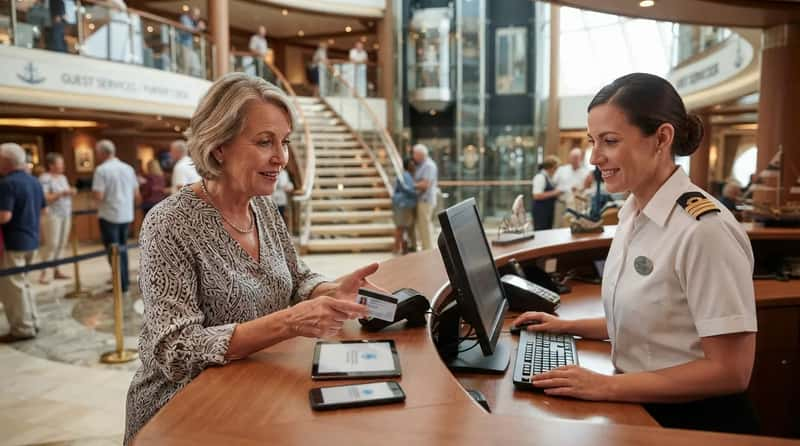
Many passengers spend half a sea day wrestling with a Wi-Fi package that won’t connect, then give up. If yours is misbehaving, the desk can often reset it on the spot.
Go to the purser’s desk before you call the ship’s Wi-Fi help number. Staff can often fix a login error or package activation faster than any technical queue.
If Wi-Fi is priced by the device, decide which single device really needs a connection and buy for that one. Cruise guides commonly suggest buying before you sail, and if your fare came with a bundle, check what it covers first.
Worth Knowing
- Login errors and package activation problems are often quick desk fixes.
- Per-device pricing rewards choosing one device that truly needs a signal.
- Check what your fare bundle already includes before paying for more.
- Buying before you sail is a common recommendation in cruise guides.
#6 – Cabin Location Advice From the Desk Beats the Booking Map

A cabin near the middle of the ship, ideally close to a central staircase or elevator, is the classic advice. If you’re prone to motion sickness, midship on a lower deck is the better choice.5
If you’re already on the wrong end of the ship, the desk can tell you what’s open and what the tradeoffs are. A deck plan can’t do that.
The cheapest balcony on the ship is usually cheap for a reason. Discounted cabins tend to sit at the far ends, which means more motion and a long walk to almost everything.
If you have any mobility concern, ask the desk about distance to the elevators, not just the deck number. A cabin at the end of a very long hallway adds real walking to every single trip out the door.
Cabin location is the hardest thing on this list to fix mid-voyage. Everything that follows is easier to change once you’re aboard.
#5 – The Desk Can Set a Spending Limit on Any Card in Your Cabin

Hand a teenager a cruise card and you’ve handed over a tab. Traveling with a grandchild or adult child? The desk can often cap what their card spends so there’s no surprise on the final bill.
On Carnival, parents can visit the desk to adjust the amount children can spend on Sail & Sign accounts.6 Other major lines offer something similar, but it’s rarely advertised, and the arcade and gift shop run on an open tab by default.
Ask the desk on embarkation day to set a spending cap on any dependent’s cabin card. It takes five minutes and prevents a conversation you don’t want to have on the last night.
#4 – Medication Concerns Start at the Desk, Not the Medical Center
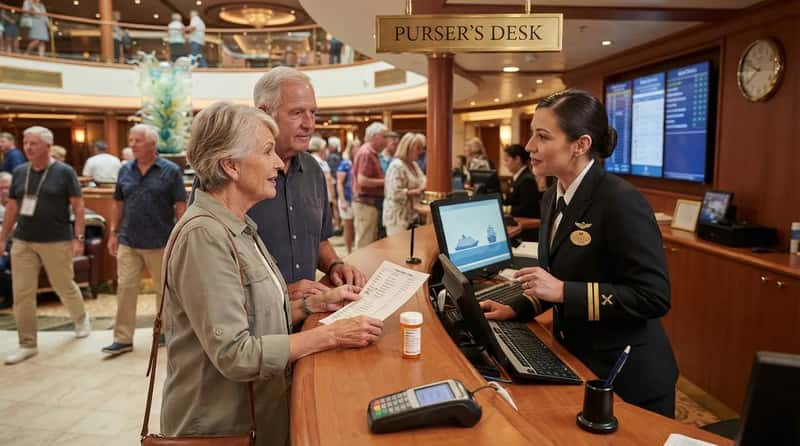
Medical center visits are usually billed to your cabin account, and the charges can climb fast. For minor issues like a mild headache, a stomach remedy, or a first-aid question, the desk is often a smarter first stop.
It can also handle the “who do I call for this?” questions that otherwise eat an afternoon. Seniors should never board without travel insurance that includes medical evacuation coverage, but the desk covers the everyday gaps.
Bring a list of your current prescriptions aboard and keep a copy at the purser’s desk. If a medication is lost or a refill question comes up at a foreign port, the desk can start the communication with port agents and local pharmacies, but only if it has the information to work with.
The desk can’t fix a medical bill after the fact. What it can do, and what almost no one uses it for, is the next item.
#3 – Document Problems Get Solved at the Desk, Not at the Pier

The purser handles passenger and crew visas and passports, and prepares paperwork for the ports and customs services along the way.1 7 That means the person behind the counter has to understand entry rules for many nations.
So the desk is the place to raise a document worry the moment you notice it, not at the port entry gate. Details vary by cruise line, but the goal is the same: catch the gap early, not when you’re staring at a foreign border officer.
If you have any question about a visa requirement for an upcoming port, ask the purser’s desk at least one day before arrival. This is paperwork the desk lives in, and the shore excursion desk doesn’t.
Document issues that surface at the gangway involve multiple parties and almost no time. The desk handles that pressure routinely, which is why it has the authority to act.
#2 – Quiet Hours and Early Visits Are When the Desk Delivers Most

The desk works a lot like a hotel front desk. The staffer fielding their tenth complaint of the day has less patience and room to maneuver than the one handling their first.
Visit the purser’s desk during mid-morning on a sea day, when lines tend to be shortest and staff have the most room to work. Better yet, stop by within your first hour onboard, before the line forms.
That first visit sets your account baseline and gives you a name at the desk. The desk runs on relationships as much as policy, and a familiar face often gets more than a stranger.
Everything on this list depends on knowing when and how to use the desk. The single most powerful move is next, and experienced passengers treat it as routine.
#1 – The Second-to-Last Evening Is Your Last Real Chance to Fix Everything
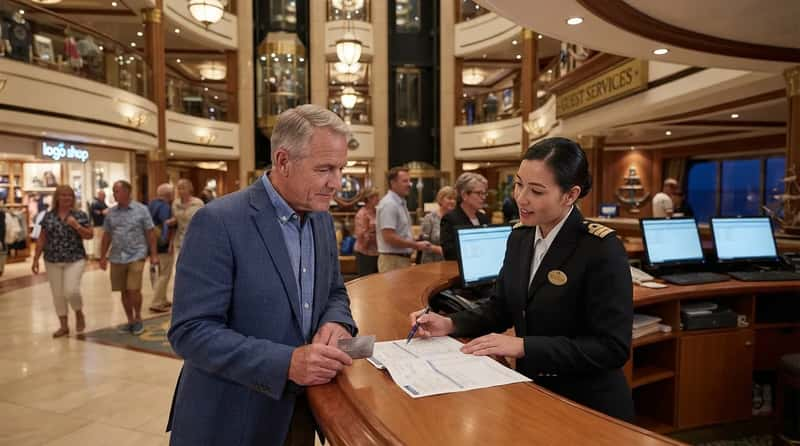
The night before the last night is the most underused window on any cruise. By the final evening, the desk is swamped.
Every billing question, unapplied credit, and gratuity mix-up that could have taken five minutes on day four turns into a long queue on disembarkation eve.
Visit the purser’s desk on the second-to-last evening to review your complete account before the final bill is locked. Once you’re home, everything lands on your credit card, and refunds take more steps.
On land, the shoreside team has to coordinate with the ship just to confirm what you’re telling them.
Before you hand back your cruise card, photograph or download the final itemized statement. That one photo is often the difference in a post-cruise dispute.
At a Glance
- Review your full account before the final bill is locked.
- Confirm every credit has been applied and used.
- Check gratuities for double charges or wrong rates.
- Photograph or download the final itemized statement.
The passengers the desk staff remember, the ones who get the quiet upgrades, waived fees, and corrected bills, are rarely the loudest. They’re the ones who showed up early, asked clearly, and stayed polite.
The brochure sells the destination, but the purser’s desk quietly decides how smoothly the trip goes. It connects every department, holds your money, and can change course, and most guests never ask it for anything.
What’s one thing you wish you’d known to ask at the purser’s desk before the ship left port?
- Documentation Purser Duties: https://www.allcruisejobs.com/i60074/documentation-purser-onboard-cruise-ship/
- Cruise Seasickness Prevention Tips: https://cruiseline.com/advice/before-you-cruise/what-to-know/how-to-avoid-getting-seasick
- Onboard Credit Expiration Guide: https://www.cruisebooking.com/articles/first-time-cruisers/how-to-use-onboard-cruise-credit-like-a-pro
- Cruise Gratuities Explained: https://cruiseclarify.com/cruise-gratuities-explained
- Midship Cabin Motion Guide: https://cruisekick.com/guides/should-i-cruise-if-i-get-motion-sickness/
- Carnival Sail & Sign Account: https://help.carnival.com/app/answers/detail/a_id/1138/kw/sail%20and%20sign
- Purser Duties Overview: https://en.wikipedia.org/wiki/Purser