


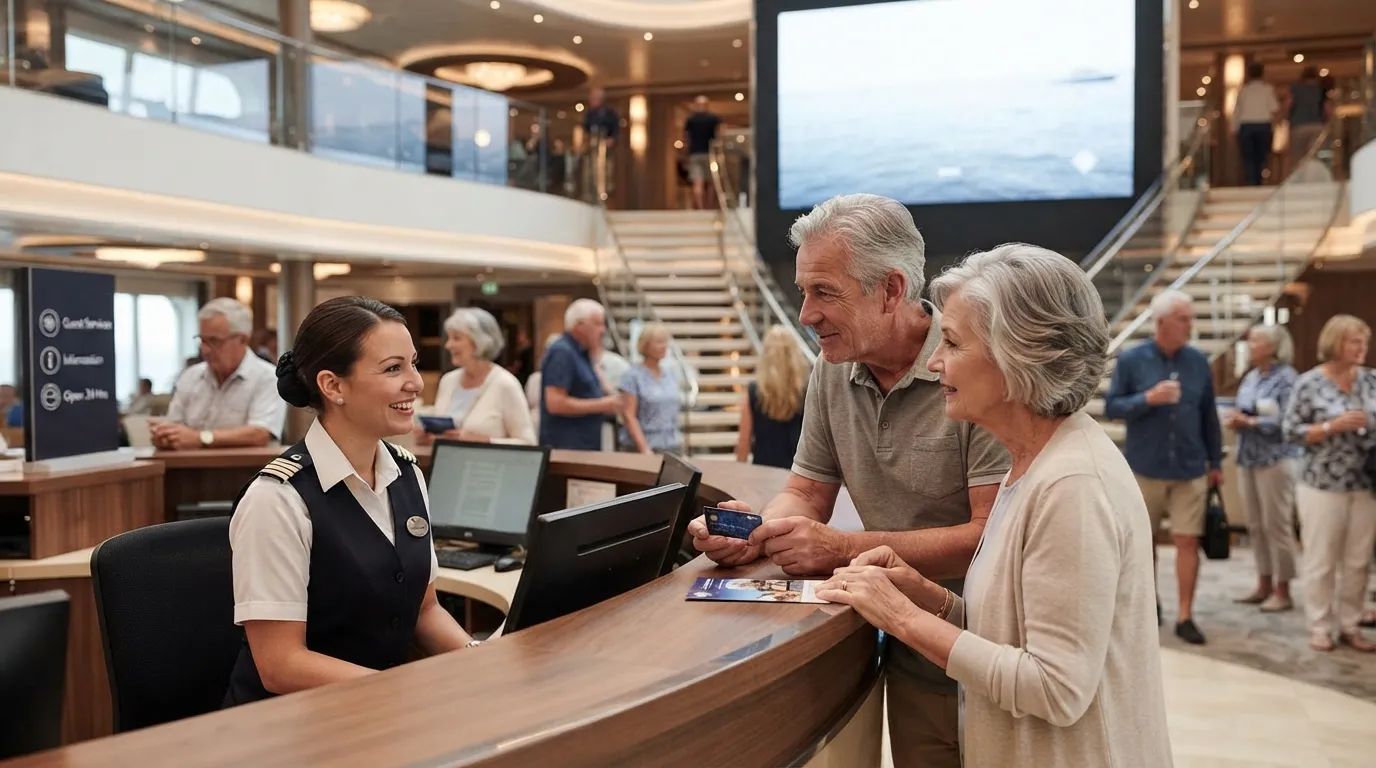
It sounds almost too easy: turn 60, walk up to the desk, ask politely, and the fees melt off your bill. The truth is stranger, because only one of these fifteen charges is actually handled at that desk.
This list sorts all fifteen by how much room you have to negotiate, and it covers the age-based fares older cruisers can claim. Carnival alone adds a “recommended” daily gratuity of roughly $17 to $19 per person, which is $119 per person over seven nights before anyone has ordered a drink. The bill starts before you board, in the port parking lot.
#15 – A Week of Parking at the Port

If you drive to the ship, the port or its parking operator charges for the car by the day. CruiseKit’s fee guide puts port parking at $15 to $25 a day, depending on the port, so a week runs roughly $105 to $175.
The cruise line does not set that rate, so no senior fare and no request at the ship’s desk will reduce it. Price a ride to the terminal against a week of parking before you book, because a neighbor or a car service can come out cheaper than you expect.
Fast Facts
- Typical port parking: $15 to $25 per day
- A seven-night cruise: roughly $105 to $175 for the car
- Who sets the rate: the port or its parking operator, not the cruise line
- Senior fares and desk requests: no effect
Parking is not the only cost at the terminal, because the curb has its own custom.
#14 – The Porter at the Terminal Curb

Terminal porters carry your bags from the curb to the ship’s check-in. Tips run about $2 to $3 per bag, and nobody will chase you for it.
That is a tip rather than a fee, so nobody can waive it. I would call it some of the best-value money in this piece if lifting a suitcase is a strain for you, and an easy skip if you travel light. Either way, keep a few small bills in your pocket before you leave the car.
Small bills are also useful on shore, where cash comes with fees of its own.
#13 – Cash Machines in Port
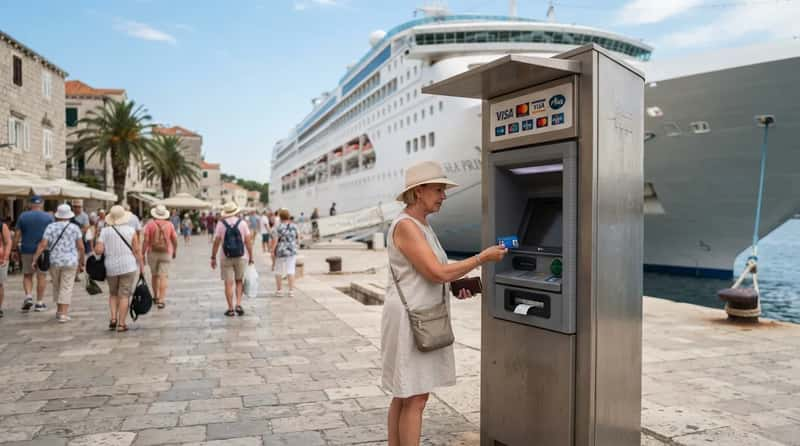
ATMs at cruise ports charge a fee per transaction, and your own bank may add another fee plus a foreign transaction percentage. Because the fees hit each withdrawal, three small withdrawals cost more than one larger one.
On the ship you can charge purchases to your cruise card, so cash is only for the dock. Before you leave home, ask your bank what it charges abroad and use a card with no foreign transaction fee if you have one.
Back aboard, the ship’s own entertainment can carry price tags too.
#12 – Paid Extras in the Activity Schedule

Many ships now charge for things that used to be free. Escape rooms, virtual reality games and specialty fitness classes often carry added fees, and some ships sell a separate pass for adults-only retreat areas.
Check the price printed in the daily schedule before you sign up, since the free program on a large ship is already full. I would pay for one of these only if you would have picked it anyway. The charge lands on your cruise card, and you will see it again on the final statement.
A different kind of surcharge has turned up in the dining room.
#11 – The Extra Entrée in the Main Dining Room

The main dining room has long been included in the fare. Norwegian Cruise Line was reported to be introducing a $5 fee for entrées beyond a set number in the main dining room on 2026 sailings.
Reports differ on whether the count starts after the first entrée or after the first two, so check the current rule for your sailing. If you like to taste a few dishes, this is where it adds up, and one entrée plus one appetizer is the easy way around it.
The same automatic add-on shows up in places that have nothing to do with food.
#10 – Spa, Salon and Room Service Add-Ons

On most lines, an 18 to 20 percent gratuity is added automatically to every spa and salon transaction.1 A $100 treatment therefore costs about $118 to $120 before you leave the chair, and you do not need to tip in cash unless the service was exceptional.
Room service varies by line. Royal Caribbean, for one, adds an 18% gratuity to room service orders,2 while on other lines a delivery tip is up to you. Read the menu card in your cabin before you order breakfast.
Some charges cannot be touched at all, and the next one is the largest of them.
#9 – Port Fees and Government Taxes

These charges are tied to the places the ship visits, and they are set by the ports and governments, not by the cruise line. Estimates for 2026 put them at roughly $150 to $400 per passenger, depending on itinerary and region.
Nothing at Guest Services or in a senior fare changes them. Compare cruises by total price, not by headline fare, because a lower fare with higher port charges can cost the same.
Staying in touch from the ship is a charge you can control better than you might think.
#8 – Wi-Fi Priced by the Device

Basic Wi-Fi packages average $15 to $25 per device per day, and plans that allow streaming or video calls can exceed $35. Because the price is per device, a phone and a tablet cost twice what one phone does.
Decide which single device really needs a connection and buy for that one. Cruise guides commonly advise buying before you sail rather than at the ship’s kiosk, and if your fare came with a bundle, check what it covers first. Norwegian’s Free at Sea promotion includes Wi-Fi along with a drink package and specialty dining.
Worth Knowing
- Basic plans: about $15 to $25 per device per day
- Streaming or video-call plans: can top $35 per day
- Two devices: roughly double the cost of one
- Bundled fares: check whether Wi-Fi is already included before you buy
Drinks and dinners bring another percentage with them.
#7 – The 18 Percent on Drinks and Specialty Dinners

The main dining room and the buffet are included in the fare, but specialty restaurants such as steakhouses and sushi bars typically charge $25 to $60 per person. On Royal Caribbean, an 18% gratuity is added automatically to beverages, beverage packages, specialty dining and minibar purchases.1 2
Specialty packages bundle several dinners at a fixed price, and they can offer real savings if you plan to dine outside the main room more than once or twice. For a single anniversary dinner, pay as you go. Removing your daily gratuity does not necessarily remove the charges added to drinks, spa services and specialty restaurants.
Everything so far is priced per person, which works out differently when only one person is in the cabin.
#6 – The Single Supplement for Solo Travelers

A single supplement is the extra charge a line adds when one guest takes a cabin built for two. It is officially 100 percent extra on most lines, though in practice sailings that are not filling run 25 to 50 percent, and studio cabins eliminate it.
It is set when you book, so the desk on board is too late to change it. If you travel alone, look for dedicated solo cabins: Norwegian offers studio cabins with no single supplement, and Cunard sells fixed-price single staterooms on Queen Mary 2, Queen Victoria and Queen Elizabeth, though not on Queen Anne. River lines run waivers on select departures too.
Age-based pricing is the other place older travelers can save, and the cutoffs differ from line to line.
#5 – MSC’s 65 and Over Rule
Not every senior rate begins at 55. MSC’s Senior Club discount requires everyone sharing the stateroom to be 65 or older, so a 66-year-old traveling with a 62-year-old spouse would not qualify.3
Celebrity runs on a different rule. It offers savings for guests 55 and over on select sailings, and one booking guide says the discount usually applies to the first two guests in a cabin, so a third traveler would pay the regular fare.4 In each case, check the terms on your own sailing before you assume.
Age is only one way to qualify, and the others have nothing to do with birthdays.
#4 – AARP, Military and Past-Passenger Discounts

Some cruise lines offer additional discounts to AARP members, military veterans and past passengers of the line. With some lines these can stack on top of the senior rate, but not everywhere, because age-based rates usually cannot be combined with other promotions.
Ask your agent which combination produces the lowest total. Holland America’s AARP benefits are a 50-plus perk, not a senior fare, so they work differently from the age-based fares on other lines. If you qualify for several, price each one separately before choosing.
The age-based fare itself sits behind a filter that is easy to miss.
#3 – The 55 and Over Fare on Royal Caribbean and Carnival

This is the age-based saving that most readers over 60 can actually claim. Royal Caribbean offers reduced fares for guests 55 and over on selected sailings, and at least one guest in the cabin must qualify,5 while Carnival shows 55+ fares under its Deals filter. Neither is applied at the ship’s desk, since the saving comes when you book.
Quick Compare
- Royal Caribbean: 55+, selected sailings, one qualifying guest in the cabin5
- Carnival: 55+ fares found under the Deals filter
- Celebrity: 55+, select sailings, usually the first two guests
- MSC: 65+, and everyone sharing the stateroom must qualify3
Cruise lines typically discount 5 to 15 percent for passengers 55 and older, and you must show proof of age at check-in. On a $2,000 fare, that range is $100 to $300, but compare it with the public sale price, because a general promotion sometimes beats it.
The fare is only the starting number, and the gratuity that rides along with it depends on when you pay it.
#2 – Prepaid Gratuities and the Norwegian Exception

Prepaying locks in today’s rate ahead of an increase, though prepaid gratuities are usually non-refundable once you have sailed. Rates do rise: Carnival raised its daily gratuity to $17 per person for staterooms and $19 for suites starting April 2, 2026,6 and Celebrity moved to $19.50 in July 2026.
Paying onboard keeps your options open, because you can adjust the charge at Guest Services. Norwegian is the exception, since you cannot remove the charge onboard and refunds require a written request after the cruise. If you are certain you will leave the charge alone, prepay; if you might not, wait.
Where the line does allow changes, the desk on the ship is where the work gets done.
#1 – The Daily Gratuity at the Guest Services Desk

This is the one charge that really is handled at the desk. On most mainstream lines, passengers can adjust or remove automatic gratuities by visiting Guest Services before the end of the voyage.1
Gratuities typically run between $16 and $20 per guest per day, depending on cabin type. For a couple on a week’s sailing at $17 each, that is $238.
Expect some friction and often a detailed explanation of how the money is distributed. The pool is shared, as the total of all passengers’ gratuities is divided among crew members such as cabin stewards, dining staff and the guest services team, so removing it takes money from the crew, not from the cruise line.1
My view is that the desk works best for a service problem, since raising it while you are still sailing gives the staff a chance to put it right. If the problem is only the size of the charge, nothing in the sources I found suggests that being over 60 changes the answer.
Where the Savings Get Decided

The charges that bend are the ones you raise early. Parking, port taxes and the 18 percent on drinks never respond to a request, while the fare, the supplement and the gratuity do, but only on the line’s schedule and usually before you board.
At a Glance
- Fixed: port parking, port fees and government taxes, automatic 18 to 20 percent on spa, drinks and specialty dining
- Bends at booking: 55+ or 65+ fares, solo cabins and single supplement waivers
- Bends onboard: the daily gratuity on most mainstream lines, though not on Norwegian
- Best timing: the weeks before sailing, with your cabin terms in hand
That makes the weeks before sailing the best time to spend an afternoon on the phone with your agent, with the cabin terms in front of you. Once you are aboard, the desk can change one charge, and you would do better to save it for a real problem.
Which charge on your last cruise bill surprised you most, and did you catch it before sailing or only when you got home?
Sources

- Forbes: Cruise Gratuities And Tipping At Sea Explained
- CruiseClarify: Cruise gratuities explained
- CruiseClarify: Hidden cruise costs, the 7 charges beyond the fare
- Senior Traveling Guide: Best Cruises for Seniors 2026
- Everything Seniors: Cruise deals and discounts for older adults
- Get Me On A Cruise: Can you refuse cruise gratuities
- CruiseKit: Hidden cruise costs
- Mundy Cruising: No single supplement cruises
- BookCruises: Solo cruise deals 2026
#16 – The Bonus Tip Nobody Shares

The most valuable move is not at the desk at all. It is a price check between booking and final payment, and most cruisers never make it.
- Find your deadline: Look in your booking confirmation for the final payment date. Until then, many lines will let you reprice a booking if the fare drops, though the rules differ by line.
- Check weekly: Look up the same sailing and the same cabin category, once with the 55+ filter and once without. Write down both totals, taxes and fees included.
- Call before the deadline: If a lower total appears, ask your agent or the line to reprice your booking or add onboard credit. Ask what the terms are before you agree to anything.
- Get it in writing: Make sure your updated confirmation shows the senior fare, then carry your photo ID to check-in.
After final payment, most of these options close, so the weeks before the deadline are where the real savings sit.
- Royal Caribbean Gratuity Policy: https://www.royalcaribbean.com/faq/questions/onboard-service-gratuity-expense
- Yahoo Royal Caribbean Gratuity Update: https://travel.yahoo.com/cruises/articles/royal-caribbean-updated-gratuity-policy-145637807.html
- MSC Senior Discount Terms: https://www.msccruisesusa.com/deals/cruises-for-seniors
- Celebrity Senior Pricing Guide: https://travelbinger.com/13-cruise-line-fees-waived-for-passengers-over-60-who-know-to-mention-it
- Royal Caribbean Special Pricing: https://www.royalcaribbean.com/faq/questions/qualifications-special-pricing
- Cruise Critic Carnival Gratuities: https://www.cruisecritic.com/news/carnival-increases-gratuities-drink-package-rates
