
Nearly half of people older than 75 have difficulty hearing, yet on the first night of a cruise many say nothing and simply nod along.1 Waiters spot it before the bread basket lands, and it’s only one of 13 small tells that never appear on the menu.
Some of these details come from hard data. Others come from staff accounts, and a few may change how you walk into the dining room on night one.
#13 – They Notice Who Walks In Early
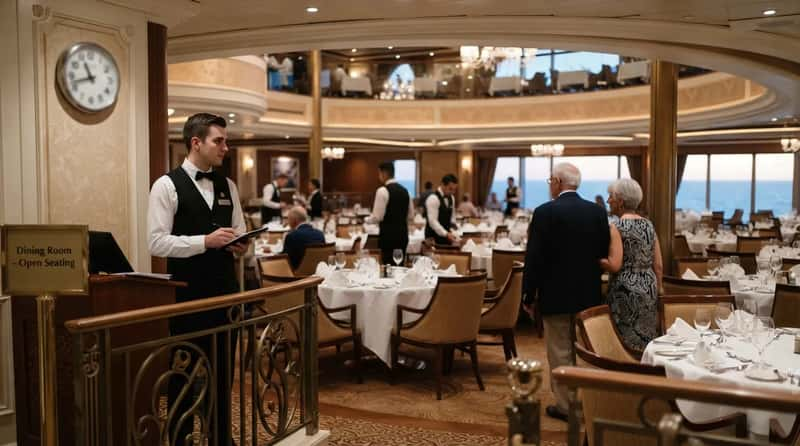
The first thing a waiter sees isn’t the passenger. It’s the clock.
Traditionally, cruise dining rooms run two dinner services, early and late, and passengers are assigned one set time for the whole cruise. A newer trend lets diners eat whenever they want.
Staff accounts compiled by travel sites say many passengers over 60 favor the earlier hour, when the room is full and the kitchen is fresh. That’s an observation, not a rule, and plenty of older guests book late seating.
Here’s the controversial part. Some travelers insist open dining is the better system, while others argue that a fixed time and a fixed table is the quiet advantage, because one waiter learns your habits.
Quick Compare
- Traditional model: early or late seating, one set time and table all cruise
- Newer model: arrive whenever you like
- Fixed-table edge: one waiter learns your habits
- Open-dining edge: no clock to watch
But the next detail has nothing to do with time. It’s about where you end up sitting, and most passengers never think to ask, as we’ll see in #12.
#12 – They Notice Who Asks for a Table (and Who Takes Whatever’s Left)
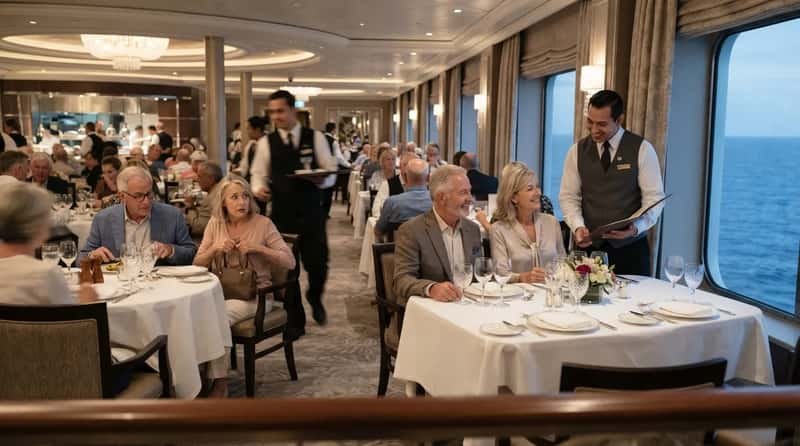
Most passengers get the table that’s left over, and waiters can tell who knew to ask.
Most passengers never request a specific spot, so they get whatever remains once the ship fills up. A quiet word with the maître d’ on embarkation day can land a table away from the kitchen doors, the show lounge traffic, or the loudest section.
The maître d’ controls table assignments in the main dining room and can designate a preferred spot for the whole voyage. That means the “random” table you got on night one may not have been random at all.
Waiters see the difference at once. Guests who arrive with a plan sit down relaxed, while guests who didn’t are often still adjusting to the noise.
And why would a quiet table matter so much? The answer is in how people lean over their plates, which brings us to #11.
#11 – They Notice the Head Tilt
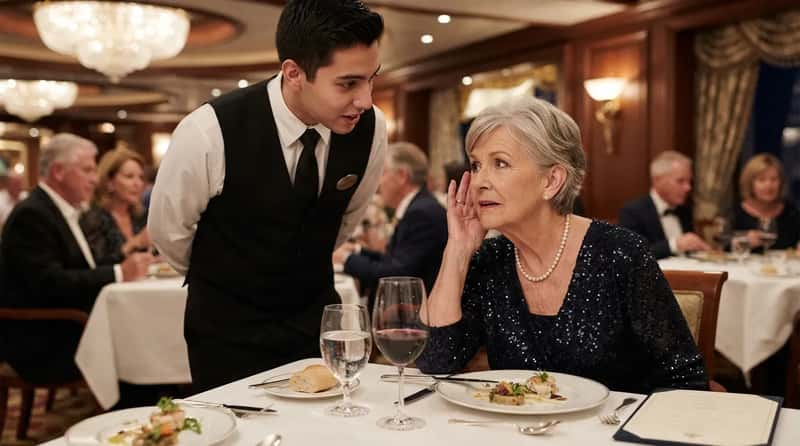
A waiter can’t see a hearing test, but they can see the lean.
About one in three people between 65 and 74 has hearing loss, and nearly half of those older than 75 have difficulty hearing. It typically affects both ears as we age.1 2
At a table, that can look like a tilted head, a polite “sorry?” or an order repeated twice. Staff who work the room night after night tend to adjust without comment, slowing down and facing the guest before reciting the specials.
Most diners miss this. The guest rarely mentions it, and the waiter rarely points it out.
But the problem isn’t only the ears. It’s the room itself, and that’s #10.
#10 – They Notice What the Room Does to Conversation
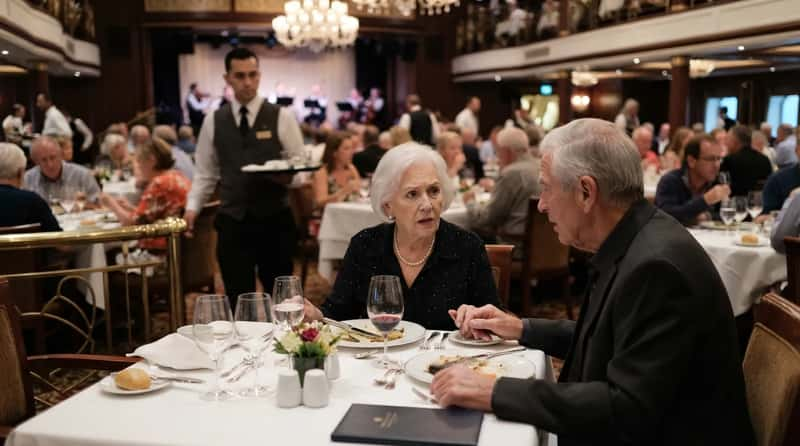
The dining room is loud, and not everyone is losing the same amount of conversation.
NIDCD-funded scientists are still working to understand what happens as we age that interferes with our ability to hear speech in a noisy environment.2 So the struggle isn’t imagined, and the science isn’t fully settled either.
The dining room is one of the few places on a ship where people actually talk to each other, and the clatter of plates, music and neighboring tables all compete. Waiters watch it happen at table after table.
Worth Knowing
- The competition: plates, music and neighboring tables all at once
- Where it shows: couples going quiet midway through the entrée
- The waiter’s move: slowing down and facing the guest
Researchers are still unraveling why a busy room makes speech harder to follow with age. Staff don’t need the research to see the effect.
Here’s an opinion some will resist. Cruise lines spend heavily on entertainment, yet a calm dining room may be the amenity that older guests value most.
Some guests solve the noise problem with a device, and waiters notice that too. The surprising part is how few use one, in #9.
#9 – They Notice Who Isn’t Wearing Their Hearing Aids

The quietest guest at the table may be the one who can’t follow the conversation.
Hearing loss is among the most common chronic conditions in older adults in the United States, and its impact is often underestimated. It is associated with poorer cognitive functioning, social isolation, and poorer physical functioning.
Despite that, fewer than 20% of adults with hearing loss use hearing aids, according to an NHANES-based figure cited in a clinical protocol. Waiters can’t diagnose anything, but they notice the guest who nods at every question and answers a different one.
A calm greeting and a clear, steady voice cost nothing. Crew who learn to do this early tend to earn a warmer table all week.
Hearing is only one sense that shifts with age. Another one shows up the moment the bread basket arrives, in #8.
#8 – They Notice the Reach for the Salt Shaker
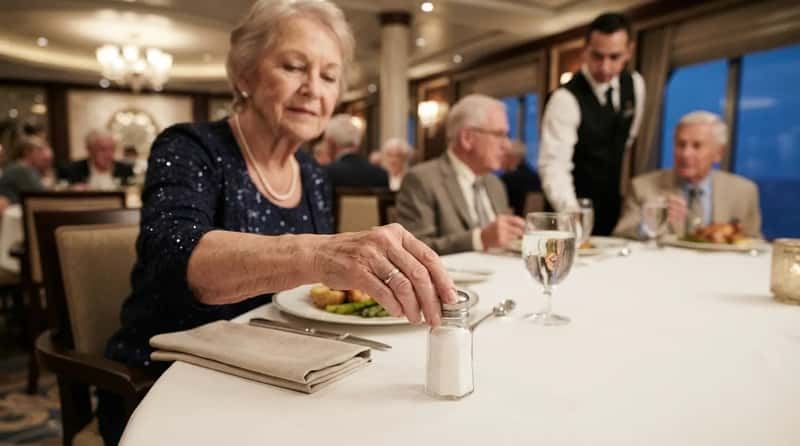
The salt shaker gets picked up before the first bite, and there’s a reason.
The number and sensitivity of taste buds decrease with age, and the decline appears greatest for salt sensitivity. Aging appears to affect smell more than taste.
To compensate for a reduced perception of saltiness, older adults often increase their salt intake.3 The NIA notes that loss of smell may lead people to eat too much sugar or salt, which can be a problem with diabetes or high blood pressure.
So the guest who salts before tasting may not be careless. Their food may genuinely taste milder to them. Waiters see it happen automatically, night after night.
That raises an obvious question. What happens when a guest can’t have salt at all? That’s the request in #7.
#7 – They Notice the “Low-Sodium” Request
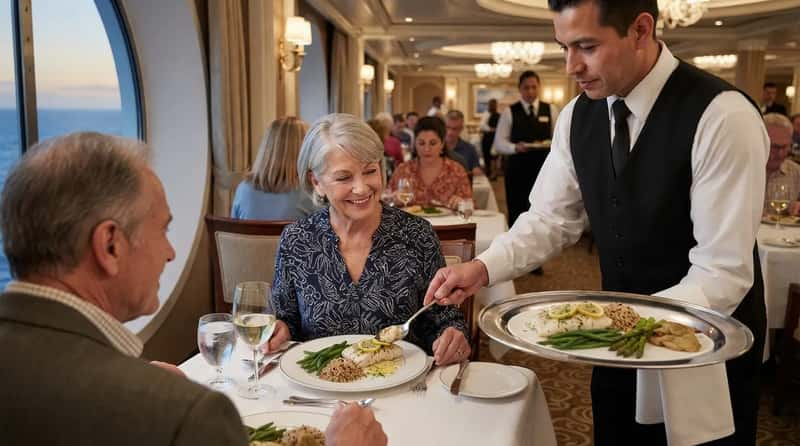
One sentence on night one can change every dinner that follows.
Low-sodium and no-sodium meals are available in the main dining room for lunch or dinner.4 Many passengers assume such plans stop at the dining room door, and they don’t.
According to one staff account, on a well-run ship, saying “low-sodium” or “diabetic-friendly” once should follow a passenger all cruise, provided the guest is clear and consistent each time. That’s a sourced account, not a guarantee, and results will vary by line and ship.
Some travelers insist dietary requests get lost at sea. The staff view is that the system works best when the guest names the need clearly at the first dinner.
Fast Facts
- Where: low-sodium and no-sodium meals are offered in the main dining room
- When: available at lunch or dinner
- Your part: say it plainly on night one
- If it goes wrong: repeat it kindly when the dish arrives
But what if the stakes are higher than a bland plate? That’s #6.
#6 – They Notice Who Mentions an Allergy Right Away
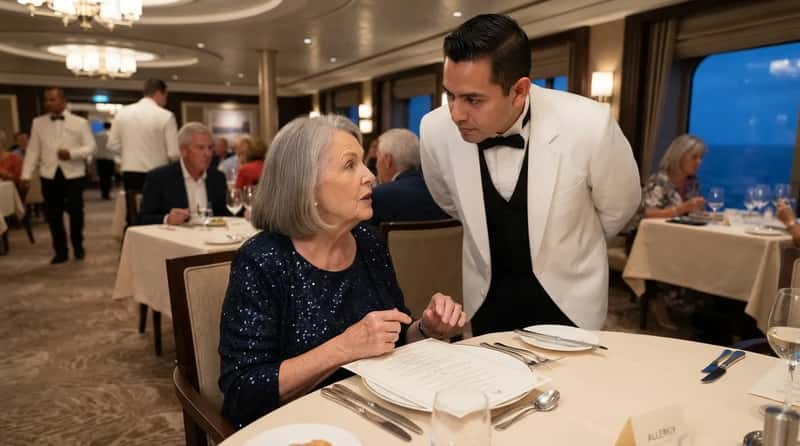
The guests who speak up early get the safest dinners.
For severe allergies, the head waiter can coordinate with the kitchen to prepare meals in a separate area with dedicated equipment.5 Most passengers never think to ask directly.
The main dining room kitchen is stocked with more ingredients than the printed menu shows, and galleys are built for volume and variety. Most reasonable modifications are well within a ship’s range.
Waiters notice who volunteers the information up front. Those guests often end up with a waiter who checks the dish before it leaves the kitchen.
Yet there’s one worry waiters pick up on that has nothing to do with food. It has to do with germs, in #5.
#5 – They Notice Who Heads for the Sink
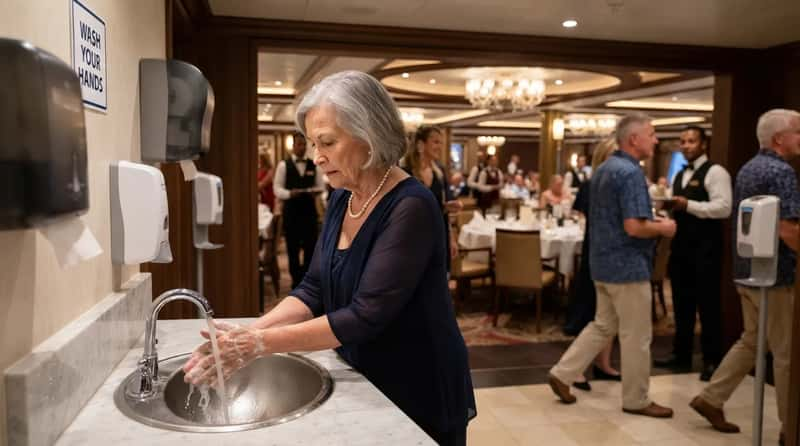
Waiters know which guests worry about getting sick at sea.
Norovirus can be dangerous for people with underlying health conditions, young children and those aged 65 and older. In a typical year it leads to about 900 U.S. deaths, mostly among adults aged 65 and older.
The fear is real, but so is the context. The CDC says norovirus outbreaks on cruise ships account for only about 1% of all reported norovirus outbreaks.
Here’s the part that surprises people. Ships put hand sanitizer at every dining room door, but the CDC points out that it doesn’t work well against norovirus.6
Soap and water, not sanitizer, is the CDC’s main advice.6
Once the health questions are settled, another habit stands out. It’s how older guests treat the menu, in #4.
#4 – They Notice Who Asks, “What’s Good Tonight?”
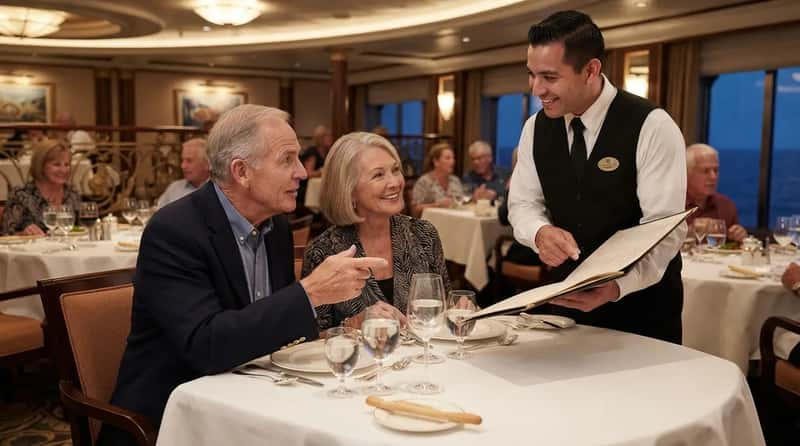
Younger guests scroll the app. Many older guests simply ask the waiter.
Staff accounts say younger diners often research the menu on the cruise line’s app first, while older guests are more likely to ask “What’s good tonight?” A server has watched hundreds of passengers react to every dish on the rotating menu.
That makes the answer worth taking. A waiter’s recommendation comes from watching which plates come back empty.
There’s another detail most first-timers miss. You can order multiple starters and entrées in a cruise ship dining room, and there’s no fee for extra dishes.
But how people dress for that menu tells waiters even more. That’s #3.
#3 – They Notice What Everyone Wore to the Table
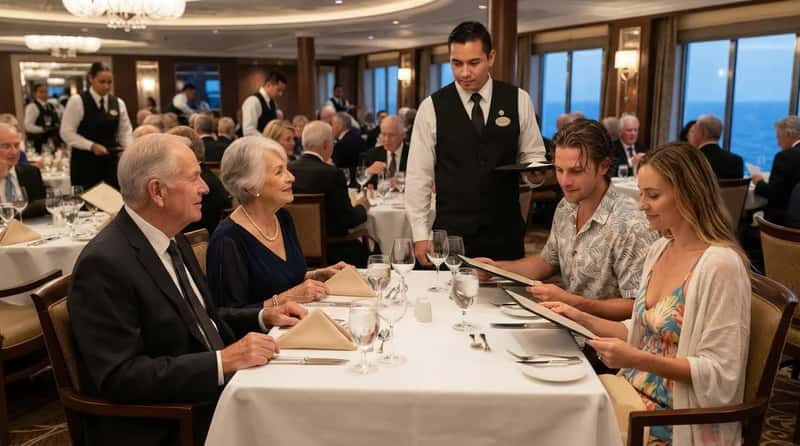
Before anyone orders, the outfit has already told the waiter something.
On ships that keep a classic dining room or formal night tradition, older passengers are often more likely to dress the part. That’s a staff observation, not a universal rule.
Waiters see the other end of the spectrum too. Flip-flops, wet hair and swim cover-ups sometimes show up at tables set with cloth napkins.
Here’s the opinion that splits the dining room. Some call dress codes a relic, and others argue the effort itself is part of what makes a cruise dinner feel like an event.
Both camps agree on one thing: waiters notice either way. And the same guests who dress up often show another trait that staff value more than any outfit, which is patience, in #2.
#2 – They Notice Who Stays Patient on Embarkation Night
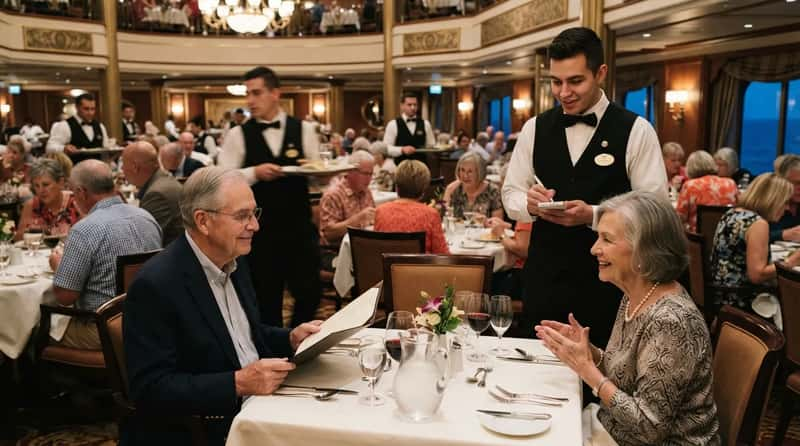
The first dinner is often the messiest meal of the week, and waiters remember who forgave it.
Embarkation night can be chaotic, and some guests write off the whole dining room after one disorganized first dinner. Staff see that as a mistake, because the room usually settles.
Crew life adds context. One former cruise waiter described having just six hours between finishing a shift and being back in the dining room.
Staff accounts say dining crew notice quiet, patient requests and respond when passengers treat them like people rather than service equipment. A calm “no rush” on night one can shape how the rest of the week’s dinners feel.
Patience is only the opening act, though. What happens at the end of the week is the last thing waiters notice, and the most revealing, in #1.
#1 – They Notice Who Treats Dinner Like a Relationship
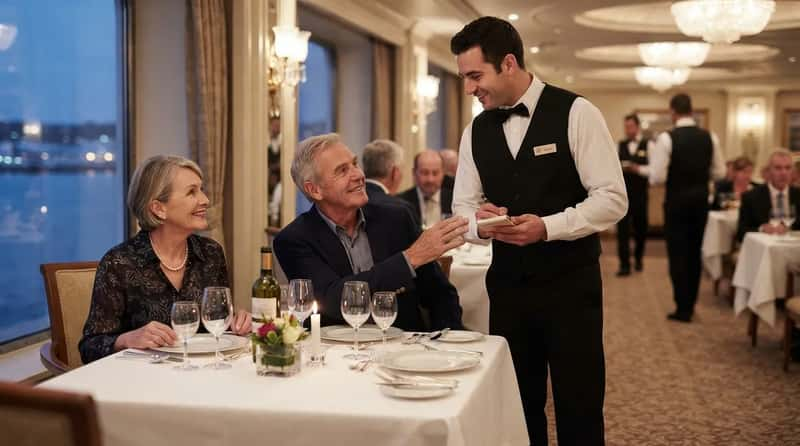
The detail waiters talk about most isn’t what guests order. It’s who they become by the last night.
A first-name greeting on night one is something most passengers never bother to give. Diners who greet the maître d’ by name tend to get checked on nightly without prompting.
Staff say the anniversaries older guests celebrate are the kind that stop a dining room in its tracks. It’s not unusual for a longtime waiter to get a hug from a passenger they served once, five cruises and two ships ago.
Even though gratuities are usually built into the fare, many guests still hand their waiter and assistant waiter a white envelope of cash on the final evening. Staff say this generation tends to treat the dining room as a relationship rather than a transaction.
Waiters don’t need a chart to read a table, but some of what they see lines up with hard data.
At a Glance
- Backed by data: nearly half of people older than 75 have difficulty hearing
- Backed by data: salt sensitivity declines most with age, and norovirus deaths fall mostly on adults 65 and older
- Staff impressions: early seating, formal dress and the final-night envelope
- The common thread: speaking up early and staying patient
Across both, the pattern holds: the guests who speak up early, ask for what they need and stay patient tend to get the best dinners.
Which of these have you noticed at your own table, or caught yourself doing?
- Hearing Loss Association Overview: https://www.hearingloss.org/managing-hearing-loss/types-causes-and-treatments/age-related-hearing-loss/
- NIDCD Age-Related Hearing Loss: https://www.nidcd.nih.gov/health/age-related-hearing-loss
- Salty Taste Perception Study: https://www.ncbi.nlm.nih.gov/pmc/articles/PMC9082481/
- Royal Caribbean Dietary Options: https://www.royalcaribbean.com/faq/questions/dining-dietary-restrictions-customer-care
- Royal Caribbean Allergy Handling: https://www.royalcaribbeanblog.com/boards/index.php?/topic/46358-special_needs-rccl-dining/
- Norovirus Handwashing Guidance: https://qz.com/norovirus-cruise-ships-spreads-easily