You booked a room at one price, and the bill at checkout says something else. Between parking, a nightly fee and a hold on your bank account, a dozen small lines can sit behind that rate.
Here are 15 of them, and a surprising number can be reduced, waived or avoided if you ask at the right moment. Turning 65 does not erase any of them automatically, but a few well-timed questions remove a good many.
One line looks tiny on a single night yet is tied to the largest total on this list, and it comes last. First, the charge that starts before you even reach the lobby.
#15 – The Early Check-In Fee on Arrival Day

Some hotels charge for checking in early or checking out late, and the amount varies widely from one property to the next. Because this is hotel policy and not a legal requirement, the front desk has room to bend it.
The easiest time to deal with it is when you book, not at the counter at noon. Hotels may waive the fee if a room is ready or if you belong to the chain’s loyalty program, and you can ask about both by phone.
If you are arriving after a long drive or an overnight flight, say so in one plain sentence, because a stated reason gives the clerk something to approve. If the answer is still a fee, many hotels will hold your bags at the desk for free, which lets you spend the morning elsewhere.
Arriving early settles one end of the stay and leaves the other, where staying past the posted hour carries its own price.
#14 – The Late Checkout Fee Before Your Flight Home

Checkout time is posted in the room and on your confirmation, and a stay that runs past it can draw a charge. It is the second half of the same policy that governs early arrival.
Ask when you check in, not on the morning you leave, because the hours before the checkout rush are when a desk clerk has time to listen. Loyalty members and guests who booked direct may find the hotel more willing to extend the hour as a courtesy, so give your membership number when you ask.
If your flight leaves in the evening, the hotel’s bag storage often costs nothing and gets you out of the room on time. Pay for late checkout only if you need to lie down or shower before a long trip, because otherwise you are buying a few hours in a room you do not need.
#13 – The Airport Shuttle That Is No Longer Free

Before you assume the ride from the airport is free, ask, because some hotels have started charging for a shuttle that used to be complimentary.
A hotel listing that says a shuttle is available does not tell you whether it costs anything. The question belongs in the same phone call as the early check-in question.
Worth Knowing
- Ask whether the shuttle is free or priced per person
- Ask where the pickup spot is at the airport
- Ask whether you need to reserve a seat ahead of time
- Ask whether the driver helps with luggage
Ask how often the shuttle runs and until what hour, since a flight that lands late may arrive after the last pickup. At that point a taxi or ride-share becomes the real cost of the trip, and you are better off knowing that before you board.
A shuttle fee at least appears as its own line, while a housekeeping gratuity fee is easy to miss when you are leaving cash on the pillow.
#12 – The Housekeeping Gratuity Charged Before You Tip
Before you leave a tip for the housekeeper, make sure the hotel is not already charging a housekeeping gratuity fee. Otherwise you may pay twice for the same service.
A charge like this goes on the room bill as a line of its own, so you can confirm it from the rate breakdown in your confirmation email or at the desk. Whether the money reaches the person who cleans your room is a fair question for the front desk.
If the desk confirms the fee goes to housekeeping staff, a second tip in cash is a courtesy and not an obligation. If nobody can say where it goes, cash left for the housekeeper reaches them directly, and the fee deserves a question at checkout.
#11 – The Groundskeeping Surcharge at a Large Resort

At resorts with lawns, gardens or golf courses, the cost of the grounds can show up on your bill as a groundskeeping surcharge. It is easy to miss because it sounds like part of the property and not a charge to you.
Since May 12, 2025, sellers of short-term lodging have had to show the total price, including mandatory fees, more prominently than any other price.1 A surcharge that every guest pays would fit that description, so it belongs in the number you see before you book.
Compare the total on the booking screen with the fee list on the hotel’s own site before you pay. If a surcharge appears for the first time on the checkout bill, point out that it was not disclosed to you in writing and ask staff to remove it.
A car brings its own fee in turn, because parking at many hotels is billed separately from the room.
#10 – The Nightly Parking Charge at a City Hotel

Parking is billed apart from the room at many hotels, especially in cities, and the nightly price is something the hotel can quote you before you leave home. Call the hotel directly to confirm any additional fees, and ask specifically about resort fees and parking.
Three answers are worth getting on that call:
- The nightly price for self-parking, and whether valet is the only choice
- Whether you can leave and return without paying again
- Whether the price is the same for a larger vehicle
A public garage a few blocks away may cost less than the hotel’s own. If you walk slowly, arrive after dark or carry heavy bags, the hotel’s garage is usually worth the difference.
The parking question goes to the hotel itself, while a separate group of fees is added by the website you booked through.
#9 – The Service Fee Added by the Booking Site

Online travel sites add their own taxes and fees to a hotel price, and the service fees are charged by the booking site, not by the hotel. That split works against you at the desk, because a clerk can drop a hotel charge but has no say over one the site collected.
Third-party booking sites have no leverage to waive fees, and booking direct and calling the front desk before arrival gives you a chance to ask whether fees can be waived. A few dollars saved on a comparison site rarely justify losing the one phone number that can fix a problem.
Booking direct also keeps you where the member and senior rates live. Hilton, for one, puts its senior rate behind a Special Rates option on its own site.2
A hold on your card is not a fee at all, yet it can tie up more of your money than any charge so far.
#8 – The Debit Card Hold That Freezes Real Cash
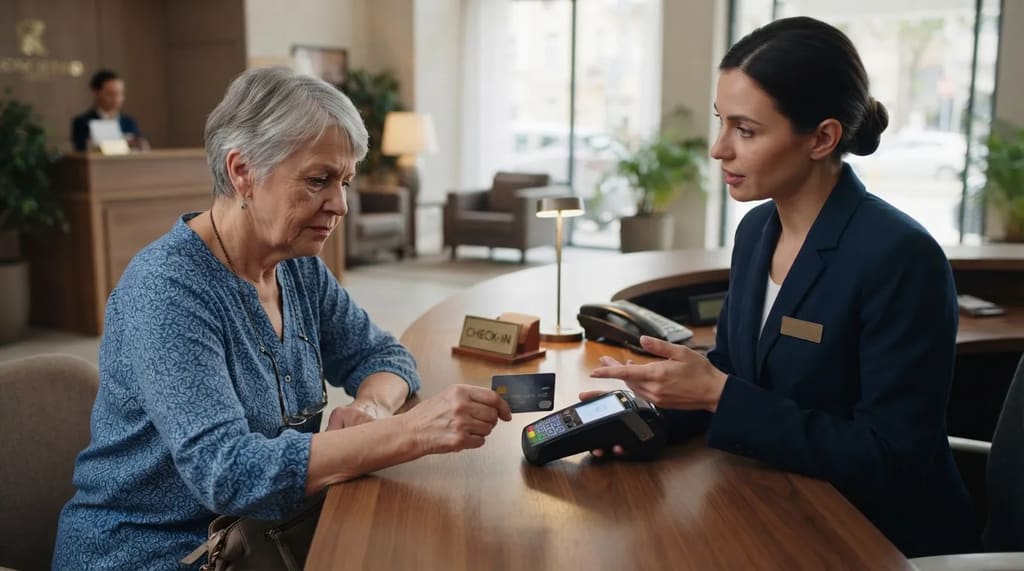
Hotels commonly place an incidental hold at check-in, typically $25 to $200 per night, and more at upscale and resort properties. The hotel sets the amount, while the card issuer decides how long the hold takes to release.3 4
On a credit card, a hold reduces your available credit and nothing more. On a debit card it encumbers money in your checking account, and the bank treats the funds as spent until release.4
If a hotel holds the nightly amount across seven nights, that could put somewhere between $175 and $1,400 out of reach, depending on the property. Ask before booking whether the hotel holds a nightly amount or the total stay.
Use a credit card for the hold when you have one, and keep a cushion in checking if you do not. Wait five business days after checkout, then call the hotel directly to get the release date, and take that date to your bank if the hold is still showing.
A hold clears with time, whereas the senior rate that lowers the room price has to be requested before the booking is made.
#7 – The Full Room Rate When a Senior Rate Exists

Each chain sets its own age and discount. Hilton’s own offers page lists up to 6% off the Best Available Rate for guests 65 and older, while Marriott, Hyatt and IHG start at 62, and Best Western at 55.5
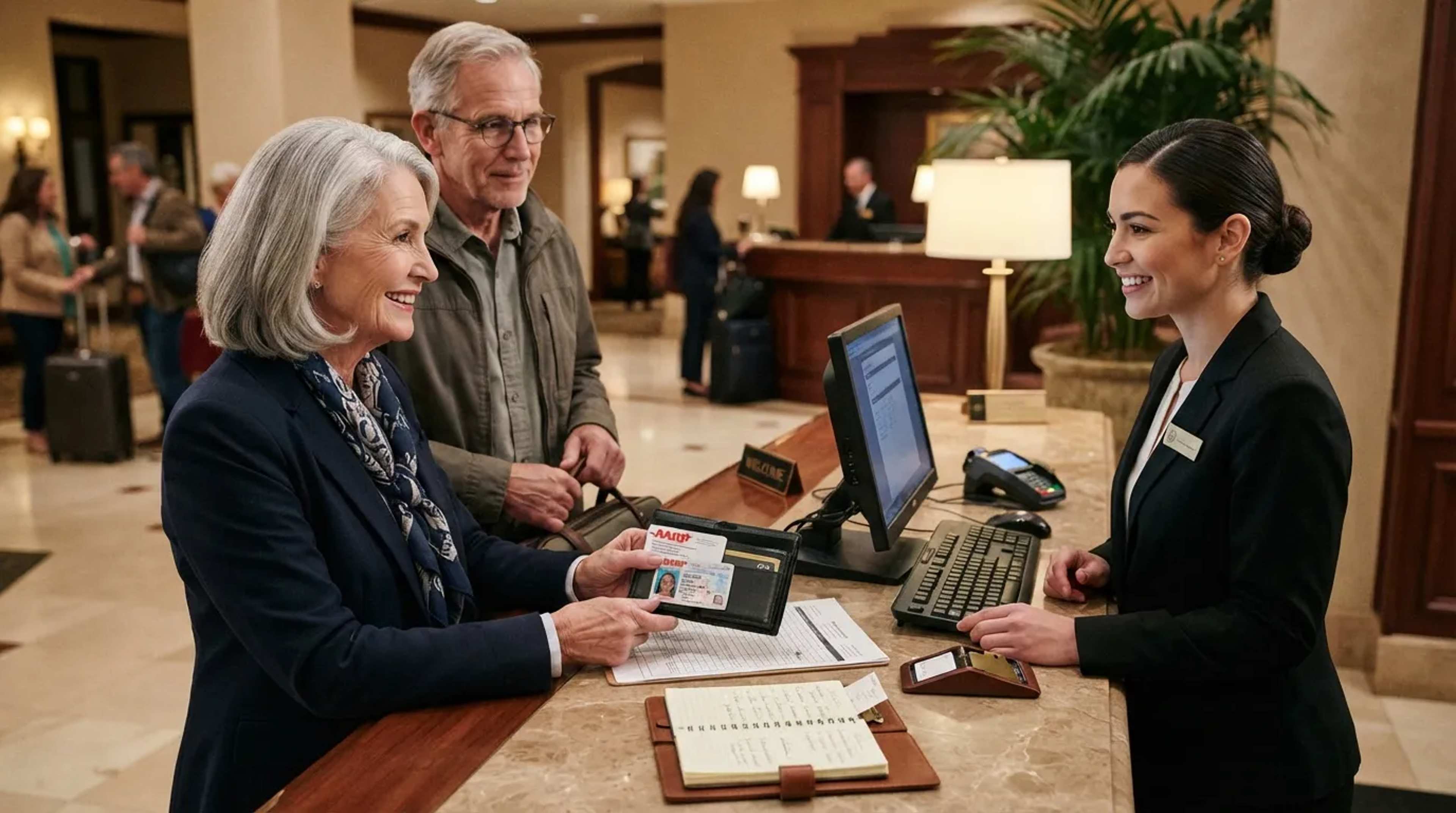
Choice Hotels offers up to 10% to guests 60 and older, or AARP members of any age, with advance reservations, and you need ID proving your age or an AARP card at check-in.6 The discount is subject to availability, so it is not guaranteed on every night.
Quick Compare
- Hilton: up to 6% off the Best Available Rate, ages 65 and older5
- Choice Hotels: up to 10% off, ages 60 and older or AARP members6
- Marriott, Hyatt and IHG: senior rates start at age 62
- Best Western: senior rates start at age 55
A senior rate and an AARP rate are sometimes separate products at the same chain. It is worth pricing both, though AARP membership carries its own fee.
These percentages are modest, so compare the senior price with the plain advance-purchase price and take whichever is lower, whatever it is called. The discount generally applies to the room rate, so a flat nightly fee added on top stays the same size, which is why the rate and the fee are best settled in one call.
A discounted rate lowers the room price and leaves the fees on top, and some of those fees carry names that never mention a resort.
#6 – The Destination Fee at a Downtown Hotel

A mandatory charge can be called a resort fee, a destination fee, an amenity fee or a facilities fee. Under the federal rule, one charged to every guest is mandatory and has to be in the total price.
These fees are not limited to beaches, since they are concentrated at resorts, casinos and upscale urban hotels. A downtown room can carry one even if there is no pool in sight.
The first price you see is now supposed to include the fee, so compare total prices rather than base rates. A $189 room with a $35 nightly fee costs $224 before taxes, which may be more than a plainer hotel nearby that charges no fee.
When you call the hotel, use the exact label printed on the booking screen, because a clerk finds a charge faster by its own name.
#5 – The Resort Fee on a Points Stay

Booking with points can remove the fee altogether, since Hilton and Hyatt both waive resort fees on points bookings. More generally, resort fees are typically waived for award stays.
That matters most at properties that charge a fee, because the points then cover the room rate and the nightly charge together. At a hotel with no fee, a points night saves only the room rate, so check where your points go furthest.
Policies differ by chain and can change, so read the fee line on your points confirmation before you count on the waiver.
Points settle the fee for guests who hold them, which leaves the fee that was never shown at the time of booking.
#4 – The Fee That Was Not Shown When You Booked

The federal rule on unfair or deceptive fees has applied to short-term lodging since May 12, 2025, and it requires the total price, including mandatory fees, to be shown more prominently than any other price.1 It remains in force.
The rule does not ban resort fees1, and the required total is inclusive of all mandatory fees other than government charges, so taxes can still be added later. What it targets is the fee that surfaces only on the last booking screen.
If a mandatory fee was not disclosed before you finished booking, you have grounds to dispute it with the hotel and your credit card company. Take a screenshot of the booking page and keep the confirmation email, since those show what you were told when you agreed.
Work your way up in steps, and stop as soon as the charge is fixed.
At a Glance
- Dispute it at the front desk at check-out
- Contact the hotel’s customer service
- File a chargeback with your credit card company
- For a large amount, file a complaint with your state attorney general’s consumer office
#3 – The Fee for Amenities You Could Not Use

A fee that covers a pool, a gym and bottled water is hard to argue with, because in most cases it is mandatory whether or not a guest uses the facilities. The charge belongs to the room, not to the pool.
Related Stories From Travelbinger



The fee often covers more than that, since hotels say it includes room phone calls and Wi-Fi in the room and around the property. Saying you received nothing is hard to support if you streamed a show every evening.
Where the amenities were closed or unavailable, you have a stronger case. Politely request a waiver at check-out, because front desk staff sometimes have the authority to remove the charge.
Ask once, calmly, and let it go if the answer is no. A properly disclosed fee is part of the rate you contracted for, so this deserves a sentence at the desk and not an argument that holds up a line.
Those fees bite when you are at the hotel, while the next one bites when you never make it there at all.
#2 – The Cancellation Fee When Plans Change

Plans change at any age, but a doctor’s appointment, a family emergency or a bad forecast can sting more when the room is already booked. Many hotels charge roughly a night’s rate if you cancel too close to arrival, and the window varies by property.
Prepaid and nonrefundable rates are the stricter version. The discount that made the price look good is often the price of giving up your flexibility.
Read the cancellation line on your confirmation the day you book, and put the deadline on your calendar. If something serious happens after the window closes, call the hotel directly and explain, because a manager can sometimes waive a fee that the website never will.
Booking direct helps here too, since the same person who holds your reservation can change it. Some travel insurance policies cover prepaid lodging for covered reasons, so check yours before you pay.
Cancellation fees hurt when a trip falls apart, but the last charge does its damage on a trip that goes perfectly.
#1 – The Small Nightly Fee That Repeats on a Long Stay

This is the line promised at the start. On a single night, a $12 or $35 daily fee barely registers, so most guests nod and sign.
Now count the nights. A $35 fee over 14 nights is $490, and a $12 fee over a 30-night winter stay is $360, before any taxes that may apply on top.
Fast Facts
| Nightly fee | 3 nights | 14 nights | 30 nights |
|---|---|---|---|
| $12 | $36 | $168 | $360 |
| $35 | $105 | $490 | $1,050 |
Longer trips are where this lands hardest, because a long stay multiplies every flat daily charge, from a resort or destination fee to parking. The room rate may carry a discount, while the nightly fees on top usually do not.
Before booking more than a few nights, multiply every nightly fee by the number of nights and compare that total, not the rate. Then ask whether the hotel offers a weekly or monthly rate, or whether an extended-stay property nearby bills fewer daily extras.
If the fee is mandatory, ask whether it can be reduced for a stay this long, and get any yes in an email. A hotel that wants seven or thirty nights of your business has more reason to say yes than one filling a single night.
Almost every charge on this list is easier to change before it posts than after it does. So when a bill looks fine at a glance, remember that the smallest line is the one that repeats, and ask about it first.
- Hotel Dive FTC Rule: https://www.hoteldive.com/news/ftc-junk-fees-rule-takes-effect-hotels/747738/
- Hilton Senior Discount Guide: https://retirehub.org/senior-discounts/hilton/
- Authorization Hold Overview: https://en.wikipedia.org/wiki/Authorization_hold
- Hotel Incidentals Explained: https://nomavue.com/hotel-incidental-charges/
- Hilton Senior Rate: https://www.hilton.com/en/offers/senior-rate-2000000292/
- Choice Hotels Senior Rates: https://www.choicehotels.com/deals/senior-rates