Royal Caribbean can charge you $25 a person for a specialty-restaurant reservation you cancel inside 24 hours, and the same fee applies if you simply don’t show.1 On a ship where the main dining room feels free, that bill catches first-timers off guard.
It’s one of twelve dining-room rules with a price on it, and the veterans at the next table already know every one. The others cost you a seat, some goodwill at your table, and in one case your health.
The twelve run from small courtesies to the one with real consequences. Stay for #1, because it has to start weeks before you board and then get repeated at every meal.
First, the smallest rule on the list, which involves a cocktail.
#12 – Your Cocktail Can Come to Dinner
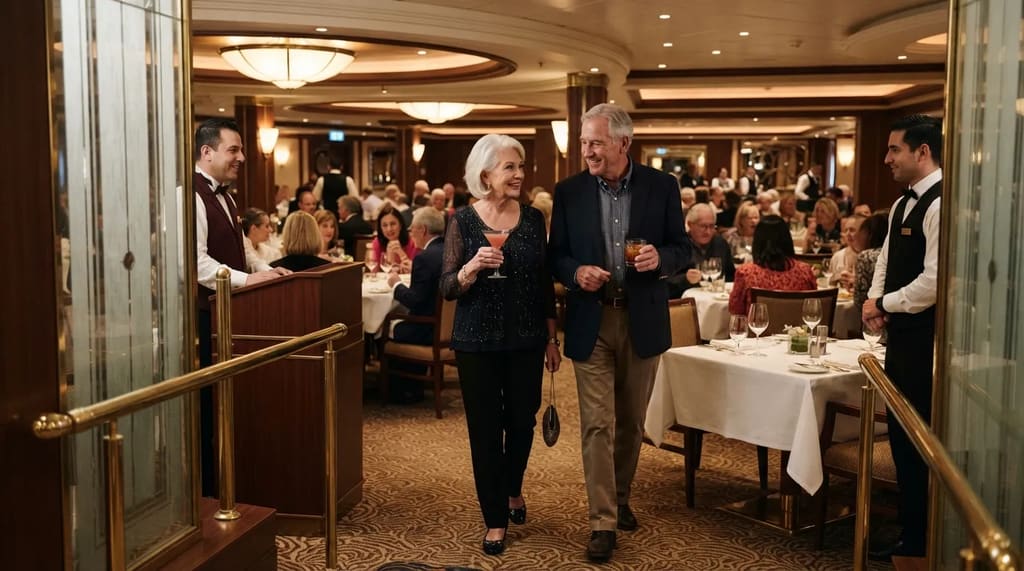
Walking from a bar into the dining room with a drink in your hand feels like a breach of manners. Cruise Critic reports that you’re allowed to take beverages into the dining room from other venues, so a pre-dinner cocktail can be finished at your table.2
That matters because of the clock. Dinner in the main dining room runs on a schedule, and the “one more round” habit at the bar is how people end up walking in late.
Carry the glass with you and you keep both the drink and your place at the table. It’s a small move that spares you the last-minute dash through the lobby.
Drinks are an extra charge on most ships, so a glass you carry in still lands on your onboard account. Leave a half-finished drink on the table only if you’re truly done with it, since the server will clear it.
Once the drink is settled, the question is what you’re wearing, and some lines will stop you at the door over a pair of bare feet.
#11 – Swimwear, Bare Feet and the Nightly Dress Code

The dress code is shorter than you’d fear, and it’s enforced more than you’d hope. Swimwear and bare feet are banned, casual wear is acceptable at breakfast and lunch, and dressier attire is expected at night.2
On Royal Caribbean, the no-bare-feet and no-tank-top rules are the ones actually enforced. Show up in either and the walk back to the cabin is a long one.
For anything above that floor, the bar is lower than the brochures suggest. The minimum is something nicer than you’d wear on the pool deck: a collared shirt and slacks or jeans for men, jeans with a blouse or a dress or skirt for women. Many lines now allow jeans.
My verdict is that this is the one rule worth following and the least worth fretting over. Neat and put-together is the standard, not fancy.
If your cruise includes formal nights, they’re a staple of many voyages and the main dining room is typically rather formal, so pack for them. Otherwise a second dress outfit is a bigger worry than the rules require.
Dressed correctly, you can still lose your table by walking in at the wrong minute.
#10 – The Clock Behind Your Assigned Seating

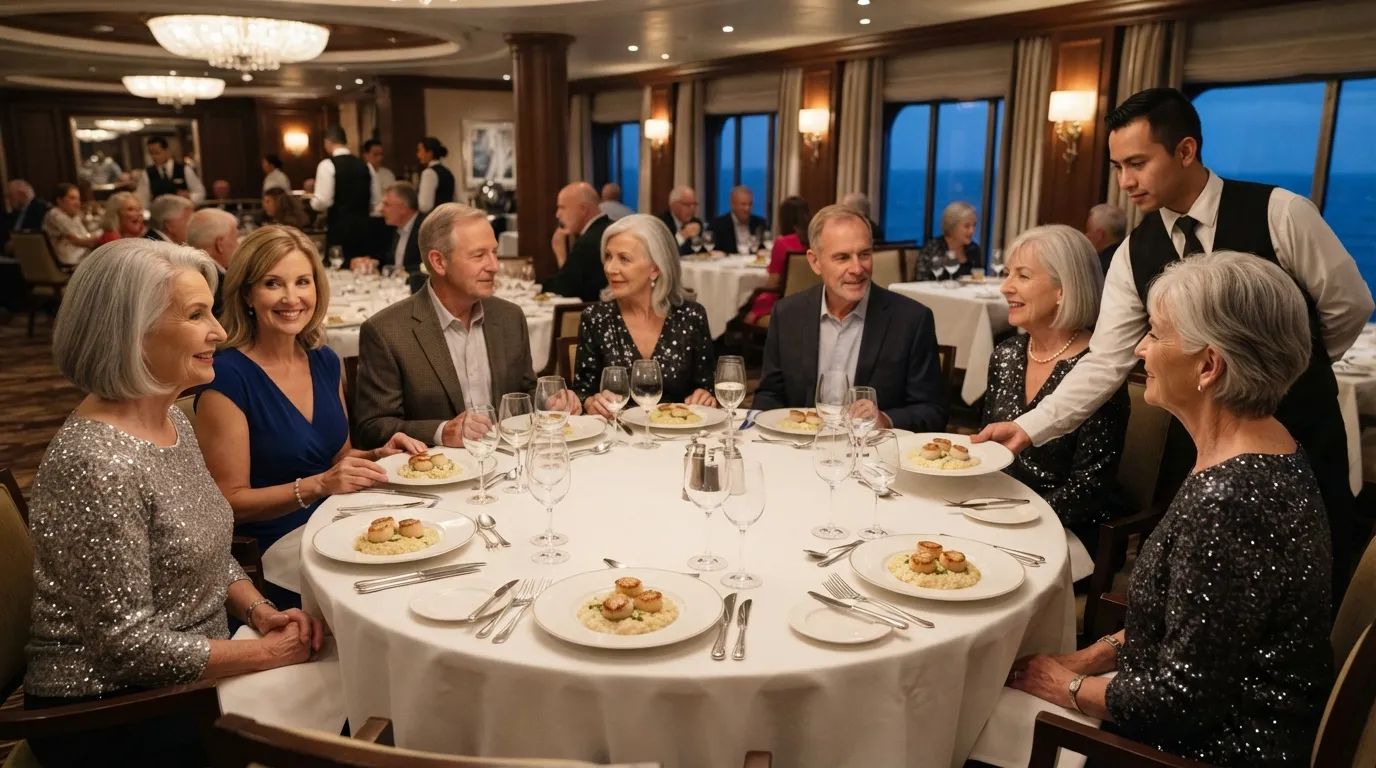
If you booked traditional dining, your arrival time is a commitment. Cruisers are usually divided into two seatings, early and late, because the dining room can’t take everybody at once.3
The courses are paced so the room can turn over for the next group. That’s why the whole evening hangs on everyone showing up together.
One empty chair holds up an entire table. Waitstaff usually don’t take dinner orders until everyone is seated, so a couple who wander in twenty minutes late delay the other six people before anyone has seen a menu.
At a Glance
- Traditional dining usually means two seatings: early and late.
- Orders typically wait until the whole table is seated.
- A few minutes late happens; habitual lateness doesn’t get a pass.
- Flexible dining has no fixed table, but it still runs on a clock.
Flexible dining has its own version of the rule. If you booked My Time Dining on Royal Caribbean and show up at the wrong time, you may not get a seat, which is the downside of the bar-to-table stroll in #12 if you let the second drink run long.
A few minutes late happens, but being significantly or habitually late causes delays for your tablemates and the waitstaff. Aim to be at the table at your assigned time, not near it.
Being on time gets you to the table, and the first thing to do once you’re there isn’t to order.
#9 – Introduce Yourself Before the Bread Arrives

Your tablemates are assigned for the week, so the first night sets the tone. Introduce yourself on the first evening, which gives everyone a chance to meet and talk as equals.
A first name and where you sailed from is enough. Nobody needs your life story before the appetizers.
There’s an old convention behind this. Etiquette says to eat in the main dining room on the first night, and the introductions and polite conversation are part of that custom. These formal dinners are among the most traditional parts of cruising, going back to the great transatlantic liners of the 19th century.
Here’s my verdict: skip the specialty restaurant on night one, however tempting. The main dining room is where your table gets set, and if the company doesn’t suit you, changing your seating after the first night is easy enough.
You can’t make that decision about people you haven’t met. Say your name to the whole table on night one.
Introductions come first, and then the plates arrive, with one small rule about who picks up a fork before whom.
#8 – Your Fork Waits for the Whole Table
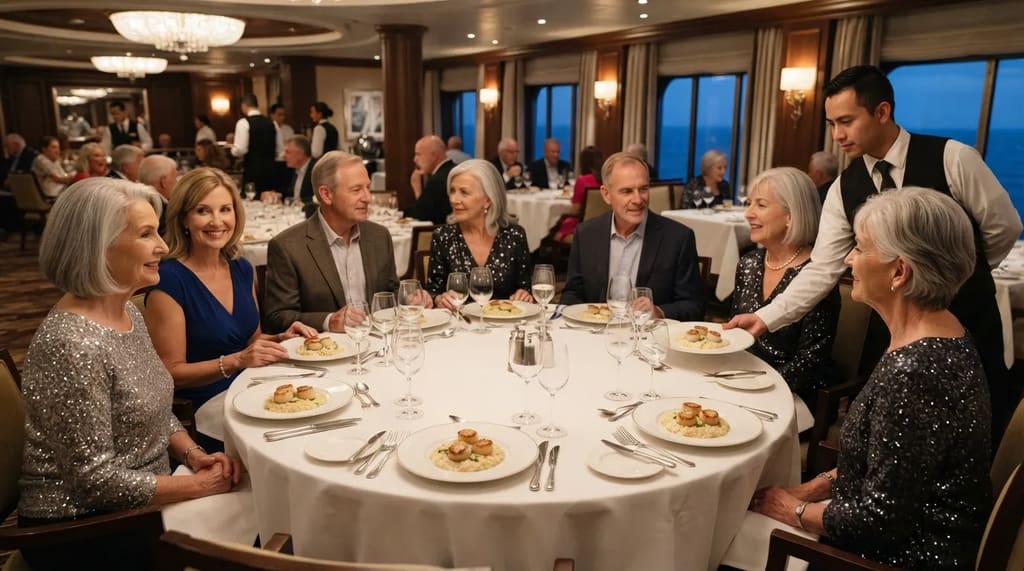
Don’t start eating until everyone has been served, and repeat that for every course. Food on a ship arrives in waves at a big table, so the diner served first is the one tested hardest.
The rule makes more sense given the pace set in #10. Because the table orders together and moves together, a person who digs in alone ends up a course ahead of everyone else.
The meal then runs ragged, and the waiter has to time the next course around you. One eager fork can throw off the rhythm for the whole table.
The exception is when the unserved person says “Please start.” I’d take that at face value, because a tablemate who waves you on doesn’t want your food getting cold on their account.
The basics from land-based dining apply here too. Don’t eat with your hands, don’t talk with your mouth full and don’t twirl your napkin. Wait for the whole table, unless someone says go ahead.
Once everyone’s eating, conversation starts, and two subjects can sour a week of dinners before the entrées are cleared.
#7 – Two Topics to Leave Off the Table

Dinner talk is part of the meal, and some of it is best avoided. One Royal Caribbean guide suggests avoiding politics and religion, since current events tend to drift into politics before you know it.
Cruise Critic’s list of dining-room don’ts adds more. Avoid controversial topics at dinnertime, especially if you’re dining with people you don’t know well, and skip the bragging about trips or purchases.3
Alcohol belongs in this category too. The last thing you want to remember from your cruise is the night you had one too many and made a spectacle of yourself in front of hundreds of strangers.
Safe ground is easy to find. Ask where people have sailed before, which ports they’re looking forward to, and what they’d recommend on this ship.
Everyone has an answer to those questions, and none of them starts an argument.
The menu is the opposite, because that’s where you’re encouraged to be greedy, with a limit.
#6 – How Much You May Order, and Finish

Ordering a second appetizer feels like something you’d get a look for. In the main dining room it’s allowed.
Nearly all the food there is included with your fare, so you can order more than one appetizer, entrée or dessert. That’s generally true unless the menu says otherwise, so check for items marked with a surcharge.
The courtesy that goes with that freedom is to finish what you order. Most of the menu is included at no extra cost, but you’re expected to eat what you order, and the cruise line is trying to cut down on food waste.
Worth Knowing
- Multiple appetizers, entrées and desserts are generally fine.
- Surcharge items are marked on the menu.
- Unsure about a dish? Ask for a small portion.
- Finish what you order; waste is what the line wants to cut.
That makes my verdict simple. Ordering two entrées to taste both is better manners than ordering one you’ll push around the plate.
If you want to try something new, tell your waiter you’re ordering it to give it a go, or ask for a small portion of the dish you’re unsure about. Phrasing counts too, since “May I please have the…” is more gracious than “Give me the…” Order as many dishes as you like, and finish each one you ask for.
#5 – Tell Your Waiter Before the Show
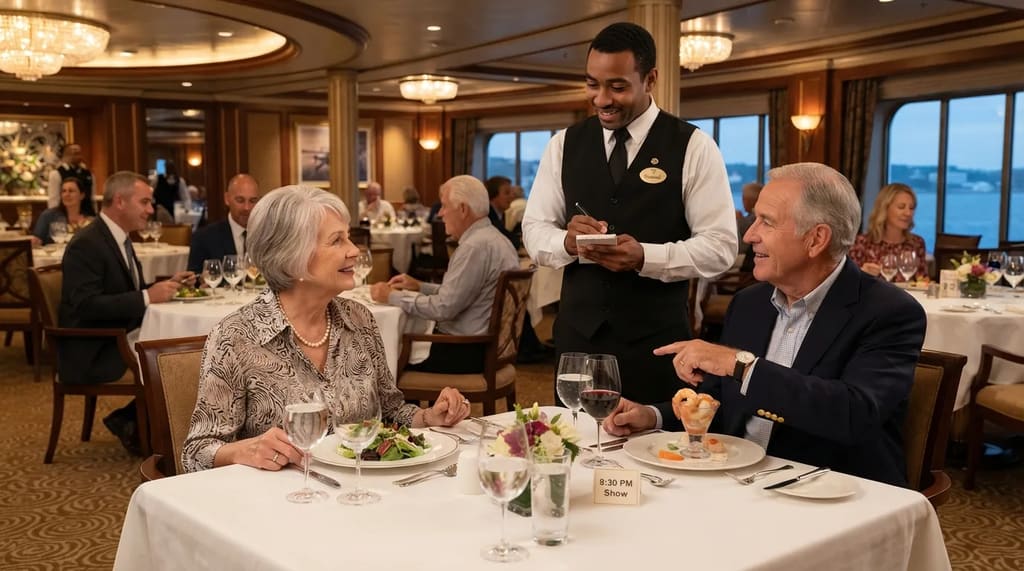
Dinner at the table isn’t fast food, and the staff know it. But the waiters have to clear your table in time for the late seating or for the next morning’s breakfast, so lingering long after the room has emptied is the mirror image of arriving late.
The fix is to say something early. Tell your waiter if you need a faster meal, since they want you to be happy and to enjoy a meal at the same time.
Mention the time you need to leave when you order, not when the dessert arrives. That works because courses can be sped up at the start but not at the end.
A waiter who knows about an 8:30 show can pace appetizer, entrée and dessert accordingly. One who finds out at dessert can only apologize.
It’s the same clock as the one in #10, and this time you’re the one who benefits from a heads-up.
If the clock isn’t the problem but the company is, there’s a polite way out, and a wrong time to use it.
#4 – The Right Way to Switch Tables
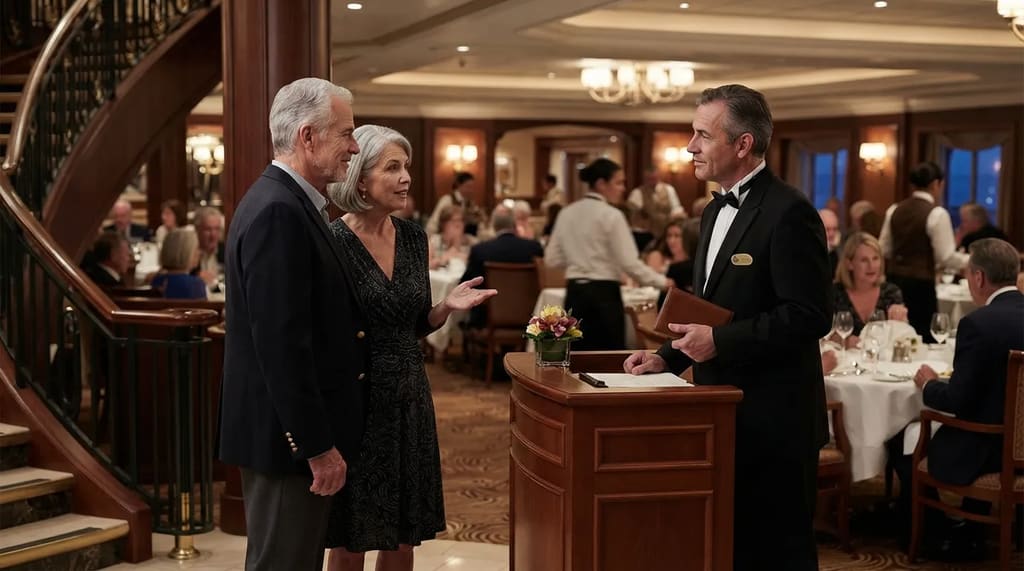
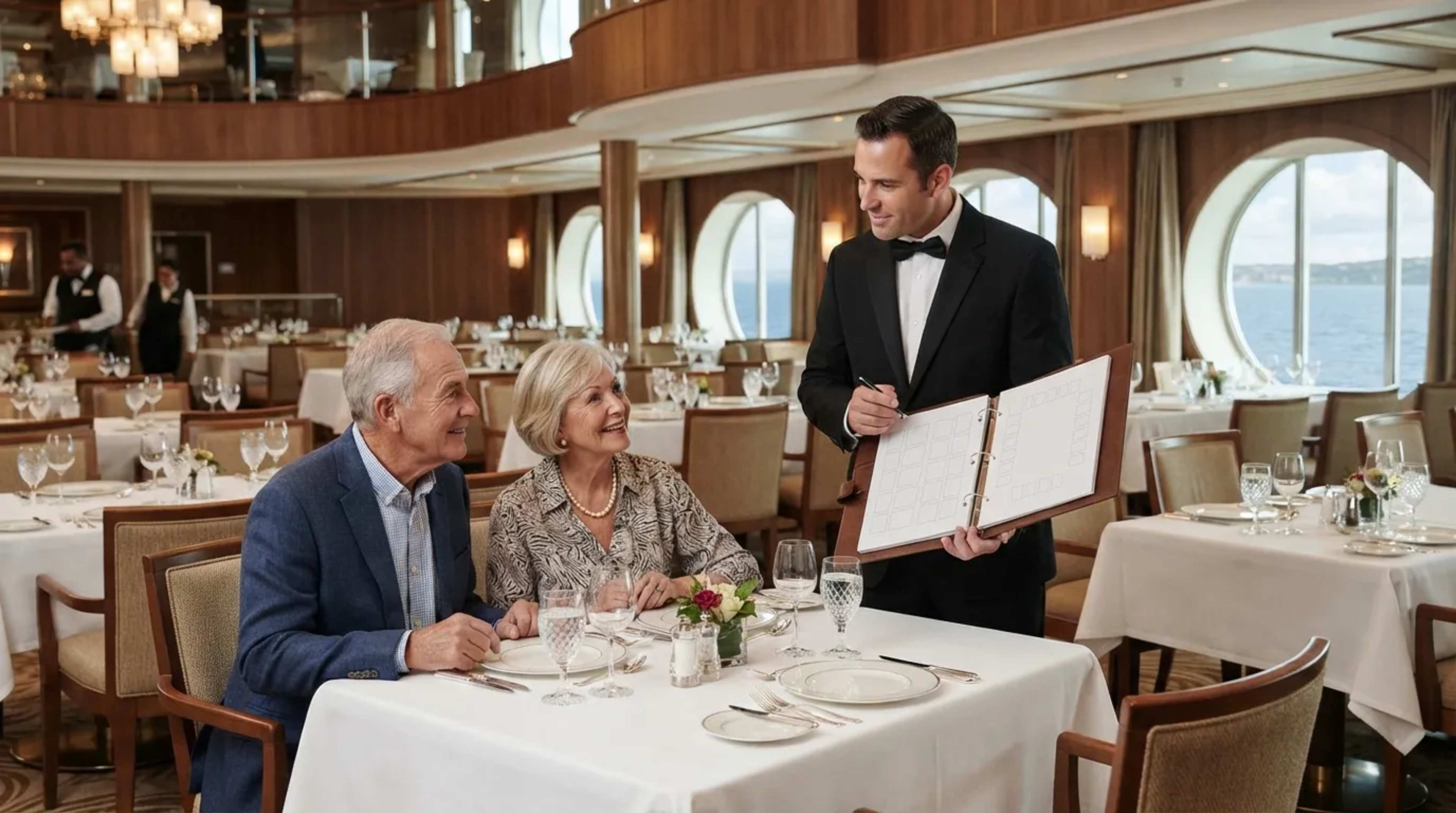
Not every table works out. If everyone speaks a different language, or the personalities simply don’t match, ask the maître d’ to move you.
Chances are your fellow passengers sense the same problem. A quiet change can be a relief for the whole table.
The timing is the rule. If you plan to change tables, do it after the first night, because one evening isn’t enough to judge a group and a request made before the main course on night one reads as a snap verdict.
Cruise Critic’s advice is the same on the process: for a problem with your dining time or table assignment, seek out the maître d’.3 Do it away from the table, since a quiet word at the maître d’s station as you leave is better than a request across the dinner conversation.
It also ties to #9: you’ve introduced yourself, you’ve given the table a fair try, and now you’re asking for something reasonable. Make the request privately and no sooner than the second night.
Leaving a table costs you nothing, but leaving a reservation empty can cost real money.
#3 – The Specialty Reservation You Forgot to Cancel
Paid restaurants on a ship are limited-capacity, and the lines have started charging for empty seats. On Royal Caribbean you can change or cancel up to 24 hours ahead, but inside that window, or if you don’t show, the fee is $25 a person.1
Some venues cost more. Certain restaurants carry a $50 per person fee, including Chef’s Table, Izumi Hibachi and the supper clubs, and Celebration Table charges half the cost of the experience.1
A couple who miss a $50 venue are out $100 for an empty evening. Nobody at the table even gets a bread roll out of it.
Norwegian’s rule is looser but still firm. A $10 per person fee applies if a reservation isn’t cancelled or changed at least two hours before the scheduled time.
Fees and deadlines differ by line, and each venue’s policy is provided when you make the reservation, so read that confirmation. My verdict: book fewer specialty nights on day one than you think you’ll want, because plans change with weather, ports and tiredness.
Related Stories From Travelbinger


Those fees are small beside a charge that lands on your bill whether you eat a single dinner or not.
#2 – The Daily Gratuity That Appears on Your Bill
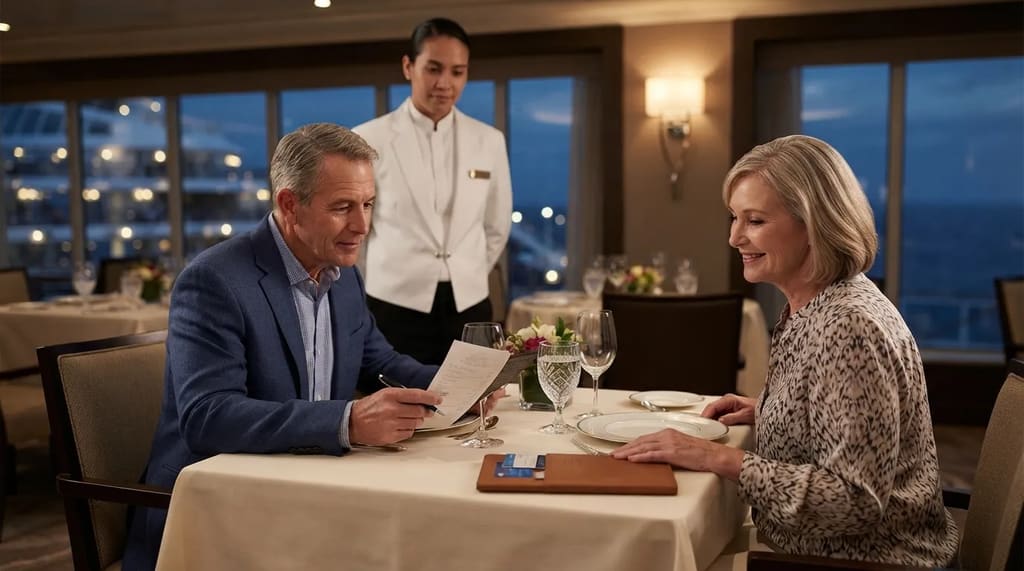
Cruise gratuities are automatic. They’re a per-person, per-day charge added for all guests across all stateroom categories.
The 2026 rates: Carnival charges $17 per person per day for standard rooms and $19 for suites, Royal Caribbean $18.50 and $21, and Princess $18 for most guests and $20 for suites.4
The arithmetic gets large quickly. For two guests on a seven-night sailing, that’s $238 on Carnival and $259 on Royal Caribbean,4 so plan on roughly $240 to $260 a couple for a week, which dwarfs the specialty-restaurant fees in #3.
Quick Compare
| Line | Standard room, 2 guests, 7 nights |
|---|---|
| Carnival | $238 |
| Princess | $252 |
| Royal Caribbean | $259 |
What does it pay for? Royal Caribbean says gratuities are shared among dining, bar and culinary staff, stateroom attendants and other hotel teams, which includes your waiter and the assistant who clears your table.
Prepaying can lock in a rate: Carnival guests who prepaid before April 2, 2026 kept the old price.5 Drinks add a separate charge, and an automatic 18 to 20 percent is typically added to drinks, spa treatments and specialty dining, so factor all of it into a fare comparison before you book.
Every rule so far costs money or goodwill, and the last one concerns something money can’t fix once the dish reaches your table.
#1 – The Allergy Note That Needs Saying Twice
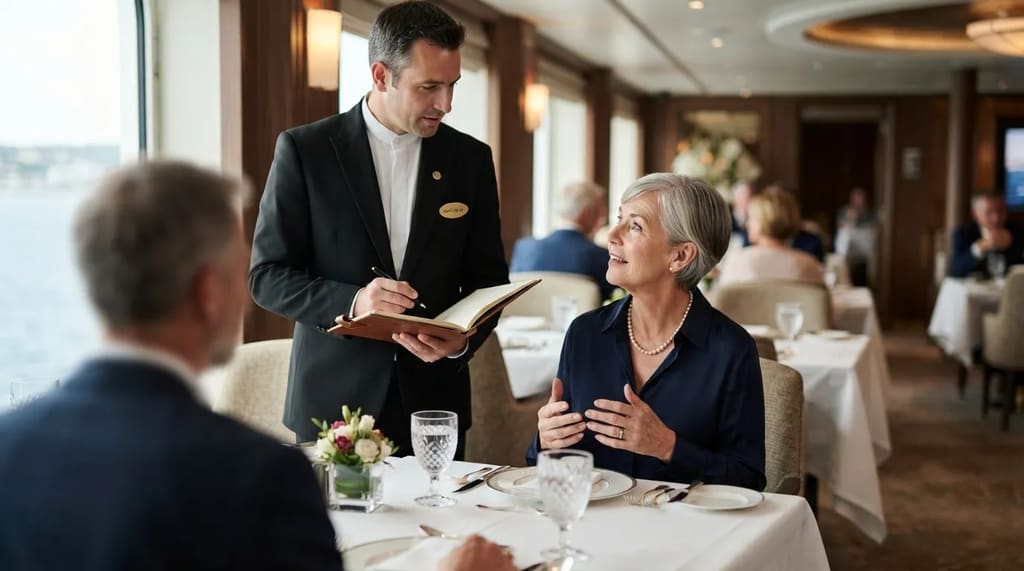
Telling the cruise line about a food allergy once is not the same as being safe in the dining room. The first step is early: report dietary restrictions to the cruise line’s special needs department before sailing, then discuss them onboard with the maître d’.2
Most lines want weeks of notice, typically 28 to 90 days, because the galley can’t improvise. The deadline depends on the line.
Fast Facts
- P&O asks for at least 28 days’ notice.6
- MSC asks for no later than 30 days.6
- Norwegian asks for at least 45 days.6
- Holland America and Viking want 90 days.7
Check your line’s window at booking and keep written confirmation. Then repeat it onboard.
On embarkation day, confirm your restrictions with the restaurant manager or executive chef and ask where special items are stored. Tell the line before you travel, then tell the dining team again before you eat. Say it again at every meal.
This is where the other rules work in your favor. The first-night dinner in #9 puts you in front of the head waiter, and the same table in #10 means the same server nightly, so you can request that server each night and they’ll get to know you and your allergies.7
Where you eat matters too. Allergies can best be accommodated in the main dining room, and Celebrity tells guests with food allergies to avoid self-service venues and speak to restaurant staff before eating.
For a serious allergy, check the details with your doctor as well as the line.
Tell the Dining Room Before It Becomes a Problem
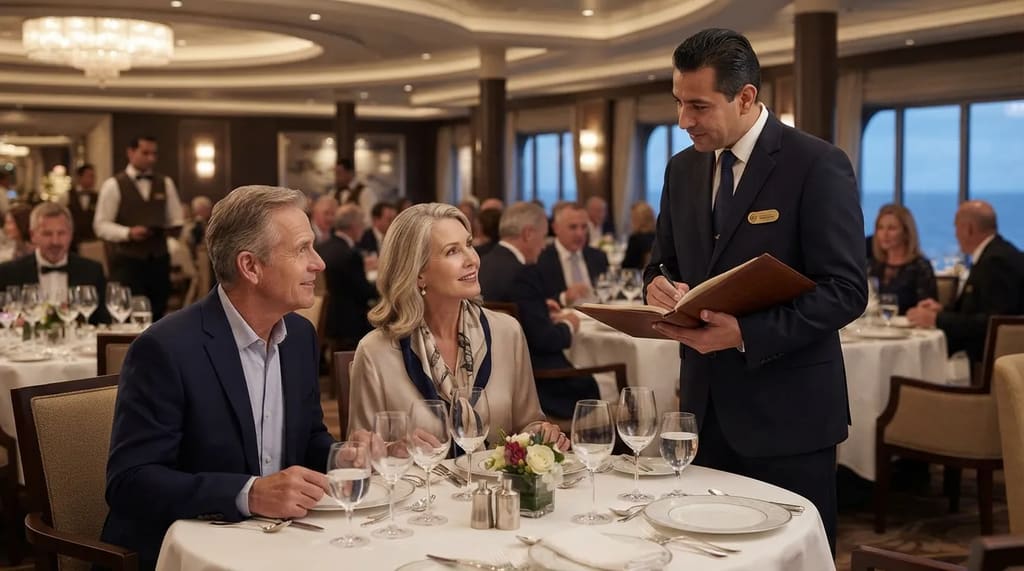
Look back across the twelve and a pattern shows. The drink you carry in, the arrival time, the table switch, the cancellation and the allergy are all situations the staff can handle if they hear about them early.
They’re much harder if the staff hear late. A dining room that seats hundreds on a schedule is forgiving of requests and unforgiving of surprises.
So the better habit isn’t memorizing rules. It’s saying what you need while there’s still time to act on it.
What’s the one thing you now tell your waiter or the maître d’ on the first night of every cruise?
- Royal Caribbean Cancellation Policy: https://www.royalcaribbean.com/faq/questions/specialty-dining-restaurant-cancellation-policy
- Cruise Critic Main Dining Room: https://www.cruisecritic.com/articles/what-to-expect-on-a-cruise-the-main-dining-room
- Cruise Critic Dining Don’ts: https://www.cruisecritic.com/articles/9-things-not-to-do-in-a-cruise-ship-main-dining-room
- Cruise Gratuities 2026 Rates: https://www.globalgulls.com/guides/cruise-gratuities-explained
- Cruise Gratuities Compared: https://seaboundjourneys.com/cruise-gratuities-compared.html
- Cruise Collective Allergy Guide: https://www.cruise-collective.com/article/cruising-with-a-food-allergy-what-to-arrange-before-you-board
- Cruise Food Allergy Guide: https://cruiseline.com/advice/before-you-cruise/what-to-know/how-to-cruise-with-food-allergies