
What makes Thien Hau Pagoda one of the most visited temples in District 5, and does it actually deserve the attention? In the middle of Saigon’s Chinatown, surrounded by traffic and shopfronts, this temple has been standing for centuries.
Dedicated to the sea goddess Thiên Hậu, it remains an active religious site rather than a preserved monument. In this guide, I’ll walk through what you can expect at Thien Hau Pagoda, its historical background, and what stood out to me personally when I spent time inside one of Ho Chi Minh City’s most established temples.
A Temple Rooted in Chinatown’s History

Thien Hau Pagoda was built in the 18th century by the Cantonese community in Saigon. That context matters. District 5 isn’t just another neighbourhood – it’s the historical centre of the city’s Chinese-Vietnamese population.
The temple is dedicated to Thiên Hậu (known as Mazu in Chinese tradition), the goddess of the sea and protector of sailors. Many early Chinese migrants arrived in Vietnam by sea, and devotion to Thiên Hậu was closely tied to protection during long, dangerous journeys.
You can feel that heritage when you step through the entrance. The structure isn’t wide and open like some Vietnamese pagodas. It follows southern Chinese temple architecture – tiled roofs, decorative ceramic figurines along the ridges, and a layout built around interior courtyards.
Unlike modern temples that sometimes feel recently polished, Thien Hau carries the weight of age. The wood beams are darkened by decades – or more accurately, centuries – of incense smoke. Nothing feels newly restored to impress visitors. It feels used.
First Impressions Inside Thien Hau Pagoda

The first time I entered Thien Hau Pagoda, the ceiling caught my attention immediately.
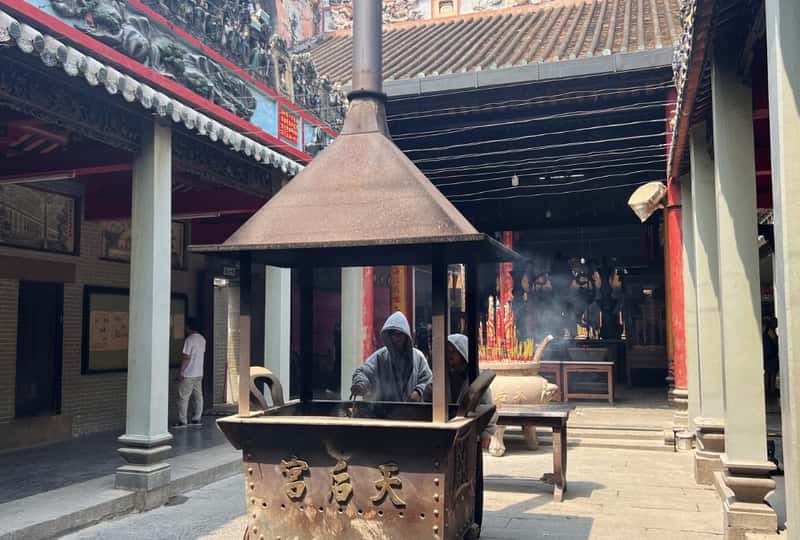
Large spiral incense coils hang overhead, suspended from the beams. Each one burns slowly over days, sometimes weeks, releasing a steady stream of smoke into the hall. Many have small red tags attached – prayer requests written by worshippers.
When light filters down through the courtyard openings above, it cuts through the smoke in visible layers. It’s atmospheric without feeling staged. The effect isn’t designed for photography, but it photographs well because it’s real.
The temple isn’t quiet in the way some smaller pagodas are. There’s movement. People lighting incense, placing offerings, and bowing at the altar. The rhythm feels steady rather than chaotic.
I’ve always found that kind of activity more compelling than empty temples. It reminds you that this is a functioning place of worship, not just a historical site.
Architecture and Layout Thien Hau Pagoda

The layout follows a traditional Chinese temple design. Instead of one large, open interior space, the temple is divided into sections connected by small courtyards.
These courtyards are practical as much as they are aesthetic. They allow light and air to enter, which is essential given the amount of incense constantly burning inside. Standing in one of these open-air sections gives you a brief pause before moving deeper into the next hall.
The roof is worth noticing from the outside. Ceramic figurines depicting scenes from Chinese folklore line the edges. They’re small, detailed, and easy to overlook if you don’t tilt your head upward.
Inside, the altars are layered and richly decorated. Red and gold dominate the colour scheme, reinforcing the Chinese aesthetic influence. The main altar dedicated to Thiên Hậu is positioned centrally, drawing both physical and visual focus.
Compared to Chùa Vạn Phật, which feels vertical and dense, Thien Hau feels horizontally layered. The movement through the temple happens in stages rather than levels.
Atmosphere and Cultural Significance

What I appreciate about Thien Hau Pagoda is that it doesn’t try to simplify itself for visitors.
There’s no large explanatory signage in English. No curated museum-style displays. You enter, observe, and quietly figure things out as you go.
District 5 temples feel more traditional in their adherence to practice. The rituals here aren’t symbolic performances; they’re daily acts. Offerings of fruit and incense are placed carefully. People bow deliberately, not hurriedly.
If you visit during festivals, especially around the Lunar New Year, the temple becomes significantly busier. Thiên Hậu’s role as a protector still resonates with many families who trace their roots back to migration stories.
Even on ordinary days, though, the temple feels active.
For me, that activity is what separates Thien Hau from more architecturally dramatic pagodas elsewhere in the city. Its beauty isn’t just structural – it’s in continuity.
What It Felt Like to Me
Every time I visit Thien Hau, I notice something slightly different.
One day, it’s the way smoke gathers near the ceiling before drifting upward. Another time, it’s the details in the roof ceramics. On a quieter visit, I stood near one of the courtyards and simply listened to the low murmur of prayers mixing with distant street noise.
What strikes me most is the contrast between the outside and inside.
Outside: Chinatown traffic, shop signs, constant motion.
Inside: slower gestures, controlled movement, deliberate ritual.
The temple doesn’t isolate itself from the city. It sits directly within it. But stepping through the entrance compresses the noise into something softer.
That transition is subtle but powerful.
Practical Information for Visiting
- Location: District 5 (Chinatown), Ho Chi Minh City
- Entrance fee: Free (donations welcome)
- Dress code: Modest clothing recommended
- Photography: Allowed, but avoid flash
- Best time to visit: Morning for softer light and fewer visitors
The temple is easy to combine with other District 5 sites, including Chùa Vạn Phật and nearby markets. Because it’s well known, it’s also easier to find than some hidden alley pagodas.
You don’t need hours here. But you do need to slow down.
Final Thoughts
Thien Hau Pagoda stands out not because it is the largest or the most visually dramatic temple in Saigon, but because it feels rooted.
In a city that changes quickly, this temple carries centuries of continuity. The architecture reflects Chinatown’s heritage, the incense coils define its interior atmosphere, and the steady flow of worshippers keeps it alive.
If you’re exploring District 5 and want to understand the cultural layer beneath the shopfronts and markets, this is where you start.
It doesn’t need to impress you loudly. It’s been here long enough not to try.