Cheddar Gorge rises abruptly from the Somerset Levels, a deep limestone incision that feels almost implausible when you approach it by car. One moment you’re crossing flat farmland; the next, sheer gray walls climb more than 400 feet on either side, narrowing the sky and focusing your attention upward. It just pops up from nowhere!
This said, the hike to the top of Cheddar Gorge doesn’t promise alpine drama or distant horizons measured in dozens of miles. Its power comes from contrast, scale, and concentration: a compact landscape where geology, history, and daily life overlap with unusual clarity. Walking here is about texture as much as views. Wind presses against exposed rock, goats pick their way along improbable ledges, and the village of Cheddar hums quietly below, framed by cliffs that have been shaping human activity for thousands of years. The gorge is not vast, but it is complete—an ecosystem, a cultural landmark, and a deeply British outdoor experience wrapped into a single loop.
A Gorge Carved by Water and Time
Cheddar Gorge is the largest gorge in England, carved into the southern edge of the Mendip Hills. Its dramatic profile is the result of millions of years of erosion. Rainwater, slightly acidic, seeped through cracks in the Carboniferous limestone, enlarging them into caves and underground rivers. During the last Ice Age, when the ground was frozen solid, meltwater flowed across the surface instead, cutting the steep-sided canyon you hike through today.
This geology explains the visual drama but also the softness underfoot. Much of the trail runs over grass and compacted earth rather than hard stone, and sinkholes and caves lie hidden beneath the plateau. It’s a reminder that the gorge is still evolving, even if its vertical walls feel timeless.
The Loop Hike Above the Cliffs

Most hikers opt for a loop that combines the gorge floor with the rim paths above. The classic circuit measures about 3 miles, with roughly 1,000 feet of elevation gain. It’s not technical, but it is sustained, especially on the climb out of the gorge via Jacob’s Ladder or one of the steeper side paths. Sturdy shoes matter here, particularly after rain, when limestone dust turns slick.
Up top, the character of the hike changes completely. The plateau opens wide, the wind picks up, and views stretch across the Somerset Levels toward Glastonbury on clear days. Trails branch off in several directions, allowing you to shorten the loop or extend it into a longer ramble across the Mendips. The sense of exposure is real but never overwhelming, and the reward is perspective: the gorge reads clearly as a geological incision, a deliberate cut through an otherwise gentle landscape.
Goats on the Edge
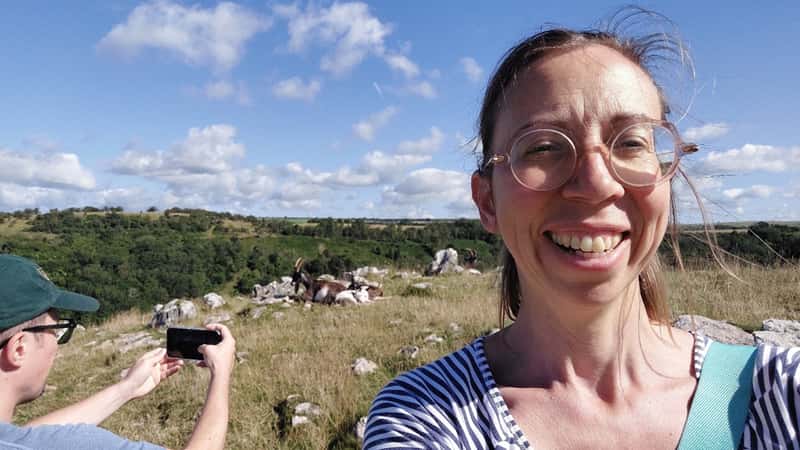
One of the most unexpected joys of hiking Cheddar Gorge is the goats. These are not farm animals but feral descendants of domesticated stock, reintroduced in recent years to help manage vegetation on the cliffs. They move with astonishing ease, clinging to near-vertical rock faces and appearing suddenly above you like sentinels.
The cliffs feel imposing until a goat walks across them as if on level ground. Their presence reinforces the wildness of the gorge, a reminder that despite the road slicing through its center and the steady flow of visitors, this remains a working landscape shaped by natural forces.
Cheddar Village: Stone, Cheese, and Continuity
At the base of the gorge sits Cheddar, compact and unapologetically tourist-friendly. Limestone buildings line the main street, housing small shops, bakeries, and cheese counters that lean into the village’s most famous export: the delicious Cheddar cheese.
Several shops sell clothbound Cheddar aged in local caves, where constant humidity and temperature create ideal conditions for maturation. This is a food tied directly to place, geology included—the same limestone that forms the gorge also shelters the cheese as it ages. Pick up a wedge to take home or build a simple picnic to enjoy on the grass with cliff walls as your backdrop.
Practical Notes: Getting There and Eating Well
Cheddar Gorge sits about 10 miles southwest of Bristol. Driving is the easiest option; parking is available in several paid lots near the village. Public transportation is possible but indirect, usually involving a train to Weston-super-Mare or Bristol and a bus connection.
For food, the village offers casual pubs and cafés serving classic British fare—think meat pies, soups, and sandwiches. Many hikers choose to eat after the hike, when the appetite is real and the mood relaxed. Bringing water is essential; shade is limited once you climb above the gorge, and summer temperatures can feel warmer than expected.
A Defined Landscape, Fully Formed
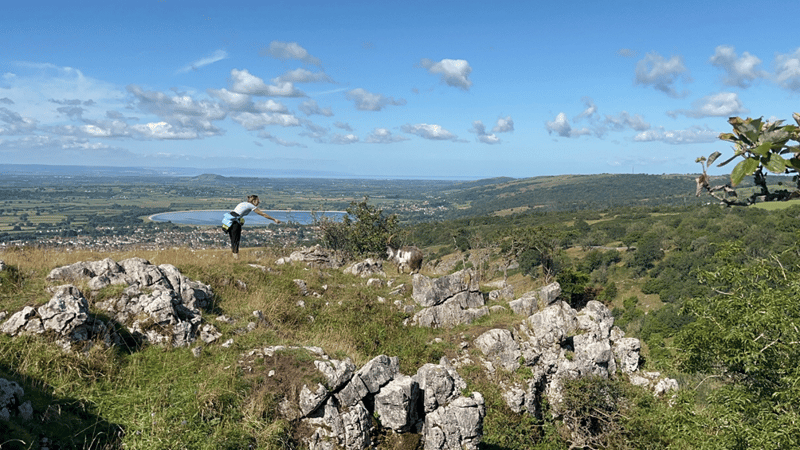
I loved my day in Cheddar Gorge. I walked through the result of ancient water flows, shared space with goats doing essential ecological work, and ended my day eating cheese aged in the same rock I just climbed above. In a country known for rolling hills and subtle shifts, Cheddar Gorge stood out as a clear statement: a hike that fits comfortably into a single afternoon and lingers in memory, precisely because it feels so sharply drawn against the surrounding plain.