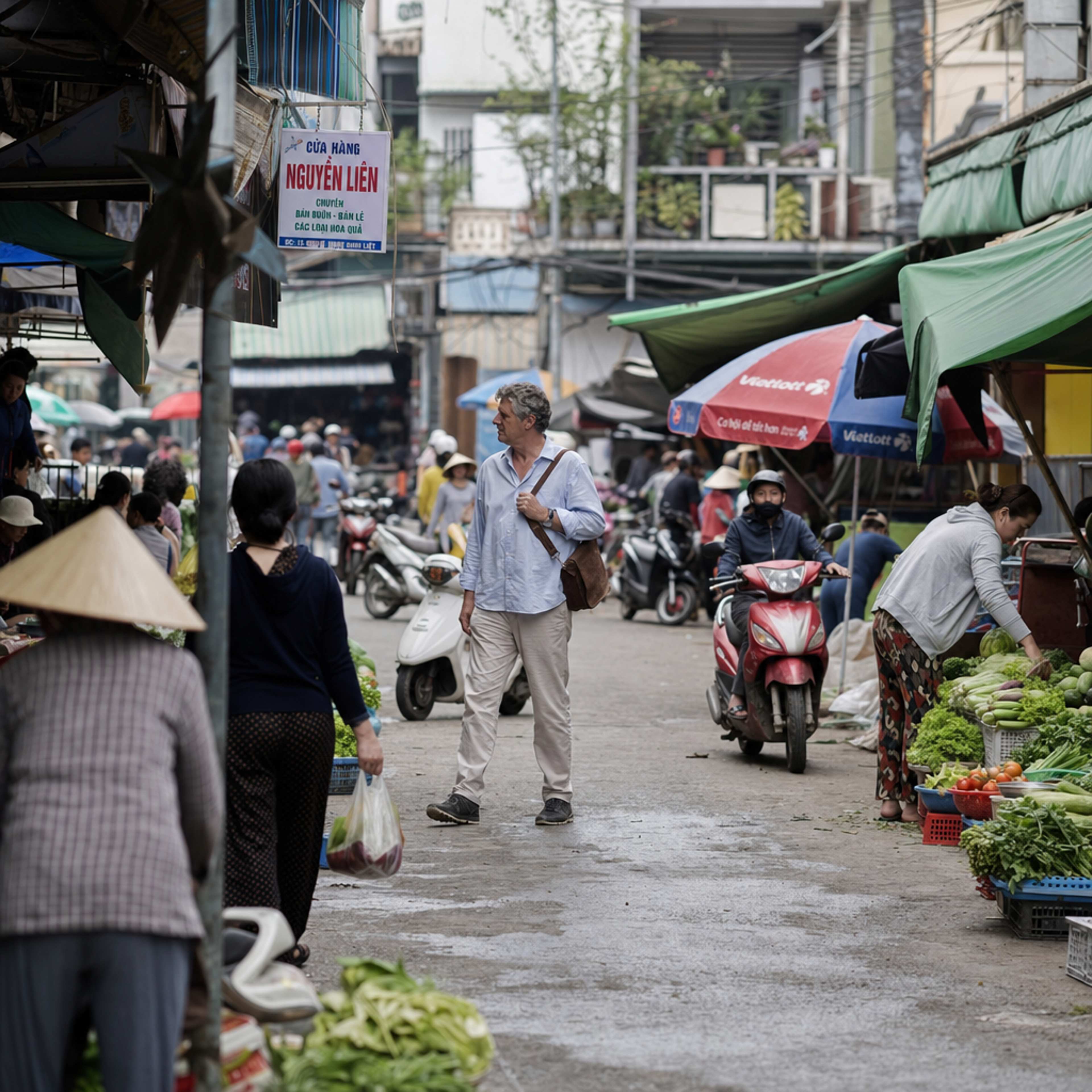

Just steps away from Notre-Dame Cathedral and the Central Post Office, there’s a pedestrian street where the usual soundtrack of Saigon fades into something noticeably calmer.
Nguyễn Văn Bình Book Street, commonly known simply as Book Street, is a dedicated cultural space in District 1 lined with bookstores, publishing houses, and small cafés. In a city defined by movement and momentum, this short stretch of pavement offers something slower. In this article, I’ll cover its history, layout, atmosphere, what you’ll find there, and what to expect when visiting one of Ho Chi Minh City’s most distinctive public spaces.
First Impressions: Stepping Off the Main Road

District 1 rarely pauses as Nam Kỳ Khởi Nghĩa and surrounding roads are constant streams of motorbikes, buses, and taxis. But the moment you turn onto Book Street, vehicles disappear, and the absence of engines is immediate and noticeable.
The street is not large, roughly 100 metres long, but it feels intentionally designed. Trees arch overhead, providing natural shade, red brick paving replaces tarmac, and benches are placed between bookstore units, inviting people to sit rather than rush.
When you first walked in, you would expected something more commercial. Instead, it felt organised and restrained, with just rows of open-air bookshops and people browsing quietly, which, for central Saigon, feels unusual.
The History and Purpose of Book Street

Nguyễn Văn Bình Book Street officially opened in January 2016. The project was part of a broader initiative by Ho Chi Minh City authorities to promote reading culture and provide a permanent platform for publishers and literary events.
Rather than creating a temporary festival space, the city designated an entire pedestrian street exclusively for books. Publishing houses were invited to open permanent stalls,a nd over time, the street developed into a stable cultural zone rather than a short-lived experiment.
Its location was carefully chosen. Book Street sits directly between two of the city’s most recognisable landmarks:
- Notre-Dame Cathedral Basilica of Saigon
- Saigon Central Post Office
By positioning it here, the city connected intellectual culture with historical architecture. French colonial façades surround the area, giving the street a backdrop that already carries cultural weight.
Since opening, Book Street has consistently hosted book launches, exhibitions, discussions, and educational programs. It has become a reliable fixture in the city rather than a novelty.
What You Will Find Along the Street

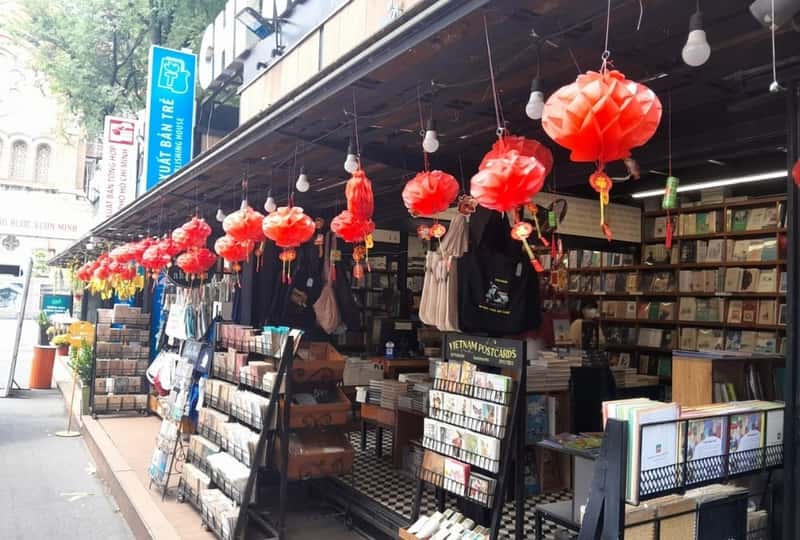
The bookstores along Nguyễn Văn Bình are operated by major Vietnamese publishers and independent book retailers. Most of the titles are in Vietnamese, reflecting the local readership, but several stores carry English-language sections.
Categories commonly found include:
- Contemporary Vietnamese fiction
- Historical and political works
- Translations of international bestsellers
- Business and self-development books
- Art, design, and photography publications
- Children’s literature
- Language-learning materials
Some shops specialise in discounted books, while others present carefully curated selections in modern, minimalist interiors. A few focus specifically on academic publications, appealing to students from nearby universities.
In addition to books, some stores sell stationery, journals, bookmarks, and literary-themed souvenirs. The atmosphere remains focused on reading rather than retail excess.
It’s possible to browse slowly without feeling pressured to buy. Staff generally allow visitors to explore freely.
Architecture and Design Details
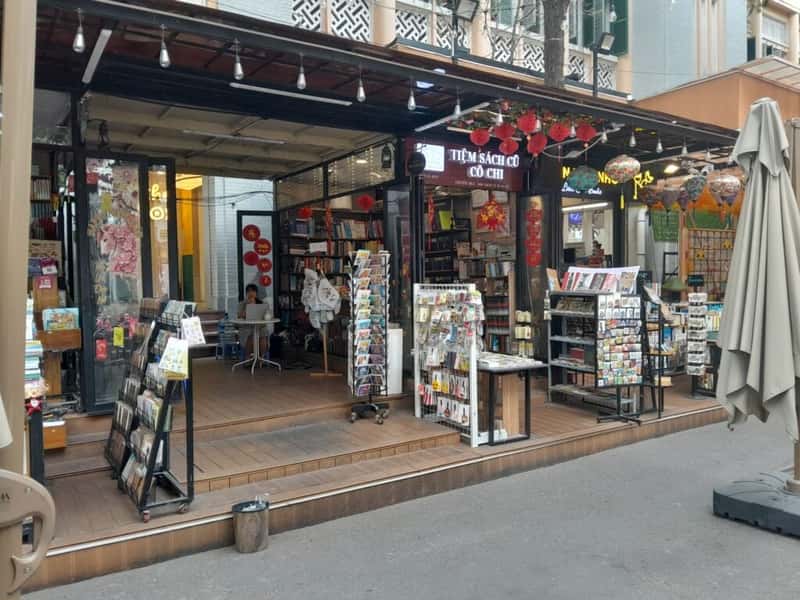
Although compact, the street’s design plays a significant role in its appeal. The red brick paving creates a cohesive visual identity. Trees planted along the centre and edges provide consistent shade, making it manageable even in midday heat and decorative lighting installed overhead gives the street a softer tone in the evening.
The surrounding colonial buildings-cream walls, green shutters, traditional balconies-frame the space with historical character. Behind them, modern office towers rise, reminding you that this is still central Saigon.
Book Street does not attempt to replicate European pedestrian zones entirely, nor does it resemble a traditional Vietnamese market. It sits somewhere between those influences.
Because it is pedestrian-only, families with young children, elderly visitors, and students all move comfortably through the space. That accessibility contributes to its steady popularity.
Cultural Events and Community Role
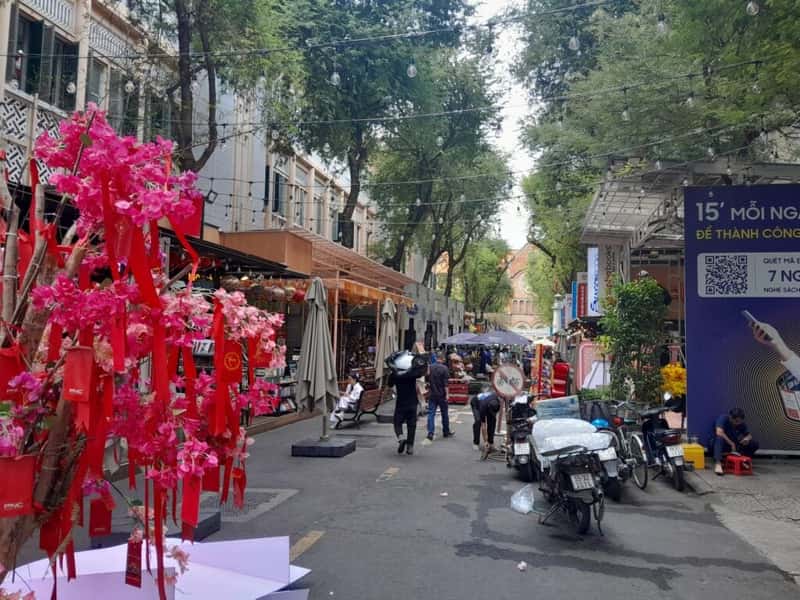
Beyond daily browsing, Nguyễn Văn Bình Book Street functions as an active cultural venue.
Publishers regularly organise:
- Book launches
- Author meet-and-greet sessions
- Public discussions
- Educational workshops
- Children’s reading activities
On weekends, the street often feels livelier. Temporary displays appear, and speakers and small stages may be set up for talks. During Vietnamese Book Day and other national cultural events, attendance increases significantly.
What’s important is that these events feel organised rather than chaotic. Even when busy, the street retains a degree of order. It’s one of the few public spaces in District 1 specifically designed around intellectual and cultural exchange rather than commerce or entertainment.
Atmosphere at Different Times of Day

The experience on Book Street shifts depending on when you visit.
Mornings are calmer and less crowded. Students and early visitors browse quietly. The shade from trees makes it comfortable before midday heat sets in.
The afternoon is slightly busier as office workers stop by after lunch and the cafés see more activity.
During the Evening the lighting becomes more noticeable, giving the street a warmer tone. It often feels more social at this time, with groups gathering near cafés.
Even when relatively busy, it never feels overwhelming in the way nearby tourist streets sometimes do.
Location and Practical Information

Nguyễn Văn Bình Book Street is located in District 1, directly beside:
- Notre-Dame Cathedral Basilica of Saigon
- Saigon Central Post Office
Because of its central position, it is easy to include in any walking itinerary through Ho Chi Minh City’s historic core.
Practical tips:
- Allow 45–60 minutes to browse comfortably.
- Weekends may include organised events.
- Most stores accept both cash and card payments.
- Combine your visit with nearby landmarks for a half-day route.
There is no entrance fee, and the street remains open as a public pedestrian space.
Why People Love This Book Street
Ho Chi Minh City develops rapidly as new towers rise constantly, shopping malls expand, and digital technology dominates daily life. In that context, a permanent pedestrian street dedicated to books feels deliberate.
It signals that despite economic growth and digital transformation, there is still institutional support for reading and publishing culture. The space is not hidden. It sits directly in the city’s most visited district.
Standing there, surrounded by colonial architecture on one side and modern high-rises behind it, you can see how the city layers past and present. French-era structures, Vietnamese publishing houses, contemporary cafés, and young readers.
Nguyễn Văn Bình Book Street offers a cultural pause in the middle of District 1. Though only about 100 metres long, it combines bookstores, cafés, colonial surroundings, and pedestrian design into a cohesive space that encourages browsing and reflection.
It won’t take long to explore, but it adds depth to any visit to central Ho Chi Minh City. If you’re already near the cathedral and post office, step onto the street and take your time. In a city known for speed, a place dedicated to books remains quietly significant.