On Royal Caribbean, a pool chair left unattended for more than 30 minutes can have your belongings removed. On Carnival, the crew clears it if you haven’t returned within 40 minutes.1
Lose track of the towel itself and the charge is $22 on Carnival and $25 on Royal Caribbean.2 And that’s before the morning sun gets involved.
The fifteen moves below cover the chair, the towel, the shade and your skin. Some are small enough to feel silly, until you see what they save.
The last one has nothing to do with chairs. If you take a daily pill, it matters more than the other fourteen, so stay with the list until the end.
Start with the number that decides who keeps a chair.
#15 – Read the Posted Time Limit Before You Claim a Chair
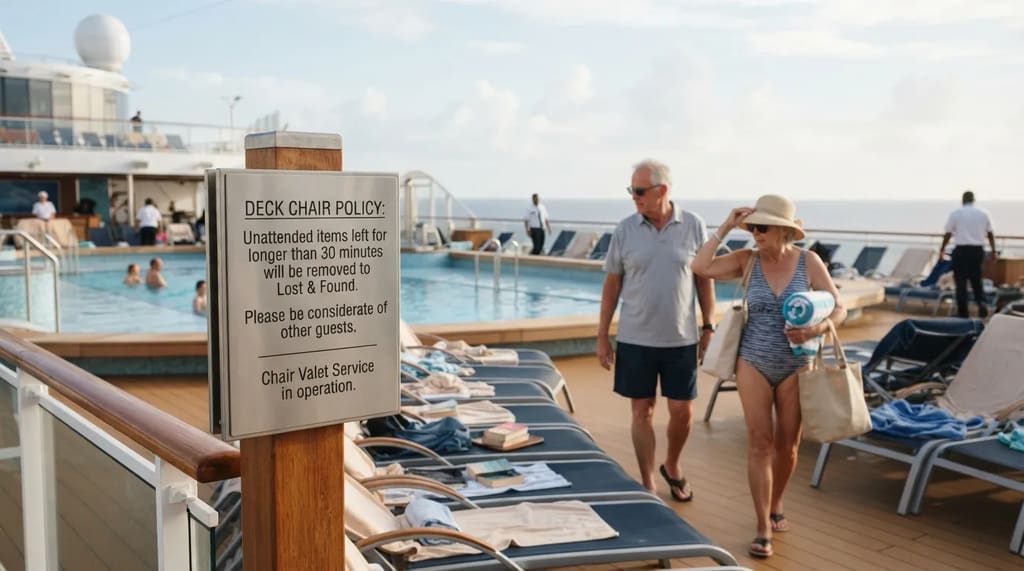
The written limit on an empty lounger differs by cruise line, and the gap is just ten minutes. That gap can be the difference between keeping your seat and walking across the ship to collect your things.
Royal Caribbean says a chair left unattended for more than 30 minutes, with no sign its guest is returning, will have its belongings moved to lost and found. MSC also uses 30 minutes, while Carnival allows 40.3
Keep this in your head: Royal Caribbean and MSC, 30 minutes; Carnival, 40. These windows exist so you can swim, eat or visit the restroom without losing your seat.
Carnival’s senior cruise director described 40 minutes as a fair allowance for guests who get up to eat, drink, swim or slide. That means a quick buffet run fits inside the rule, while a long morning away does not.
A written limit only helps if someone on your ship enforces it, and one question to the right crew member tells you whether anyone does.
#14 – Ask the Deck Crew Which Rules They Enforce
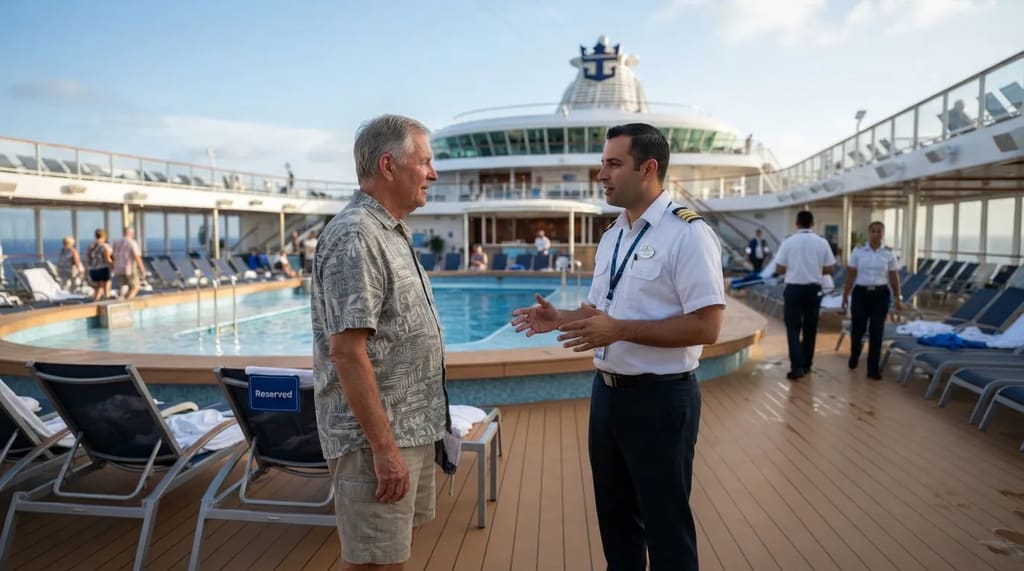
A rule can be printed clearly and still be applied unevenly on deck.
Royal Caribbean’s 30-minute limit is worded plainly. Even so, day-to-day enforcement varies sharply by ship, week and pool attendant team.
The posted number therefore tells you less than what the crew is doing that particular week. So ask: Ask the deck supervisor on day one whether the rule is being enforced.
A pool deck supervisor can tell you whether the team is actively running the policy that sailing, and the same conversation can point you toward calmer spots. Many ships have tucked-away areas with far fewer loungers than the main pool.
Don’t assume quiet means free of chair hogs, though. In one recent report from a Royal Caribbean ship, the shady spots on Deck 15 and the adults-only Solarium were popular with chair hogs.
The crew’s answer is a better guide than a deck’s reputation. Whatever they tell you, one early habit works against you on every line with a time limit, and it begins with a towel and a walk to breakfast.
#13 – Don’t Save a Chair Through Breakfast
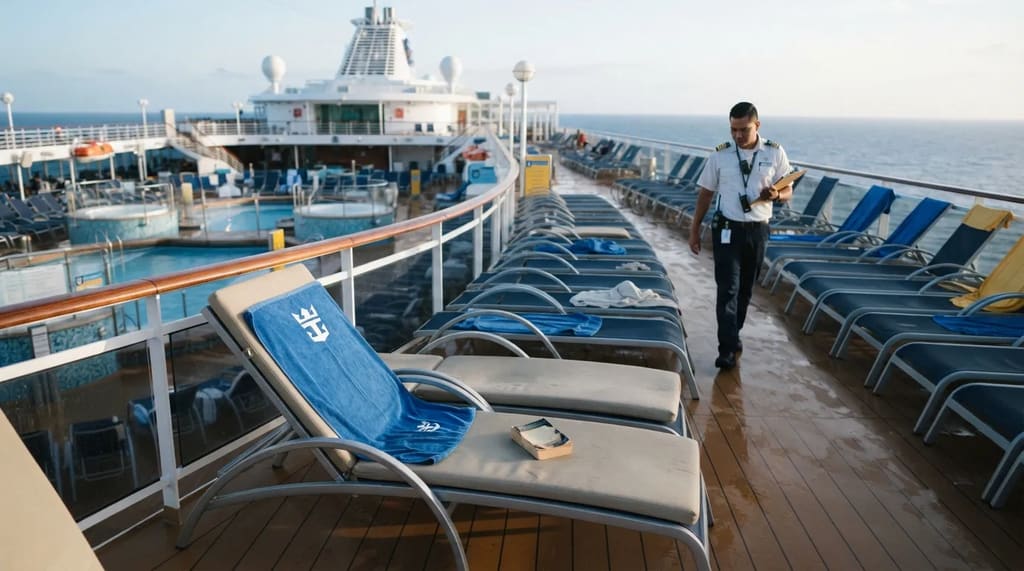
You drop a towel on a lounger at 7:00, head for a sit-down breakfast, and the clock starts without you.
Leaving a towel to hold a chair through a full breakfast is a bad bet on any line with a limit. Royal Caribbean doesn’t object to an item left while you’re in the pool or hot tub, in the restroom or grabbing a snack.2
A seated meal usually runs well past 30 minutes, so it falls outside that allowance. The cost of losing the bet depends on the line.
On Carnival, crew members place a time-stamped notice on the chair and remove your belongings if you don’t return within 40 minutes. On Royal Caribbean, they go to lost and found.
Quick Compare
- Royal Caribbean: 30 minutes, then belongings go to lost and found
- Carnival: 40 minutes, with a time-stamped notice placed first
- MSC: 30-minute limit, same as Royal Caribbean
Either way you’ve swapped a chair for an errand across the ship. Eat first, then claim a chair when you can sit in it.
Hold a chair for 30 to 40 minutes at most. Early morning is when the best spots are open anyway, so you give up almost nothing by sitting down after breakfast, and you keep your towel.
#12 – Find Out Where Cleared Belongings Go
A sticker on your lounger is a countdown, not a verdict.
On Carnival, crew attach a card or sticker noting when they saw the chair empty. If the chair stays unused beyond the allowed window, they clear it and move the belongings to a central location.
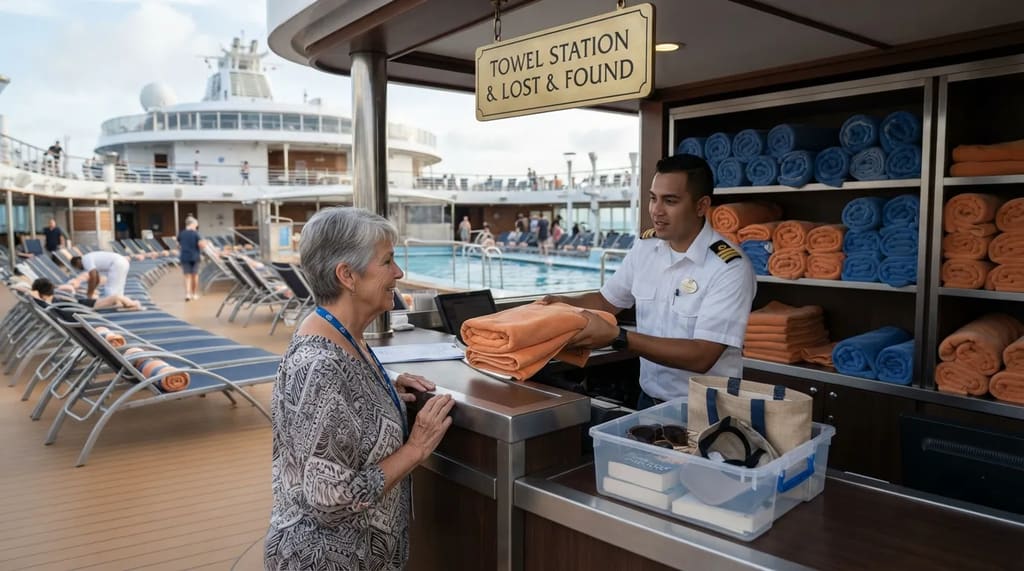
That location is the towel hut. If you return before the time is up, you can simply sit down and the notice no longer matters.
Carnival: towel station. Royal Caribbean: lost and found. That’s where to go first when a towel or book has vanished from a chair.
Ask there before you assume anything is gone, because it saves you a search of the whole ship.
The towel itself is the next problem, because on a windy deck one blue towel looks exactly like the next.
#11 – Clip Your Towel to the Chair
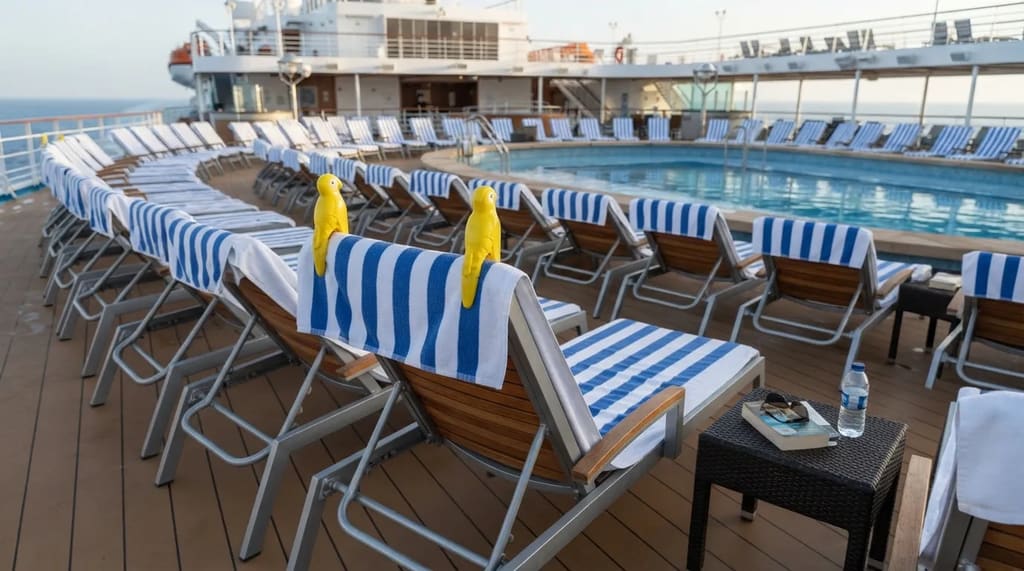
Pool towels on a ship are identical, and that works against you.
Every guest gets the same pool towels, so it’s easy to mix yours up with someone else’s by the pool. A breeze can also lift a loose towel off a lounger.
Towel clips stop towels blowing away and make it easy to recognize your own sun lounger. That second benefit matters more than it sounds.
When you come back from a swim, a row of loungers with matching towels all look alike. A clip in a color you’ll spot from the water settles it in a second.
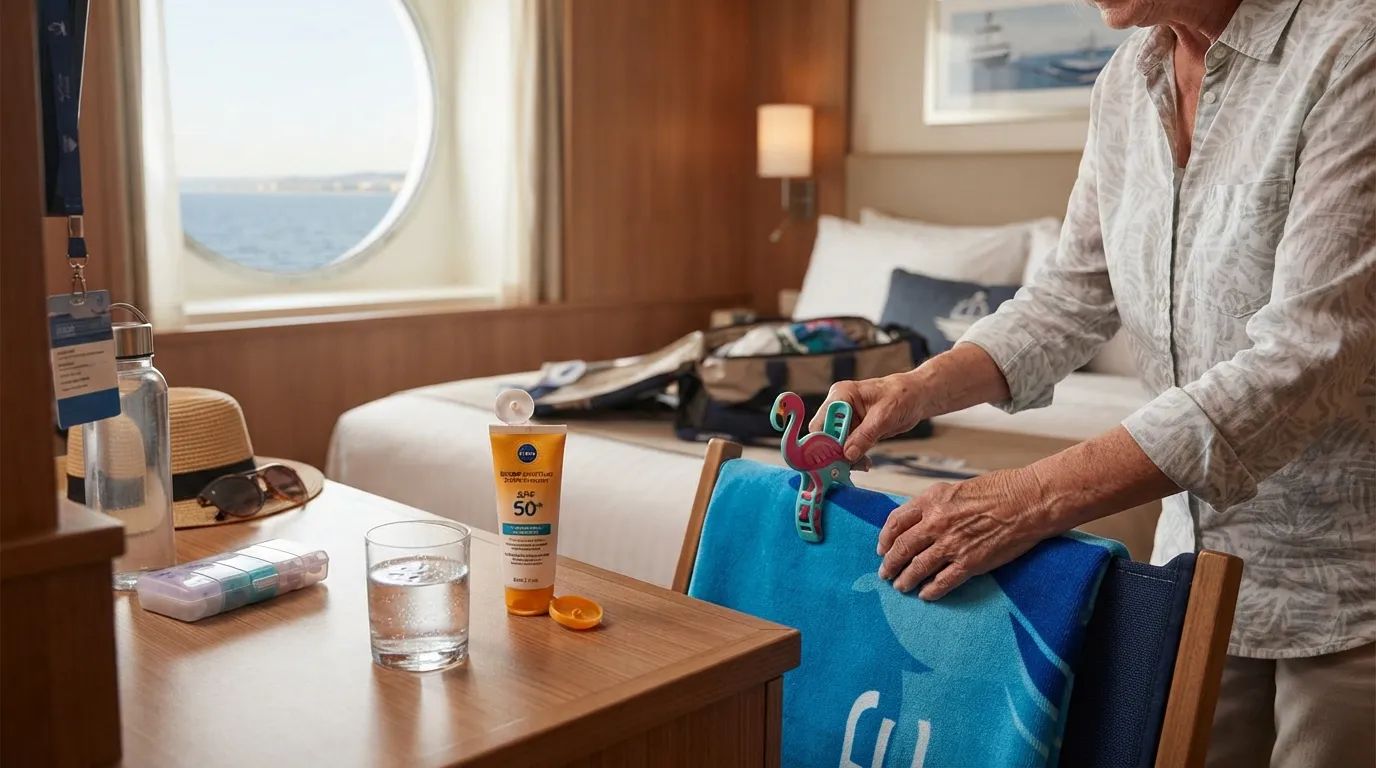
Pack two towel clips; they cost a few dollars and weigh almost nothing. Bring one per chair if you’re traveling as a pair, since a towel clipped to your chair is far less likely to end up in someone else’s bag.
Which towel you clip matters too, and one towel in your cabin shouldn’t leave the room.
#10 – Take the Pool Towel, Not the Cabin Towel

Cabin towels and pool towels look alike, but they don’t do the same job.
Cabin towels are thinner and aren’t meant for the pool or beach, and taking stateroom towels to the pool is generally discouraged. Pool towels come from the stations near the pool, and your cruise card is usually the key.
On Royal Caribbean, a crew member scans the towel to your account, and you return it to any towel station. You don’t need to carry a wet towel back to the cabin.
On MSC you can usually swap a wet towel for a clean one at a towel exchange station. Each line runs its own system, so learn yours at the first station you pass.
Many ships issue towel cards or tokens to control pool towel distribution. Ask how your ship tracks towels before you take the first one.
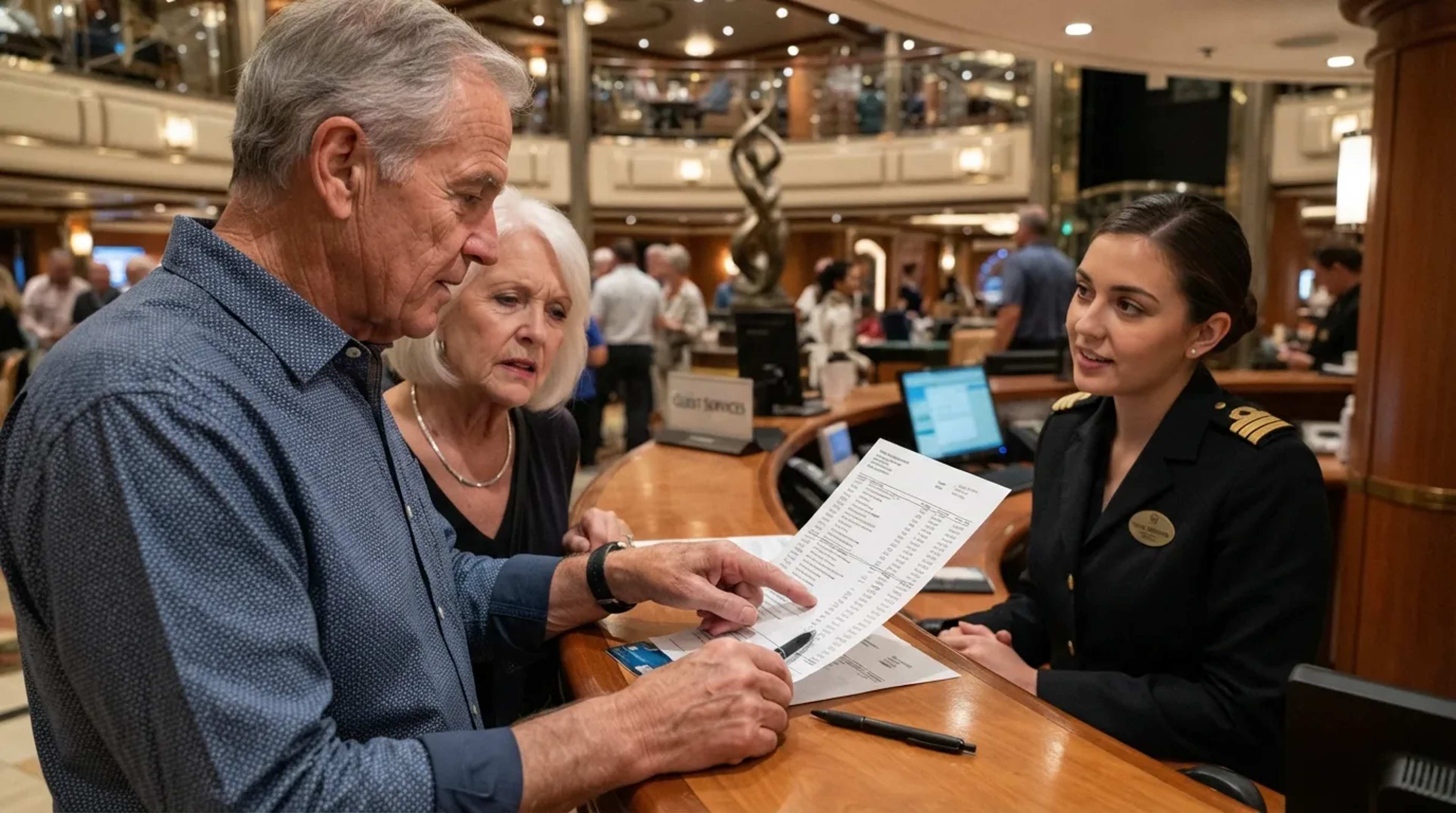
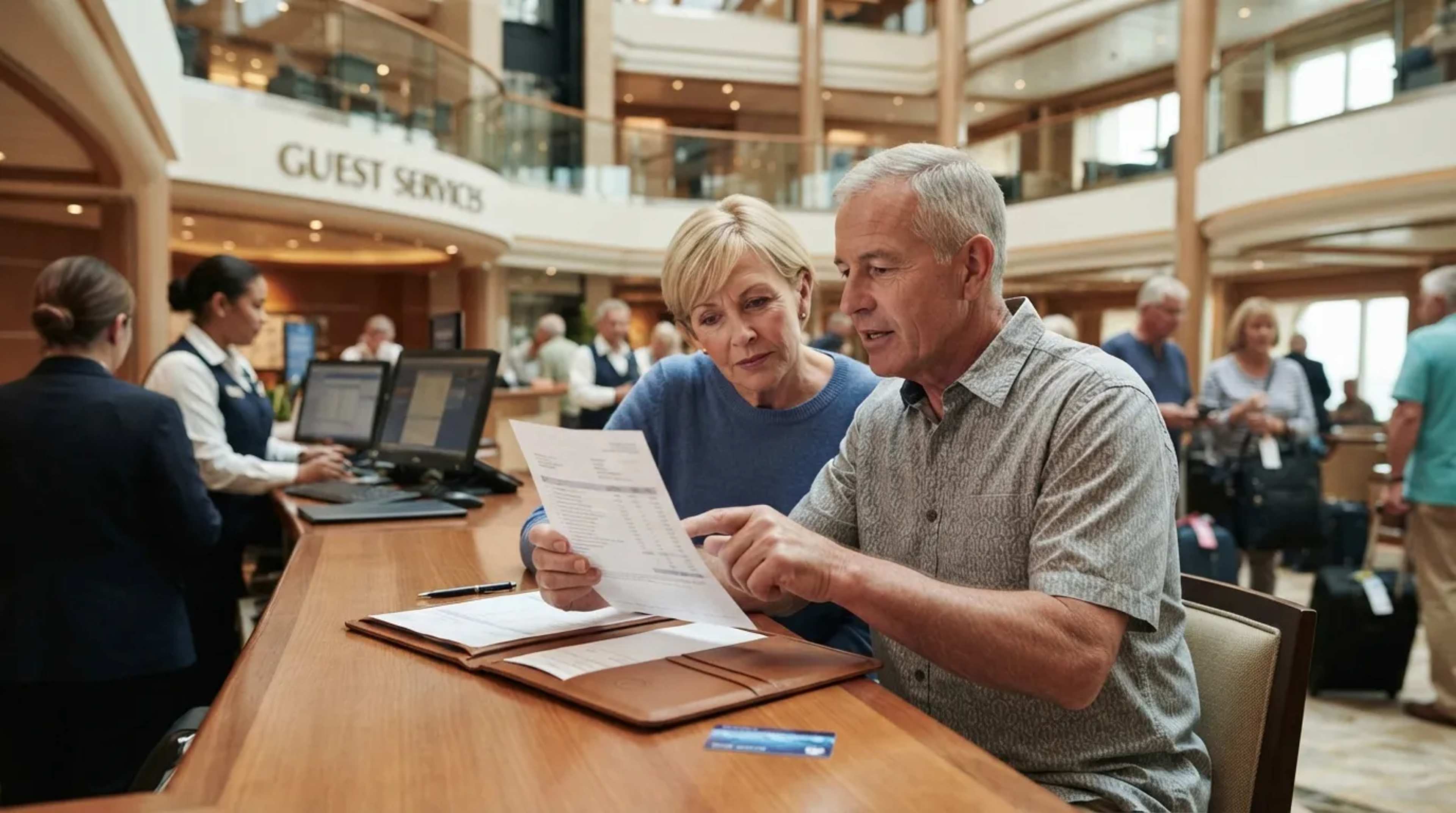
It takes thirty seconds and affects the bill you’ll see on the last morning. Getting the right towel is the easy part, and getting every one of them back is where the money is.
#9 – Count Your Towels Before You Hand Them Back
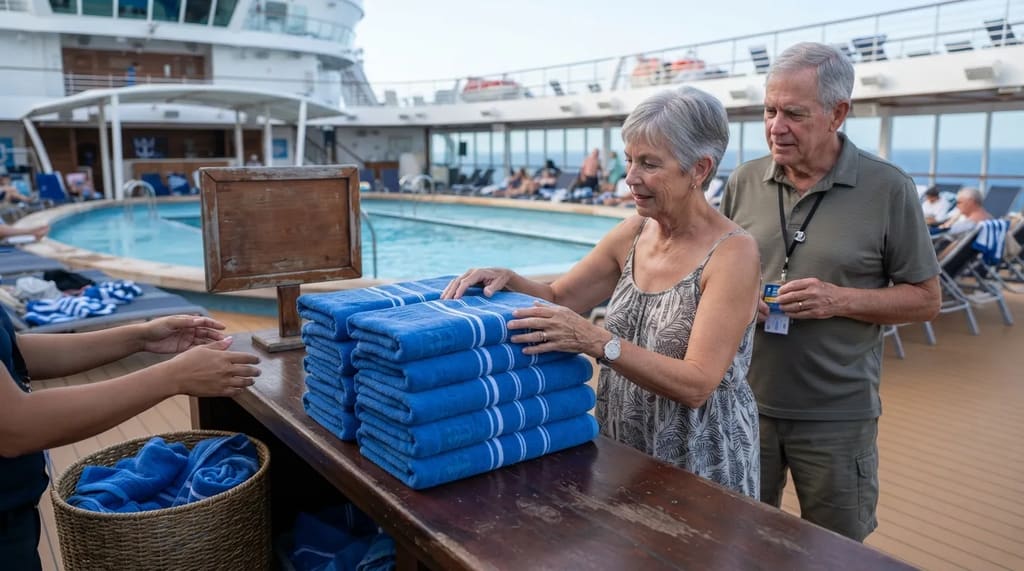
The fee for a towel you don’t return is $22 on Carnival and $25 on Royal Caribbean and Virgin Voyages.
Carnival charges $22 per towel, and Virgin Voyages charges $25 for each beach towel not returned to your cabin by the end of the cruise. Royal Caribbean adds $25 to your onboard account for each towel short of the number you checked out.
Fast Facts
- Carnival: $22 per towel
- Royal Caribbean: $25 for each towel short of your checkout count
- Virgin Voyages: $25 per beach towel not returned by the end of the cruise
- Four missing towels on Royal Caribbean: $100
The charge appears after you’ve left the pool deck. The fee has a history: Carnival introduced its towel fee to address towels being left in Cozumel taxis.4
That’s why you must return the same number of towels you checked out. The count matters even if you never left the ship.
Scanning errors can add to the total. One Royal Caribbean guest reported being billed for six extra towels after an attendant scanned a card incorrectly.
Towels settled, the more important question is where the chair sits, and your own shadow tells you whether you’ve chosen well.
#8 – Use the Shadow Test Before You Settle Into Shade
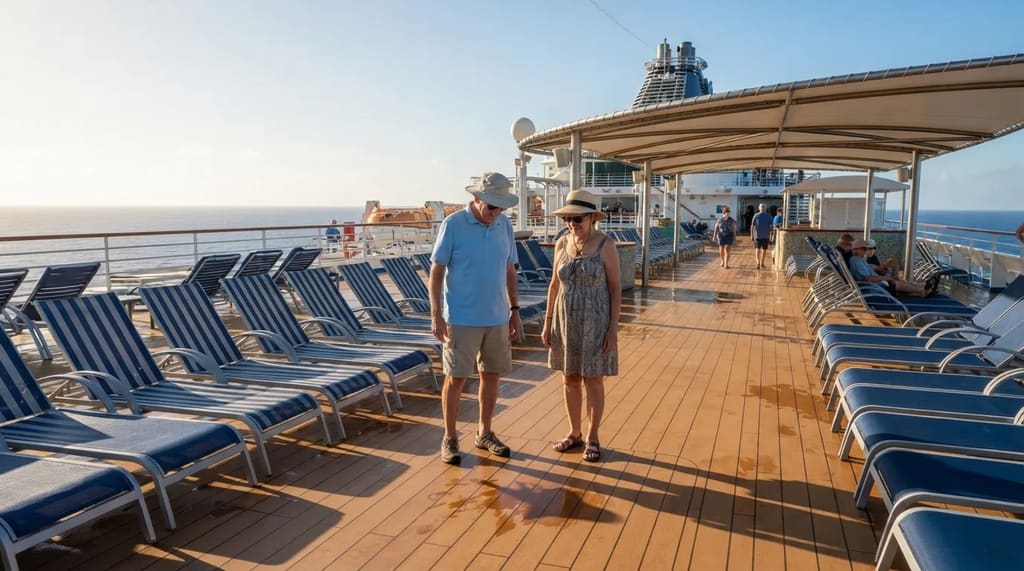
If your shadow is shorter than you are, the American Academy of Dermatology says to seek shade. You don’t need an app for that rule, just a look down.5
The sun’s rays are strongest from about 10 a.m. to 4 p.m., so a chair in direct sun is gentler at 8 than at noon. Your shadow shrinks as the morning goes on, and that’s your cue to move.
Shade is also the first thing hogs go after. In the Royal Caribbean report mentioned earlier, the shady spots on Deck 15 were popular with chair hogs.
If you want a shaded chair at 10, claim it by 9, while you can still sit in it. An umbrella or an awning doesn’t replace sunscreen.
Shade, clothing and sunscreen work as a set. The American Cancer Society, the FDA and the AAD recommend SPF 30 or higher along with protective clothing, hats and sunglasses.6
Shade handles the angle of the sun, but a number in your weather app tells you how hard it’s hitting, even when the breeze feels cool.
#7 – Check the UV Index and Wear the Hat
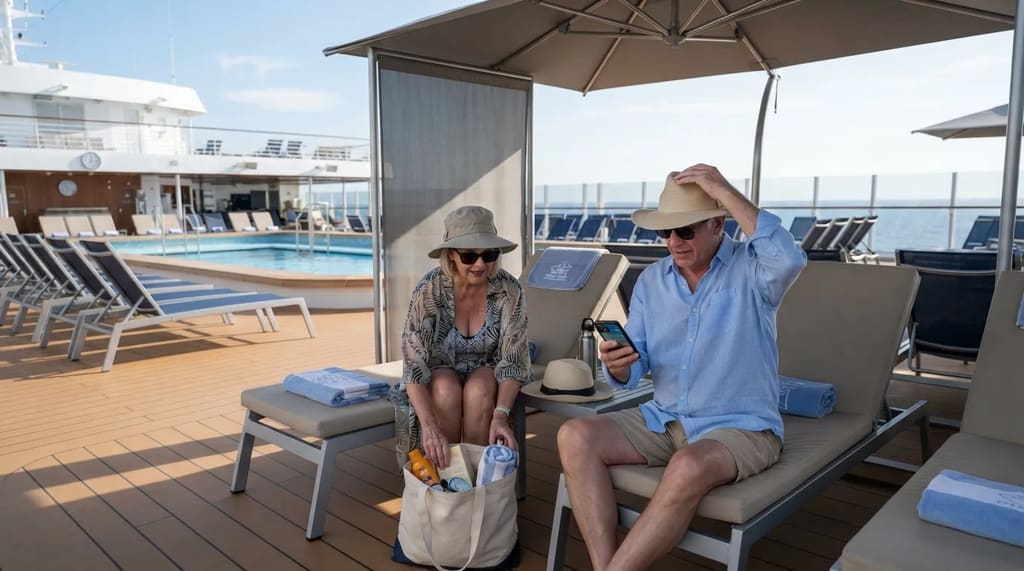
Feeling cool isn’t the same as being safe.
A higher UV Index means your skin can burn more quickly, even on cool or cloudy days. A sea breeze can make a deck feel mild while the index stays high.
Check the UV Index in your weather app before you leave the cabin. Then dress for the number.
A hat and sunglasses are part of the standard advice, not an optional extra. Put them in your tote or hang them by the door so they leave with you, because a hat left on the dresser protects nothing.
If the index is high, treat the chair as a place to sit under cover rather than a place to catch sun.
Your hat is only half the plan, and the cabin is where the other half should happen.
#6 – Put Sunscreen On Before You Leave the Cabin
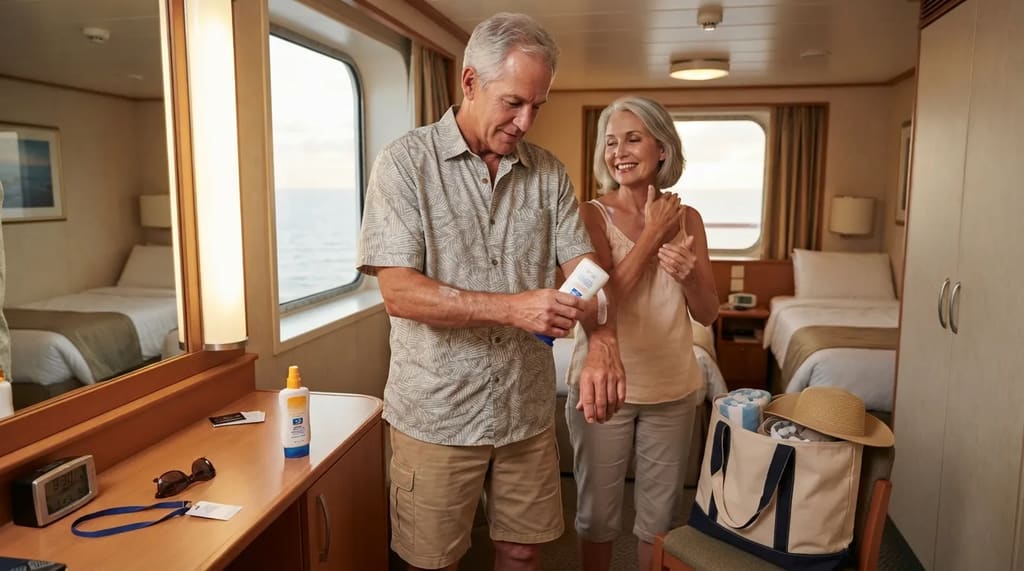
It takes about 15 minutes for your skin to absorb sunscreen and protect you.7
Put it on after you sit down on the pool deck, and your skin is unprotected and can burn during that first stretch. So make sunscreen part of getting dressed.
Apply it in the cabin, about 15 minutes before you go out. A cabin application also means you won’t be hunting for a bottle on a crowded deck.
Read the label for three things: SPF 30 or higher, water resistance, and broad-spectrum coverage, which protects against both UVA and UVB rays.7 If a sunscreen lacks any of those, leave it in the drawer.
Timing is half the job. The amount is the other half, and the usual coat falls well short of what the label assumes.
#5 – Use a Full Ounce and Don’t Skip Your Back
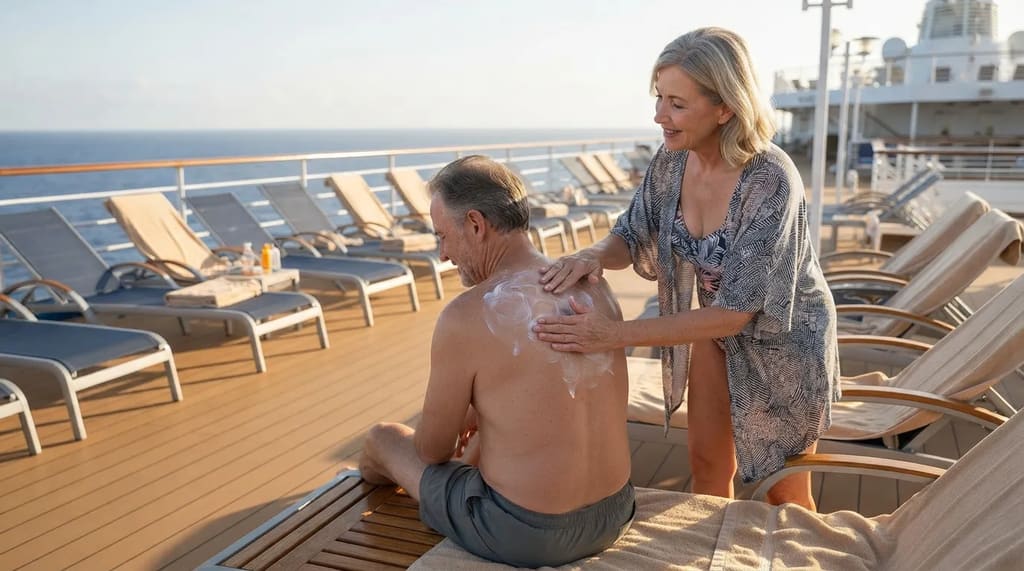
Most adults need at least one ounce of sunscreen, about enough to fill a shot glass, to cover all exposed skin.
That’s more than it looks like. Many people apply only about 20 to 50 percent of the amount needed to reach the SPF on the label, so a thin coat delivers a fraction of what the bottle promises.
Use about one ounce for all exposed skin. Cover the ears, neck, hands and tops of your feet too.
For your back, ask someone to help you or use a spray. For your lips, use a lip balm with SPF 30 or higher.
Makeup or daily moisturizer with SPF doesn’t replace this. Typical daily amounts aren’t enough to reach the advertised SPF, so treat that as a small bonus and put real sunscreen on top before you go out.
Even a perfect coat has a limit of about two hours, and the towel in your hand shortens it.
#4 – Reapply Every Two Hours and After Toweling Off
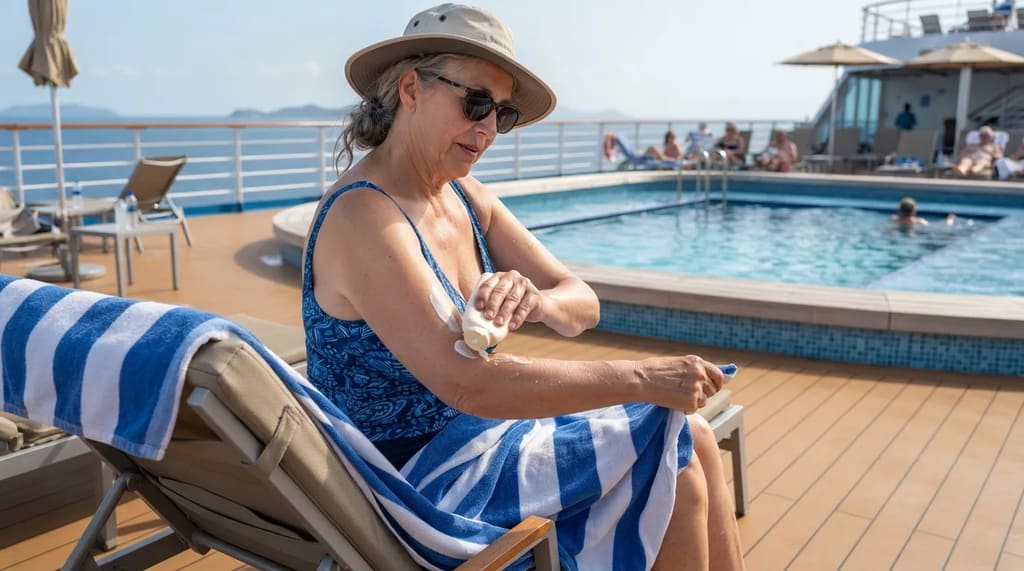
In an American Academy of Dermatology survey, only 33% of adults said they typically reapply sunscreen every two hours.
The rule is simple: reapply every two hours, or after swimming, sweating or toweling off.5 That last item connects to your towel, because it wipes lotion off along with the water.
So the moment you dry off after a swim, put on a fresh coat. Don’t count on the label to do the work.
A Wake Forest dermatologist suggests looking for “water-resistant 80 minutes” and “broad-spectrum,” which tells you that water resistance has a time limit. Reapply at least every two hours, and right after toweling off.
At a Glance
- In the cabin: apply about 15 minutes before you head out
- How much: about one ounce for all exposed skin
- On the label: SPF 30 or higher, broad-spectrum, water-resistant
- Redo it: every two hours and after toweling off
Start a timer when you apply the first coat in the cabin, since the American Cancer Society suggests setting an alarm on your watch or phone.6 A coat put on at 8:30 is due again by 10:30.
Related Stories From Travelbinger



Sunscreen protects skin from the outside, but the next move is about the inside, and your body warns you less than you’d expect.
#3 – Drink Before You Feel Thirsty

The thirst signal weakens with age, so waiting until you’re thirsty means you’re already behind.
Sweat glands become less active with age, so the body cools less efficiently, and thirst weakens enough that dehydration can set in before you feel it. A senior may feel fine while entering mild-to-moderate dehydration.
A morning in the sun without a drink can catch up with you before you notice. Drink water even when you aren’t thirsty.
Take a bottle to the chair and finish a glass before you leave breakfast. If you’ve been cutting back on water to avoid walking to the restroom, that’s a bad trade, because dehydration worsens when people reduce fluids to manage bathroom visits.
The restroom trip is short, and the 30-to-40-minute chair window from earlier covers it. Water is the prevention, and the symptoms it prevents follow a pattern that your travel partner should know.
#2 – Agree on a Heat Check-In With Your Companion
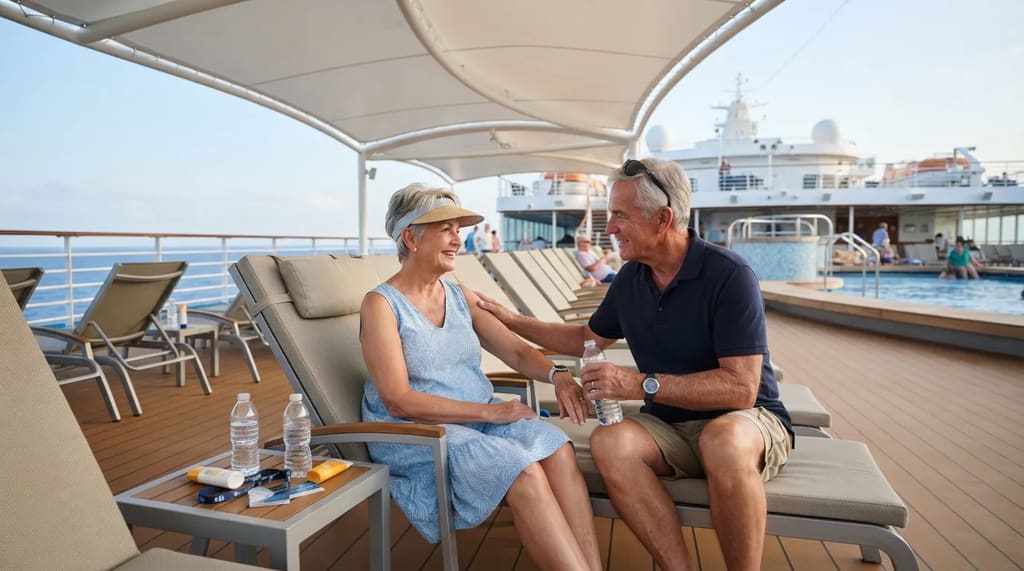
Heat illness rarely starts with a collapse.
Fainting, cramps and heat exhaustion can progress to heat stroke if left untreated. The early signs are easy to wave off, since dehydration may show up as lightheadedness and fatigue.
On a vacation morning, that feels like a late night. So make an agreement before you leave the cabin.
Pick one person to check on you, and check on them. The CDC’s guidance for clinicians says patients on medicines that raise heat risk should name a point of contact to check on them.
If you cruise alone, tell someone aboard that you’ll check in at a set time. When either of you feels dizzy or unusually tired, stop, move into shade and drink water.
If symptoms don’t ease quickly, go to the ship’s medical center. All of this assumes your body reacts to sun and heat in the usual way, and the most important item on this list is the one that finds out whether it does.
#1 – Check Your Pill Organizer Against Sun and Heat Warnings
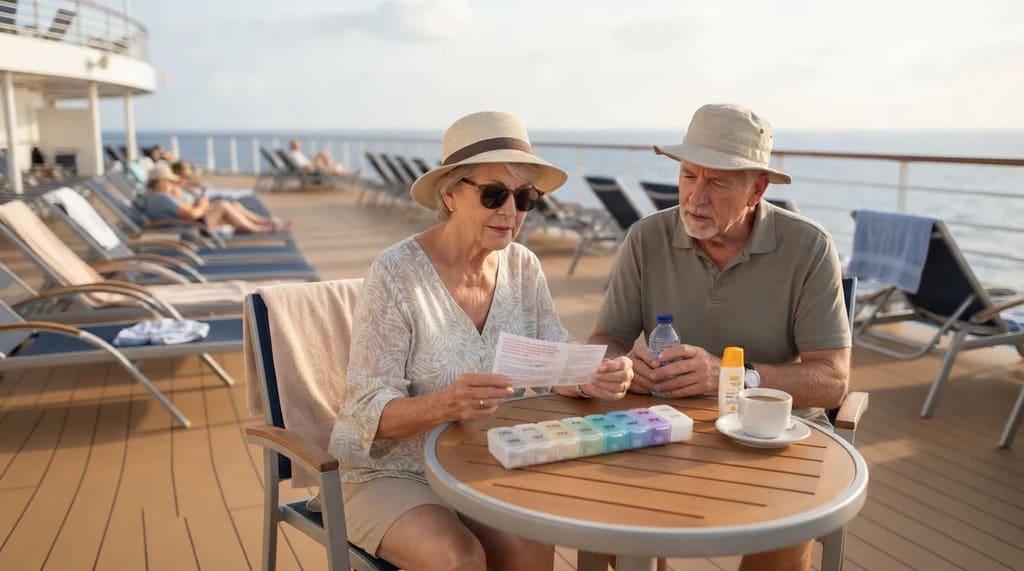
Your pill organizer may be the least-checked thing you bring to the deck. The FDA lists antibiotics, antifungals, antihistamines, cholesterol-lowering drugs and retinoids among medicines that raise the risk of sun sensitivity.
Statins such as simvastatin, atorvastatin, lovastatin and pravastatin cause photosensitivity. The CDC says tetracyclines, fluoroquinolones and some antifungals can raise sun sensitivity and cause a sunburn-like rash.
That rash can appear a few hours to a few days after exposure, so the damage may show up after you’ve left the deck. Heat is a separate risk.
Diuretics speed fluid loss and raise dehydration risk, and beta blockers reduce blood flow to the skin, which keeps heat in. If you take either, the water habit and the check-in from the last two moves matter even more.
Worth Knowing
- Sun sensitivity: antibiotics, antifungals, antihistamines, cholesterol-lowering drugs and retinoids
- Delayed rash: it can appear a few hours to a few days after exposure
- Heat risk: diuretics raise fluid loss, and beta blockers reduce blood flow to the skin
Not everyone who takes these medicines will react, so don’t stop anything on your own. Ask your doctor or pharmacist about sun and heat warnings before you sail.
That includes any daily supplements. If something is flagged, the routine from sunscreen to the two-hour timer is your protection.
What Gets Settled Before You Reach the Deck
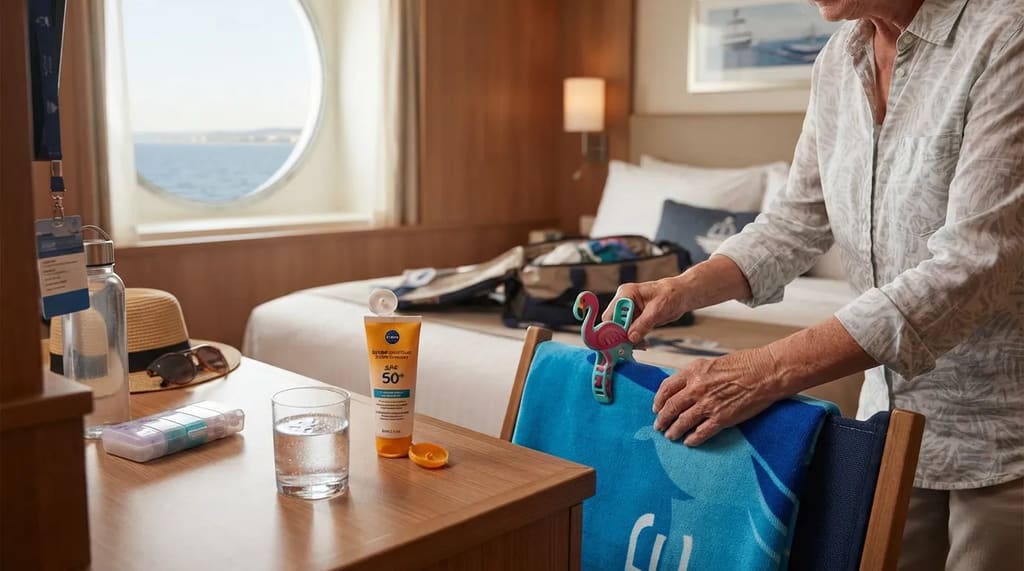
Every move on this list happens before you settle in: the clip on the towel, the coat of sunscreen, the glass of water, the question to your pharmacist.
The chair itself is the least important part, because a lost lounger costs you a few minutes and a burn or a heat problem can cost you the day.
Spend your first hour on the preparation. The best seat on deck means little if the rest of your day ends up in a cabin.
Which sun or towel habit do you do before you leave the cabin, and where did you pick it up?
- Carnival 40-Minute Rule: https://parade.com/news/carnivals-brand-ambassador-officially-weighs-in-on-the-chair-hog-debate-were-not-charging-for-loungers
- Royal Caribbean Chair Policy: https://www.cruisehive.com/chair-hogging-frustrations-loom-despite-royal-caribbeans-policy/159188
- Cruise Line Chair Comparison: https://travel.yahoo.com/cruises/articles/cruise-lines-fighting-chair-hogging-154104445.html
- Carnival Towel Fee History: https://www.yahoo.com/lifestyle/carnival-cruise-line-explains-board-134800449.html
- AAD Practice Safe Sun: https://www.aad.org/public/everyday-care/sun-protection/shade-clothing-sunscreen/practice-safe-sun
- ACS How to Use Sunscreen: https://www.cancer.org/cancer/risk-prevention/sun-and-uv/how-to-use-sunscreen.html
- AAD How to Apply Sunscreen: https://www.apderm.com/blog/apply-sunscreen-american-academy-dermatology/