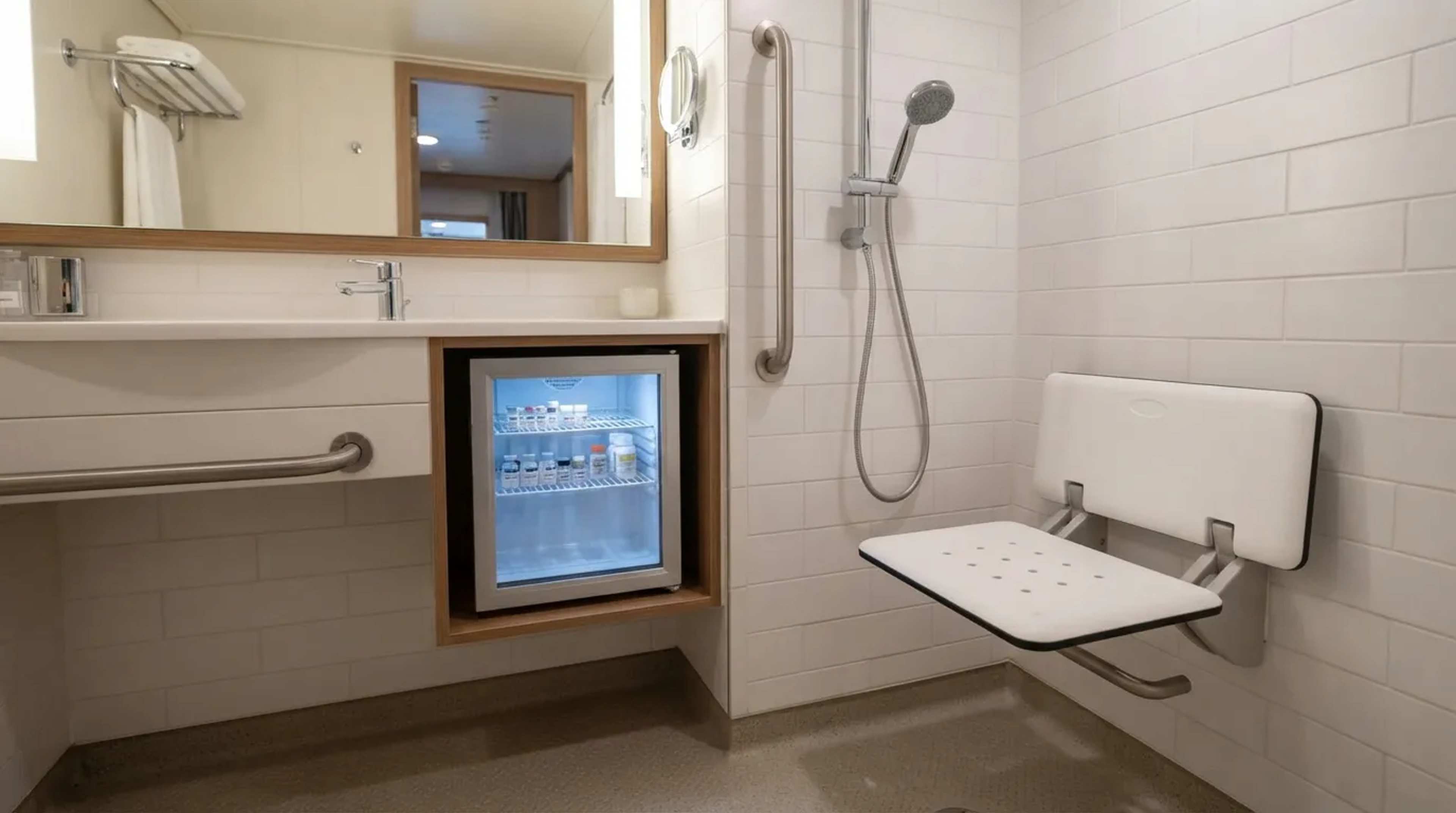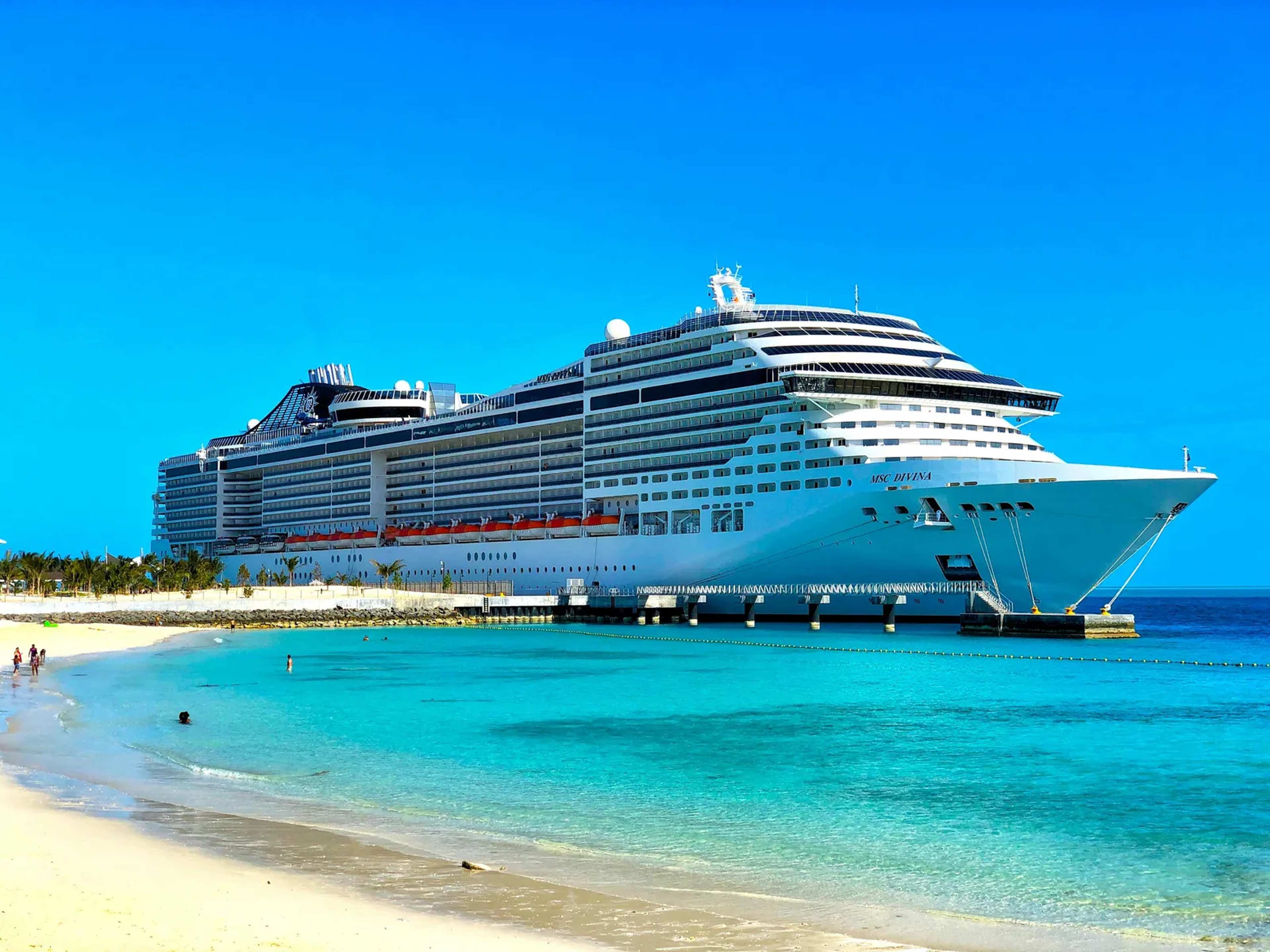
While most passengers charge toward the buffet, the veteran cruisers are quietly flushing toilets and opening cabinet doors. They aren’t being fussy, because they know your checked bags may not reach the cabin door until a few hours after you board.
That gap is the best inspection window you’ll get. A balky toilet, a safe that won’t reopen or a medication fridge that isn’t cold all cost you more the later you find them.
Stay to the end, because the last check on this list is the one where a wrong assumption can affect your health, and its fix has to be arranged before you reach the cabin. Start with the easy ones, beginning with the dial on the wall.
#15 – The Thermostat Nobody Set for You
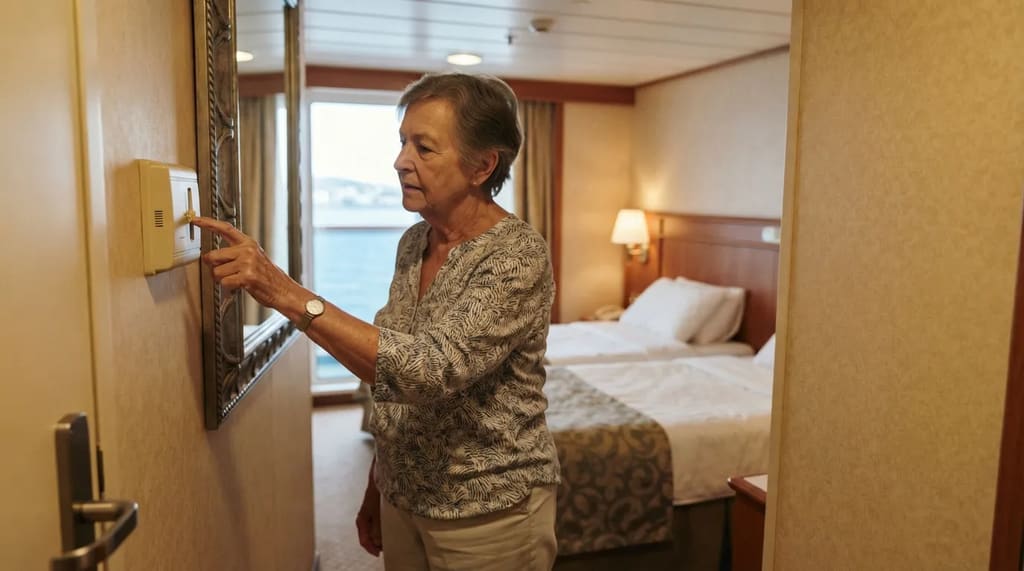
Your cabin’s air conditioning may still be set for the last guest, so find the thermostat before you find the balcony. On newer Royal Caribbean ships you can pick an actual temperature, while older ships use a slider.
On a slider ship there’s no number to aim for, so nudge it a little and give the air several minutes to respond before you judge it. Royal Caribbean’s own guidance includes testing the air conditioning during your first look around the room.
A cabin that stays warm at night costs you sleep all week, so report a room that won’t cool the same day. If the thermostat isn’t working properly, tell your cabin steward as soon as possible.
The opposite problem has an easy fix. Stewards can bring extra pillows or blankets, hangers and ice, so a vent blowing across the bed doesn’t have to ruin your first night.
Speaking of the bed, the layout you walked into may not be the one you wanted.
#14 – Bed Layout, Pillows and a Quick Sheet Check
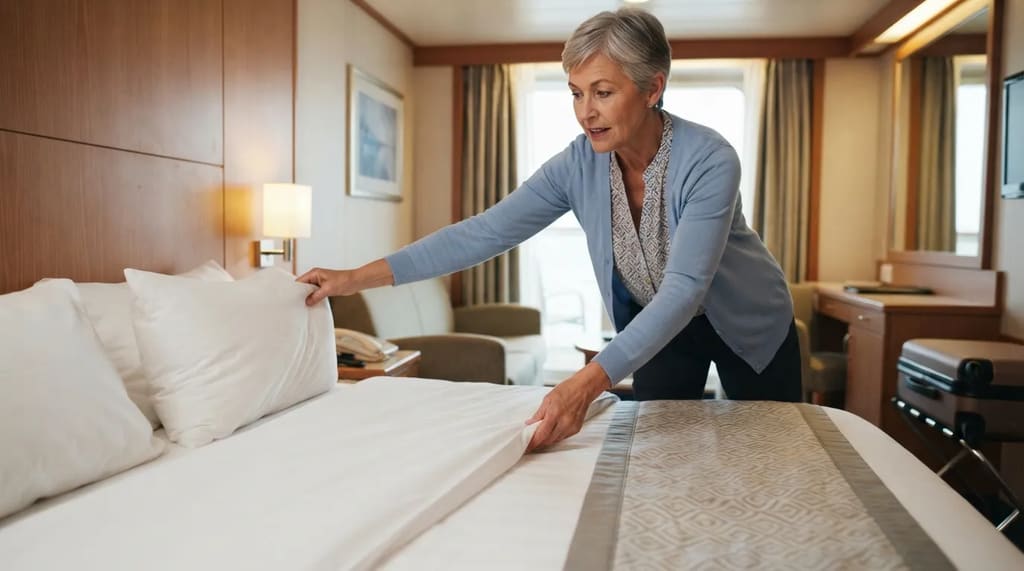
You’ll sleep in this bed for a week, so the layout deserves thirty seconds before you unpack. Make sure the beds are arranged the way you want them for the whole cruise, and if they aren’t, tell your steward, who will do their best to accommodate you.
Pick up a pillow and squeeze it. Stewards can often bring extra pillows, or a variety close to what you require, which matters if you have a stiff neck or a bad shoulder.
Then turn back a corner of the sheet. Bed bugs are rare on cruise ships, but a look for tiny blood spots is quick, and a thirty-second look now saves a room change later.
Once the bed is settled, step back into the corridor. A long hallway of identical doors costs you a minute every day unless yours looks different.
#13 – A Magnet Test on Your Cabin Door
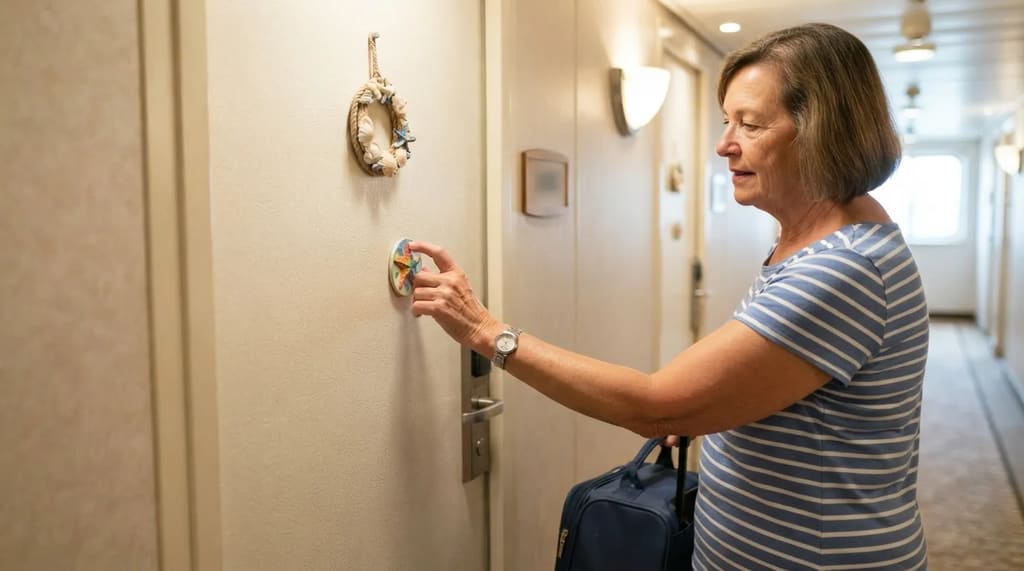
Cruise cabin doors are generally steel, and that quietly solves the problem of finding your room. You can’t use adhesives that might damage the paint, so magnets are the safe way to hang things.
A name sign, a small flag or battery-powered lights make your cabin easy to spot from down the hall. Names, LED lights and “I’m on vacation” signs are all common choices.
Test a magnet from your carry-on on the door before you set anything out. Most cabin walls and doors are magnetic, but the shower area usually isn’t, so suction cups hold small organizers better there.
Quick Compare
- Magnets: best for the door and most cabin walls.
- Suction cups: the better pick for the shower area, where magnets usually won’t hold.
- Adhesives: skip them, since they can damage the paint.
Put something distinctive on the door on day one, because corridors fill up with identical doors and you’ll walk past yours at least once.
Now go inside and shut the bathroom door behind you, because the fixtures in there are the ones you’ll miss most at two in the morning.
#12 – Flush, Run the Shower, Check the Grab Bar
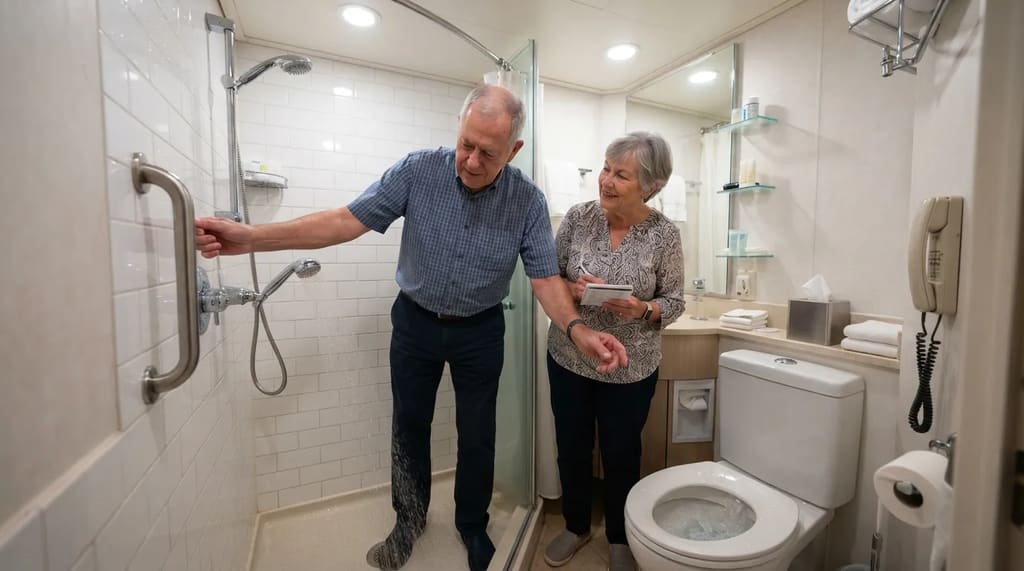
Three tests take half a minute: flush the toilet, run the water hot, and watch how the shower drains. Check the water pressure and temperature, and tell your steward if something seems wrong.
If anything fails, you don’t have to hunt for anyone. Pick up the stateroom phone and dial the maintenance or housekeeping extension, and do it before you unpack, because a repair is simpler in an empty bathroom.
Ship bathroom ventilation is often weaker than what you have at home, so don’t treat a sluggish fan as a defect. Candles and incense are prohibited onboard anyway.
Look for a grab bar and a non-slip surface, since a wet floor at sea is a harder place to catch your balance. Ask early for a shower stool if you’d use one, because Princess, for one, lists shower stools, bed boards and toilet seat raisers among items available on request.
With the plumbing cleared, there’s one more thing in the room you’d use to order breakfast.
#11 – The TV Remote and the Room Phone
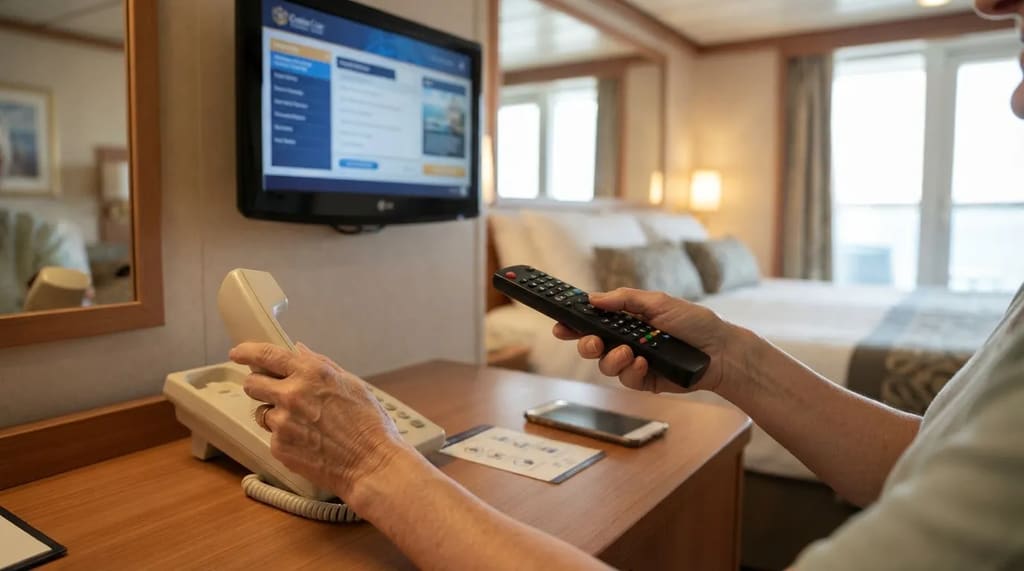
A dead television sounds like a small annoyance, but it can also be your room service menu. You can usually order room service through the stateroom TV, so it’s worth confirming it works even if you never plan to watch a movie.
Switch it on, find the channel with the ship’s information and make sure the remote responds. A remote with weak batteries is a ten-second fix now and an irritating call at ten at night.
Then lift the phone handset and listen for a tone. Your cabin attendant usually gives you a card with their phone number on it.
Photograph that card and the key extensions with your own phone, since cell service at sea is spotty and costly, and the cabin phone is your direct line to maintenance.
Your devices will be fighting for the same wall plate shortly, and that’s the next check.
#10 – Count the Outlets Before You Unpack
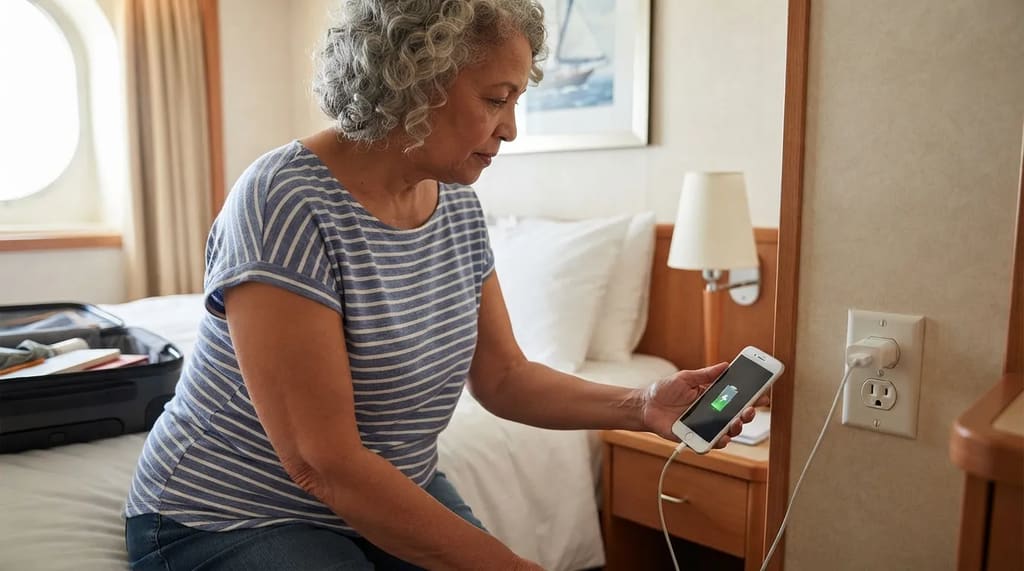
Walk the room and count the outlets before a single charger comes out of your bag. Cabins typically don’t have many power outlets, and it’s worth verifying that each one works.
Plug a phone charger into each one and watch for the charging symbol. If one is dead, you’ll want your steward to know before your tablet, hearing aid case and camera all line up for the one that works.
Note where each outlet sits compared with the bed, and check whether there are bedside USB or USB-C ports as well. Find out which outlet is nearest your pillow, because that’s where a CPAP machine or a nightstand charger will have to live.
At a Glance
- Test every outlet with a real charger, not by eye.
- Mark the one closest to the bed for bedtime devices.
- Look for USB or USB-C ports before you reach for adapters.
- Tell your steward about any dead outlet right away.
If you’re short a charger or adapter, ask. Stewards can sometimes source chargers or adapters.
The obvious fix for too few outlets is a power strip, and that’s the one item that can be taken from you at the terminal.
#9 – The Power Strip Security May Confiscate
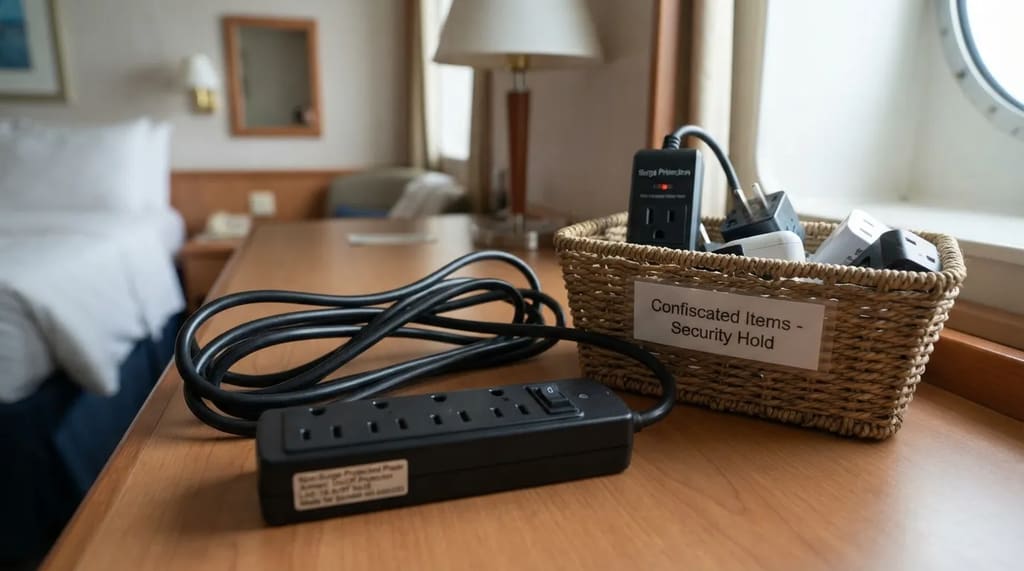
Most major lines ban surge-protected strips for cabin use, and security can pull yours at the pier. Items judged a safety hazard are confiscated at boarding and returned on the last day of the cruise before you disembark.1
The trap is the strip already in your drawer at home. Most power strips sold for home use include surge protection, and a mention of surge protection, joule ratings or a “protected” indicator light on the label means it will likely be confiscated.
Rules also differ by line and change over time. Royal Caribbean‘s policy has reportedly tightened in recent years, while Carnival’s policy allows strips without surge protectors when used with proper caution.2
My verdict: if all you need is to charge phones, a plain USB charging cube is the safer bet than any strip. Read your own line’s prohibited-items page before you pack, since what was allowed on your last sailing may not be allowed now.
Power settled, you can finally open the sliding door and see what you paid for.
#8 – The Balcony Door, Its Lock and the Divider
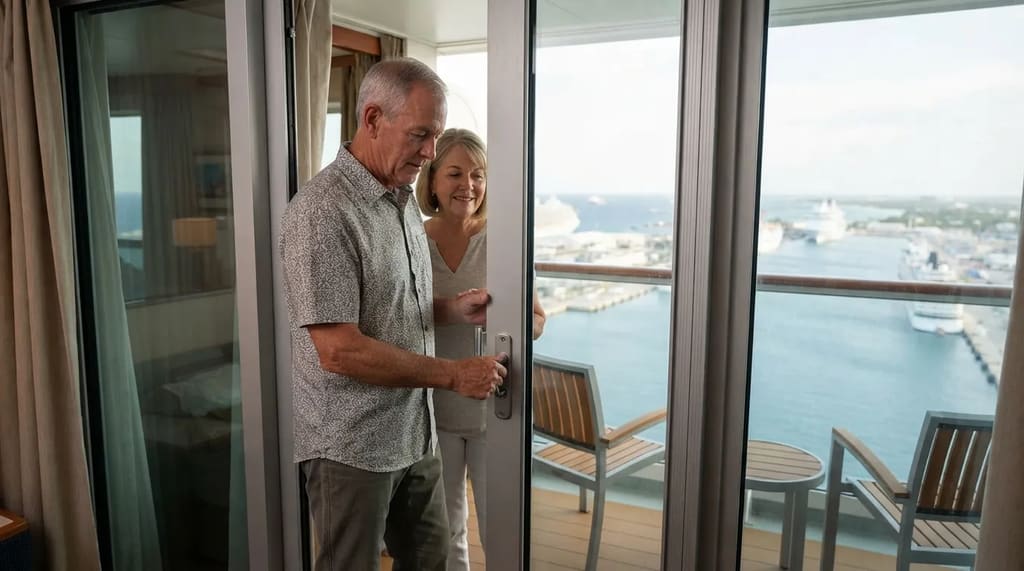
A private balcony is the one place on the ship where you never compete for a sailaway view, provided the door works. Royal Caribbean’s blog notes that with a balcony stateroom you don’t have to compete with anyone for a spot.
Slide the door fully open and fully closed, and test the latch from both sides. A door that sticks on day one won’t improve, and you’ll use it far more often than you expect.
If you booked connecting balconies, look at the divider. Check that it’s open, and if it isn’t, ask your stateroom attendant to open it.
Count the chairs and check the table too, since two guests need two seats. Check the divider before sailaway, not after, because the steward is nearby on embarkation day.
The view out is one thing, but what’s on the other side of your walls is another, and you can still check it before the ship moves.
#7 – What Sits Beside, Above and Below You
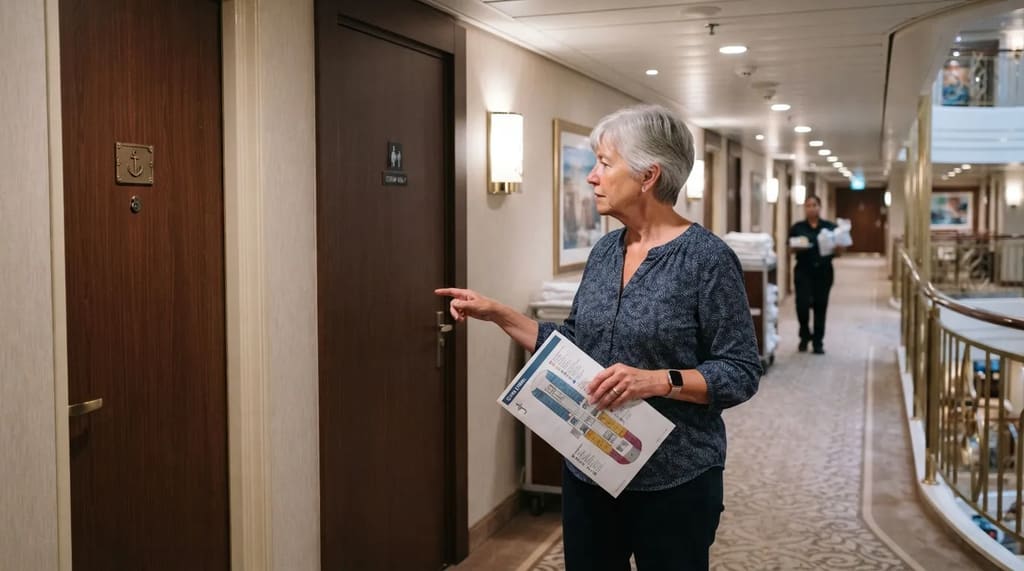
The deck plan you booked from shows rooms, not noise. Even if you chose your cabin carefully, misreading the plan can backfire.
Step into the corridor and look around. Check for crew service doors, housekeeping pantries and noisy venues such as nightclubs, bars and kids’ clubs.
A crew door or pantry near yours means traffic outside it that you’ll hear through the wall. Also confirm the cabin category matches your booking, especially if you chose a specific layout or location, because mistakes are easier to correct early while crew are handling embarkation issues.
Worth Knowing
- Noise travels through ceilings and floors, so check the decks above and below on the plan, not just your own corridor.
- Service doors and pantries mean crew traffic at odd hours.
- Venues like bars and kids’ clubs can be louder than the deck plan suggests.
- Early requests are easier to fix than late ones.
My verdict: a noisy location isn’t something you repair, it’s something you move away from, so raise it at guest services on day one, not day three. By then the ship will be busier with other guests’ requests, and you’ll have lost a few nights.
The room is sorted, so now your valuables need somewhere to go.
#6 – Test the Safe Before You Trust It
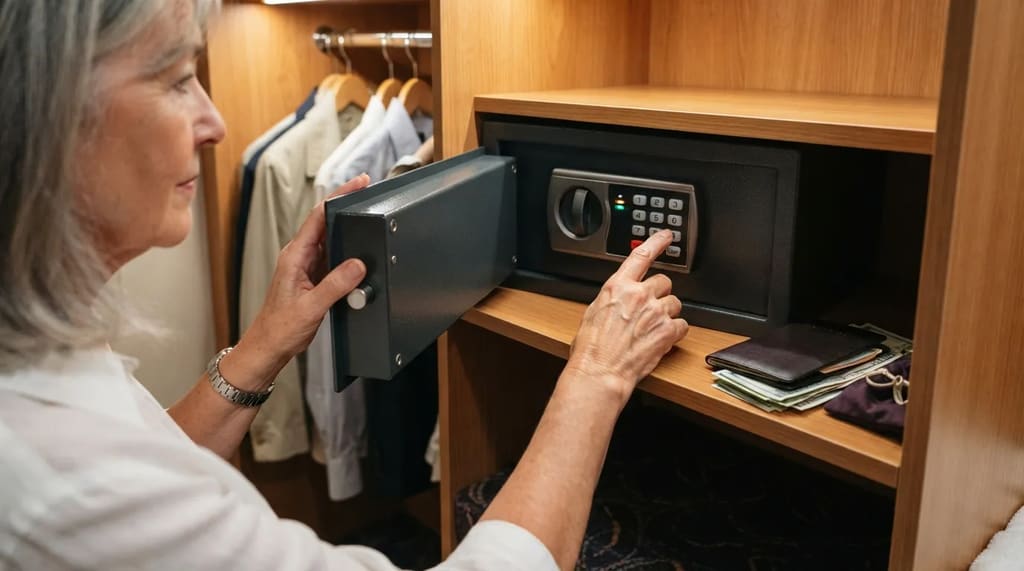
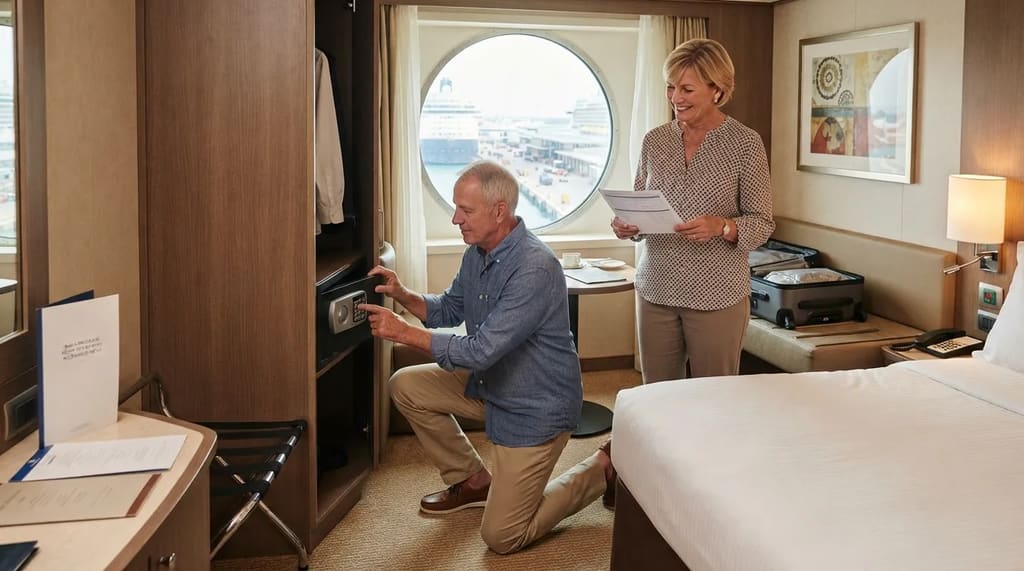
A safe that won’t reopen with your passports inside is a bad way to start a trip. Make sure the safe is fully functioning before you store anything in it.
Find it first. The safe is almost always in the closet, though on some ships it’s in a drawer, and you set a four-digit code to open and close it.
Set the code, lock it empty, and open it again before anything goes in. Then store the items you won’t need on shore, such as passports, a wallet, cash and jewelry you won’t be wearing.
Choose a code you’ll remember without writing it on something you keep near the safe. Even guests who don’t bring expensive jewelry still have valuables worth locking up.
One person on board can fix nearly everything on this list, and they’re probably within shouting distance.
#5 – Your Cabin Steward in the Corridor
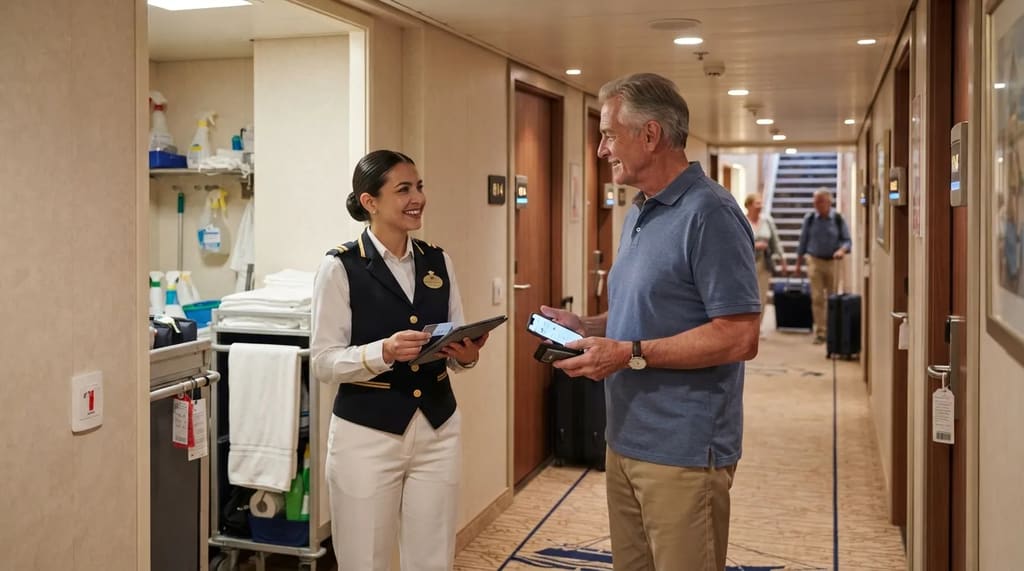
Your steward is the fastest repair line on the ship, and embarkation day is when they’re easiest to reach. More than likely your attendant will be somewhere nearby, and this is the time to make special requests.
Make them count. Extra towels, a bucket of ice, separating or joining the beds, or opening balcony dividers are all common requests, and it helps to mention extra pillows, more hangers or a regularly filled ice bucket early so they can plan.
Take the card with their number. Put that number in your phone, since it’s the first call for most of the fixes in the earlier checks.
My verdict: five minutes introducing yourself beats any complaint on day five. A problem raised politely on the first afternoon gets handled before it becomes a grievance.
This is also the check that costs you nothing at all. Before the steward leaves, though, there’s something far more important than ice to look at.
#4 – The Life Jackets and the Posted Instructions
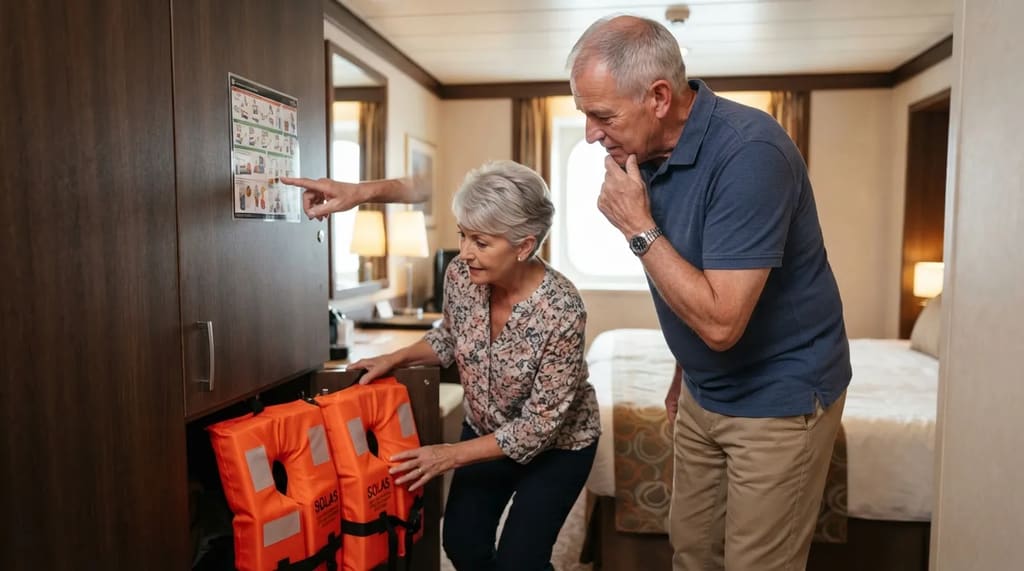
Three things must be posted in your cabin. Under SOLAS, the instructions must tell you your muster station, the essential actions to take in an emergency, and how to put on a life jacket.
Find that card, then find the life jackets, and count one for each person traveling. Your muster station is often indicated on the life jacket itself, so crew can direct you from a glance.
Don’t assume you should carry yours. Some lines tell guests not to bring life jackets to the drill, and a crew member provides one at the muster station.
Follow your line’s instruction about whether to bring the jacket, because lines differ.
That route leads to the drill itself, which has run under different rules since 2015, and your memory of an older cruise may be out of date.
#3 – The Drill That Now Comes Before Sailaway

The Costa Concordia disaster changed when passengers learn where the lifeboats are. The timing rule was strengthened afterward, replacing the older rule that allowed lines up to 24 hours to conduct the drill.3 4
Related Stories From Travelbinger


Today the drill is normally held shortly before you leave. Most lines carry it out 30 to 60 minutes prior to departure, according to Cruise Critic, and many have replaced the crowded-lounge version with a faster e-muster system.
Your sailing history doesn’t excuse you. The Coast Guard requirement applies to all guests, even if they’ve sailed previously, and if you miss it you’ll be found out and required to attend a make-up drill.4
My verdict: skipping the drill to grab a deck chair isn’t worth it, because the make-up drill costs more time than the original. Crew also check attendance at the muster station or via the e-muster, so your absence doesn’t go unnoticed.
The ship’s safety is covered. Your own health depends on equipment the crew isn’t allowed to carry for you.
#2 – The Outlet Beside the Bed for Your CPAP
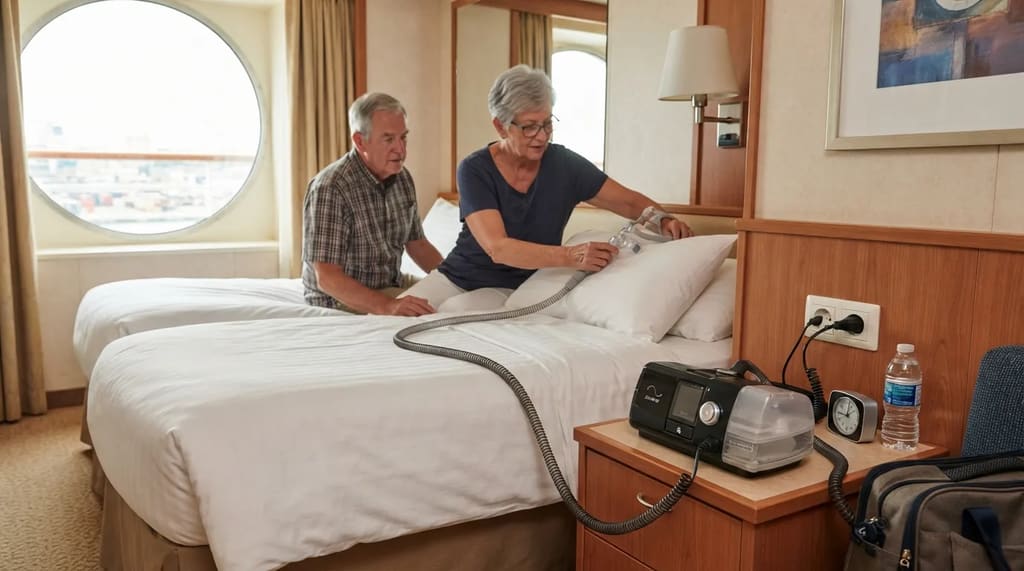
Carnival says its crew isn’t permitted to handle medical equipment during embarkation or disembarkation. You’re expected to carry all your own equipment and supplies.5
The machines themselves are welcome. Carnival allows oxygen concentrators, CPAP, BiPAP, APAP, nebulizer and ventilator machines, with no permission or advance notice required, and Princess permits the same devices, though supplies for them aren’t available on the ship.5
Bring every mask, filter and length of tubing you’ll need, and check the cord reaches the outlet nearest your pillow. This is where the outlet count from earlier pays off, and where a banned power strip would have been tempting.
If you use distilled water, plan ahead. Princess says you can request distilled water for a CPAP machine when you make your reservation, and if you’ve forgotten, ask your steward rather than improvising with something else.
The last check on the list involves a small refrigerator and the one thing it may not do.
#1 – Whether the Cabin Fridge Can Hold Your Medicine
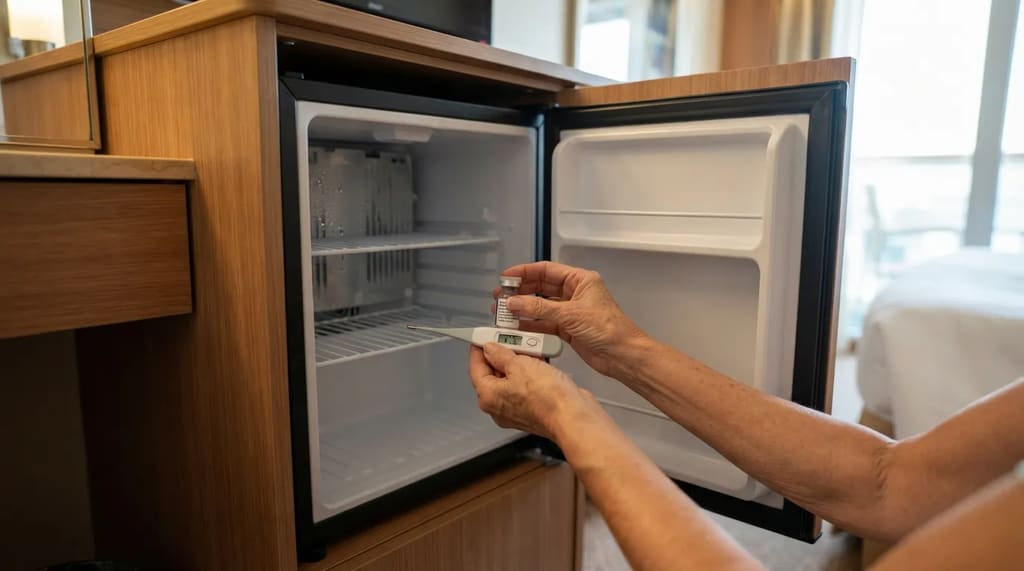
A cabin mini-fridge is built for soft drinks, not prescriptions. Norwegian’s guidance says plainly that minibars are not suitable for temperature-sensitive medicine, and mini-fridges may not keep temperatures cold enough for insulin.
So open the fridge, confirm it’s running and put a small pocket thermometer inside. Many refrigerated medicines are kept between 36 and 46 degrees Fahrenheit, so ask your pharmacist what yours requires.
If the fridge fails, the fix runs through paperwork. Carnival tells guests whose cabin fridge isn’t cold enough to notify the ship before boarding through its pre-cruise medical forms.
Princess directs guests without a stateroom refrigerator to its accessibility team, and storage may be available at the ship’s medical center during open hours.
My verdict: don’t trust the cabin fridge with anything your doctor says must stay cold. Carry an insulated case, and label every medicine with your full name and cabin number, wherever it’s stored.5
Why the First Hour Aboard Costs You Least
A cabin is a small system you’ll live in all week, and every fix gets harder once the crew is busy and the ship has left the dock. The shift is simple: walk in as the person who inspects, not the guest who adjusts.
None of these checks needs tools or more than a few minutes. Most need only a call to your steward, and the one that matters most needs a form filled in before you board.
Fast Facts
- Your steward is the first call for most cabin fixes, so save the number early.
- Test the safe empty, and set the code before anything goes inside.
- Medicines that must stay cold need a plan before boarding, not after.
- The muster drill usually happens 30 to 60 minutes before departure.
Sharps belong in that same conversation, since needles, lancets and blades must go in a sharps container you can request from your housekeeping steward. That makes the steward from #5 your first stop, and the pre-cruise form your real deadline.
What’s the first thing you do when your cabin door opens, and what made you start doing it?
- Royal Caribbean Power Rules: https://www.thewalkingcruiser.com/post/royal-caribbean-power-adapter-rules-2026
- Cruise Power Strip Rules: https://cruise-talk.com/cruise-cabin-power-strips-and-outlets/
- Skuld Safety Drills: https://www.skuld.com/topics/ship/safety/passenger-ship-safety-drills/
- Points Guy Muster Drill: https://thepointsguy.com/cruise/cruise-ship-muster-drill/
- Carnival Medical FAQs: https://help.carnival.com/app/answers/detail/a_id/11347/