
Delta’s own fares-and-discounts page says some discounts are not available at delta.com. A traveler over 70 who books online and never phones can end up paying the published fare when a lower senior fare existed on the same flight.
The real list of perks for older passengers is shorter than the headlines promise. Some are hidden behind a phone call, a few have quietly been retired, and several of the best-known benefits come from a federal rule or a disability provision rather than an airline’s goodwill.
The biggest benefit on this list asks nothing about your age, and it costs nothing. We will count down to it, starting with a fare you can only get by picking up the phone.
#16 – Delta’s Senior Fare That Exists Only by Phone

Delta offers senior discounts on certain domestic markets to passengers 65 and older. You will not see them on delta.com, so you have to call Delta reservations and ask.1
None of the big carriers publishes what its senior fares are worth. Any percentage you read online is unconfirmed until an agent prices your actual flights.
The call is worth about ten minutes when you are buying a full-fare ticket, say on short notice. It is not worth much more when a sale fare is already showing on the website.
A deeply discounted public fare can still beat a senior discount, so the senior fare does not always win.
The phone call tells you nothing about United, which puts its own senior option right on the booking page.
#15 – United’s Senior Dropdown and the Basic Economy Catch

United offers senior fares for passengers 65 or older in certain markets and on certain routes. You find the option by choosing “Senior (65+)” from a dropdown on united.com.
Guides disagree on where it applies. Some list it on select routes, mostly international and primarily to Latin America, while another report lists the program as discontinued.
The dropdown is worth trying, but it is not worth planning a trip around.
The catch is that Basic Economy is excluded. The senior discount applies to a standard fare, so compare it with the cheapest Basic Economy fare on the same flight, which may still be lower.
Basic fares normally limit seat choice and changes. The cheaper ticket makes sense only if you can live with those limits.
American has a similar menu option, but there the question is whether it reaches domestic flights at all.
#14 – American’s Senior Box in the Passenger Menu

When you book on American’s website, you select “Senior (65+)” under the passengers section. If a senior discount applies to your flight, it is applied automatically.
What the fare covers depends on the guide. Some limit it to select international routes and say domestic flights generally don’t qualify, while at least one source reports that American discontinued its senior discount program.
A comparison of airline programs also notes that American’s senior fare is often not cheaper than a sale fare. You can also phone the airline and ask an agent about senior fares.
Ticking the box costs nothing. It does deserve one extra search with the box left blank, and you should book whichever fare comes out lower.
Quick Compare
- Delta: senior fares for 65+ on certain domestic markets, by phone only.
- United: a “Senior (65+)” dropdown on united.com, with Basic Economy excluded.
- American: a “Senior (65+)” box in the passenger menu, with reports split on whether it still exists.
- Southwest: senior fares retired in 2019.
Southwest’s story is blunter: the fare many people still search for is gone.
#13 – A Southwest Senior Fare That Ended in 2019

Southwest retired its senior fares in 2019, after decades of a 65-and-older rate. Any site still promising a Southwest senior discount is out of date.
Even so, at least one 2026 guide still presents Southwest’s senior fares as one of the most accessible programs for U.S. travelers. That is how a dead fare keeps wandering around the internet.
If a page tells you about a fare that an airline’s own site doesn’t offer, trust the airline’s booking page or an agent’s quote.
A retired fare you cannot book costs you only the time you spent hunting for it. A trip planned around it costs far more.
Southwest’s age line was 65. One budget carrier has set its own at 55.
#12 – Frontier’s Promo That Starts at 55

Frontier’s 55FOR55 promo starts at age 55, not 65. A 2026 guide described the code as 55% off base fares for travelers 55 and older.
That makes it a rare case where a traveler younger than 65 gets a deal the legacy carriers don’t match. Promo codes come and go, so confirm the code is currently offered before you plan around it.
The discount applies to the base fare only. On a budget carrier, carry-on bags and seat selection are typically sold separately.
A passenger over 70 who wants an aisle seat and a small bag has to price the whole trip before comparing it with anyone else’s fare.
The next discount has nothing to do with age at all. It depends on a membership card you may already carry.
#11 – British Airways Rates Through an AARP Membership

British Airways offers discounts to AARP members on select itineraries originating in the US. Cheapflights lists the discounts as ranging from 5% to 50% on certain US flights.
A range that wide means the amount depends on the route and the date. Treat the top figure as something to look for, not something to expect.
Membership in AARP is open from age 50 and carries annual dues. If a single London trip is your only reason to join, check that the saving would cover the dues.
A trip that continues past the first European airport raises another question, since Air France sells a pass for flights inside Europe.
#10 – Air France’s €49 Pass for Flights Within Europe

Air France’s Senior Pass is available from age 65 for €49 a year. It advertises up to 30 percent off, but only within Europe.2
US routes are excluded, so the pass does nothing for the Atlantic crossing itself.
Because the saving is “up to” 30 percent, the arithmetic is worth doing before you pay. At the full 30 percent, the pass breaks even once the fares you buy during the year add up to about €163.
At a smaller discount the break-even total is higher. A traveler planning one short hop may not reach it, but someone spending a season in Europe, with several flights between cities, might.
Fast Facts
- Minimum age: 65.
- Cost: €49 a year.
- Advertised saving: up to 30 percent, within Europe only.
- Break-even at the full discount: about €163 in fares.
Then there are the airlines where, according to the research, the senior fare you are hoping for does not exist.
#9 – What Air Canada and WestJet Do Not Offer

Cheapflights’ Canadian site notes that Air Canada, Air Canada Jazz and WestJet do not offer any senior airfares. A separate 2026 Canadian discounts guide agrees: Air Canada does not currently offer a standard, published senior discount, and WestJet has no universal senior fare program right now.
That runs against other web pages that promise a 65-and-older fare on both airlines. Some of them contradict themselves, stating in one place that WestJet no longer provides a senior discount and in another that it offers discounts for seniors 65 and over.
When a page argues with itself, don’t trust either side. If you are planning a trip to Canada, a quote from the airline’s own booking page settles the question.
Airfare is only one place where age matters on a trip, and the federal government draws its own line at the security checkpoint.
#8 – TSA’s Age Line at 75, Not 65 or 70

TSA’s own page sets its line at 75, not 70 and not 65. The agency says travelers 75 or older can receive a form of expedited screening through risk-based, intelligence-driven security.3
This is a TSA procedure, not an airline allowance. Still, it is the first place your age is likely to matter once you have the ticket.
TSA’s Secure Flight program collects your full name, date of birth and sex. Enter your birth date exactly as it appears on your ID when you book.
The wording is “some form of” expedited screening, not a fixed lane, so keep your usual time cushion at the airport. If nothing seems to change at the checkpoint, tell the officer your age.
At a Glance
- Age line: 75 or older, not 65 or 70.
- Who runs it: TSA, not your airline.
- What it is: some form of expedited screening, not a guaranteed lane.
- What to do: match your booking birth date to your ID.
For years the most noticeable part of that 75 break was shoes, and that part changed in 2025.
#7 – Shoes On, Jackets Off After July 2025
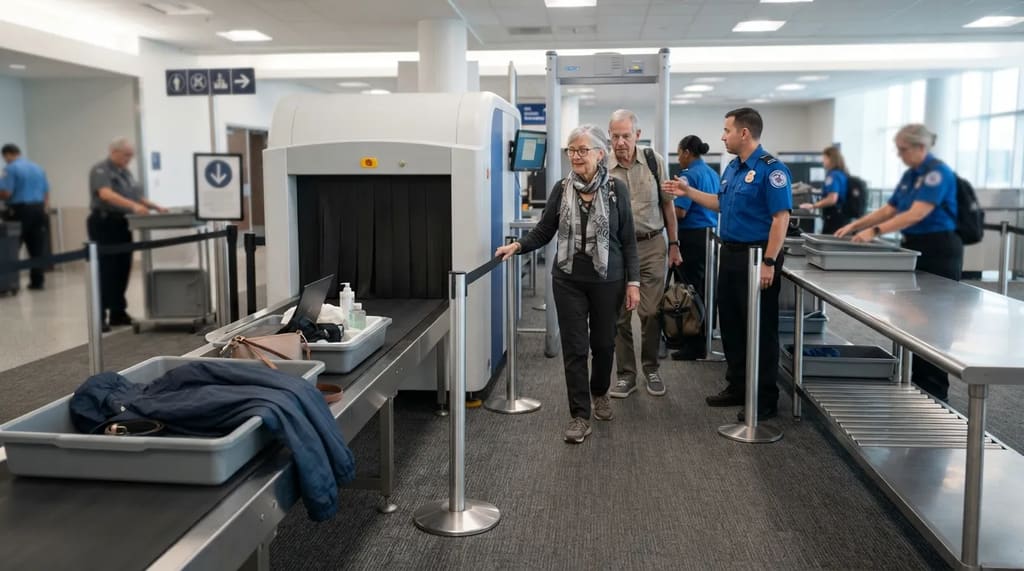
TSA ended its shoe-removal mandate at U.S. airport checkpoints on July 8. Before then, children 12 and under and passengers 75 and older were exempt.4
The shoe advantage that older travelers once had is now shared by every adult in line. You may leave your shoes on, but light jackets still come off for Advanced Imaging Technology screening.3
That changes the value of TSA PreCheck, which AARP prices at $75-plus. With shoes no longer the difference, what remains is belts, jackets, electronics and liquids.
For a traveler over 75 who flies once or twice a year, that is a modest return. A frequent flier carrying a laptop may see it differently.
If an alarm goes off, you may be required to remove your shoes for further screening or undergo a pat-down.3 That is the one case the shoes-on rule leaves open, and it is where a chair becomes available.
#6 – A Chair When an Alarm Calls for More Screening
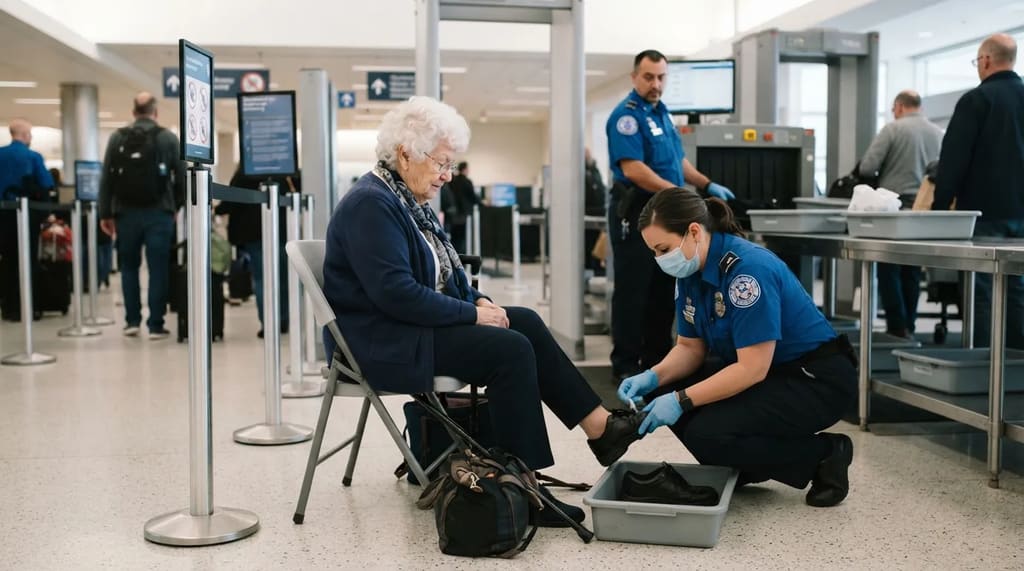
Passengers over 75 may still be required to remove their shoes if the alarm goes off, but they can request to be seated during that part of the process.3 Those who have difficulty standing at all are screened using other methods.
This is not reserved for the oldest travelers. Passengers whose medical conditions prevent them from standing or walking at the checkpoint are not required to remove shoes, though their shoes are manually inspected.
In both cases the condition is doing the work, and the age is secondary. The same pattern runs through nearly every disability rule later in this piece.
Guides to the 75-and-older rule also say a first alarm can lead to a second pass through the detector before a pat-down is required.
Medical items raise their own questions at the checkpoint, and TSA has a card meant for exactly that.
#5 – The TSA Notification Card and the 72-Hour Call
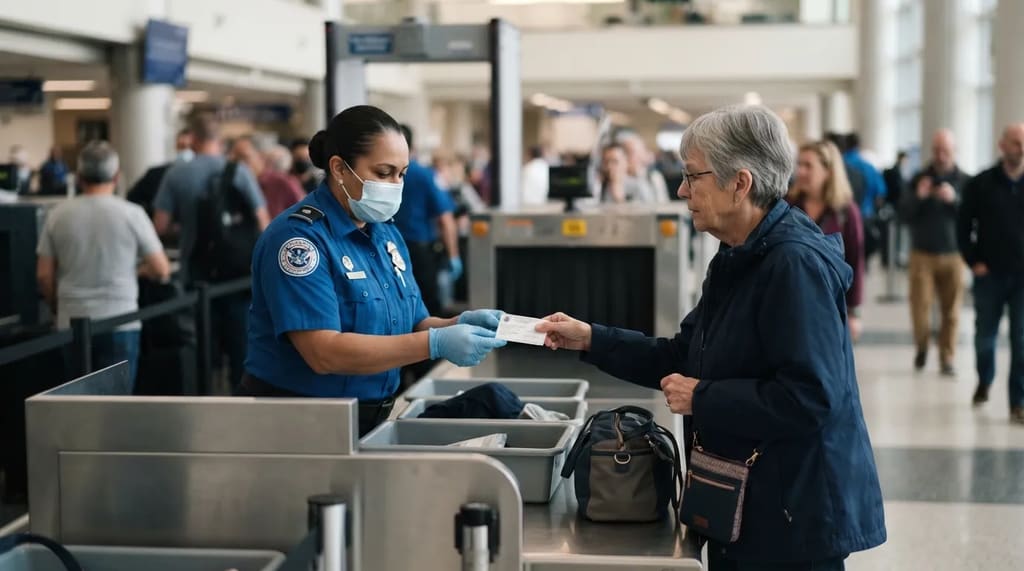
Travelers with disabilities and medical conditions may consider getting a TSA Notification Card, which specifies health conditions, disabilities, or medical devices that may affect screening. You provide the card to the TSA officer at the checkpoint so they can make special considerations.
That spares you from explaining an implant or a pump to a stranger while a line forms behind you.
The card also gives instructions for calling TSA 72 hours before you travel to request any assistance you may need. Make that call when you book, not the night before, so a request has time to be handled.
Liquid medications are the other item to prepare. Keep your doctor’s name and number within reach in case an officer needs to verify your pills, gels and liquids.
The checkpoint is TSA’s job. Past it, the airline’s own staff take over at the gate.
#4 – Telling the Gate Agent You Need More Time

Airlines must allow a passenger with a disability who self-identifies at the gate as needing additional time or assistance to board. That rule is the legal footing behind the early boarding call.
It depends on need, not on a birthday, so it covers a traveler whose knee or balance makes the jet bridge slow going.
For most requests of this kind, a disabled passenger is generally not required to give the airline advance notice. The practical move is to speak to the agent at the desk before boarding starts and say plainly what you need.
Nothing here requires a card or a form, and the request can be as simple as one sentence.
Boarding is only the start, because the seat you land in and the things you carry matter just as much.
Related Stories From Travelbinger



#3 – Seat Help, Free Devices and the 48-Hour Notice
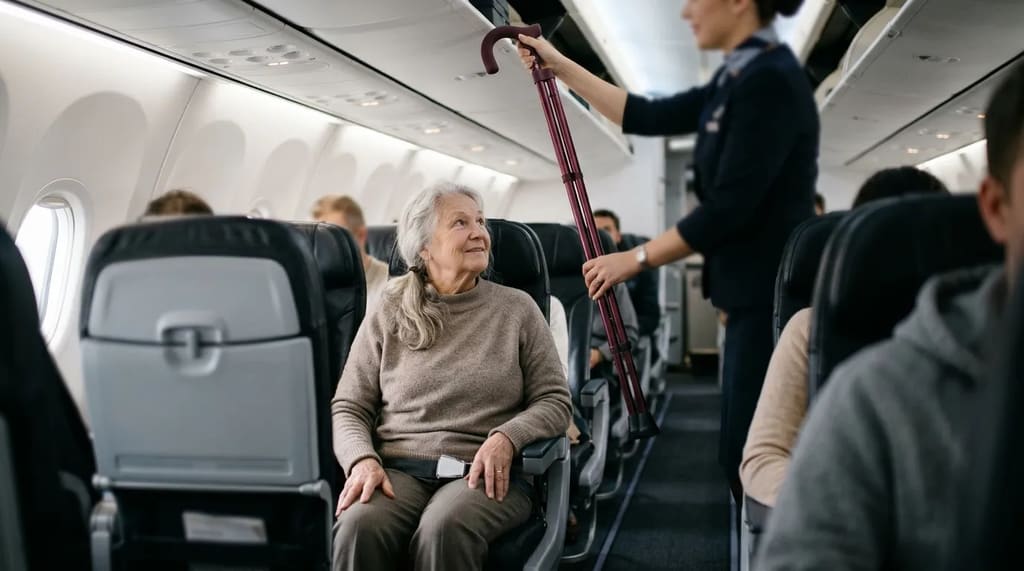
The Department of Transportation’s disability regulation requires airlines to provide seating accommodation assistance that meets passengers’ disability-related needs, and help loading and stowing assistive devices. Airlines must allow assistive devices that help with a disability as carry-ons in the cabin free of charge.
A cane or a folding aid therefore does not count against your baggage allowance. The airline cannot bill you for it.
Some arrangements need lead time. Airlines may require up to 48 hours’ advance notice for accommodations that need preparation, such as respirator hook-up.
If you use portable oxygen, ask the airline about its requirements well before the trip. On aircraft with more than 60 seats and no accessible lavatory, an airline must place an on-board wheelchair on the flight if you give 48 hours’ notice that you can use an inaccessible lavatory but need the chair to reach it.
Those rules cover what you carry on board. A wheelchair that goes in the hold falls under a newer set of rules.
#2 – Your Own Wheelchair, Handled Under the 2024 Rule
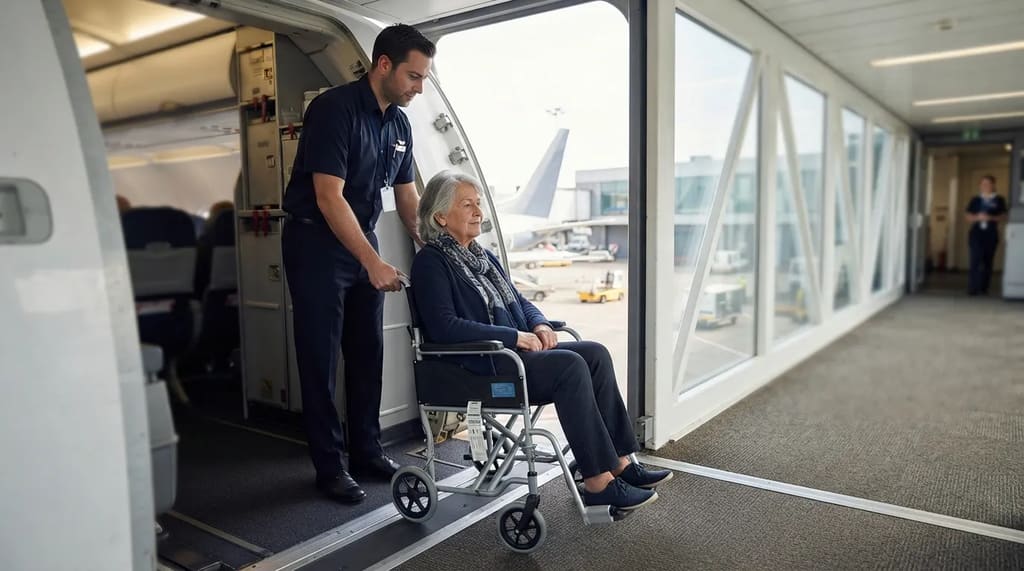
On December 17, 2024, the Department of Transportation issued a final rule titled “Ensuring Safe Accommodations for Air Travelers With Disabilities Using Wheelchairs.” It requires “safe and dignified” assistance for passengers with disabilities and took effect January 16, 2025.5 6
Employees and contractors who physically assist passengers or handle wheelchairs and scooters had to be trained by June 17, 2026. Several of the rule’s provisions affect your trip directly.
Airline staff must make your personal wheelchair available as close as possible to the aircraft door, if you request it. Airlines must also reimburse the cost of transportation to or from the airport if they delay your wheelchair or scooter.
A passenger who cannot move independently may not be left unattended in a ground or boarding wheelchair for more than 30 minutes. A wheelchair is considered a medical device, so it travels free.
That makes it a larger saving than a senior fare on many trips, since it never depends on a route or a fare class.
Those rules begin once you have a chair of your own. The help that gets you from the curb to the gate does not require you to own one.
#1 – Free Airport Wheelchair Help That No Birthday Unlocks
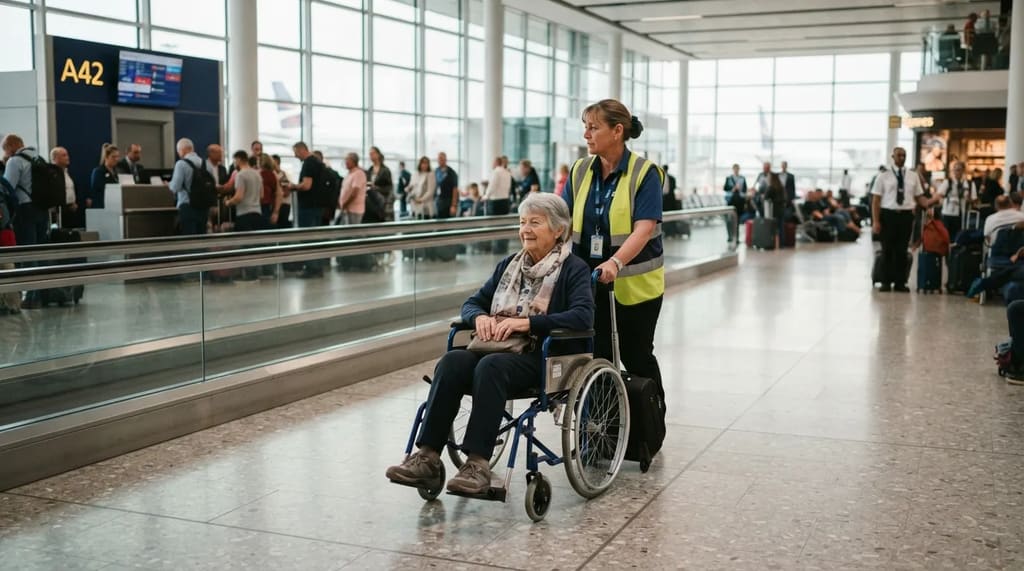
The disability regulation requires airlines to provide prompt wheelchair or other guided assistance to board, deplane, or connect to another flight. That includes help moving from the curb to the departing flight and between gates to make connections.
Airlines cannot charge extra for wheelchair assistance. The Air Carrier Access Act applies to all U.S. carriers on any route, plus foreign carriers operating flights to or from the United States.
Nothing in these rules mentions an age. The help is written around need, so a long walk to a connecting gate is what matters if distance is your obstacle.
That is why this item outranks the senior fares that opened this list. Their savings depend on the route, the fare class and which agent picks up the phone, while free assistance does not.
Even so, airlines can set deadlines for notice on certain arrangements, as with the respirator hook-up covered earlier.
What to Ask For Before Your Next Booking

The research points to an uncomfortable pattern. The airline benefits aimed at older passengers are narrow and unpublished, while the federal protections are broad and written around need.
That makes the booking call and the gate desk better places to ask a question than any promotional page. A senior fare takes one phone call to rule in or out.
A request for boarding time or wheelchair help takes one clear sentence, and it carries legal weight that no discount code does. Check any specific fare with the airline before you pay for it.
Worth Knowing
- At booking: ask the agent to price your flights with and without a senior fare.
- 72 hours before travel: call TSA if you want help arranged, as the Notification Card suggests.
- Up to 48 hours before: airlines may require notice for respirator hook-up or an on-board wheelchair.
- At the gate: say plainly if you need extra time to board.
The best allowance on this list was never about your age, only about whether you asked. Have you ever phoned an airline to ask about a fare that wasn’t on its website, and what did the agent quote you?
- Budget Seniors Delta Discount: https://www.budgetseniors.com/travel-transportation/best-discounted-flights-for-seniors/
- Air France Senior Pass: https://wwws.airfrance.fr/en/information/offres/cartes-de-reduction/carte-senior
- TSA Screening Age 75+: https://www.tsa.gov/travel/tsa-cares/screening-passengers-75-and-older
- CBS News Shoe Rule: https://www.cbsnews.com/news/tsa-shoes-rule-expires/
- Federal Register Wheelchair Rule: https://www.federalregister.gov/documents/2025/02/20/2025-02817/ensuring-safe-accommodations-for-air-travelers-with-disabilities-using-wheelchairs
- DOT Wheelchair Final Rule: https://www.govinfo.gov/content/pkg/FR-2024-12-17/html/2024-29731.htm