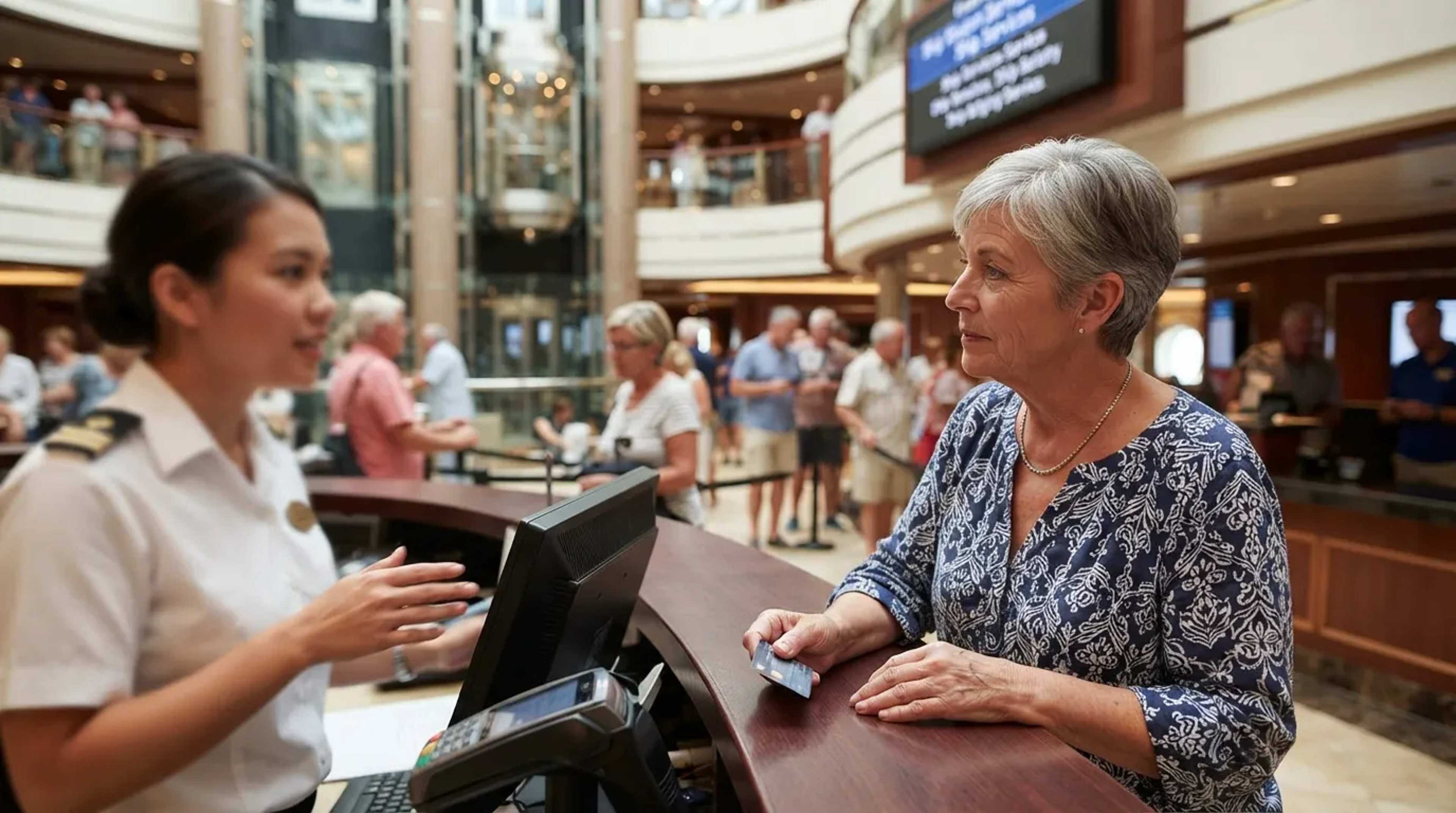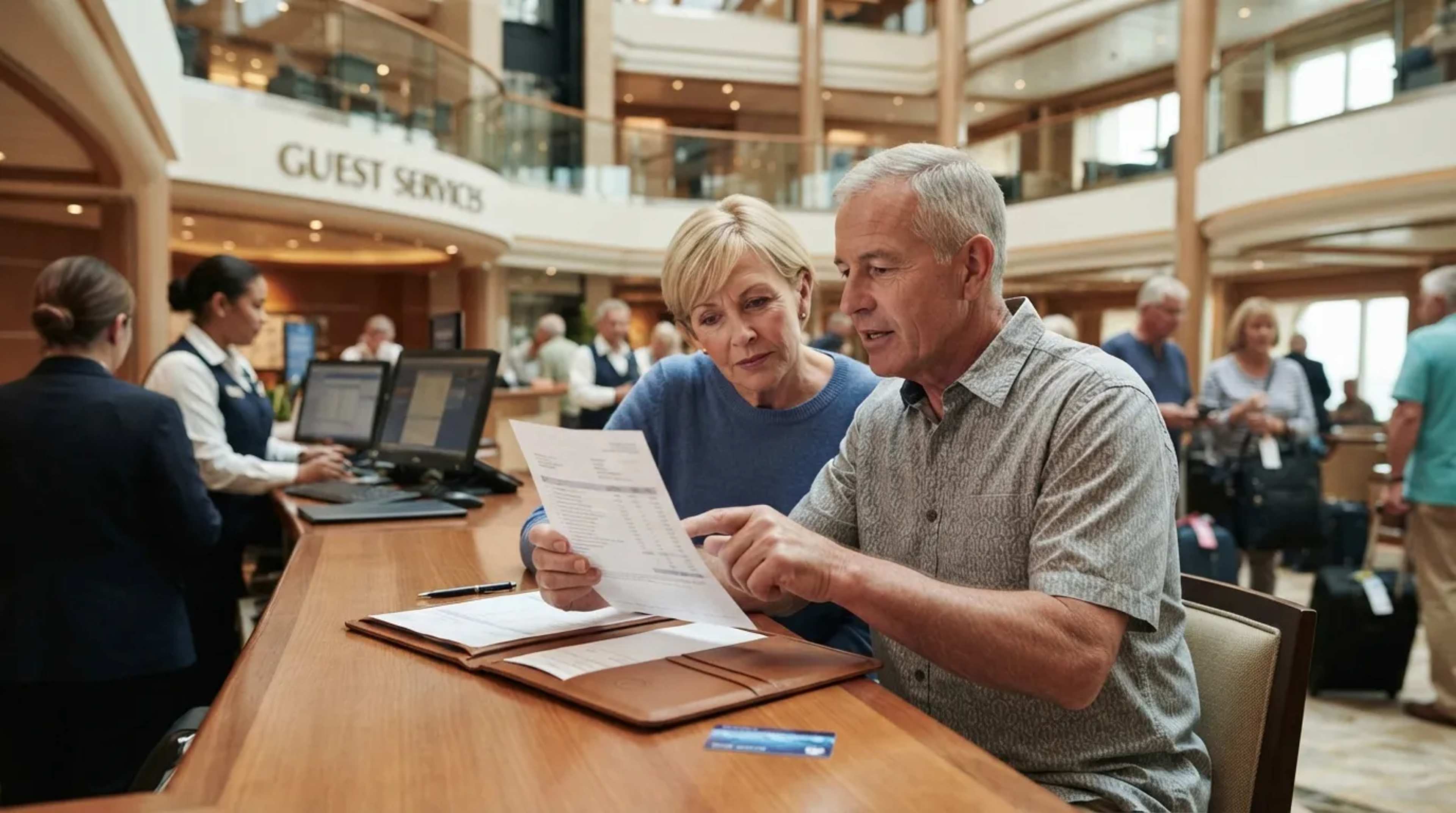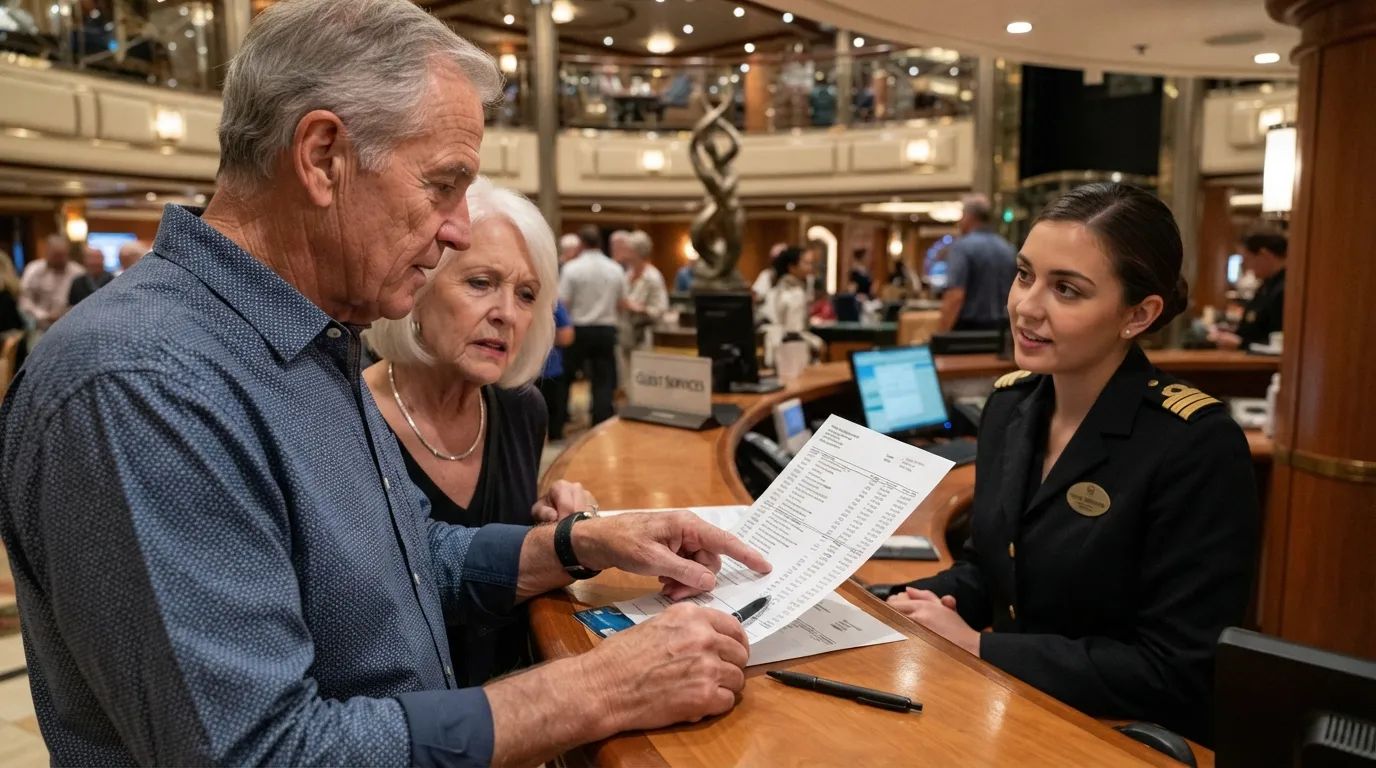
You’d think a cruise ends when you step off the ship, but the real deadlines hit the night before. Luggage usually has to be outside your cabin door between about 10 p.m. and midnight, and the final bill and tip adjustments close on much the same schedule.1
That’s the trap for anyone who thinks they know the routine: a bag misses the cutoff, a charge goes unread, a driver shows up two hours early. The last item is the billing problem that’s nearly impossible to fix once you’re ashore, so stay for it, but first comes a habit that costs nothing.
#15 – Photographing Every Tag Before Bags Leave
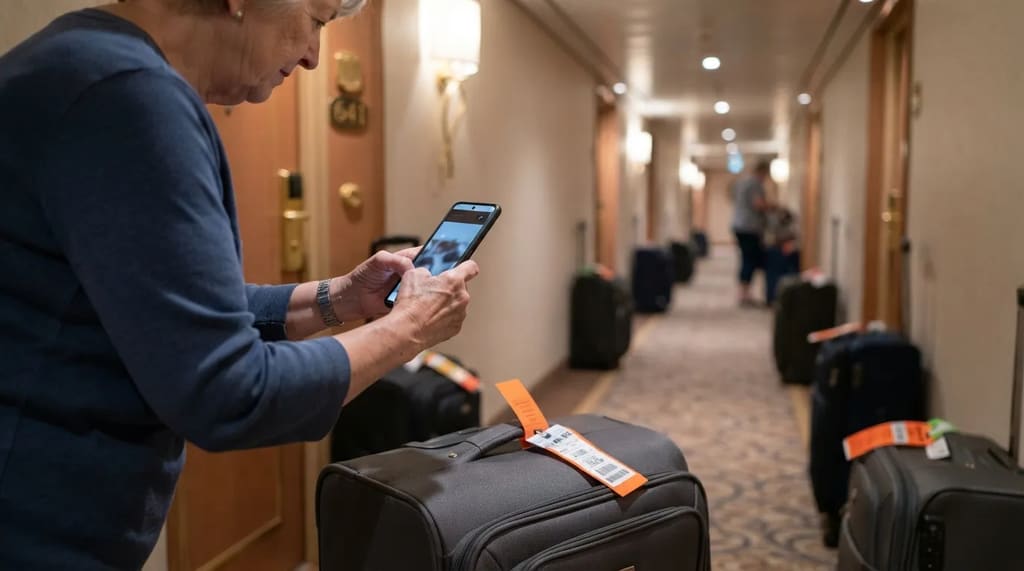
The day before disembarkation, staff deliver color- and number-coded luggage tags to your cabin, along with an approximate departure time. At the pier, bags are sorted by group color and number, and thousands of them will be waiting.
Photograph the tag on every bag before it goes into the hallway. A tag can fall off during collection, and once the bag is outside your door you can’t check it.2
If a bag turns up late or not at all, the photo gives staff your group and number in seconds. It also spares you from trying to remember at seven in the morning whether you were Red 4 or Yellow 5.
It’s a thirty-second job that feels a little silly in the moment. It’s also the kind of thing you’ll be grateful for when a tag goes missing.
The tag decides where your bag waits, and it also sets your own exit time, which may not suit your flight.
#14 – Checking Your Exit Time Against Your Flight
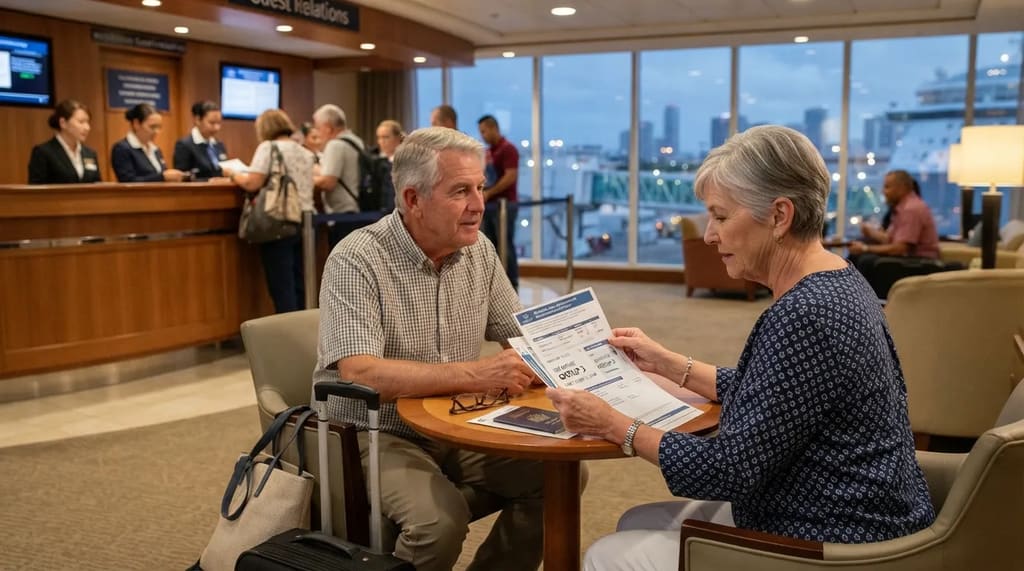
A later group means a later exit, and the slot you were handed may not fit your day. Cruise lines usually assign departure times based on flight times, stateroom category, loyalty status and sometimes luggage tags, so the time on your tag isn’t always the one you’d choose.3
Look at it the moment the tags arrive, because that evening is when your options are widest. You can ask your steward about different tags or go to guest relations, which is probably faster.
If you hold an early flight, say so when you pick up the tags. One cruise guide advises asking for an early departure at that point and confirming your waiting lounge the night before.
Ask for different tags that evening, not on the morning you’re called. The photo you took of the first set won’t help if the group printed on it leaves the ship after your flight closes.
Swapping a tag is a two-minute errand. Deciding what must never go into the hallway with the tagged bags is the harder call.
#13 – The Carry-On Bag That Never Leaves Your Hands
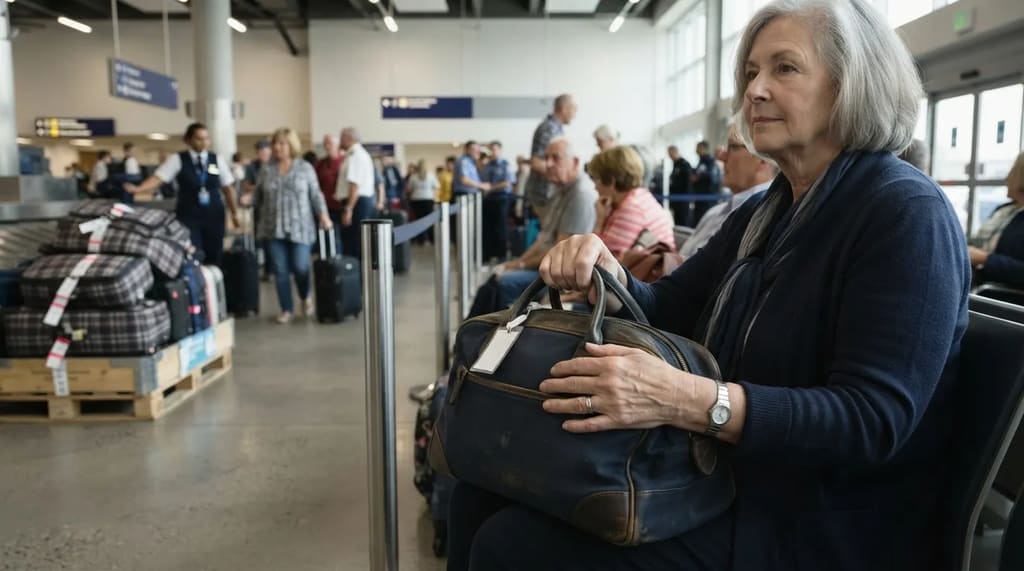
Medications have no business in a checked bag. Crew collect your luggage overnight and hold it until the ship docks, and you reclaim it in the terminal, where you usually have to take it through customs before leaving.4
Until you find your suitcase in that hall, whatever you need has to be on you. Here’s what belongs in the carry-on:
- Passport and identification, plus travel documents
- Medications
- Electronics, chargers, valuables and jewelry
- A change of clothes if you’re flying afterward
Medications, passport and travel documents never go into a checked bag. A small separate bag with morning essentials avoids a scramble if your luggage is slow to reach the terminal.
Think of it as the bag you’d grab if the luggage never arrived. If you’d be stuck without something for a day, it stays with you.
Everything in that bag stays with you, but the suitcases need to be outside your door by a cutoff that changes from ship to ship.
#12 – The Hallway Deadline and the Tags That Must Be On
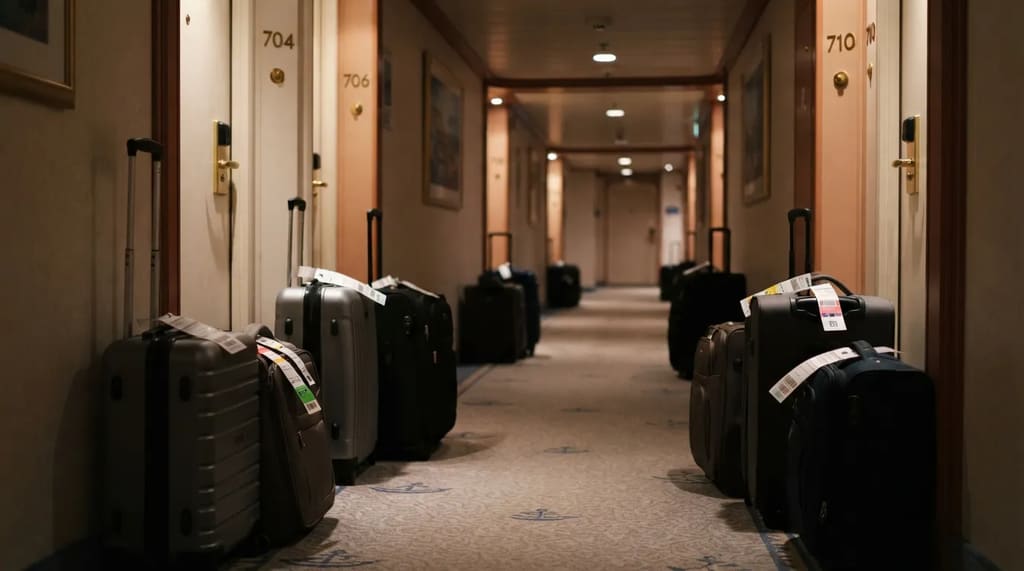
Plan on 10 p.m. to midnight, and don’t count on the same hour you had last time. The exact time appears in the daily program or the cruise line’s app.
That varies by ship, so a routine that worked on your last sailing can miss the cutoff on the next. Attach the tags before the bags go out, because a bag without a tag has nowhere to go.
Here’s a verdict you can argue with: packing at the last minute is a bad habit, not a style. Start after dinner, not at midnight, because a cutoff you’re racing is how a suitcase ends up in the cabin when it should be in the hall.
Check the exact cutoff in your daily program or the cruise line’s app. Write it on the back of your tag sheet so you can see it while you pack.
Once the bags are out, the cabin still holds a few things that belong in neither the hallway nor the carry-on.
#11 – The Safe, the Outlets and One Last Sweep
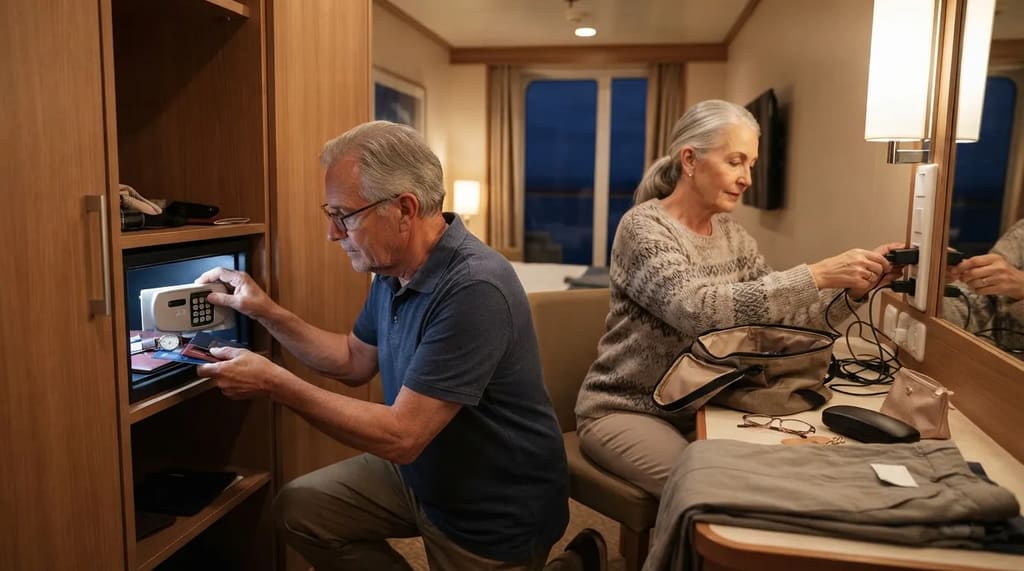
Once the bags are in the hallway, whatever you leave in the cabin becomes its own problem. The cabin safe is the usual culprit, since it’s closed, out of sight, and easy to forget at dawn.
Open the safe and sweep drawers, closets and the bathroom before bed. Check the outlets too, because chargers left plugged in rarely make it home on their own.
There’s also the question of what you need overnight. Anything you’ll use before bed that can’t go in the hallway belongs in a separate small bag, so you remember to move it into your carry-on in the morning.
On clothes, the last night is typically casual, and some cruisers find it easiest to wear the same outfit off the ship the next morning. That means your suitcase can close for good earlier in the evening than you’d think.
Take one last slow lap with your phone flashlight under the bed and behind the door. Reading glasses and shoes love those hiding spots.
With the cabin empty, the ship will want you out of it by a set hour, and it doesn’t always give you a comfortable place to wait.
#10 – Where You Wait After the Cabin Closes
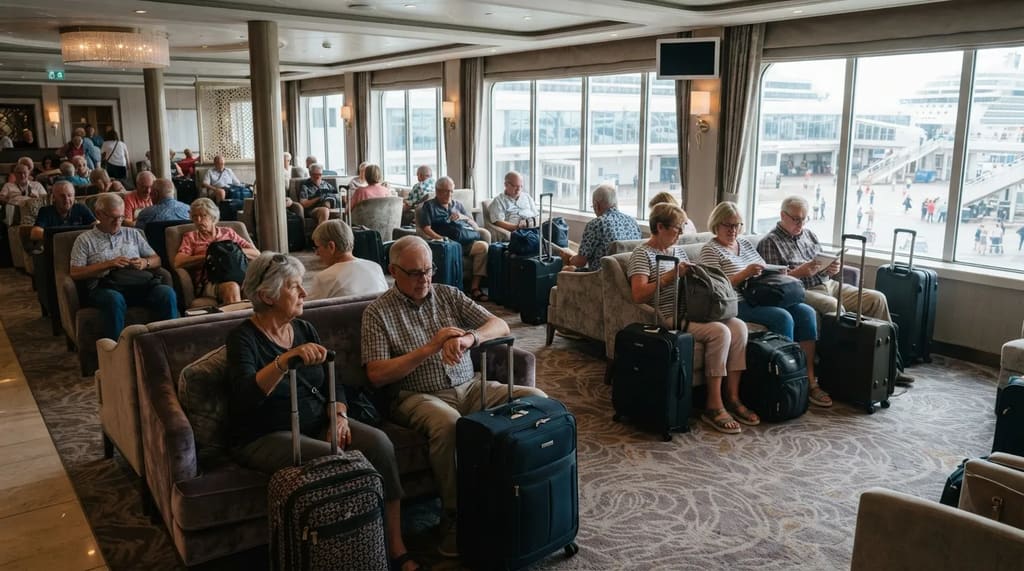
On disembarkation morning, you may be asked to leave your cabin well before your group is called. That can mean sitting in public areas like the buffet, a lounge or the theatre for over an hour.
So plan the morning around your group, not around your alarm. Breakfast venues will likely run on a different schedule on the last day, so check the open hours before you go.
If you’re carrying your own bags, try to avoid the elevators closest to the gangway. Everyone with a suitcase heads for those first.
At a Glance: The Waiting Game
- Your cabin may need to be vacated before your group is called
- Expect the buffet, a lounge or the theatre to double as a waiting room
- Last-day breakfast hours can differ, so check them first
- Skip the elevators nearest the gangway if you’re hauling bags
Keep your ship card and passport in hand while you wait. That way you’re ready the moment you’re called.
Groups are called in sequence, and once yours is called, you can typically be off the ship in about 15 minutes.1 Be dressed, packed and holding your documents before that call comes.
If that walk to the gangway worries you, there’s help to be had, but only if you ask in time.
#9 – Asking for Mobility Help the Evening Before
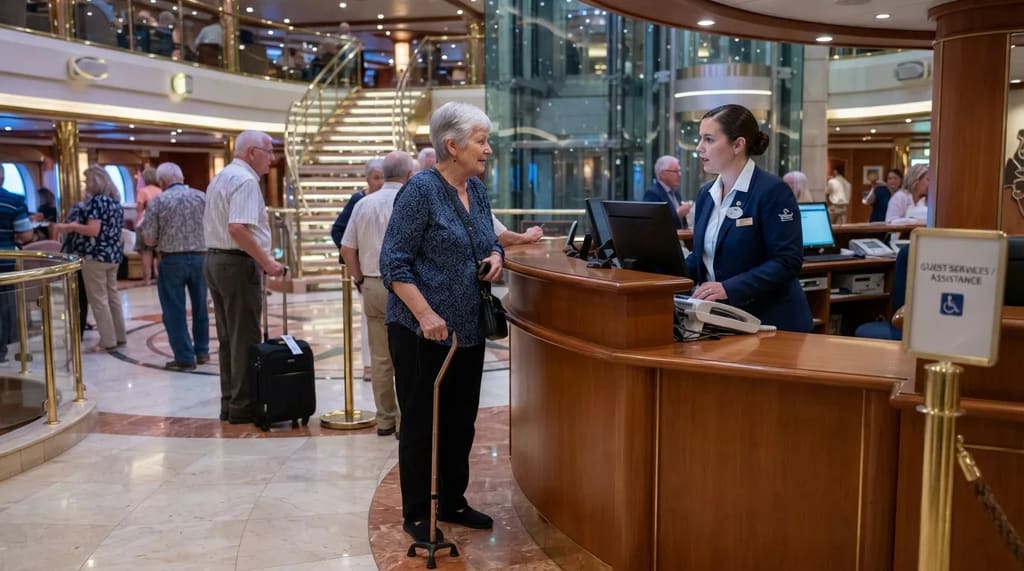
A long walk through a terminal looks different at 8 a.m. when your bags are somewhere you haven’t found yet. You leave the ship, find your group’s section, then usually take your bags through customs before leaving the cruise terminal.
If stairs, distance or standing are a problem, ask for help while the desk can still arrange it. Travelbinger’s roundup notes that the wheelchair request has a deadline that falls the evening before.
When you ask, get the practical details: when help arrives, where you’ll wait, and whether your group time changes. If you use a cane, walker or scooter, ask how it gets off the ship.
Asking for help isn’t an admission of anything; it’s logistics. Crews arrange these requests on every sailing, and an early request gives them time to do it well.
Request wheelchair or mobility help the evening before, not on the morning you leave. The time on your tags from #14 may shift once the desk knows you need help, so confirm it afterward.
Some travelers skip the help and the hallway altogether, a choice with an early start time and a catch that matters if you don’t pack light.
#8 – Self-Assist Walk-Off and Its Catch
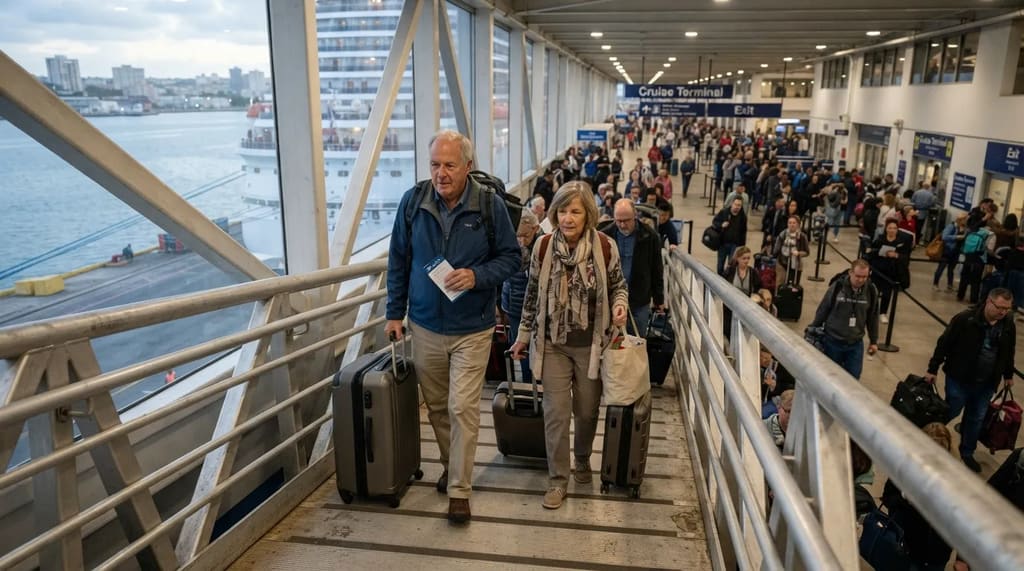
Walking off at 7:00 a.m. with your own bags sounds like the smart move. You can typically leave once the port authorities clear the ship, usually between 7:00 and 7:30 a.m.1 5
You keep your bags in the stateroom, skip the tags, and head to the gangway with your ship card in the morning. Don’t count on a porter to carry anything for you.
My verdict: self-assist is overrated for anyone who isn’t racing a flight. Otherwise you trade a leisurely breakfast for stairs, elevators and a terminal full of people.
Self-assist makes sense only with an early flight and bags you can carry. Assisted groups are typically called between 8 and 10 a.m. or later, and that’s a small price for not hauling suitcases.
Whichever way you leave, someone is waiting at the curb, and the time you give them has to allow for a step you can’t speed up.
#7 – Setting the Pickup Time for Your Ride

Self-assist walkers and assisted groups leave in very different windows. The last groups are usually called by late morning.
Your exit time isn’t the cruise line‘s to promise. Local port authorities clear the ship first, and nobody walks off until they do.
Quick Compare: Ways Off the Ship
- Self-assist: typically around 7:00 to 7:30 a.m., with bags you carry yourself
- Assisted groups: typically called from about 8 to 10 a.m. or later
- Last groups: usually called by late morning
- Flights: common guidance is to avoid anything leaving before about noon3
After you’re called, you still have to find your bags and clear customs. So a driver booked for your group’s call time will arrive too early, and one booked for your flight departure will be too late.
Give your driver or family a pickup window, not an exact time. If you booked a transfer through the ship or a car service, put the confirmation and phone number in your carry-on.
That noon guideline leaves room for the terminal hall.
After the gangway comes the terminal’s customs check, and a form the ship hands out decides how long it takes.
#6 – The Customs Form and the $800 Rule
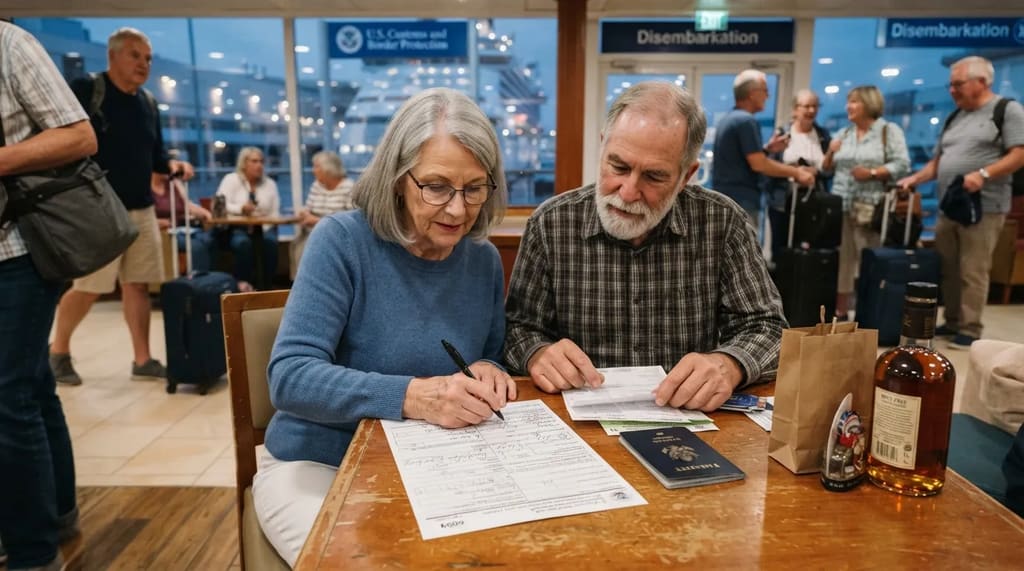
If your cruise ends at a U.S. port, each returning resident can generally bring back $800 in goods duty-free. The declaration form is almost always provided by the cruise ship.
The exemption applies when you’ve been outside the United States at least 48 hours and haven’t used it within the past 30 days.5 Alcohol is limited to one liter duty-free for travelers 21 and older, within what state law allows.
Ship purchases count. A duty-free shop doesn’t necessarily mean no duty at home, since the item is only duty-free in the country where you bought it.6
The $800 exemption is per person and covers purchases made on the ship. If you bring back more than your exemption, you’ll have to pay duties.
Customs counts what you carry off, but the ship also holds some balances and purchases that are only worth anything while it’s still open for business.
#5 – Leftover Credit, Casino Accounts and Photos
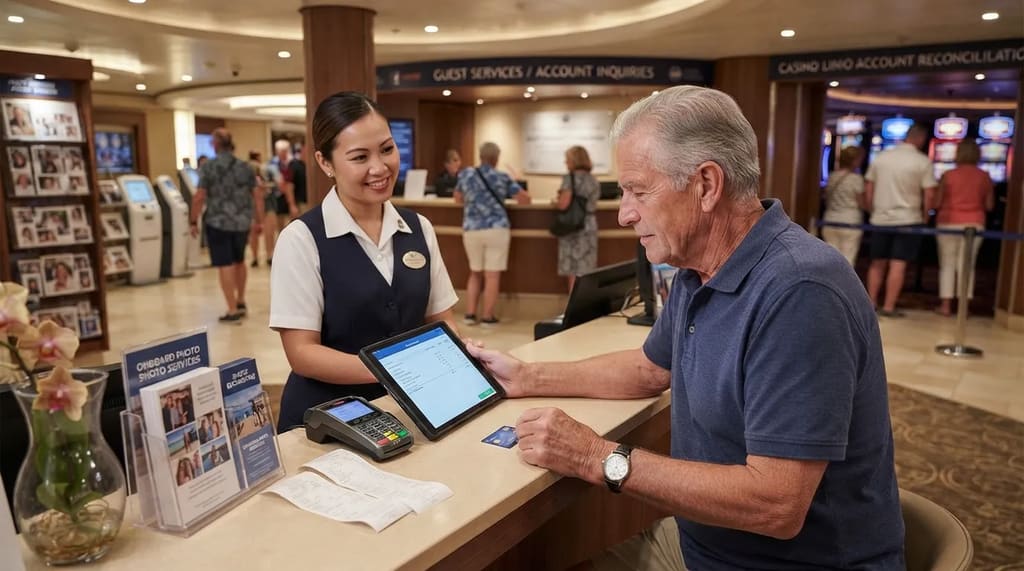
Most venues and amenities close by the morning of disembarkation, so the final full day is your last chance to use them. That includes any credit still sitting on your account.
Spend leftover onboard credit while the shops and venues are still open. Check the balance that evening, because most places are closed by the next morning.
Photos need attention too. Buy the ones you want before they’re gone, and if your line uses facial recognition to link photos to your account, some may be missing due to technical errors.
The casino deserves a closer look. If you used a cash advance or marker, confirm the repayment matches what you withdrew, since casino activity may be reconciled separately from the general onboard account and is easier to miss.
Worth Knowing: Your Last Evening Onboard
- Most venues and amenities are closed by disembarkation morning
- Check your credit balance the evening before, not at breakfast
- Photo purchases can disappear, and facial-recognition matching can miss some shots
- Casino markers and cash advances may be settled apart from your main account
Spending down the credit is the easy part. Reading what’s actually on the final statement is where mistakes get caught.
#4 – Line Items Worth Reading in the Final Statement

A spa add-on you declined out loud can still appear on the final account. The treatment receipt and the final account should match what was authorized.
Other lines deserve a look as well. Art auction wins should match the winning bid, including any buyer’s premium or shipping fee, and loyalty or referral discounts may be applied to the fare instead of the onboard account, so they’re easy to overlook.
Charges can also be wrong with no receipt to show for them. The Points Guy’s Jamie Page Deaton found Haven restaurant charges on her final Norwegian bill that should have been included, and she never signed a receipt.
Read every line of the printed statement the evening it arrives. On a shared account, check the guest name beside each entry before assuming a charge is wrong.
Related Stories From Travelbinger



A wrong line is a one-time error. A tip charge can be billed twice, and it hides in plain sight.
#3 – Prepaid Tips That Show Up Twice
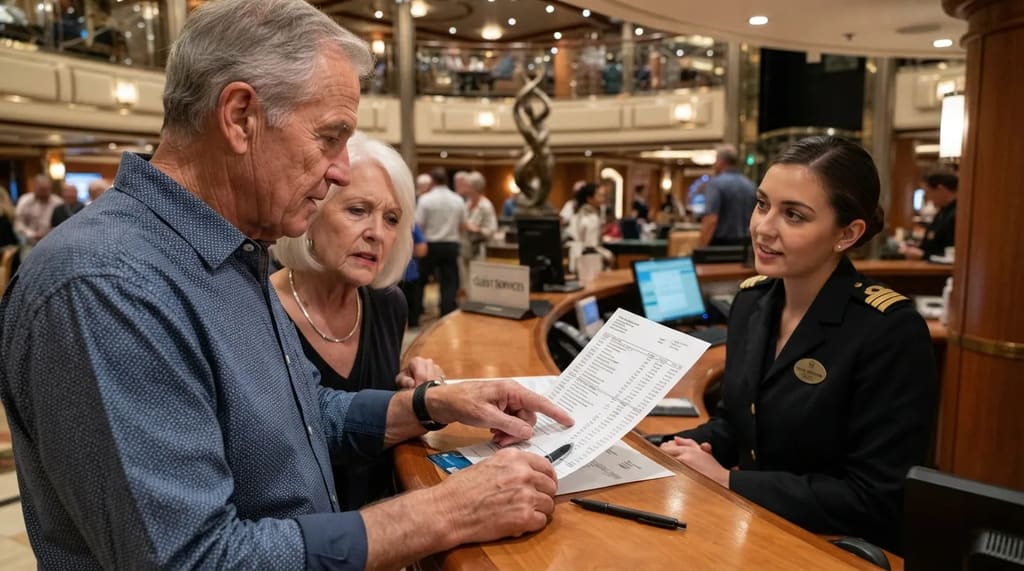
If you prepaid gratuities, the same daily charge can land on your onboard account a second time. Check that it wasn’t also applied onboard, and if both appear, ask guest services to reconcile the account before disembarkation.
Rules differ by line. Carnival lets you adjust gratuities at any time during the cruise, while Royal Caribbean requires you to do it before the morning of disembarkation.7
My verdict: prepaying is a convenience, not a discount. It does lock in the current rate, but prepaid gratuities can have different cancellation and refund rules, so you’ve given up flexibility.
Ask Guest Services to reconcile both charges before the ship docks. Take the statement you read in #4 and point to the line.
If you didn’t prepay, a daily charge has been building on your account all week, at a rate that adds up faster than you’d guess.
#2 – The Daily Gratuity That Builds All Week
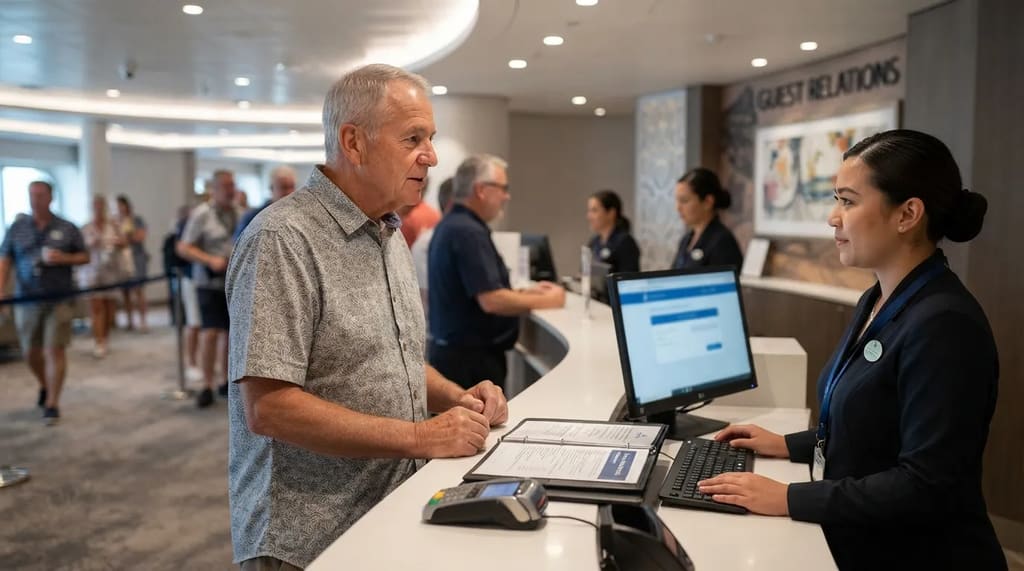
On many mainstream lines, a daily amount is added to your onboard account automatically unless gratuities were prepaid or included in the fare. It’s usually between $16 and $20 per person per day.
You can still change it, but not forever. Many lines require changes to daily gratuities to be handled while you’re still on board.
Royal Caribbean lets eligible guests modify gratuities through Guest Relations before disembarkation. Other lines, including Carnival, Celebrity, Princess and Holland America, also set their own windows for adjusting the charge, typically before the final morning.
Decide on your gratuities before the final morning, since many lines won’t change them afterward. Whether you keep, raise or trim the charge is your call, and it’s the same desk you’d use for #3.
A documented dispute over a $320 tip charge, made from home, shows how this ends when the window has closed.8
#1 – The Account You Can Only Fix While Aboard
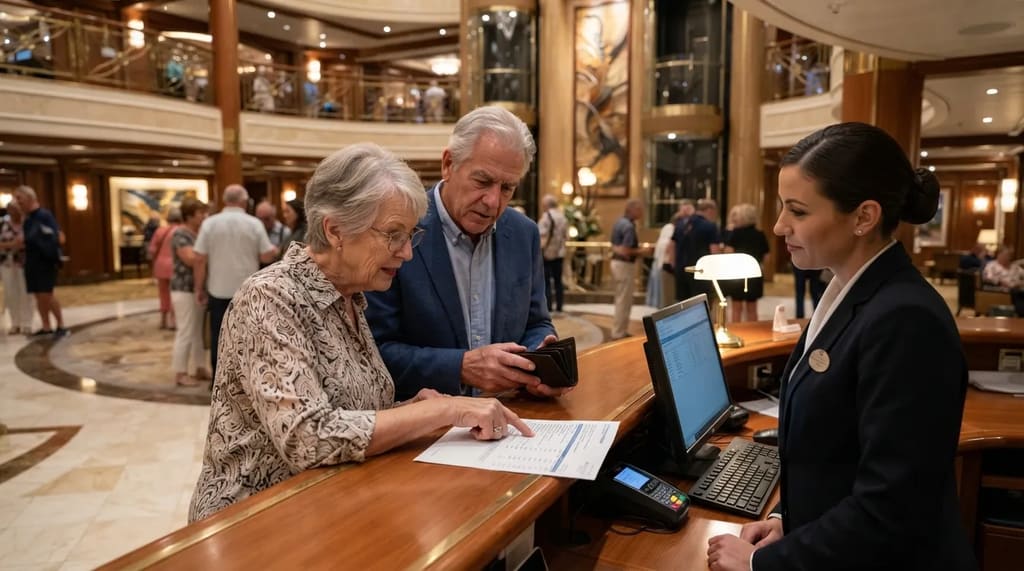
After you leave, it’s nearly impossible to get cruise line land staff to fix onboard billing mistakes. Customer service doesn’t always have access to your onboard bill, and you may spend hours on hold just to reach an agent.
Consumer Rescue documented how that plays out on an Oceania sailing. With five minutes left before disembarkation, no one was able to adjust the invoice.
The passenger then disputed the $320 in tips with her credit card, and the dispute went nowhere. The line had disclosed the gratuities in her confirmation and told the card company it applied the tip several days before the cruise ended.8
That’s why the other items on this list lead here. The statement from #4, the double charge from #3 and the daily tip from #2 all have to be fixed while someone on the ship can change them.
Fix the account the evening before, while someone aboard can change it. Better still, go to guest services on the last night and ask for a printout, rather than joining the morning crowd.
Every deadline in this piece falls on the final evening: the tag cutoff, the statement, the gratuity change, the mobility request. The morning belongs to walking off, not to fixing things.
Try giving the last night its own hour, set right after dinner. Spend it with the statement in one hand and the tag sheet in the other, and you’ll catch what you’d otherwise miss.
Which task did you leave until the final morning on your last cruise, and what did it cost you in time or money?
- Disembarkation Day Expectations: https://cruisereadyguide.com/blog/disembarkation-day-what-to-expect.html
- Cruise Disembarkation Day Guide: https://www.cruiseshiptracking.com/blog/cruise-disembarkation-process
- Travelbinger Disembarkation Morning Guide: https://travelbinger.com/17-things-experienced-cruisers-over-65-do-on-disembarkation-morning-that-everybody-else-discovers-too-late
- MSC Disembarkation FAQ: https://www.msccruisesusa.com/faq/disembarkation
- Debarkation Day and Customs: https://cruiseports.co/cruise-debarkation-day-customs/
- CBP Customs Duty Information: https://cbp.gov/travel/international-visitors/know-before-you-visit/customs-duty-information
- Royal Caribbean Gratuities Policy: https://www.royalcaribbean.com/faq/questions/beverage-package-gratuities-policy
- Consumer Rescue Oceania Tips: https://consumerrescue.org/cruise-fiascos/what-happens-dont-want-tip-on-cruise/