
Most of America’s best lake towns got discovered, developed, and turned into something unrecognizable – overpriced cocktail bars where the bait shop used to be, luxury condos where the motor lodge stood for forty years. But a quiet handful slipped through. These are towns where the ice cream stand has been run by the same family since Carter was president, where kids still ride bikes to the public beach without a parent tracking them on an app, and where the biggest event of the summer is the fishing derby. The screen doors still bang. The loons still call across the water at dusk. You can still smell a bait shop at 7 a.m.
What’s surprising is how different these places are from each other – a Great Lakes fishing village that’s barely changed since the Eisenhower administration, a Rocky Mountain town with a lake so blue it looks computer-generated, a New England resort town old enough to predate the country itself. The one thing they share: none of them are trying to look retro. They just never stopped being the real thing. Here are 19 of them, ranked from deeply charming all the way up to the one that might actually make you want to move.
#19 – Kimberling City, Missouri (Table Rock Lake)
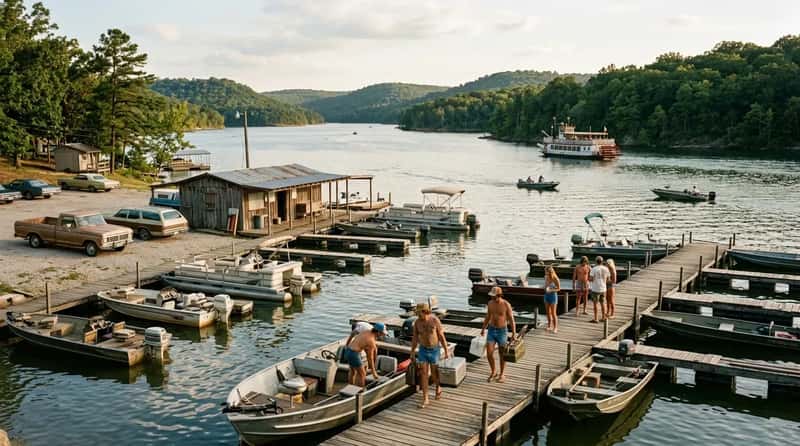
Kimberling City sits in the Ozark Mountains along the shores of Table Rock Lake, and most of life here revolves around the water – boating, fishing, and swimming on a lake that hasn’t been gussied up for Instagram. There are no celebrity chef restaurants, no curated boutique hotel lobbies. Just honest lake culture that’s been running on the same frequency for decades. A good day here means getting the boat out early and coming back with a cooler full of bass and a solid sunburn.
A paddlewheel cruiser still departs from a nearby marina for scenic lake tours, and a few miles south, Dogwood Canyon Nature Park offers guided Jeep, horseback, and bike adventures through Ozark hill country. On summer mornings, a soft haze settles over the lake and the surrounding hills in a way that postcard painters have been trying to capture for generations. Kimberling City is where it still actually exists, unmediated and unhurried.
Fast Facts
- Table Rock Lake covers roughly 43,100 acres with over 800 miles of shoreline
- The lake was created in 1958 when the Army Corps of Engineers dammed the White River
- Largemouth bass, smallmouth bass, and catfish are the primary targets for local anglers
- Dogwood Canyon Nature Park spans more than 10,000 acres of Ozark wilderness just south of town
- The area sits entirely within the Missouri Ozarks – no interstate cuts through it
#18 – Eureka Springs, Arkansas (Beaver Lake & Lake Leatherwood)
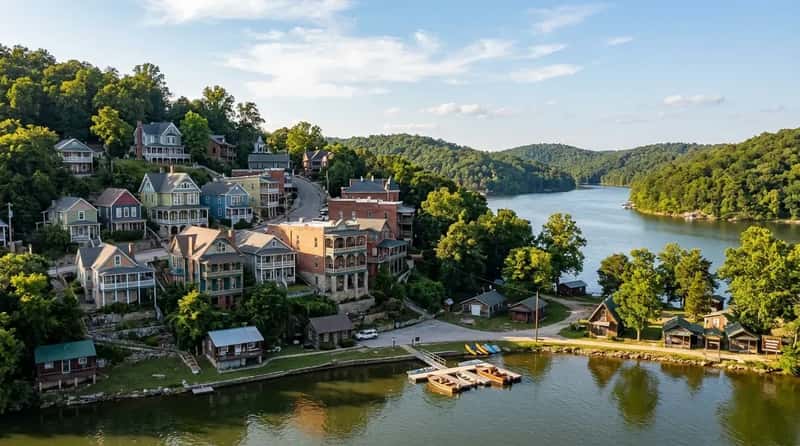
Eureka Springs wears its weirdness like a badge of honor, and somehow that makes it feel more authentic than a dozen perfectly manicured tourist towns. The community of around 2,200 is nestled in the Ozark Mountains within a few miles of both Beaver Lake and Lake Leatherwood, and its Victorian architecture climbs the hillsides in a stacked, slightly chaotic way that makes the whole town look like it was built by someone who thought gravity was optional. It works completely.
Both lakes offer cottage and campsite rentals alongside kayaking, fishing, and hiking, but what keeps Eureka Springs feeling old-school is its total resistance to corporate anything. The historic district has been preserved not as a museum piece but simply because the community chose it over expansion, decade after decade. The result is a town that feels genuinely handmade – and worth every mile off the interstate.
#17 – Lake Lure, North Carolina (Blue Ridge Mountains)
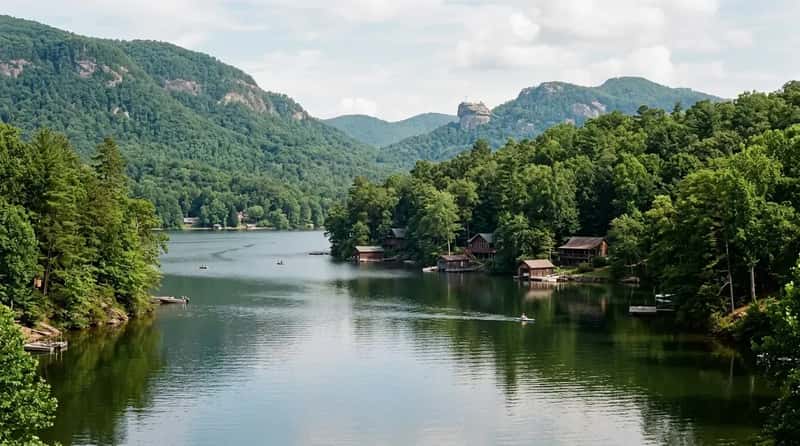
Tucked into the Blue Ridge Mountains of western North Carolina, Lake Lure has just over 1,400 residents – small enough that on a Tuesday morning in July you can actually find a quiet cove to yourself. The mountains roll down to the water’s edge in a way that makes the whole scene feel enclosed and private, like the rest of the country genuinely doesn’t know this place exists. It’s most famous as a filming location for the 1987 movie Dirty Dancing, with key scenes shot around the lakefront cottages of Firefly Cove.
Beyond the film history, Lake Lure offers boating and kayaking on the lake and hiking in nearby Chimney Rock State Park – and it isn’t chasing tourism dollars with flashy new developments. Come mid-July, when the hydrangeas are blooming along the lakefront roads and the mountain air is heavy and warm, the whole scene looks almost exactly like a summer memory you didn’t know you had. That’s not an accident. It’s just what this place is.
#16 – Sandpoint, Idaho (Lake Pend Oreille)
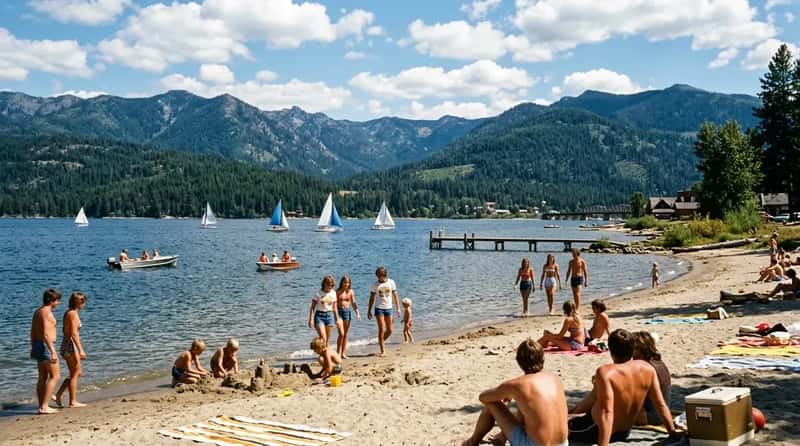
Surrounded by pine-covered mountains and resting on the shores of Lake Pend Oreille, Sandpoint is the definition of Idaho serenity – and Lake Pend Oreille is deeper than most people realize, plunging over 1,100 feet at its deepest point, making it one of the deepest lakes in the entire country. What makes Sandpoint feel genuinely old-school is the combination of spectacular scenery with a downtown that hasn’t been overrun by tourist infrastructure. You can walk from the beach to a diner in five minutes flat, and neither one will disappoint you.
Locals and visitors mix easily at Sandpoint City Beach Park, where kids build castles in soft sand and sailboats drift across the horizon against a backdrop of Selkirk Mountain peaks. The surrounding mountains give Sandpoint a drama that Idaho’s flat-state reputation doesn’t prepare you for at all. The summer community here has the easy, unhurried quality of a place that’s never needed to market itself aggressively, because the lake does all the talking – and the lake is very, very convincing.
#15 – Saugatuck, Michigan (Lake Michigan)
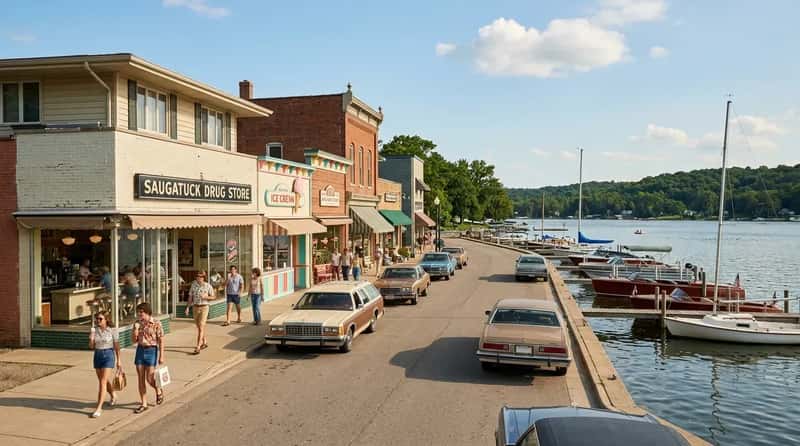
Saugatuck is the town that quietly anchors a lot of midwestern summer nostalgia. During the mid-century decades, American families drove to lakeside towns like this one because a Great Lakes beach was the pinnacle of leisure – before cheap flights, before resort-style everything, before anyone thought a beach vacation required a passport. That inheritance shows up on every block of Saugatuck’s main drag, Butler Street, where retro motels and quaint ice cream parlors face the water with a cheerful, unself-conscious confidence.
The 1950s-themed Drug Store and Soda Fountain is one of the best places in Michigan to step back in time – root beer float at a classic counter, no irony required. The summer playbook here hasn’t changed in five decades: beach, ice cream, boat rental, repeat. The town’s position on the eastern shore of Lake Michigan means big water, big sunsets, and miles of dune-backed shoreline that look essentially the same as they did when your parents were young. Nobody in Saugatuck is arguing that needs to be fixed.
#14 – Cooperstown, New York (Otsego Lake)
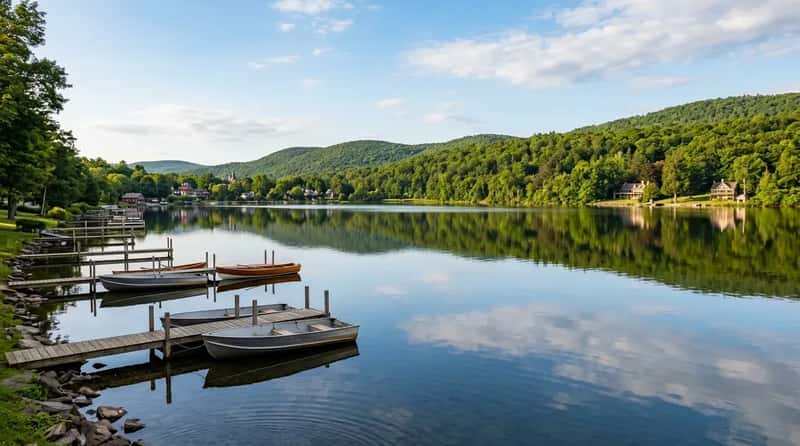
Cooperstown has a nickname it fully earns: America’s most perfect village. The town sits at the foot of Otsego Lake, a long, clear body of water that James Fenimore Cooper called “Glimmerglass” in his Leatherstocking Tales. On a calm July morning, the lake is so still and reflective it looks like the sky dropped to ground level. Expedia once ranked it the number two small town to visit in the entire country, and honestly that ranking feels modest given what’s actually here.
Most visitors come for the National Baseball Hall of Fame, but the town keeps them longer than planned – Main Street is full of vintage charm, with buildings dating to the late 1800s housing bookstores, bakeries, and antique shops. The Inn at Cooperstown has been welcoming guests since 1874. The ten-mile-long Lake Otsego has remained unspoiled for generations, and in summer the combination of history, architecture, and that glassy, glimmering water adds up to something that’s genuinely hard to leave. The Hall of Fame draws the crowds. The lake is why they stay.
At a Glance: New York’s Old-School Lake Towns
- Cooperstown – Otsego Lake, 10 miles long; National Baseball Hall of Fame; inn open since 1874
- Hammondsport – southern tip of Keuka Lake; home to America’s first federally licensed winery
- Bolton Landing – quieter northern shore of Lake George; Sagamore Resort anchoring it for over a century
- Skaneateles – lake so clean it supplies drinking water to more than 165,000 people without a filtration plant
- Saranac Lake – surrounded by Adirondack waterways; Lake Flower sits right inside the village itself
#13 – Hammondsport, New York (Keuka Lake)
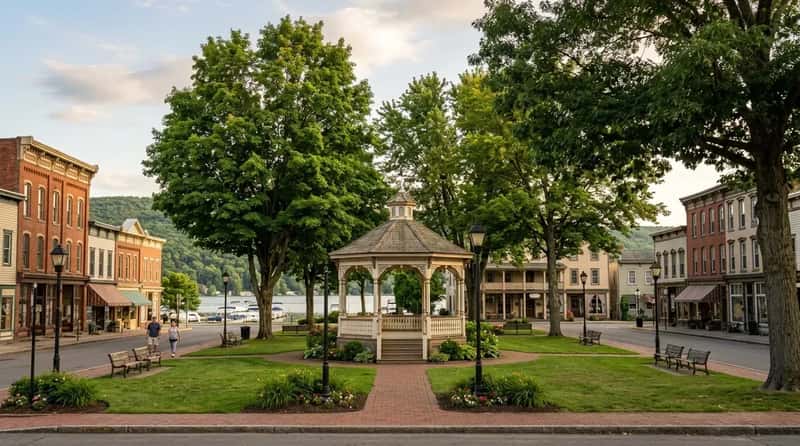
Hammondsport is the kind of village that makes you slow your car down and say “wait, is this real?” Sitting at the southern tip of Keuka Lake in the Finger Lakes, the town has a quiet, old-world charm that feels completely unhurried. The village square is one of the most intact examples of 19th-century small-town America you’ll find anywhere in the Northeast – and it doesn’t feel preserved so much as simply unchanged. That bandstand gazebo in the center of the square still hosts live bands on summer evenings, the same way it has for well over a century.
Hammondsport is home to the first federally licensed winery in the entire United States, which gives it a seriously cool historical identity that most visitors don’t know about until they’re already here. The Y-shaped Keuka Lake offers stunning views from every angle, and boating on its clear water is as unhurried as the town itself. The combination of an intact historic downtown, a spectacular Finger Lake, and local wineries that haven’t been swallowed by corporate hospitality groups makes Hammondsport one of the most underrated summer destinations in the entire country. Genuinely.
#12 – Garden City, Utah (Bear Lake)
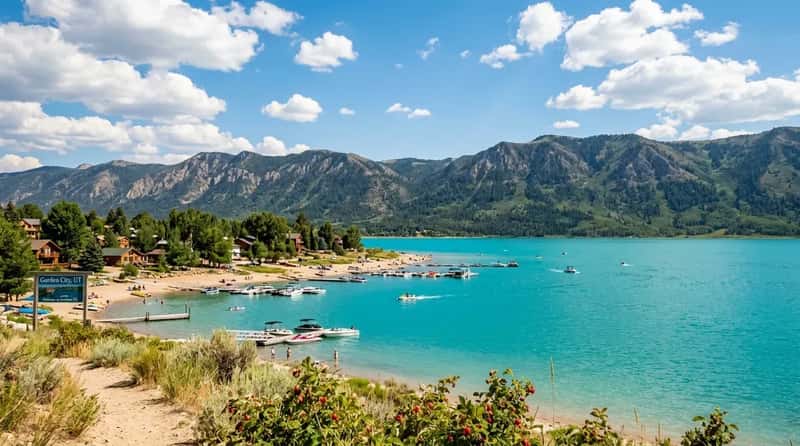
Bear Lake sits right on the Utah-Idaho border at 6,000 feet elevation, and the first time you see it you will actually stop mid-sentence. The lake’s electric turquoise color – caused by limestone particles suspended in the water – is so vivid it looks like a rendering rather than a real place. Sometimes called the “Caribbean of the Rockies,” Bear Lake offers beaches, boating, swimming, and even scuba diving, all at an altitude that keeps the summer heat from getting oppressive. Garden City is the tiny community that anchors the Utah side.
Summertime in Garden City also means raspberries – specifically, the world-famous Bear Lake raspberries that get harvested in late summer and turned into milkshakes at roadside stands that have been operating in the same spot for generations. The three-day Bear Lake Raspberry Days Festival in August celebrates the harvest the way small-town America used to celebrate everything: with a parade, live music, and an unhealthy amount of pie. Garden City itself is barely a blip on the map in terms of size, which means the lake-to-town ratio is overwhelmingly, gloriously in favor of the lake.
#11 – Bayfield, Wisconsin (Lake Superior)
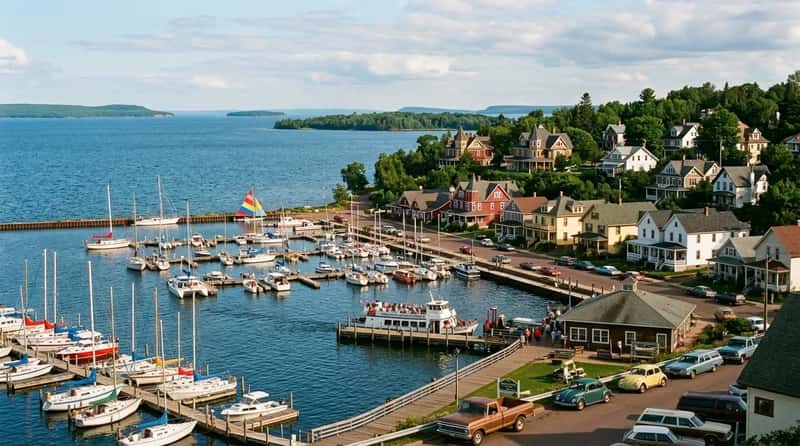
The smallest city in Wisconsin sits on the banks of the world’s largest freshwater lake by area – and somehow that fact still catches people off guard. Bayfield, a town of fewer than 600 people, borders Lake Superior, which spans an incredible 31,700 square miles. The colorful harborfront, the sailboats bobbing in the marina, the Victorian-era inns on the hillside above town – it all looks slightly fictional, like someone built a movie set overlooking the largest lake on earth and then forgot to tear it down.
Bayfield is the gateway to the Apostle Islands National Lakeshore, a stunning collection of sandstone sea caves, forested islands, and historic lighthouses accessible by kayak or ferry. In summer, the turquoise water of Lake Superior turns legitimately warm enough to swim in, and kayakers glide into sea caves that look like something from a nature documentary. The apple orchards on the hillsides above town bloom in spring and bear fruit in fall, giving Bayfield a seasonal rhythm that hasn’t changed in a very long time. Summer here feels genuinely earned – and genuinely quiet.
#10 – Bolton Landing, New York (Lake George)
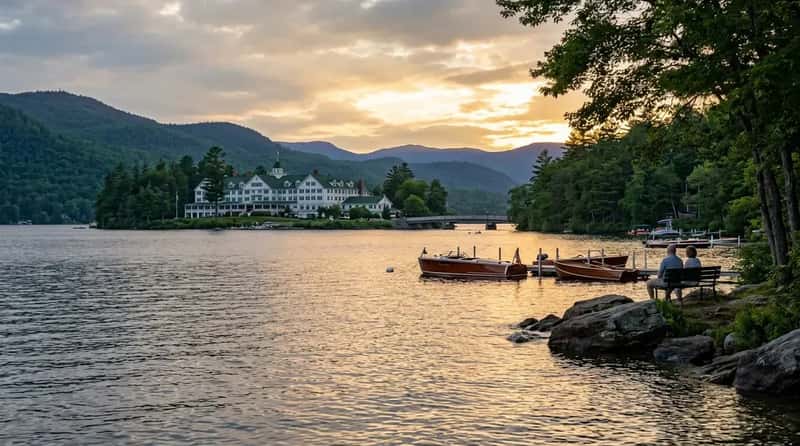
Lake George gets significant summer traffic, but most of it floods into Lake George Village at the southern end of the lake – leaving Bolton Landing, twelve miles up the western shore, in a state of relative calm that feels like a different decade. The Adirondack landscape here has a cinematic quality that no amount of set design could manufacture, and the sunset views from the Bolton Landing shoreline are the kind that make people actually put their phones down. That’s a rare and powerful thing.
The Sagamore Resort has anchored this community for over a century, bringing a grand historic elegance to the lakeside setting without overwhelming the village character around it. The town itself is small and walkable, with waterfront dining and local shops that feel genuinely personal rather than franchise-assembled. The fact that most Lake George tourists never make it this far north is the quiet secret that keeps Bolton Landing in its 1970s groove. The locals aren’t complaining about that – not even a little.
#9 – Egg Harbor, Wisconsin (Green Bay / Lake Michigan)
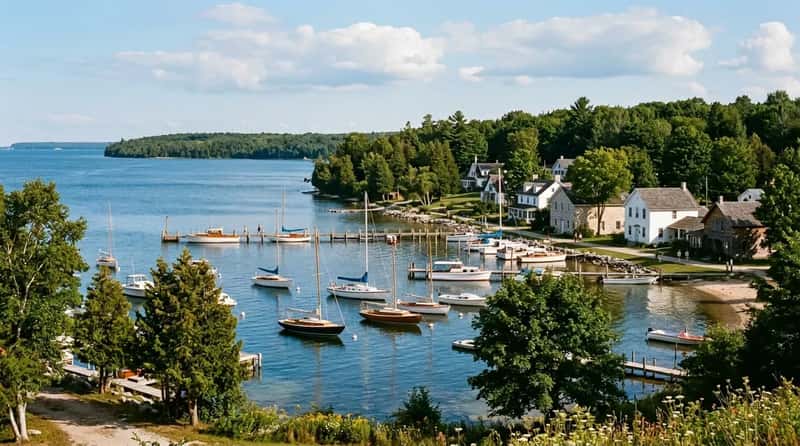
Egg Harbor has around 250 full-time residents, but this Door County village has earned its reputation as one of America’s best small towns. Its name supposedly comes from a genuinely strange 1825 incident in which two rival boat captains engaged in a full-on egg-throwing battle while anchored in the harbor, leaving the shoreline littered with shells. That story alone tells you everything you need to know about the spirit of the place. It’s charming, a little ridiculous, and completely its own thing.
The village is lined with restored historic buildings, independent bakeries, an organic greengrocer, and some of Door County’s most popular restaurants – none of them chains, none of them trying to be anything other than what they are. The harbor’s marina draws a spectacular weekend sailboat display, including a weekly Saturday morning regatta where ten to twenty sailboats race across the waters of Egg Harbor. Watching those white sails from a bench on the pier on a warm Saturday morning, with no schedule and nowhere to be, is about as close to a 1970s summer afternoon as the modern world will give you.
Worth Knowing: What Makes These Wisconsin Lake Towns Different
- Door County has over 300 miles of shoreline and 11 lighthouses – more than any other county in the U.S.
- Egg Harbor’s full-time population of ~250 swells dramatically every summer, but the village character stays intact
- Bayfield, the state’s smallest city, sits on a lake larger than the entire state of South Carolina
- Both Door County and the Bayfield Peninsula are known for cherry and apple orchards harvested each fall
- Neither area has a major chain hotel presence that dominates the lakefront – a rarity for any Midwest tourist region
#8 – Saranac Lake, New York (Adirondacks)
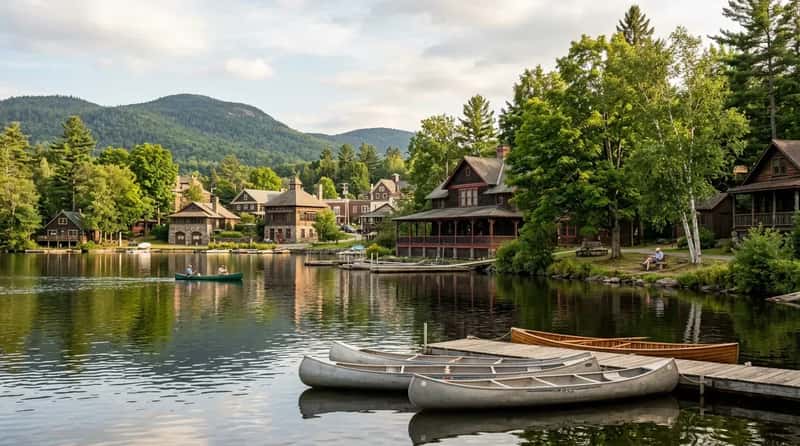
Saranac Lake operates at its own peaceful frequency, and once you tune in, you won’t want to leave. The Adirondack town is surrounded by a chain of small lakes and waterways that make it a paddler’s paradise, with Lake Flower sitting right at the center of the village itself. Unlike some Adirondack destinations that get overwhelmed with summer crowds, Saranac Lake manages to filter out the loudest, most gear-obsessed visitors and hold onto a quieter, more local energy. The locals feel it. Visitors feel it within about four hours.
The town’s architecture leans heavily on the Adirondack Great Camp aesthetic – dark wood, stone foundations, wide porches facing the water – and it hasn’t been retrofitted into something modern and glossy. The old tuberculosis sanatorium that once defined the town’s identity has been reimagined into apartments and community space, giving Saranac Lake an unusually layered sense of history you can feel on an evening walk. The farmers market, the community sailing club, the local diner that doesn’t have a website – it all adds up to a summer that’s genuinely, stubbornly unhurried in a way that’s increasingly hard to find anywhere.
#7 – Bigfork, Montana (Flathead Lake)
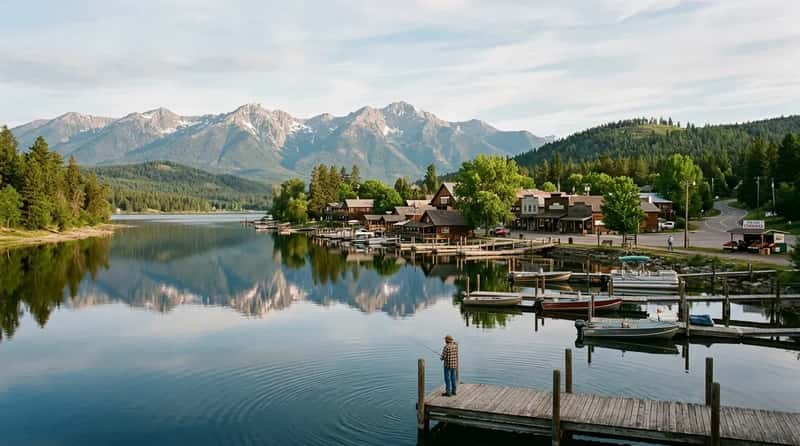
Flathead Lake is the largest natural freshwater lake west of the Mississippi, and Bigfork sits on its northeastern arm like a town that has absolutely no idea it should be more famous than it is. The Swan River empties into the bay right at the village’s doorstep, and on a July morning when the water is still and the Mission Mountains are reflected perfectly in it, the whole scene has the quality of a painting that got out of hand. The town is small enough that you’ll recognize faces from breakfast by the time you’re buying fresh cherries at a roadside stand in the afternoon.
Bigfork has a legitimate arts scene for a town of its size – a summer stock theater operating in repertory for decades draws serious theater-goers who’d otherwise have no particular reason to be in northwest Montana in August. The wild cherries that grow along Flathead Lake are a genuine regional delicacy, harvested every summer with the kind of seasonal urgency that modern agricultural supply chains have made almost extinct everywhere else. Everything about Bigfork – the scale, the lake, the pace, the cherries – feels inherited rather than invented. And that’s exactly what makes it feel so startlingly real.
#6 – La Conner, Washington (Swinomish Channel)
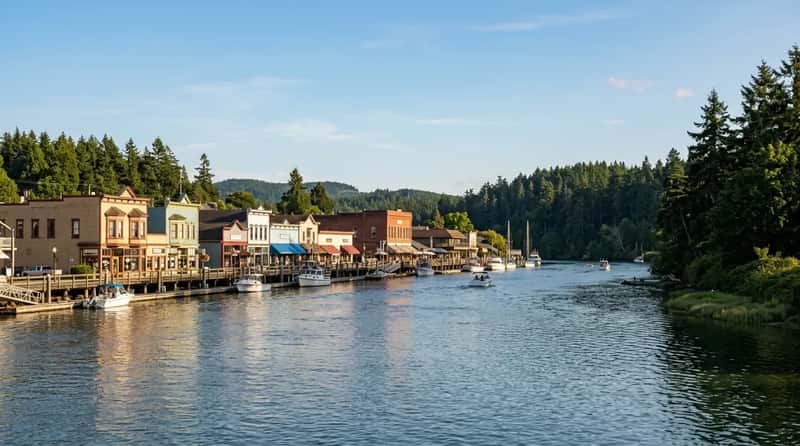
La Conner calls itself a “tiny town with big charm” – and the description is accurate enough that it’s almost annoying. Sitting just an hour north of Seattle, it’s surrounded by tulip fields and farmland to the west and the evergreen-lined Swinomish Channel to the east. The town’s historic First Street runs along the channel with Victorian-era storefronts that have housed galleries, bookshops, and restaurants for decades without significant renovation. Walking it feels less like a heritage trail and more like a street that simply never got the memo about modernizing.
La Conner has long attracted artists and writers – the painter Morris Graves lived nearby for years, and the town has drawn creative types since the 1960s without ever tipping into pretension. The fishing boats that tie up along the channel are working boats, not decorative ones, and the local pub belongs to the fishermen who actually come in for dinner on Tuesday nights, not just the weekend crowd. That tension between the authentic and the visited is what gives La Conner its particular charge. It’s charming without having been made charming. That’s a genuinely rare thing.
#5 – Mount Dora, Florida (Lake Dora)
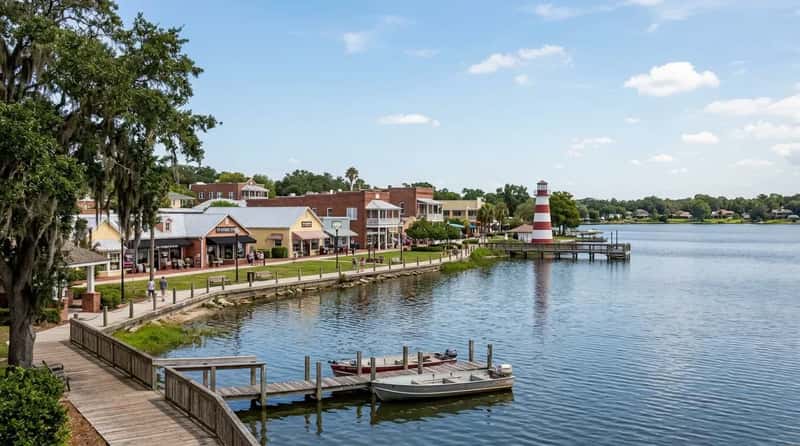
Florida has been overdeveloped almost everywhere a developer could reach, which makes Mount Dora’s survival as an intact small town on a real lake feel close to miraculous. Far from the theme parks, Mount Dora is built around lakeside views, antique shops, and a downtown lined with mom-and-pop stores that feel unchanged for generations. Lake Dora is part of the Harris Chain of Lakes – a series of connected waterways stretching across Lake County – and the town’s position on the northern shore gives it dramatic waterfront views that the Orlando sprawl never quite swallowed.
The antiques scene here is serious business, not the decorative kind where everything costs twelve times its value, but deep-cut multi-room dealers with genuine finds that make people drive three hours from Tampa. The town’s famous antiques fair each February draws dealers from across the Southeast. But in summer, Mount Dora is at its most quietly itself: boat tours on the lake, ice cream on a shaded veranda, and the kind of evening light coming off the water that makes you want to sit on a bench and simply watch it for a while. The charm isn’t in the attraction checklist. It’s in the in-between moments.
#4 – Mackinac Island, Michigan (Lake Huron)
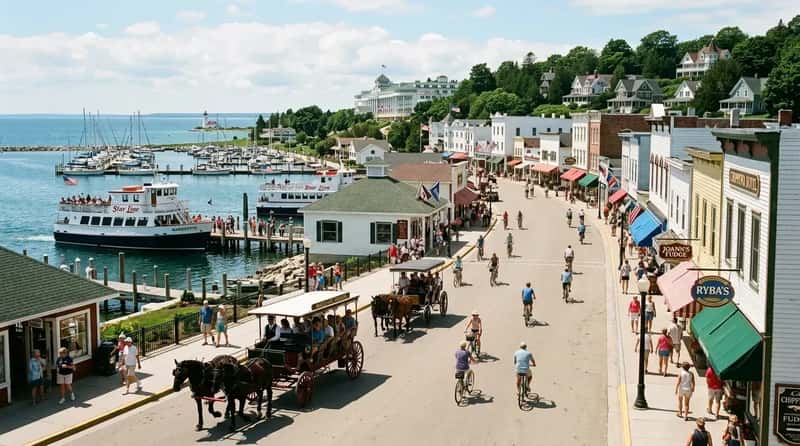
In 1898, automobiles were banned from Mackinac Island. That single decision, made over a century ago, turned it into something no amount of historic preservation money could manufacture. When you step off the ferry and the sound of car engines simply stops, your nervous system doesn’t quite know what to do with the quiet. It’s disorienting in the best possible way. The streets are filled with horse-drawn carriages and bicycles, many of the buildings date to the 1800s, and Victorian-style cottages climb the hillside above a main street that has looked essentially the same for well over a hundred years.
In the early 20th century, Mackinac Island became a summer destination for families from Chicago and Detroit, and the town’s grand hotels and cottages were built during that era and never significantly altered. The Grand Hotel’s 660-foot porch remains the longest in the world, and sitting on it watching the Straits of Mackinac on a summer afternoon is genuinely, unironically magnificent. The island’s 13 fudge shops produce around 10,000 pounds of fudge daily during peak season – a detail that tells you everything about the cheerful, unapologetic excess of the place. This island doesn’t just feel like the past. It practically insists on it.
Fast Facts: Mackinac Island by the Numbers
- Cars banned since 1898 – making it one of the few car-free communities in the U.S.
- 13 fudge shops produce roughly 10,000 pounds of fudge daily during peak tourist season
- The island imports about 10 tons of sugar per week just to keep up with fudge demand
- The Grand Hotel’s famous front porch stretches 660 feet – the longest in the world
- The entire island covers only 3.8 square miles, with 80% designated as state parkland
#3 – Skaneateles, New York (Skaneateles Lake)
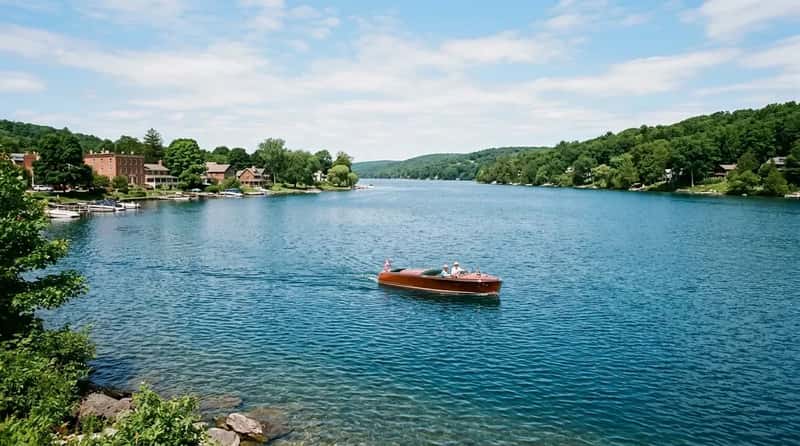
Skaneateles – pronounced “skinny-atlas” by the locals, in case you’d like to avoid the tourist tell – sits at the northern tip of one of the clearest lakes in the Eastern United States. Skaneateles Lake is approved by the New York State Department of Health to supply drinking water without a filtration plant, which is nearly unheard of for a large-system municipal water supply anywhere in the country. The lake runs eleven miles long and is ringed almost entirely by intact shoreline with no highway sprawl or big-box retail to break the spell. Out on the water in a wooden runabout on a Tuesday morning, you’d have no reliable way to know what decade it is.
The village itself is compact and walkable, with a main street of 19th-century brick storefronts still occupied by independent businesses rather than franchise locations. The Sherwood Inn has anchored the waterfront since 1807 and still serves dinner with unobstructed views of the lake. In December, Skaneateles transforms for its annual Dickens Christmas celebration – carolers in period costumes, glowing storefronts, the kind of scene that makes you want to call your whole family. But summer is the real revelation: the lake is extraordinary, the village is perfectly scaled, and the whole thing operates with a quiet confidence that comes from a community that has never needed to reinvent itself.
#2 – Wolfeboro, New Hampshire (Lake Winnipesaukee)
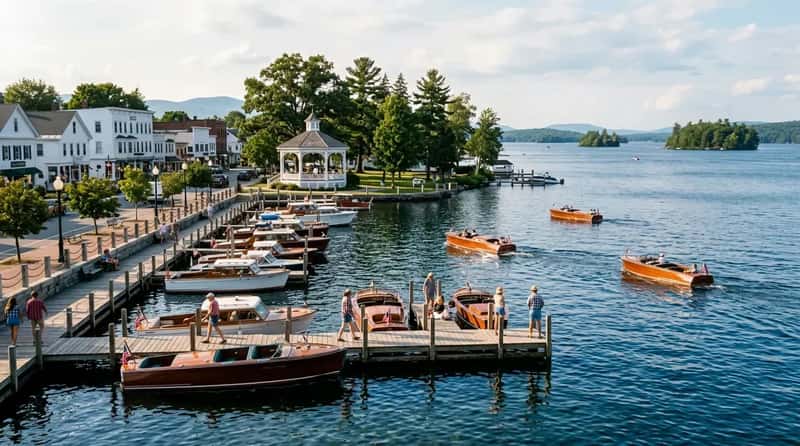
Wolfeboro calls itself “America’s Oldest Summer Resort,” and the claim isn’t marketing spin – it traces its resort identity to 1763, when Governor John Wentworth built a summer estate on the water’s edge, making every summer tradition in this town older than the country itself. That kind of historical gravity is palpable the moment you pull into town. The docks, the bandstand, the white clapboard storefronts – all of it feels like it was arranged with great intention a very long time ago and then simply maintained with care.
Wolfeboro sits on the eastern shore of Lake Winnipesaukee, New Hampshire’s largest lake at 72 square miles with 288 miles of shoreline – the crystal-clear water and mountain backdrop creating the quintessential New England summer scene. The town’s permanent population of around 6,400 swells dramatically in summer, a seasonal transformation that has been happening here for well over a century. Yum Yum Shop has been making homemade fudge since 1948. The Fourth of July parade with antique cars, the farmers market, the gazebo bandstand in Cate Park overlooking the docks – all of it has been happening here for generations. You don’t visit Wolfeboro. You inherit it.
At a Glance: Wolfeboro’s Old-School Summer Resume
- Resort history dates to 1763 – before the United States existed
- Lake Winnipesaukee spans 72 square miles with 288 miles of shoreline and 365 islands
- Black’s Paper Store & Gift Shop has been on the main street since 1867
- Weekly farmers market runs mid-May through early October every Thursday
- Free waterfront concerts at Cate Park are a summer fixture that costs nothing to enjoy
- The Libby Museum, founded in 1912, is the oldest natural history museum in New Hampshire
#1 – Leland, Michigan (Lake Leelanau / Lake Michigan)
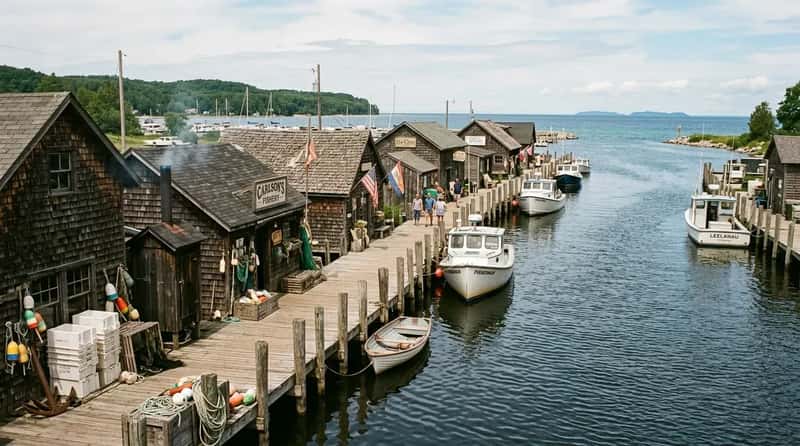
The town that edges everything else on this list isn’t the most famous or the most dramatic. It’s Leland – a village of fewer than 2,000 people on the Leelanau Peninsula, tucked between Lake Leelanau and the cold, clear waters of Lake Michigan. The reason it’s number one is a single, extraordinary block called Fishtown: a cluster of weathered cedar-shake fishing shanties hanging over the Leland River on wooden docks, still actively used by commercial fishermen who net whitefish and lake trout the same way families on this river have done for well over a century. There is no reconstruction happening here. It’s not a living museum. The smokehouses are still smoking.
Leland was designated a National Historic District partly because of Fishtown, and the broader village around it operates with the same unforced authenticity. The Manitou Island ferry departs from here each summer, crossing the sparkling Manitou Passage just as it did in the 1950s when families from Chicago and Detroit first discovered the Leelanau Peninsula. The cherry orchards are working orchards. The beach at the end of the river channel is cold, rocky, and perfect. No valet services, no rooftop bars, no curated “experiences” – just a Great Lakes summer in its purest form, running on its own private clock, completely indifferent to the year on the calendar. If one town in America still smells like 1973, it’s Leland. Find it before everyone else does.
None of these towns became what they are by accident. They stayed this way through a combination of geography, stubbornness, community pride, and the good fortune of being slightly off the path that mass tourism tends to bulldoze. That balance is fragile – and it’s getting more fragile every year as remote work and short-term rental platforms push development into corners of America that were previously insulated by their own obscurity. If you go, spend money at the local diner, the bait shop, the family-run inn. The best thing you can do for a place like this is show up and care about it the right way.