

Pull up a photo of a typical American living room from 1975 and most people under 30 will assume it’s a movie set – or a very committed interior design mistake. The colors alone look like someone spun a wheel. The furniture sits so low it practically dares you to get back up. And there’s something hanging from the ceiling that nobody can immediately name. Here’s the thing: every single one of those bewildering choices was intentional, considered, and widely admired at the time.
What’s strange isn’t that these rooms existed – it’s how complete they felt. Nothing was out of place because everything belonged to the same confident, slightly wild design universe. The quirks weren’t accidents. They were the whole point. And a few of them, by the end of this list, might actually make you wish you could go back.
#19 – Wall-to-Wall Dark Wood Paneling on Every Single Surface
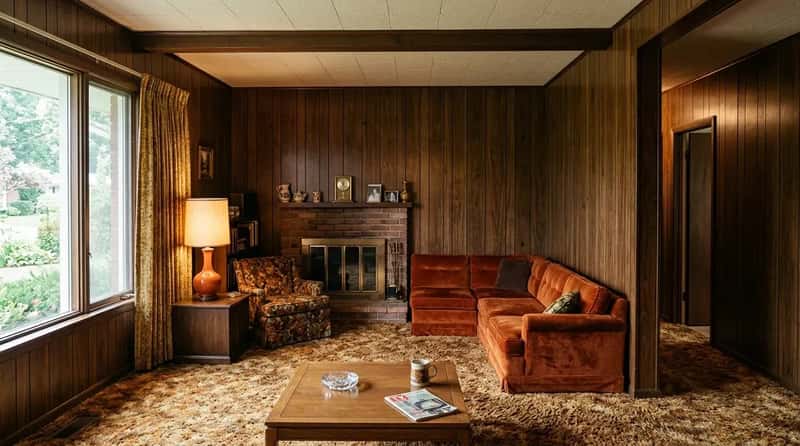
It covered every surface, top to bottom, corner to corner – and somehow nobody thought this was alarming. The paneling was usually a thin sheet of pressed wood printed to resemble real walnut or mahogany, and it made every room feel like the interior of a ship’s cabin, which seemed to be the point. For families who installed it, the paneling wasn’t dark or oppressive. It was warm, masculine, and modern – the kind of finish you’d see in a nice restaurant or a law office.
Today, younger people walk into a paneled room and immediately start calculating how many coats of paint it would take. In 1974, you walked in and felt like you’d arrived. The paneling gave off a sophisticated yet relaxed vibe – a private club, but in your own home. That gap between how it reads now versus how it read then is almost impossible to bridge, which is exactly what makes it the perfect place to start.
#18 – The Shag Carpet With Its Own Dedicated Rake
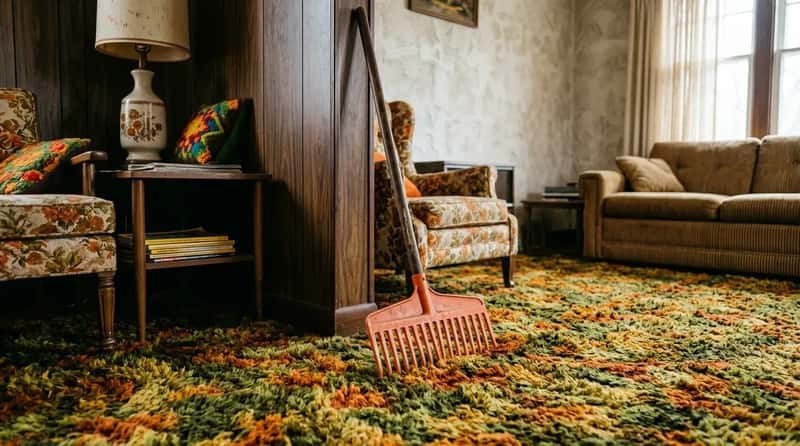
Shag carpet was the defining textile of the decade, and it required its own tool for maintenance: the carpet rake, a long-handled plastic comb designed solely to fluff the pile back up after foot traffic flattened it. It sat in the corner of the living room like a slightly embarrassed lawn implement. Dropping a coin in shag carpet was a genuine loss event – you watched it disappear and made a mental note to find it during the annual move-the-furniture cleaning, which was also when you confirmed what else was living down there.
The colors are what stop people cold today – deep orange, avocado green, harvest gold. Anyone under 30 looking at a period photo assumes the carpet was chosen as a joke. It was chosen as a flex. Shag was plush, tactile, and expensive-feeling underfoot, and owning a thick pile in a saturated earth tone meant you were keeping up. The rake wasn’t a burden. It was proof of the investment.
Fast Facts
- Shag carpet pile could run 1 to 3 inches deep – long enough to swallow small toys, coins, and remote controls whole.
- The most popular colors were avocado green, harvest gold, burnt orange, and a rust-brown with no official name.
- Deep-pile shag acted as a natural sound dampener, absorbing echo and making rooms feel noticeably quieter and cozier.
- Carpet rakes were sold alongside the carpet itself at stores like Sears – owning one was simply part of the package.
- Today, shag-style area rugs are widely available as retro accent pieces – but wall-to-wall installation in bold earth tones is almost entirely gone.
#17 – The Conversation Pit Literally Sunken Into the Floor
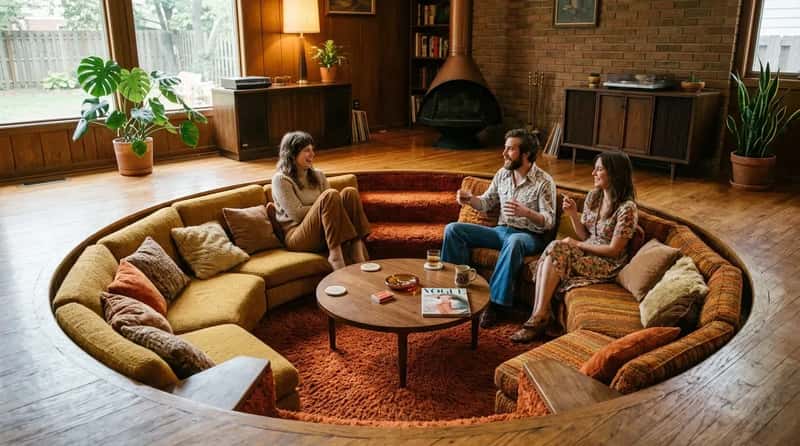
The concept sounds absurd to anyone raised in a world of flat-floor open plans: you literally excavated a section of your living room floor and put seating in the hole. The sunken conversation pit created an instant sense of intimacy – a room within a room, a social pod that pulled people down into it and faced them toward each other. The steps down weren’t an obstacle. They were an invitation.
The conversation pit started gaining traction in the late ’50s, peaked hard in the ’70s, and appeared prominently in pop culture – the set of the Mary Tyler Moore Show featured one of the most recognizable examples on American television. Today, people are actively trying to recreate them, but most houses built after 1980 simply don’t have them. The architectural commitment required is exactly what made them feel special – and exactly why they disappeared.
#16 – The Console TV That Was Also a Piece of Furniture
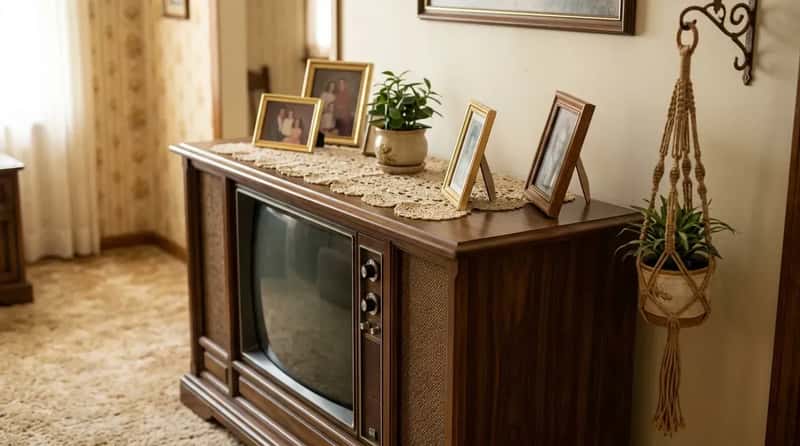
It wasn’t just a television. It was furniture – specifically, a very large piece of furniture that happened to contain a television inside a walnut-veneer cabinet the scale of a sideboard. The top surface became a dedicated display area: a crocheted doily, a few framed photos, a plant in a macramé hanger, possibly a ceramic horse. When the TV stopped working, the cabinet stayed. For years. Because it was a perfectly good cabinet, and also because moving it required four adults and someone getting hurt.
At their peak in the early 1970s, console TVs cost the equivalent of $3,000 to $5,000 in today’s money, which is partly why families treated them as genuine furniture investments and displayed them accordingly. Today, a 65-inch flat screen gets wall-mounted and forgotten. In 1973, the TV was the centerpiece of the entire room, the anchor around which all other furniture orbited, and it weighed roughly as much as a small refrigerator.
#15 – Macramé Everywhere – Walls, Ceilings, Plant Hangers, Curtains
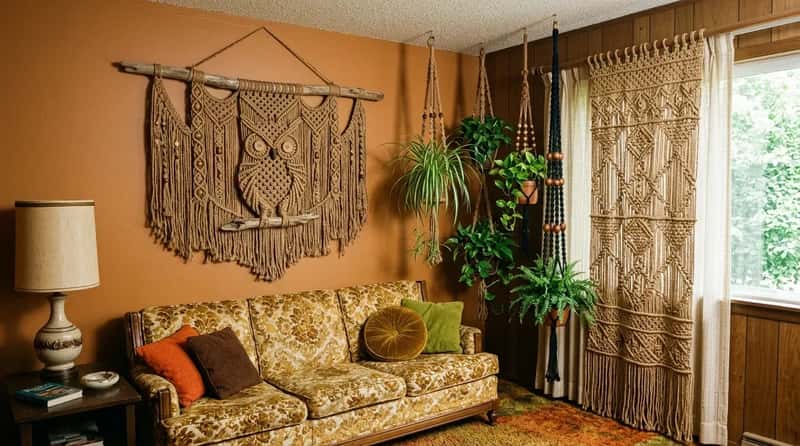
Macramé – the art of knotting rope or cord into intricate patterns – didn’t just show up in ’70s living rooms. It colonized them. Wall hangings, plant holders, curtains, and room dividers, all knotted by hand from scratchy jute, often featuring a geometric owl with button eyes staring down from above the sofa. The scale of the commitment is what floors people today – it wasn’t one small accent piece. It was a full decorating philosophy made from rope.
Every living room had at least one piece, and at least one person in the household had made it themselves from a kit purchased at a craft store that no longer exists. The driftwood dowel at the top was from an actual beach trip. The knot patterns were either deeply intentional or completely improvised depending on how the afternoon went. Anyone under 30 sees a craft project. Anyone who grew up in the ’70s sees their mother’s living room exactly as it was.
#14 – Spider Plants Suspended From the Ceiling in Knotted Rope
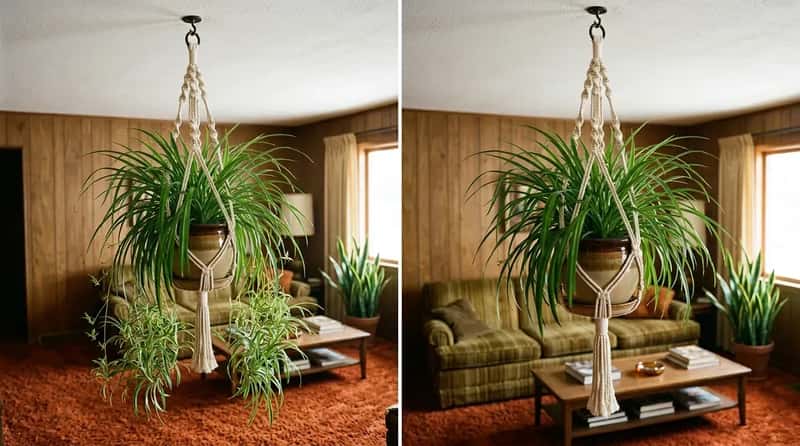
As the indoor-jungle trend took over in the ’70s, ceilings became part of the decorating canvas. Hand-knotted macramé hangers dangled from ceiling hooks, almost always holding a spider plant – the decade’s plant of choice, nearly indestructible, constantly producing trailing baby plants, and apparently impossible to own just one of. The long tendrils of plantlets hung down like the thing was slowly reaching for the shag carpet below.
What’s strange to anyone under 30 isn’t the plant itself – it’s the ceiling installation. Today you put a plant on a shelf or a windowsill. In the ’70s, you drilled a hook into your living room ceiling, looped rope through it, and called the result interior design. And honestly, the effect – a softly lit room with greenery at eye level and trailing vines at shoulder height – was genuinely lush in a way that a shelf plant never quite replicates.
At a Glance: The ’70s Indoor Plant Obsession
- Spider plants were prized for being nearly indestructible – surviving low light, missed waterings, and determined cats.
- Baby plantlets were routinely clipped, potted in reused margarine containers, and gifted to visitors who admired them.
- Rooms in the 1970s often featured so many plants they looked more like terrariums than living spaces.
- Macramé hangers, ceramic pots, and tiered wrought-iron plant stands all served as display infrastructure for the indoor jungle.
- The trend reflected a broader ’70s obsession with natural textures – rope, jute, wood, and living greenery over plastics and synthetics.
#13 – The Bead Curtain Instead of an Actual Door
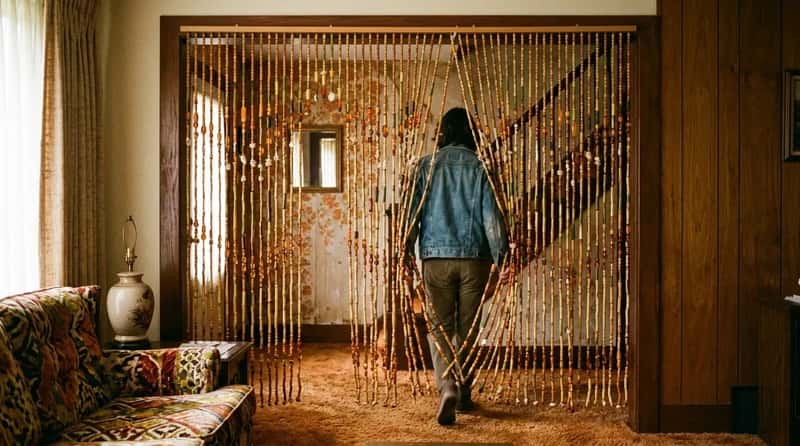
Wooden beads, plastic beads, sometimes shells, occasionally bamboo sections threaded together, hanging from a wooden rod across the full width of a doorway, doing absolutely nothing to block sound, light, sight, or drafts. The only thing the bead curtain reliably blocked was comfortable passage from one room to the next. Walking through it involved a face-full of beads and the specific tactile sensation of a dozen strands dragging across your shoulders. This was considered atmosphere.
The bead curtain was most commonly found between the living room and a hallway – anywhere a door once stood or could have stood, but where a door felt too formal for the decade’s vibe. The idea was that an open, flowing house replaced hard divisions with texture and movement. It just also happened to smack you in the face every time. Anyone under 30 who encounters one today assumes it’s a novelty or a Halloween decoration. In a ’70s home, it was a considered design statement.
#12 – The Swag Lamp Hanging From a Ceiling Hook on a Visible Cord
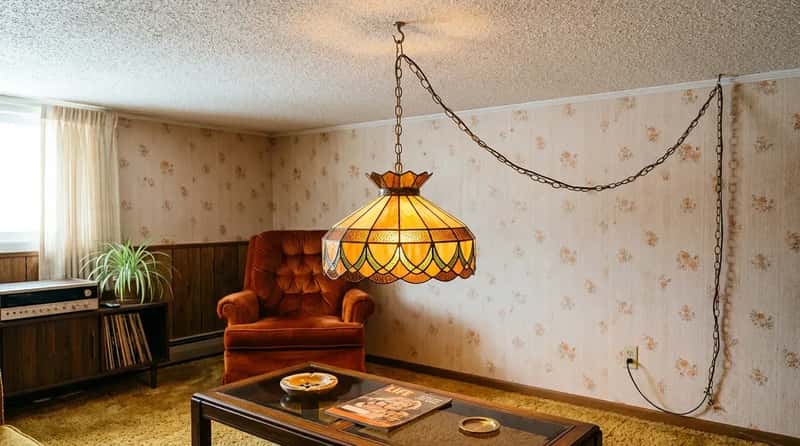
The swag lamp asked only one thing of its owner: a single ceiling hook and enough cord to reach a wall outlet via a decorative swooping arc that somehow nobody found strange. It was not hardwired. It was not structurally committed to its location. It was simply hanging there, confident, casting amber light over the coffee table below. The cord running along the ceiling and down the wall was always slightly visible, always slightly concerning, and always completely ignored.
The swag lamp came in dozens of varieties – tiffany-style glass, rattan, brass, and smoked amber acrylic among the most popular. What they all shared was that genius workaround: no electrician required, no ceiling fixture needed, just a hook from the hardware store and a long cord draped decoratively. Today a visible cord running across the ceiling would trigger a renovation. In 1972, it was just part of the lamp’s character – and the warm amber glow it cast over a shag-carpeted room was, admittedly, genuinely beautiful.
#11 – Harvest Gold and Avocado Green as Serious, Sophisticated Color Choices
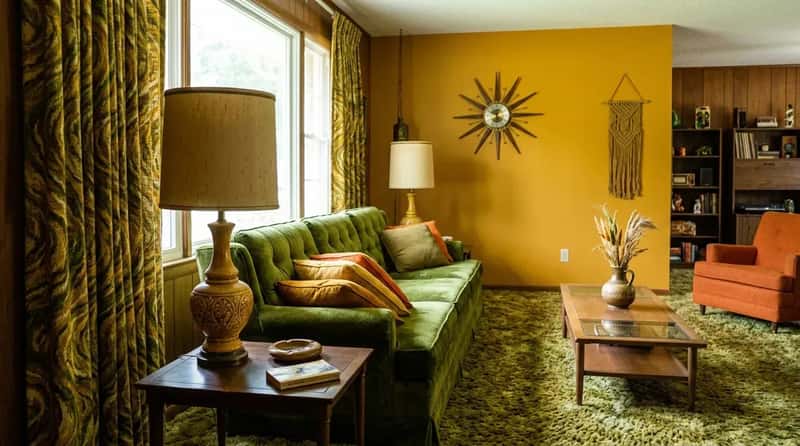
Avocado green. Harvest gold. That particular shade of brown that didn’t have a name but lived in every house between 1971 and 1983. These weren’t considered garish – they were considered earthy, warm, and deeply on-trend. The palette extended beyond appliances and carpet to sofas, drapes, accent walls, and ceramic lamp bases, all in the same saturated family of tones, all in the same room, all at the same time.
Anyone under 30 raised on the gray-and-white minimalism of modern interiors will do a visible double-take seeing an entire living room committed to these colors. But in context, saturated earth tones read as natural and enveloping rather than overwhelming – the visual equivalent of sitting inside a warm autumn afternoon. The decade wasn’t wrong about the emotional effect. It was just very, very committed to it.
#10 – The Encyclopedia Set Displayed on a Shelf Like a Trophy

Every volume in perfect order, spines aligned, gold lettering on burgundy covers glinting under the table lamp. They were purchased from a door-to-door salesman who was very convincing, they cost roughly what a used car cost, and they were consulted perhaps four times between 1974 and 1991. Mostly they were furniture. Very expensive, slightly guilty furniture that signaled, to anyone who visited, that this was a household that took education seriously.
The full set of World Book Encyclopedia ran to 22 volumes and cost roughly $600 in 1975 – over $3,500 in today’s money – and families financed them in monthly payments. They sat on a dedicated shelf unit, never moved, and were occasionally dusted. Anyone under 30 has never needed a physical reference book for anything. The concept of spending thousands of dollars on books you rarely opened, purely for the intellectual signal they sent to guests, belongs to a completely different social universe.
Quick Compare: How the ’70s Living Room Signaled Status
- Encyclopedia set: $600 in 1975 (~$3,500 today) – bought on installment, rarely touched, always displayed
- Console TV: $500–$800 in 1972 (~$3,500–$5,500 today) – the room’s undisputed centerpiece
- Stereo console: $400–$700 (~$2,800–$4,900 today) – the room’s second-most-important anchor piece
- Shag carpet (room-sized): Premium install ran $500+ – a flex that required its own dedicated tool
- Today’s equivalent: A mounted 65-inch TV, a Spotify subscription, and a Wikipedia bookmark – total cost under $1,000
#9 – The Kidney-Shaped Coffee Table That Made No Ergonomic Sense
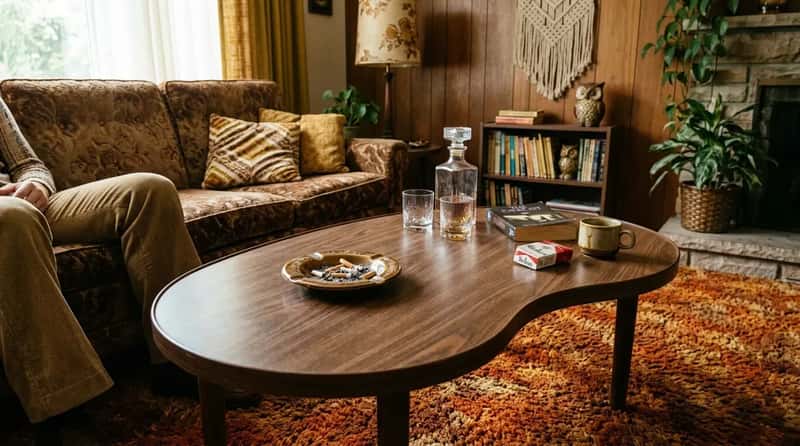
The kidney shape was a design holdover from the late 1950s that had no intention of leaving. It was asymmetrical, organic, and completely impractical for placing things on in a balanced way – which seemed to be of no concern to the decade that chose it as its signature coffee table form. The irregular curve was borrowed from the biomorphic design movement, which prized natural shapes over straight lines and right angles.
You can’t center anything on a kidney-shaped table. There’s no logical place for a remote, a stack of magazines, or a drinks tray. One end is wide; the other tapers to a gentle point. It makes no sense next to a sofa. And yet, for roughly two decades, it sat at the center of millions of American living rooms – usually in blonde wood or smoked glass – confidently defying every rule of function that modern furniture follows without thinking.
#8 – Lava Lamps Used as Actual Ambient Lighting
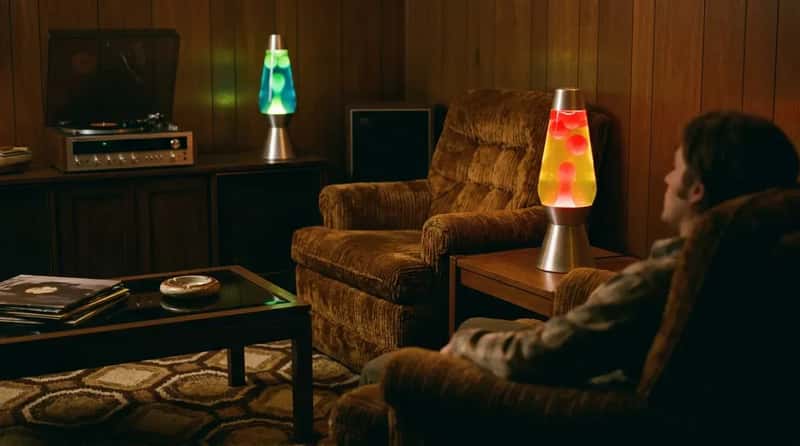
By the early ’70s, the lava lamp had migrated from college dorms into mainstream living rooms – a soft, glowing blob of wax floating in a lit cylinder of liquid, providing essentially zero useful light but enormous amounts of what the decade called “atmosphere.” They weren’t great for reading. They were perfect for listening to records and contemplating the universe, which was apparently a more common evening activity than it sounds.
The original Lava Lite lamp was invented in Britain in the 1960s and hit American mass-market stores hard by 1970, with millions of units sold annually at peak popularity. The colors ranged from classic red wax in yellow liquid to psychedelic combinations that matched whatever the carpet was doing. Anyone under 30 today sees a lava lamp as a gag gift. In 1972, it sat on the end table next to the sofa as a completely sincere design choice, and nobody questioned it for a single second.
#7 – Beanbag Chairs Scattered Around the Floor as Primary Seating
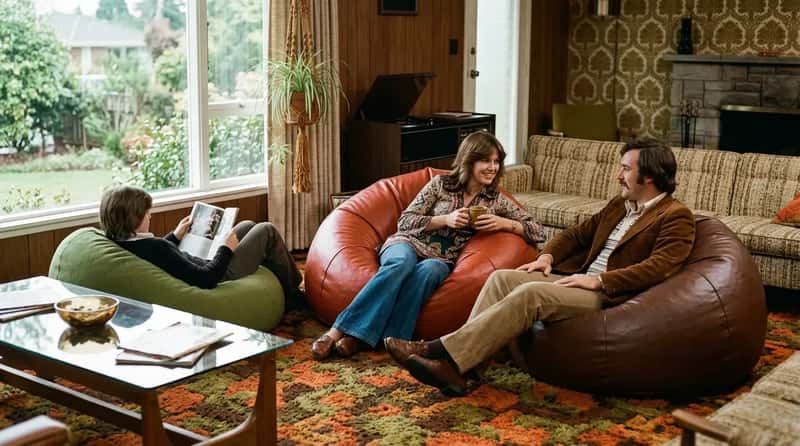
The original Sacco beanbag chair was designed by Italian designers Piero Gatti, Cesare Paolini, and Franco Teodoro in 1968, and it landed in American homes almost immediately, becoming one of the most copied furniture forms of the early ’70s. No ’70s living room was complete without a few scattered around – low, shapeless, deeply comfortable, and completely committed to keeping you on the floor.
What confuses younger people isn’t the beanbag itself – those still exist – it’s the context. In a ’70s living room, the beanbag sat alongside the main sofa as an equal seating option for adults, not a kids-only exception. Parents sat in them. Guests sat in them. Getting back up was everyone’s problem equally, and nobody seemed to find this undignified. The whole decade’s seating philosophy was built around being as close to the floor as possible, as comfortably as possible – which, in retrospect, sounds less like a living room and more like a very relaxed yoga studio.
Worth Knowing
- The Sacco is now in the permanent collection of the Museum of Modern Art in New York – the beanbag chair is officially fine art.
- The original version was made from leather with fine Italian stitching; the mass-market knock-offs arrived almost immediately in synthetic fabrics.
- By the mid-’70s, beanbags had moved from boutique furniture stores into Sears and JCPenney catalogs – a sign they’d fully gone mainstream.
- The Sacco chair won the Compasso d’Oro award in 2020, exactly 50 years after initially being passed over – better late than never.
#6 – The Record Console as the Room’s Anchor Piece
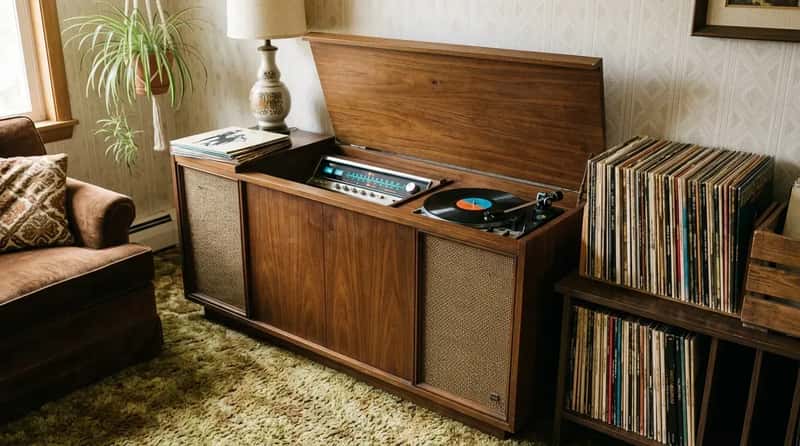
Long before Spotify, the family’s music collection lived inside a massive wooden cabinet that doubled as a sideboard. These stereo consoles featured built-in speakers and a turntable under a heavy hinged lid – the ’70s version of a home theater system, except it weighed 200 pounds, required two people to move, and the speakers were built directly into the cabinet rather than positioned for optimal audio. It anchored the entire room layout the way a fireplace once had.
The record collection displayed alongside it was its own form of social currency. Albums were stored in wooden milk crates or custom shelving, spines facing out, curated and fully visible to every visitor. Selecting a record, handling it carefully, placing it on the turntable, and dropping the needle was a ritual that happened in the middle of the living room, in full view of everyone. Today, music is invisible. In the ’70s, it was furniture – giant, beautiful, proudly displayed furniture with a dust cover and a stylus you replaced every six months.
#5 – TV Trays as the Standard, Fully Organized Dinner Solution
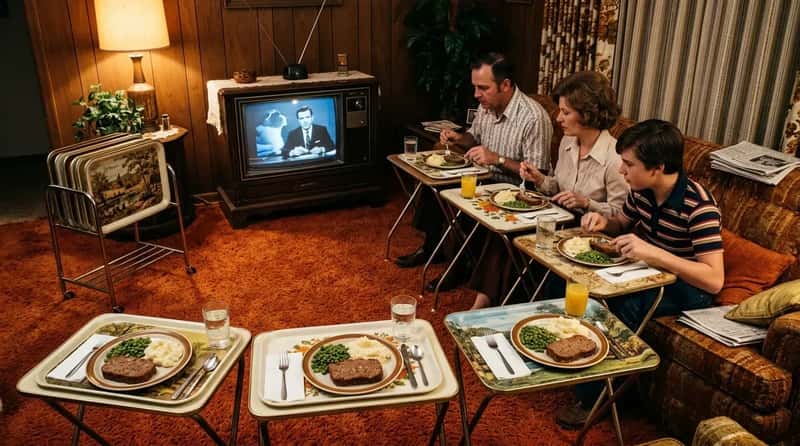
As television became the new hearth of the home, foldable metal TV trays became essential for eating dinner while catching the evening news. They were usually decorated with floral patterns or painted landscapes, and they allowed the family to abandon the dining table without making a catastrophic mess on the shag carpet. The TV tray set – four trays nested in a rolling stand – was a standard wedding gift and housewarming staple throughout the decade, parked in a living room corner and ready to deploy at any moment.
What’s strange to anyone under 30 isn’t eating in front of the TV – that still happens constantly – it’s the formality of the infrastructure built around it. The trays had dedicated stands. They came in matched sets. Families had TV-tray etiquette. There was a right way to unfold one (legs first, then top) and a wrong way (the way that collapsed it onto the shag carpet and launched the Tang). The casual act of watching TV while eating was, somehow, an organized domestic system with its own equipment, its own protocol, and its own consequences.
#4 – Geometric Wallpaper Covering All Four Walls Simultaneously
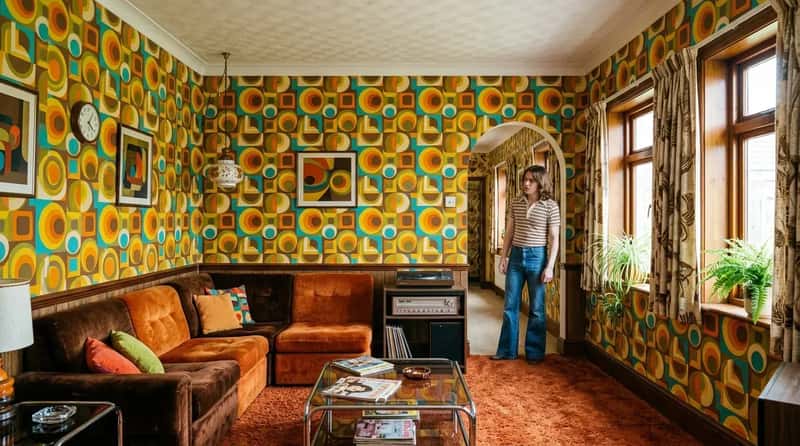
The ’70s commitment to wallpaper was total. It wasn’t an accent wall – it was all four walls, often including around windows and door frames, occasionally including the ceiling. The patterns ranged from restrained repeating diamonds and hexagons in earth tones to full-on Op Art explosions of concentric circles and interlocking shapes in colors that had no business being that close together. The room would feel visually active even with minimal furniture, because the walls were already doing a lot of work.
Today, the aesthetic shows up occasionally as deliberate maximalism or nostalgic irony. In 1976, it was just Tuesday. A younger person entering a fully wallpapered ’70s living room today would need a moment to calibrate their eyes before they could process anything else in the room. Which was, in a way, entirely the point – the walls announced the room before anything inside it could.
#3 – Modular Sofas That Could Theoretically Be Reconfigured Into Anything
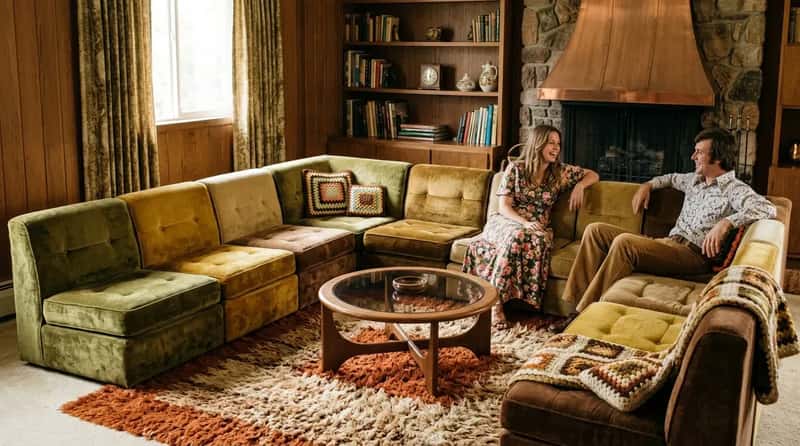
Modular sofas were one of the decade’s great promises: individual sections that could be mixed, matched, and rearranged to suit any occasion or number of guests. The theoretical flexibility was a genuine selling point and reflected the ’70s obsession with adaptable, multi-use living spaces. In practice, most families assembled their modular sofa once, in the L-shape shown in the catalog photo, and never moved it again.
The modular sofa often came in earth-toned velvet or corduroy, with low backs and equally low seat heights. Arranged in an L or U around the conversation pit or coffee table, it created a self-contained social pod in the middle of the room. Younger people today would recognize the form – modular sectionals have made a strong comeback – but the original versions sat so close to the ground that getting up gracefully required planning and genuine core strength. The decade’s seating, across the board, was not designed with exit strategies in mind.
#2 – The Plastic-Covered “Good” Furniture Nobody Was Allowed to Actually Sit On
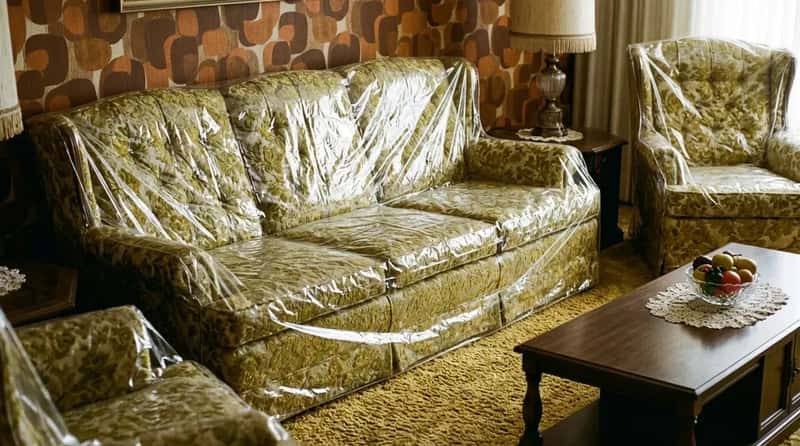
The good furniture – usually a formal sofa and pair of chairs in velvet or brocade – lived under tight-fitting clear plastic slipcovers that crinkled when you sat, stuck to bare legs in summer, and announced every small movement with a sound like a grocery bag being handled. The plastic existed to preserve the upholstery for a future special occasion that, in many families, never actually arrived. The furniture underneath remained pristine. Technically. Theoretically. Forever.
What makes this genuinely baffling to anyone under 30 is the psychological logic: furniture you were not allowed to use comfortably was displayed most prominently in the home. The beautiful, pristine, completely uncomfortable plastic-covered set faced the front door so guests would see it first. Visitors were then expected to sit on it – on the plastic – and pretend not to notice. The entire arrangement was a performance of prosperity aimed at people who were themselves performing not noticing. It is, in retrospect, one of the most specifically American things the decade produced.
#1 – The Entire Room Was Designed Around Talking to Each Other Instead of a Screen
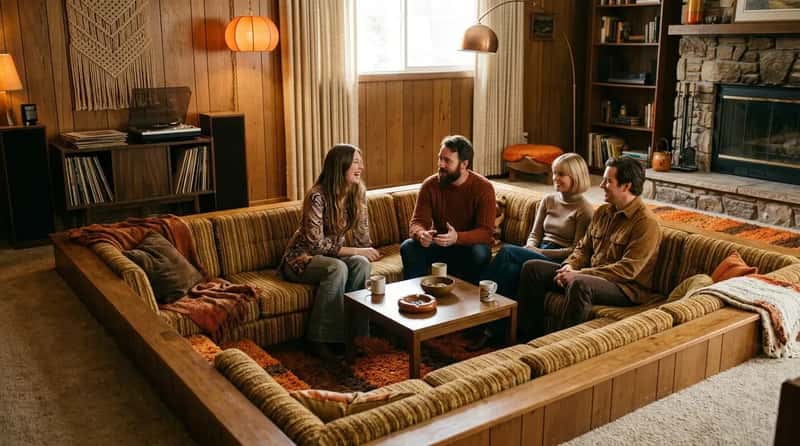
Strip away the shag carpet, the avocado green, the swag lamps and bead curtains, and one thing becomes undeniable: the ’70s living room was architecturally, philosophically, and functionally oriented toward people facing each other. Low seating arranged inward. The record console as the communal anchor. The conversation pit pulling everyone down to the same level. The absence of a dominant screen wall. Every choice, however strange it looks now, was downstream of a single assumption – that a room full of people would want to face each other.
Conversation pits are making a genuine comeback in interior design, driven by nostalgia and a post-pandemic appetite for intimate gathering spaces. But the comeback is mostly aesthetic. The underlying assumption – that the room exists for conversation rather than consumption – is the part that’s hardest to recreate, and the part that hits hardest when you really look at those old photos. Every other quirk on this list was just decoration. This one was a completely different idea about what a home was for.
“Sunken living rooms and built-in seating areas nod to the concept, while offering a more modern, functional take – creating the best of both worlds.”
Kerrie Kelly, former national board chair, American Society of Interior Designers
From bead curtains to sunken pits, from carpet rakes to console TVs that doubled as credenzas, the 1970s living room was one of the most fully committed domestic environments in American design history. Every quirk connected to the others. Every odd choice made total sense within the system. What’s strangest isn’t how weird it looks now – it’s how coherent it was then. Walk through any one of these rooms today and you’re not looking at mistakes. You’re looking at a complete world.