
Most golfers assume resort staff forget them the second the cart clears the bag drop – smile, take the tip, move on, nothing personal. That’s not how it actually works, and the guests who think they’re invisible are often the ones staff remember best, for all the wrong reasons.
After thousands of rounds, bag drop attendants, caddies, superintendents, pro shop staff, and rangers build long memories – and the moments that stick rarely match what golfers expect. Some guests still believe a premium green fee buys a free pass on basic etiquette, and by the time you reach #1 on this list, you’ll understand exactly why that belief costs them more than they realize.
#21 – Showing Up Late and Expecting the World

Arriving late for a tee time is one of the fastest ways to get flagged by pro shop staff – and they absolutely notice.
PGA head golf professional Jason Crawford at Massanutten Resort notes that golfers should check in at least 20 minutes before their tee time, because starting late throws off the rhythm of the entire course.
At resort courses with back-to-back tee sheets, a single late group creates a chain reaction that rangers spend the next three hours untangling.
What makes it worse is when the late golfer demands an upgrade or complains about the pace they themselves created.
Dress code violations cause almost as much friction – and the arguments that follow are even harder for staff to forget.
#20 – Ignoring the Dress Code and Arguing About It

Resort courses post their dress codes clearly, and yet staff see violations every single day.
Erika Larkin, director of instruction at Creighton Farms golf club, told Business Insider that players should always pay attention to a golf course’s dress code, noting that jeans, tank tops, and backward hats “can be seen as disrespectful.”
Golf has always been a game about class and integrity.
Erika Larkin, Director of Instruction, Creighton Farms
The part staff never forget isn’t the violation – it’s the argument that follows when a guest is politely corrected at the pro shop counter.
At a resort where a round can cost several hundred dollars, debating a collared shirt policy in front of a full lobby leaves an impression on every employee in earshot.
The bag drop tells its own story before a golfer ever sets foot on the first tee.
#19 – Treating the Bag Drop Like a Drive-Through
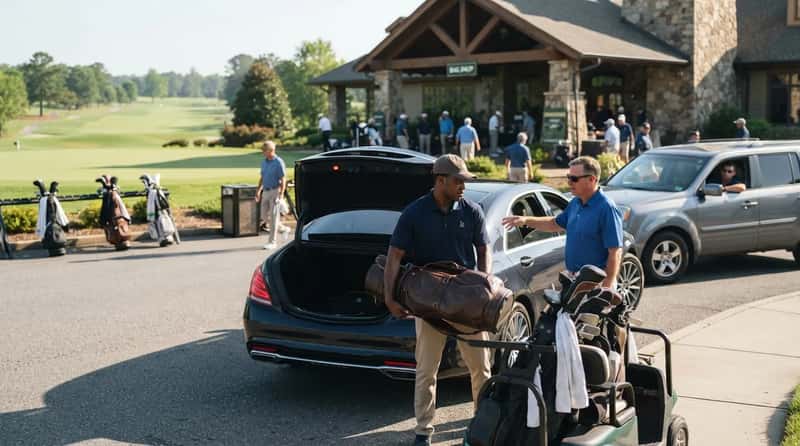
The bag drop is the first handshake between a golfer and the course – and a surprising number of golfers fumble it spectacularly.
A golf bag drop is a designated curbside area near the clubhouse where an attendant takes your clubs while you park. It is not a place to leave your car running, block traffic, and disappear for fifteen minutes.
Bag drop attendants at busy resort courses handle dozens of bags before 9 a.m., and they remember the golfers who make their job harder without a word of acknowledgment.
These attendants often work primarily for tips, and a small gesture of thanks – $2 to $5 per bag is a good rule of thumb – is both customary and appreciated.
Volume becomes the next battlefield, and it’s rarely the group playing the music who notices.
#18 – Playing Loud Music Without Asking Anyone

Bluetooth speakers have become one of the most reliably divisive items at resort courses, and staff are usually the ones fielding the complaints.
If you’re going to play music on the course, ask in advance and keep it in a remote spot – most people play golf to get away from their phone, not to hear yours.
At premium resort courses, a quiet, immersive experience is part of what guests are paying for – and another group’s playlist at full volume destroys that instantly.
Rangers at resort properties consistently rank noise complaints among their top daily issues, yet confronting a group about it is one of the most uncomfortable parts of the job.
Nothing tests a resort’s memory quite like what happens – or doesn’t happen – at the caddie shack.
#17 – Stiffing the Caddie at a High-End Resort

At resort courses that offer caddie programs, the post-round tip isn’t optional – it’s a deeply established professional norm, and staff notice who walks past the caddie shack without stopping.
You should generally tip a forecaddie anywhere from $50 to $100 per player after the round, with a dedicated caddie closer to that $100 figure – and at higher-end resorts, the tip should be at least $100.
The caddie who gets stiffed after 18 holes still has to carry the next group’s bag that afternoon. They don’t forget the face, the group, or the cart number.
Pro shop staff and caddie masters compare notes – a reputation for poor tipping at a prestigious resort travels faster than most guests realize.
Fast Facts
- Forecaddie tip: $50-$100 per player after the round
- Dedicated caddie tip: closer to $100 per player, more at high-end resorts
- Caddie masters and pro shop staff routinely compare tipping reputations across departments
- A caddie who gets stiffed still carries the next group’s bag that same afternoon
Off the caddie shack and onto the cart path, the complaints only get louder.
#16 – Driving the Cart Wherever They Please

Golf course superintendents consistently rank cart path violations among their biggest daily frustrations – and resort courses, where guests are often unfamiliar with the layout, see this more than anywhere else.
Superintendents and maintenance teams cite golfers ignoring cart directional signs as a top pet peeve – from driving through wet areas to ignoring the 90-degree rule to failing to return carts properly.
When carts are permitted off paths, golfers should observe the 90-degree rule – turning off the path toward the ball and returning straight back – since carts inflict real wear on the course.
At resort courses, turf damage caused by cart misuse is a visible, expensive problem that affects every guest who plays the next day.
Even after the cart is parked, the damage some golfers leave behind is just getting started.
#15 – Skipping Divot Repair on the Green
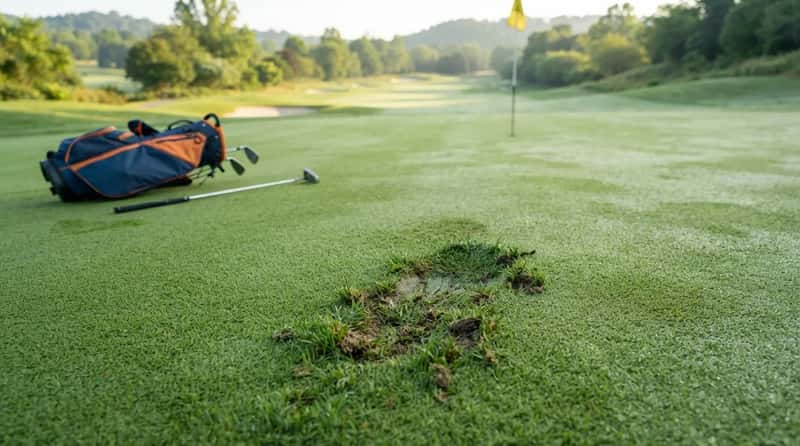
Unrepaired ball marks on resort greens are one of the most common complaints from both superintendents and the golfers who follow behind.
Leaving ball marks and setting your bag down on the green is considered bad etiquette by golf professionals and course employees alike.
Every unrepaired pitch mark on a putting surface takes roughly two weeks to heal on its own – versus 24 hours if fixed immediately. At a resort course seeing 250 rounds a day, the math becomes a genuine agronomic problem.
Superintendents can often tell which hole saw the most neglectful play just by walking the greens at dawn – and they share those observations with the pro shop staff who manage tee sheets.
Then there’s the golfer who takes the course’s own biology personally.
#14 – Complaining About Aeration Like It’s a Personal Offense

Aeration season brings out a specific type of golfer behavior that resort staff dread: the guest who feels genuinely wronged by the biological needs of grass.
Some golfers expect a perfectly manicured course whenever they want it, whatever the weather, with no disruption from greenkeeping practices – and they tend to view the greenkeeper as the enemy.
The front desk and pro shop bear most of this frustration, even though they have zero control over the maintenance calendar.
Most golfers are forgiving of aeration issues as long as staff is upfront about what they’re buying – the problem is the ones who weren’t told, or the ones who simply refuse to accept the explanation.
Inside the pro shop, a different kind of frustration is quietly building.
#13 – Ransacking the Pro Shop and Buying Nothing

Resort pro shops are often stocked with premium merchandise – and a small percentage of guests treat them like a museum, touching, trying, and monopolizing staff attention for half an hour before walking out empty-handed.
Pro shop staff at resort properties are often also responsible for managing tee sheets, coordinating starters, and handling check-ins – their time is genuinely limited.
The guests who spend 40 minutes trying on gloves, asking detailed questions about shaft flex, and then announce they’ll “check online” are remembered by name. Quietly. Unfavorably.
While tipping isn’t common for pro shop staff, you can still show appreciation by leaving a positive review or recommending the shop to fellow golfers – it goes a long way.
Sometimes it only takes one person in a foursome to poison the whole day – for staff, too.
#12 – Letting One Person in the Group Ruin It for Everyone

Resort staff learn very quickly that groups have dynamics – and that one difficult personality in a foursome puts every employee on edge for the entire round.
The ranger who gets berated at hole 7 radios ahead to the next marshal. The beverage cart attendant who gets talked down to mentions it to the clubhouse.
By the time a problem group reaches the 18th, the entire operation knows their cart number – and being boorish, even casually, leaves an impression that outlasts the round.
The silent majority of resort staff are keeping a running mental ledger, and it absolutely influences what they do and don’t go out of their way to offer.
That same frustration has a way of ending up airborne.
#11 – Throwing Clubs Where Maintenance Staff Can See

Club throwing is one of those behaviors golfers sometimes treat as personal and private – as if the fairway is an empty room.
PGA professionals are clear on this: throwing clubs and cursing “not only disrupts your game but also affects others’ enjoyment.”
Grounds crew working inside the ropes on adjacent holes witness club throwing more often than golfers realize – and at resort properties, they are required to document safety incidents involving erratic behavior with equipment.
Erratic behavior that damages carts or creates unsafe conditions is a genuine concern for maintenance teams, since it can damage equipment and injure others nearby.
And when tempers flare, the marshal becomes everyone’s least favorite – and most necessary – person on the course.
#10 – Expecting the Marshal to Be Invisible Until Needed

Resort golfers have a complicated relationship with course marshals: they resent being told to speed up, but demand a ranger immediately the moment another group bothers them.
Marshals who try to uphold pace of play often get no support from the pro shop when their instructions are ignored – even when groups behind are actively complaining.
The marshal job at a busy resort is one of the most thankless in golf – they carry authority without enforcement power, and experienced ones map every difficult personality on the course by hole 5.
Most resort rangers have stories of golfers demanding their names to file complaints, simply because they were asked to maintain pace. Those names get shared at the end-of-day staff debrief.
The tension doesn’t disappear on the range, either – it just changes shape.
#9 – Using the Practice Range Wrong on “Mats Only” Days

Driving range etiquette at resort courses is a surprisingly dense minefield – and the “mats only” sign is the one most frequently ignored.
When a range is restricted to mats, there’s always a reason: the turf is being repaired so golfers can enjoy actual grass in the coming weeks. Ignoring the sign sets back that recovery timeline for every future guest.
Range staff at resort courses report that a meaningful portion of golfers who ignore mat-only rules do so not out of ignorance but out of a belief that the rules don’t apply to paying resort guests. That distinction is exactly what makes it memorable.
The range attendant who has to redirect a guest three times in one session will remember that interaction long after the guest has forgotten it entirely.
Quick Compare
- Mats-only day: Turf is recovering – hitting off grass anyway restarts the repair clock for every guest behind you.
- Full grass day: Turf is established – normal range etiquette applies, including replacing your own divots.
- Either day: Range attendants are watching for repeat offenders, not first-time confusion.
None of it compares to the one habit that slows down an entire tee sheet.
#8 – Not Playing Ready Golf and Holding Up the Field

Slow play is the single most complained-about issue at every resort course on the planet – and it almost always comes down to the same preventable habits.
PGA instructor Justan Johnson says he dislikes when golfers waste time watching other players’ shots land – instead they should be preparing for their own shot, ready to hit within 20 seconds of their partner finishing.
Johnson notes that keeping things moving can save about 30 minutes per round – which at a resort with packed tee sheets is the difference between a relaxed round and a miserable one for every group on the course.
Rangers at resort properties consistently say slow play almost never involves just one group – it’s contagious, and the group that starts it rarely realizes they’re the cause.
And nothing accelerates slow play faster than what happens at the halfway house.
#7 – Overindulging at the Turn and Making It Everyone’s Problem

The halfway house at a resort course is a beloved institution – and also the point where a small percentage of groups shift from enjoyable to exhausting for everyone around them.
Golfers who overindulge in alcohol tend to leave their best judgment behind, and it can lead to unrepaired club and ball marks along with poor decision-making on the course.
Beverage cart staff at resort properties are trained to monitor consumption – but the social pressure of a corporate group or bachelor party makes it genuinely difficult to enforce. The ones who do it professionally are some of the most underappreciated employees on the property.
Locker room attendants and bag staff who deal with the aftermath of overserved guests at the end of a round have long memories – and the stories circulate through the staff for years.
Which leads to one of the strangest contradictions resort rangers see on repeat.
#6 – Demanding Pace of Play Be Enforced on Others but Never on Themselves
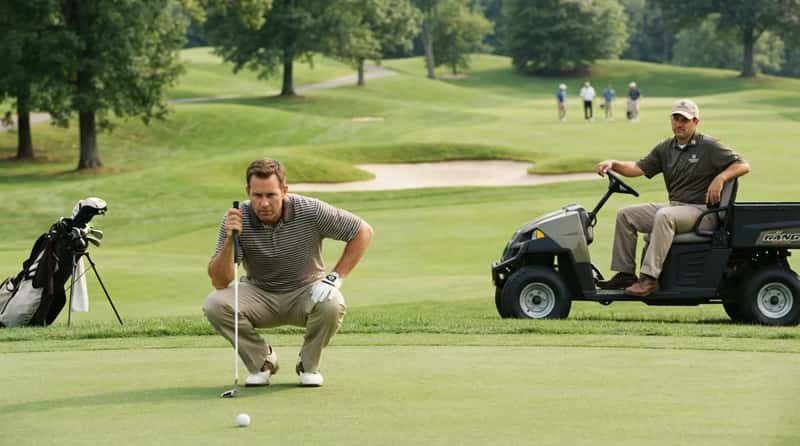
This is one of the most consistent ironies resort rangers encounter: the golfer who aggressively complains about slow play while being slow themselves.
Staff see it constantly – a player flags down a marshal to demand action on the group ahead, then spends five minutes lining up a twelve-foot putt from three different angles.
It’s not uncommon for golfers to spend excessive time hunting for lost balls in the rough while lining up putts from every angle – behaviors rangers notice fast, with one common thought: it’s not the U.S. Open.
Experienced resort rangers develop an almost clinical ability to spot self-unaware slow players within the first three holes – and those groups tend to get more frequent visits from marshals for the rest of the round.
At a Glance
- Demanding the group ahead speed up while lining up a putt from three angles
- Searching the rough for a lost ball well past the reasonable limit
- Re-reading the same putt after already marking it once
- Blaming pace of play on everyone except their own group
That same entitlement follows some golfers straight into the locker room.
#5 – Treating the Locker Room Like a Hotel Room
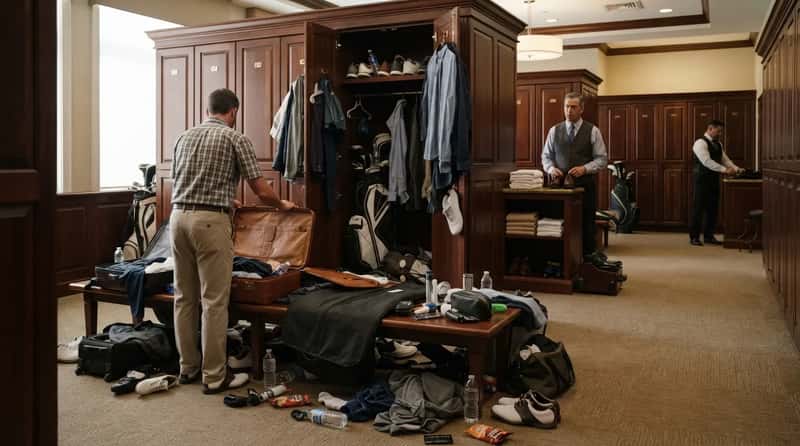
Resort locker rooms are a premium amenity – and a subset of guests push what “premium access” actually means to its absolute limits.
Classier locker rooms come staffed with an attendant whose job is to greet you and make you feel at home. Their job is not to retrieve items from the pro shop, babysit valuables for hours, or serve as a personal valet for an entire group.
Locker room attendants at high-end resorts will clean your spikes, provide fresh towels, and help with a guest locker – but the guests who treat the space like a personal dressing room for ninety minutes before a round are remembered by every attendant on shift.
At a nice resort, locker room staff keeps the place looking great, handles your guest locker, and cleans and repairs your shoes – and if they’re helping you, you should tip them.
All of it traces back to one psychological shift resort staff know all too well.
#4 – Acting Like the Green Fee Buys Unlimited Entitlement

Resort courses occupy a strange psychological space for some golfers: the higher the green fee, the more certain some guests become that every normal rule of behavior has been waived for the day.
One golf course superintendent has described a “crazy rewiring of the brain” that happens the moment a golfer decides to head to the course – a transformation that turns otherwise ordinary human beings into something unrecognizable.
The symptoms he identifies are consistent: golfers become arrogant and entitled, or angry and inconsiderate, or impatient and ill-humored – sometimes all three at once.
Resort staff across every department – from valet to the 19th hole bar – encounter this attitude, and it’s the behavior most universally remembered and discussed when staff compare notes at the end of a shift.
Sometimes the smallest habits reveal the most – starting with something as tiny as a club cover.
#3 – Iron Covers at a Club That Cleans Your Clubs
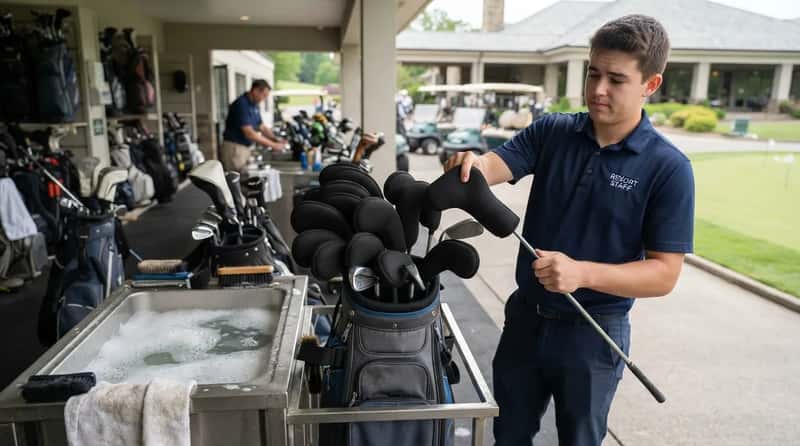
This one might seem minor – but at resort properties with professional back-shop staff, iron covers create a specific, well-documented frustration.
The issue isn’t the golfer who uses iron covers, it’s the impact they have on the people cleaning clubs – at courses where staff wipe down every bag after a round, iron covers slow the process significantly.
If there’s one group golfers should avoid irritating, it’s the back shop staff – they hold more power over your golf day than most players realize.
Back-shop staff at resort courses handle dozens of bags per day, often under time pressure between waves of arriving and departing golfers. A bag with fourteen iron covers, no two of which come off the same way, earns a very specific kind of attention from the team – and not the good kind.
Which brings up the tip that gets skipped more than any other on the property.
#2 – Skipping the Tip on Club Cleaning After the Round

Of all the tipping touchpoints at a resort course, the post-round club cleaning tip is the one most often skipped – and back-shop staff are acutely aware of who stops and who doesn’t.
Tipping the staff who wipe your clubs after a round – $5 to $10 per bag is a good standard – matters more than many golfers realize, since a lot of these workers get stiffed regularly and the tip is a genuine part of their compensation.
At high-end resorts where an attendant cleans clubs after the round, an additional $5 to $10 on top of the arrival tip is considered appropriate.
The golfer who hands $200 to the caddie and walks past the club-cleaning attendant without a word is a story that gets told in the staff break room that same evening. It’s one of the clearest signals of how a guest actually views the people serving them.
Worth Knowing
- Bag drop attendant: $2-$5 per bag on arrival
- Forecaddie or caddie: $50-$100 per player after the round
- Club-cleaning attendant: $5-$10 per bag after the round
- Locker room attendant: a few dollars when they’ve helped with spikes, towels, or your locker
But none of it compares to the one behavior resort staff still talk about years later – the one that separates guests who get remembered fondly from everyone else.
#1 – Treating Staff Like They Don’t Love the Game Too
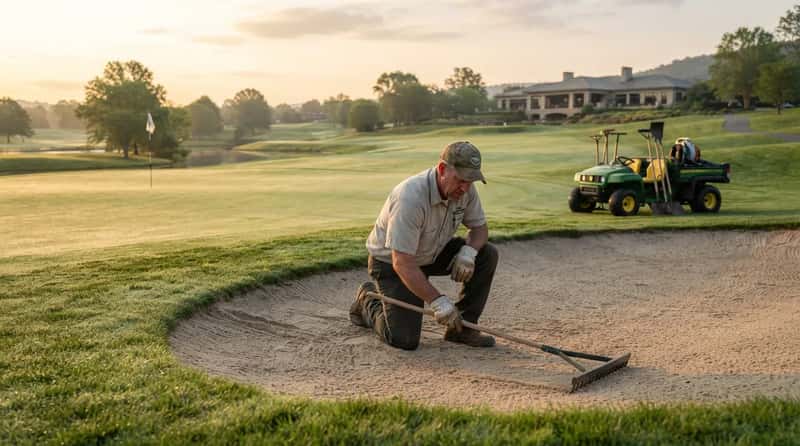
Every person working at a resort golf course – from the superintendent who arrives before sunrise to the locker room attendant polishing spikes at dusk – is there because golf matters to them.
No one should forget that golf courses are in the hospitality business, and every operation, from the most expensive resort to the 9-hole neighborhood course, expects its employees to make golfers feel valued. The relationship is supposed to go both ways.
Any superintendent can confirm that the people in charge of maintenance deal with constant headaches – droughts, damaged drainage pipes, dull mower blades, broken sprinkler heads. They do it because they care about the product, not because they’re invisible infrastructure.
The golfer who says “great course” to the superintendent at the bag drop, who remembers the starter’s name from two visits ago, who asks the ranger how the course is holding up after last week’s rain – that person is talked about in the staff break room too. Just very, very differently. Those guests are the ones who get the best carts, the best loops, and the quiet upgrades no one advertises – because respect is the one resort amenity that never appears on the fee sheet, and it changes everything about the experience you receive.
The Bottom Line

Resort course staff are professionals with long memories and tight-knit communication networks across every department.
The behaviors that stick – late arrivals, skipped tips, cart path violations, entitlement tantrums, club-throwing – follow a guest from the bag drop to the back shop faster than they realize.
The good news is that almost every item on this list costs nothing to fix.
Show up on time, tip appropriately, play ready golf, repair your pitch marks, and treat every employee like the golf-obsessed professional they are – and you’ll earn a reputation at any resort course that no green fee can ever buy.