
Walk into any American home decorated between 1980 and 1989 and you’d know exactly where you were within five seconds. The living room wasn’t just a place to sit – it was a declaration. Every sofa, every shelf, every glint of brass said the same thing in a different voice: We made it. The 1980s were a decade of unapologetic ambition, and nowhere was that ambition more carefully arranged than in the room where company was received.
Most people remember the neon fashion and the big hair. But the living room told the deeper story. Some of these features now look dated. Others are quietly coming back. And a few of them reveal just how much that era’s version of the American Dream was built on pure, carefully staged show. Here’s what those rooms actually looked like – and why every single detail mattered.
#29 – The Mauve and Dusty Rose Color Scheme
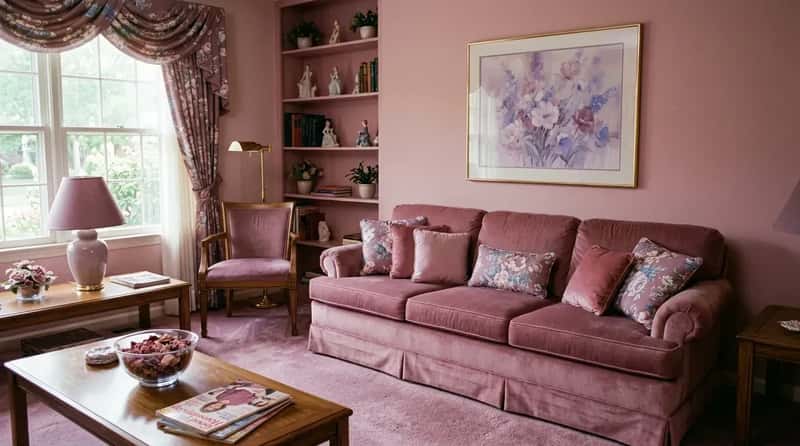
Before anyone writes this off as a pastel quirk, consider this: mauve was everywhere in the 1980s American living room – on walls, sofas, curtains, and carpet, often all at the same time. Forget the neon-soaked stereotypes for a moment and think about the softer side of the decade. Dusty rose, cornflower blue, and peach brought color into a room without overwhelming it. It felt sophisticated and quietly feminine without shouting.
The commitment was total. If you had a mauve sofa, you had mauve throw pillows, mauve wall-to-wall carpet, and a mauve floral print somewhere in the mix. Entire paint company product lines were built around these hues. It felt like warmth. It felt like arrival. And it’s quietly creeping back into contemporary design whether anyone wants to admit it or not.
At a Glance
- Mauve, dusty rose, cornflower blue, and peach were the era’s signature palette
- Total room coordination was expected – walls, sofa, carpet, and curtains often matched
- Major paint brands built entire product lines around these soft hues
- The look signaled sophistication on a middle-class budget
- Interior designers are actively reviving muted ’80s pastels in 2024-2025
#28 – Popcorn Ceilings
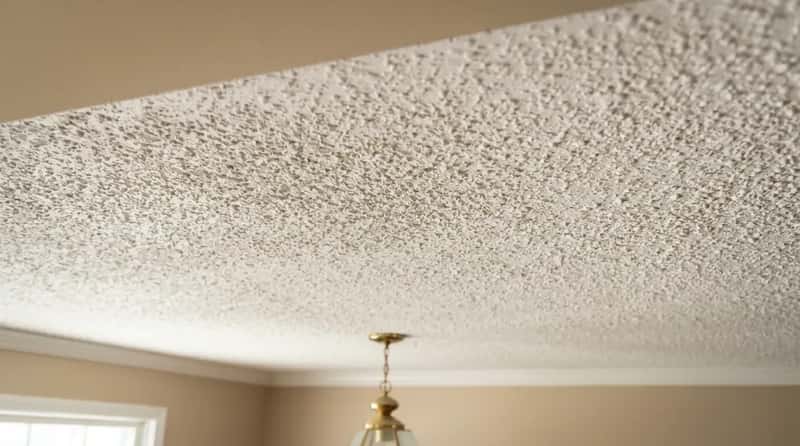
Nobody chose a popcorn ceiling because it was beautiful. They chose it because it was practical – and in the 1980s, practical and stylish were not mutually exclusive. Those bumpy, textured ceilings helped with soundproofing and hid drywall imperfections beautifully. For a growing middle class putting up walls fast and moving in faster, that was a genuine selling point. Skip the skim coat, move on with your life.
The real twist came later: many were made using vermiculite or, in older applications, asbestos – materials you absolutely do not want disturbed today. Removing them became a cottage industry by the 2000s. But in 1985, looking up at that bumpy ceiling meant you owned something – and in the 1980s, that counted for everything.
#27 – Wall-to-Wall Carpeting in Earth Tones
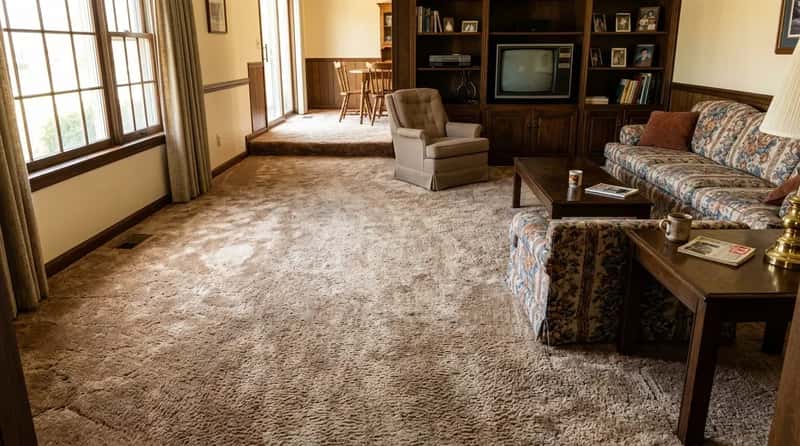
It wasn’t just carpet. It was commitment. Beige was the baseline, but the full range ran from burnt sienna and warm brown to dusty tan and the occasional dark chocolate shag that made a room feel both cozy and slightly claustrophobic at the same time. Living rooms were carpeted wall to baseboard with no apology and no exceptions.
The logic was sound: carpet was cheaper than hardwood, warmer underfoot in winter, and felt genuinely luxurious after a long workday. By the mid-1980s, carpet covered roughly 70 percent of American residential floors, making it the decade’s single most dominant flooring choice. Today homeowners rip it out in a frenzy looking for original hardwood underneath. But in 1983, a fresh install of plush wall-to-wall in a warm neutral was the definition of a home that had its act together.
#26 – The Oversized Floral Chintz Sofa
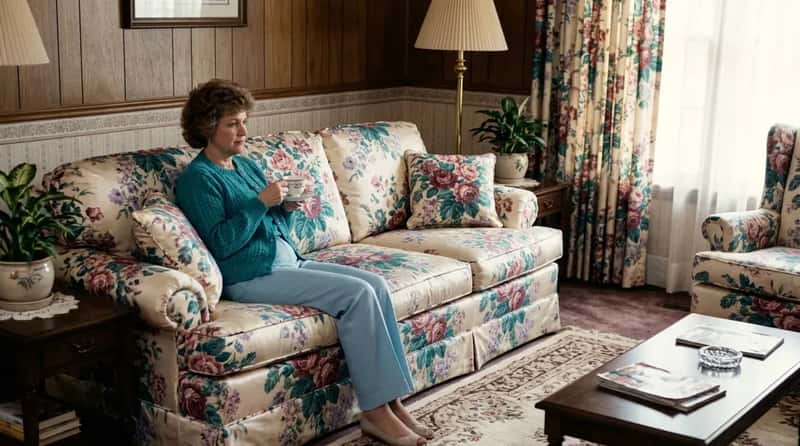
If you sat in a living room in the early 1980s and didn’t encounter a chintz-covered sofa with giant roses blooming across it, you were in the wrong house. These weren’t dainty little blossoms – the prints were bold, the flowers were the size of your fist, and the colors were unapologetically saturated. Large pink and green country roses were everywhere, and Laura Ashley was the name on everyone’s lips.
The fully coordinated floral living room – sofa, drapes, and cushions all in the same print – was the apex of put-together decorating for a certain kind of American family. It signaled taste, effort, and disposable income all at once. Today it reads as maximalist chaos. In 1982, it read as a woman who absolutely had her life together.
#25 – The Recliner With a Built-In Cup Holder
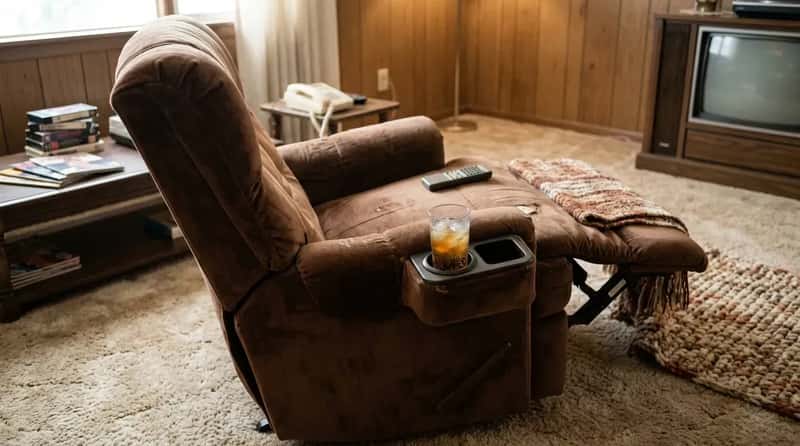
No piece of furniture in the 1980s American home was more honestly itself than the recliner. It made no pretense. It existed for one person, in one position, watching one television. The built-in cup holder in the armrest – which became standard through the decade – was an act of pure domestic engineering. Dad’s throne was complete. Nobody else sat in it. Everyone understood this without being told.
By the late 1980s, La-Z-Boy alone reported $150 million in sales as early as 1981, a figure that kept climbing as the decade wore on, making it one of the best-selling furniture items in the country. The recliner wasn’t just comfortable – it was a status symbol of a very specific kind. It said the man of the house had earned his rest. It said the family had enough space to accommodate a personal leisure pod. It was the American Dream in upholstered form.
#24 – Swag Drapery and Valances
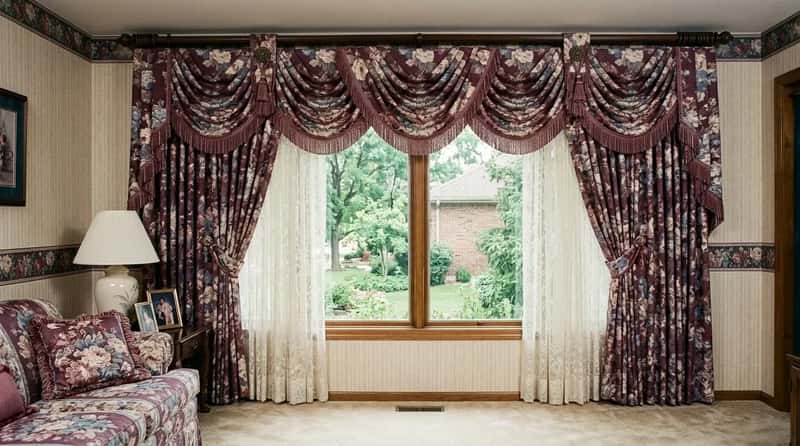
The windows in a properly decorated 1980s living room were not simply covered. They were draped, festooned, and valanced within an inch of their lives. Swag curtains – fabric gathered in dramatic, swooping curves across the top of the window – were everywhere. Simple curtains were for people who hadn’t quite arrived yet. The heavier and more elaborate the treatment, the more effort it signaled to anyone who walked through the door.
The valance above the curtain panels was treated as a design centerpiece in its own right. In a fully coordinated 1980s living room, the valance matched the sofa fabric, which matched the throw pillows, which matched the wallpaper border. The amount of fabric deployed in a single 1980s window treatment could upholster a small car. It felt formal. It felt finished. And it represented a version of elegance that middle-class America had worked very hard to access.
#23 – Mirrored Walls
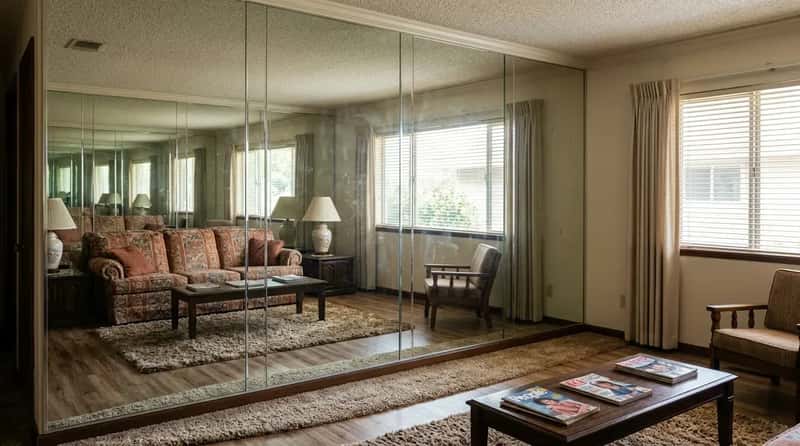
Walk into a 1980s living room with mirrored walls and the room instantly doubled – at least visually. Large panels of mirror, sometimes running floor to ceiling on an entire accent wall, were treated as an affordable luxury upgrade. They made small rooms feel larger, bounced light around, and gave the space a glamorous, almost nightclub-like quality that felt very much in step with the decade’s aspirations.
The appeal was partly practical and partly pure theater. Mirrored walls were especially popular in smaller tract homes where making a visual impact on a budget mattered most – a touch of hotel-lobby glamour brought home. Today they’re one of the first things buyers ask to have removed. In 1986, they were listed as a selling point. That gap tells you everything about how dramatically the decade’s taste has aged.
#22 – Geometric Print Throw Pillows

The throw pillow situation in a 1980s living room was not subtle. Bold geometric designs, abstract squiggles, and wild contrasting patterns were mixed and matched across a single sofa with genuine enthusiasm. A sofa might have six to eight pillows stacked across it, none of which you were actually supposed to lean against when sitting down. Removing them to sit was a small ritual everyone accepted.
The geometric pattern – triangles, zigzags, checkerboards in primary colors or jewel tones – was the most distinctly 1980s option of them all. These pillows were often the only place in an otherwise traditional room where the decade’s bolder, postmodern instincts broke through. They were inexpensive enough to swap out seasonally, which made them the living room’s most democratic design element. Every budget could participate. And almost every living room did.
Quick Compare
- Traditional rooms: chintz sofas, mauve carpet, swag drapes – structured and coordinated
- Postmodern accent: geometric pillows, track lighting, glass coffee table – graphic and angular
- Aspirational focal point: cathedral ceiling, brick fireplace, built-in shelves – architectural and permanent
- Tech centerpiece: wall unit, VCR, console TV – the room organized around entertainment
#21 – The Cathedral Ceiling
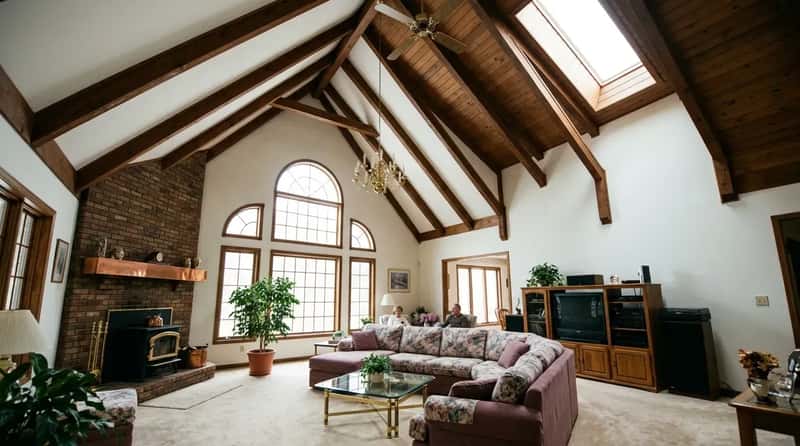
If a house built in the 1980s had one architectural feature that separated the merely comfortable from the genuinely arrived, it was the cathedral ceiling. Vaulted ceilings in the living room sent an immediate spatial signal: this house does not have normal proportions. This house has ambition. Walking into a living room where the ceiling shot up to 14 or 16 feet was a deliberate dramatic gesture, and everyone who built one knew it.
Cathedral ceilings became a staple of the decade’s new construction because the 1980s building boom gave developers room to offer them as a premium upgrade. They were so popular that by the late 1980s, they appeared in nearly a third of newly built single-family homes in suburban America. Nobody fully accounted for the heating bills – all that warm air rises straight to the top – but that was tomorrow’s problem. Today’s problem was looking successful, and a soaring living room ceiling handled that beautifully.
#20 – Brass Fixtures and Accessories
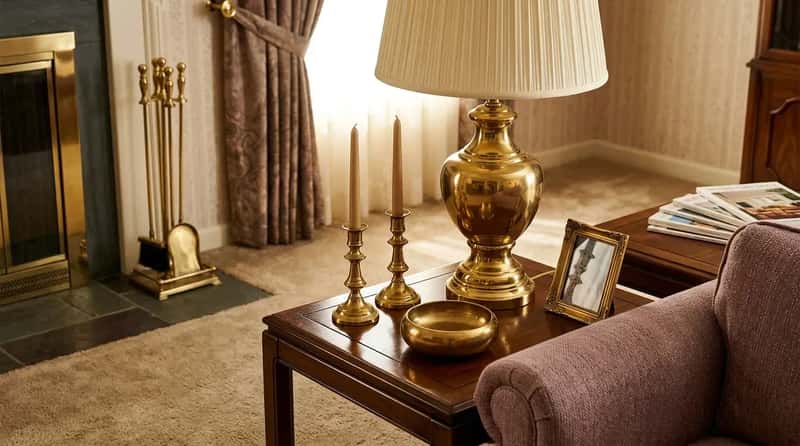
Brass was the metal of the 1980s American living room, full stop. It showed up on lamp bases, candle holders, picture frames, curtain rods, fireplace tools, and decorative bowls. It caught the light. It announced itself. It looked expensive in a way that chrome did not, because brass implied warmth rather than sterility – and warmth was what the 1980s living room was selling.
The brass lamp was perhaps the most universal expression of this: a heavy base in polished or satin brass topped with a drum shade, positioned on an end table beside the sofa. Entire furniture stores organized their floor plans around brass accent pieces, and the industry boomed accordingly. Today, matte black and brushed nickel dominate. But for a solid decade, brass wasn’t a retro affectation – it was the only sensible choice for a room that wanted to be taken seriously.
Fast Facts
- Brass appeared on lamps, curtain rods, fireplace tools, frames, and candle holders simultaneously
- Polished and satin brass were both considered premium finishes through the mid-1980s
- Matte black and brushed nickel began displacing brass in the early 1990s
- Warm-toned brass is staging a full comeback in contemporary interiors as of 2024-2025
#19 – Decorative Ceramic and Glass Vases
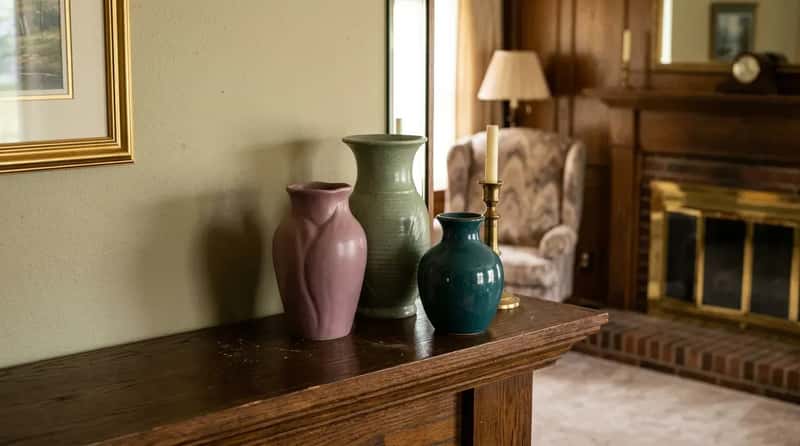
In the 1980s American living room, empty shelf space was wasted shelf space, and ceramics were the answer. These weren’t just vases for flowers – they were treated as small sculptures and grouped on mantels, shelves, and side tables with deliberate care. A cluster of three vases in graduating heights was a design rule so widely followed it might as well have been federal law.
Colors ranged from earthy terracotta to deep jewel tones to the now-iconic dusty mauve and sage green, all chosen to complement the dark wooden cabinets and warm carpet beneath them. Pottery Barn and similar stores built their early retail empires partly on the American appetite for exactly these objects. They didn’t do anything. They didn’t need to. They simply announced that this was a home where people had taste – and enough money to prove it.
#18 – The Console Television Set
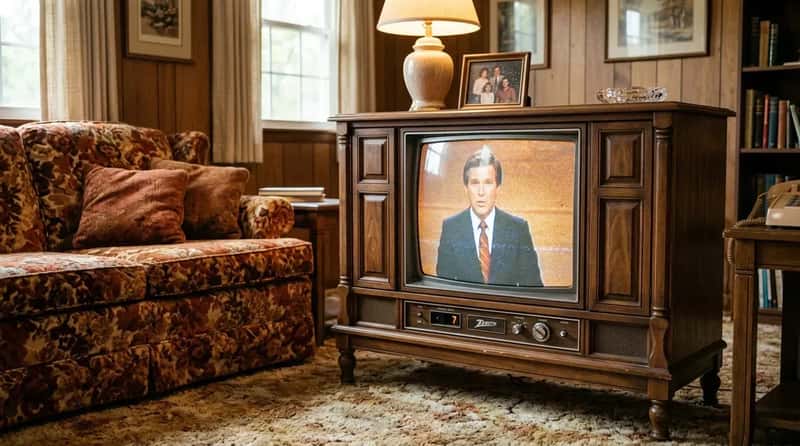
Before flat screens, before mounting brackets, before any of it – there was the console TV. A television set housed inside its own wooden cabinet, standing on legs, positioned in the living room like a piece of furniture in its own right. The console TV could weigh over 200 pounds and occupy the visual real estate of a small dresser, yet American families treated it as the room’s crown jewel. Everything else was arranged in relation to it.
A Zenith or RCA console in a walnut-finish cabinet meant you had invested in your family’s entertainment, and you were not ashamed of showing it. The shift toward standalone sets happened mid-decade as screen sizes grew and prices dropped, but the console held on in millions of homes well into the late ’80s. It was a big, heavy, gorgeous, completely impractical machine that the whole family gathered around like a campfire every single night – and there was nothing wrong with that.
#17 – The Sunken Living Room
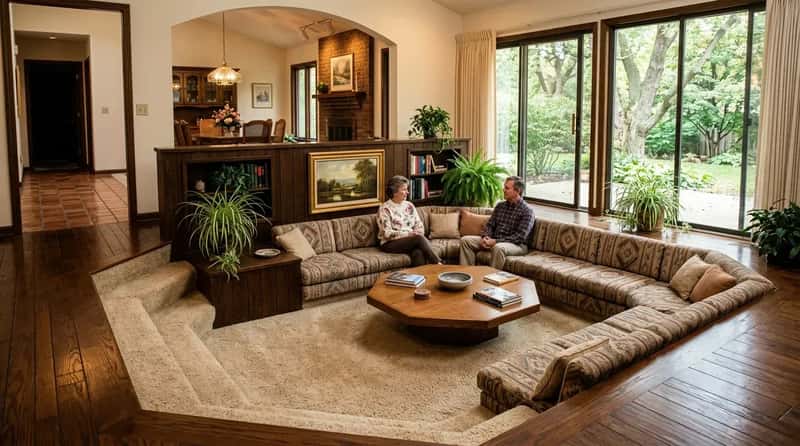
Few features said “we are doing well” quite like a living room floor that was literally lower than the rest of the house. In these spaces, the floor dropped several inches below the adjoining rooms, with steps leading down into what designers called a “conversation pit.” The architectural gesture was entirely theatrical – you didn’t just walk into the living room, you descended into it, which felt exactly as significant as it sounds.
The sunken living room peaked in the late 1970s and carried well into the 1980s, especially in custom and semi-custom homes. It created a natural boundary between spaces without using walls, which felt both modern and open. Architects marketed it as a feature that could engineer better social lives. Today it’s a liability disclosure item in real estate listings. In 1984, it was the finishing touch on a home that had truly arrived.
#16 – Track Lighting
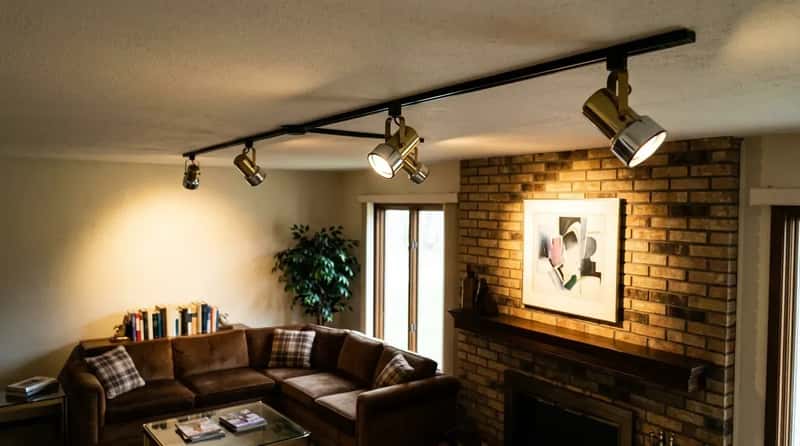
Track lighting was the 1980s living room’s way of saying: we have moved beyond the single overhead fixture, and we are not going back. A metal track mounted to the ceiling with individual spotlight heads that could be aimed and adjusted – this was functional, architectural, and looked like something from an art gallery. It was proof that lighting could be a design statement rather than an afterthought, a principle that felt genuinely new to most American homeowners.
The heads were often finished in brass or chrome, and the tracks were wired so that multiple zones could be highlighted separately. You could spotlight the art wall, illuminate the bookcase, and wash the seating area in warm light, all from one fixture. It was the first time many middle-class homes had directional, gallery-style lighting – and it felt sophisticated. Today it reads as slightly dated. The underlying logic, flexible targeted illumination, is now the premise behind $500 smart lighting systems. The 1980s just got there first.
#15 – The Wall Unit Entertainment Center
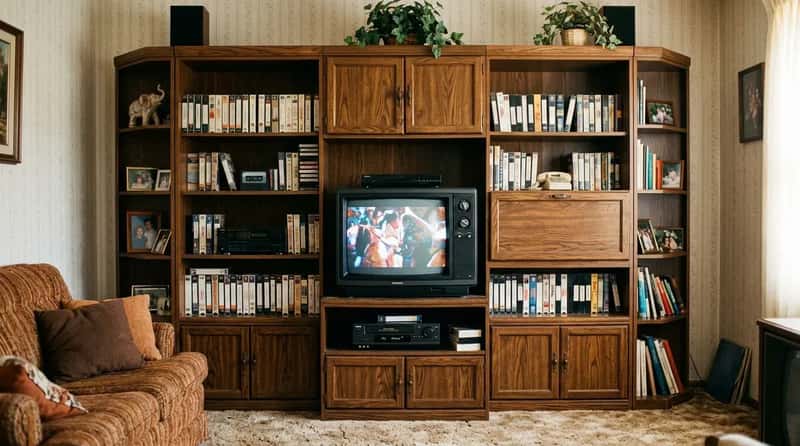
The entertainment center was a monument to optimism. It was built, or purchased in a flat-pack, to house an entire entertainment system that in practice usually turned out to be one 27-inch TV and a VCR. But the idea – a dedicated architectural structure for the family’s technology – was completely new and completely serious. It consumed the dominant wall of the living room. It didn’t just hold the TV. It was the wall.
The entertainment center boom of the 1980s was driven almost entirely by the rise of VCR ownership. In 1980, fewer than 1 percent of American homes had a VCR in the living room. By 1987, that figure had reached 50 percent – and someone needed furniture to house all of it. The oak-finish wall unit with adjustable shelves, a center bay for the TV, and flanking cabinets for VHS tapes became the living room centerpiece of an entire generation. It was proof that technology had moved in, and the home was ready.
#14 – Silk or Dried Flower Arrangements

Fresh flowers are perishable and expensive. The 1980s living room found a better answer: silk florals and dried arrangements that looked perpetually in bloom without the maintenance. The dried arrangement – pampas grass, dried statice, baby’s breath, and wheat stalks in an earthenware vase – sat on a pedestal or mantel in tens of millions of homes across the country, season after season, never wilting.
Silk flower arrangements went further, mimicking roses and peonies with increasing realism as manufacturing improved through the decade. By the late 1980s, the silk floral industry in the United States was a multi-billion-dollar business, with department stores devoting entire sections to them. They gathered dust quietly on mantels across America. They never needed water. They just sat there, looking almost alive – a hint of nature, fully under control. That combination was irresistible.
#13 – The Glass-Top Coffee Table

Glass surfaces were fashionable throughout the 1980s, and nothing demonstrated this more clearly than the glass-top coffee table positioned at the center of the living room. It was modern, it was light, and it let you see straight through to the rug beneath it – which meant the rug had to look good, too. This was design as a chain reaction, each element making demands on the one below it.
The glass top gave even a modest living room a slightly upscale feel – and it showed every fingerprint, every water ring, and every smear without mercy, which is why the brass coaster set on top of it was not optional. It required effort and maintenance, which was quietly part of its appeal. A household that could keep a glass coffee table clean was a household that had its priorities in order. Americans understood the message and bought the table by the millions.
Worth Knowing
- Glass-top tables were seen as a glamorous, futurist upgrade over solid wood in the early 1980s
- The brass coaster set was a near-universal companion piece – functional but also decorative
- Glazed coffee tables, TV units, and dining tables were all part of the same glass-surface trend
- Smoked glass versions added an extra layer of 1980s drama and were popular in den-style rooms
#12 – Wallpaper With Coordinating Borders
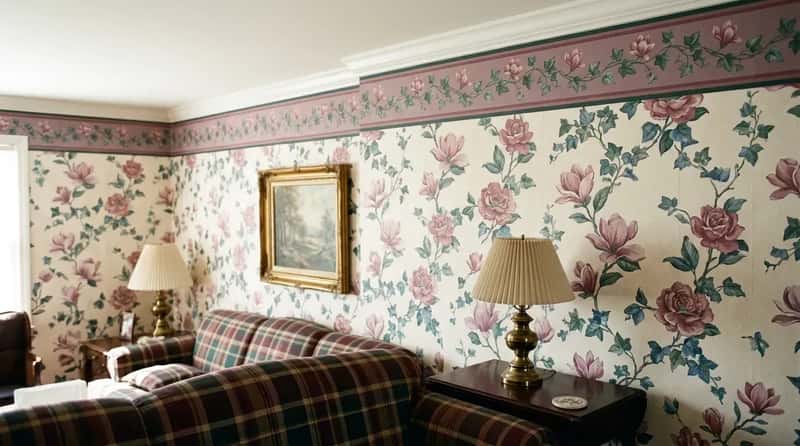
The wallpaper of the 1980s American living room wasn’t just a background – it was a design commitment. And it almost always came with a coordinating border strip: a narrow band of pattern that ran along the top of the wall where the paper met the ceiling. The border was the finishing touch that told every guest you hadn’t just slapped up some paper. You had designed the room. There was a difference, and it showed.
Patterns ranged from small geometric repeats to oversized floral prints to country ivy vines, depending on the theme of the room. A single living room wallpaper job could cost more than a week’s salary for a middle-class family, which is exactly why it was such a powerful status signal. It showed investment. It showed permanence. It said this family wasn’t renting their aesthetic – they owned it, right down to the coordinating border along the top.
#11 – Curved Furniture With Rounded Edges
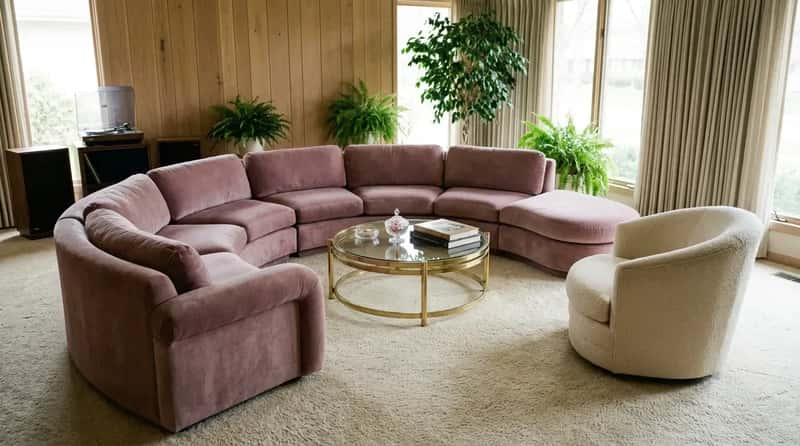
Furniture in the 1980s often chose curves over sharp angles. Circular coffee tables, sofas and chairs with rounded arms, and chaise lounges with gently curved silhouettes were everywhere. This wasn’t accidental softness – it was a deliberate design philosophy shaped by the postmodern movement, which rejected rigid geometry in favor of something more organic. After decades of boxy modernism, curved furniture felt like a genuine breath of fresh air.
The curved sectional sofa – a rounded, semi-circular arrangement that could seat an entire family – was the era’s most ambitious expression of this idea. It turned the living room into a gathering space by design, pulling everyone toward the center. Today designers are rediscovering exactly why it worked, and curved furniture is having one of its biggest revivals in decades. The 1980s, as it turns out, figured that out first.
#10 – The Sectional Sofa
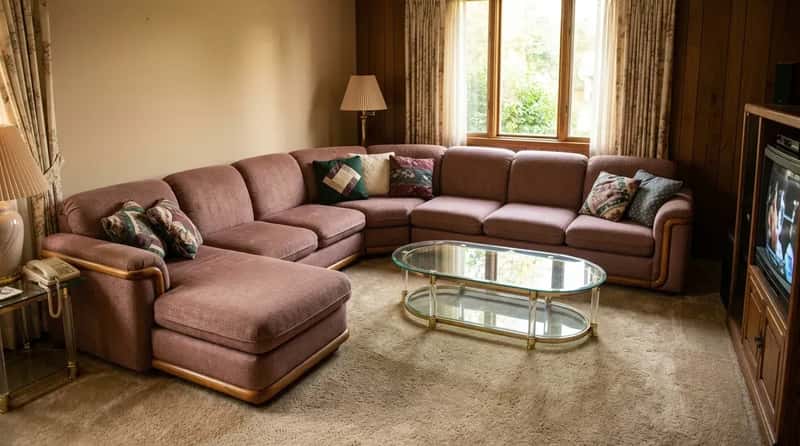
If the recliner was Dad’s throne, the sectional was the whole family’s vote for abundance. A modular, multi-piece seating arrangement that could wrap around two or three walls of a room – the sectional sofa was the ultimate expression of 1980s domestic scale. It came loaded with cushions and throw pillows, often with a built-in chaise at one end, and it solved a very real problem: how do you seat eight people for the Super Bowl without folding chairs?
It also created a new problem – once the sectional was in, rearranging the room was essentially impossible. The sectional committed you to a floor plan, sometimes permanently. It was often upholstered in mauve or dusty blue fabric with wooden trim accents, positioned around the console TV or the entertainment center wall unit. It made the living room feel generous and full. It made it feel like a family actually lived there. That was the whole point.
#9 – The Atari or Nintendo Gaming System

The 1980s turned home gaming into a living room institution. The Atari 2600 had arrived at the tail end of the ’70s, but it was the ’80s that made a gaming console as expected in the living room as the sofa itself. The Nintendo Entertainment System launched in North America in October 1985, and by December 1991 had sold nearly 30 million units in the United States alone – transforming the living room into an interactive entertainment space for the very first time.
The gaming system also changed how the room was used. Before it, the TV was a passive experience. With a controller in hand, siblings competed, skills were tested, and kids had a legitimate reason to be in the main room of the house. Parents tolerated it because the kids were home and visible. The gaming system became an anchor for family time that nobody had planned for but everyone welcomed – and in retrospect, it was the first small step toward everything the living room would eventually become.
#8 – The Waterfall Valance and Lace Curtain Combo
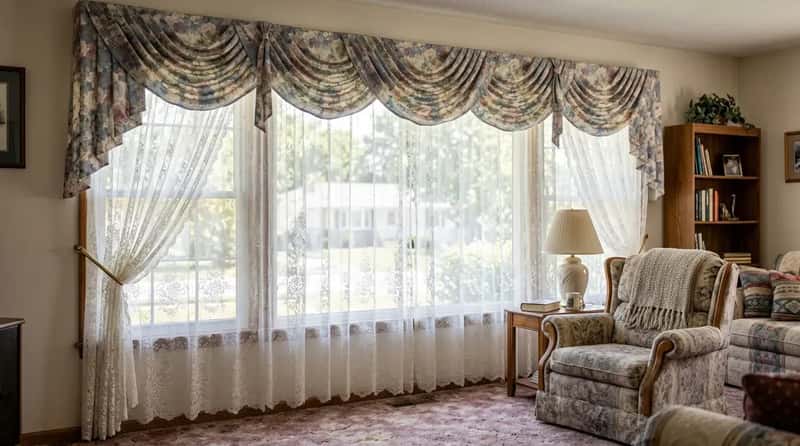
For a certain segment of 1980s America – particularly in the South and Midwest – no living room was dressed until the windows had both a structural fabric treatment and sheer lace panels underneath. The lace curtain filtered daylight into something soft and diffused while keeping the street from seeing in. The valance above added structure and formality. Together they created a layered window treatment that required real effort to install and maintain – and that effort was the whole point.
Lace curtains alone were a multi-hundred-million-dollar industry in the United States throughout the 1980s, with imports from Belgium and domestic manufacturers competing for the American window. They yellowed from sunlight and cigarette smoke and required delicate hand washing. None of that slowed anyone down. If your living room windows had lace, your living room was dressed. Everything else was just furniture.
#7 – The Potted Ficus Tree

Every self-respecting 1980s living room had a large potted plant in the corner – and nine times out of ten, that plant was a ficus benjamina. The weeping fig, with its glossy oval leaves and graceful drooping branches, was the houseplant of the decade. It could grow to six or seven feet tall, filling an entire corner with something organic and green, and it said something specific: this household is warm, cultivated, and capable of keeping living things alive.
The ficus was also notoriously temperamental. Move it three feet from its spot and it would drop every leaf overnight, as if personally offended. Millions of American families kept their ficus in one exact location for years, rearranging everything else in the room around the plant’s preferences rather than the other way around. It was a running joke that became a point of pride. If your ficus survived the decade, you had demonstrated patience, consistency, and a reliably warm indoor temperature. In the 1980s, that was not nothing.
Fast Facts
- Ficus benjamina (weeping fig) was the dominant living room houseplant of the 1980s
- Mature indoor specimens could reach six to seven feet, filling an entire room corner
- The tree was famous for dropping leaves when moved even a short distance
- Other popular 1980s living room plants: snake plant, pothos, and Boston fern
- The large potted plant signaled domesticity, warmth, and a certain level of commitment
#6 – Built-In Bookshelves
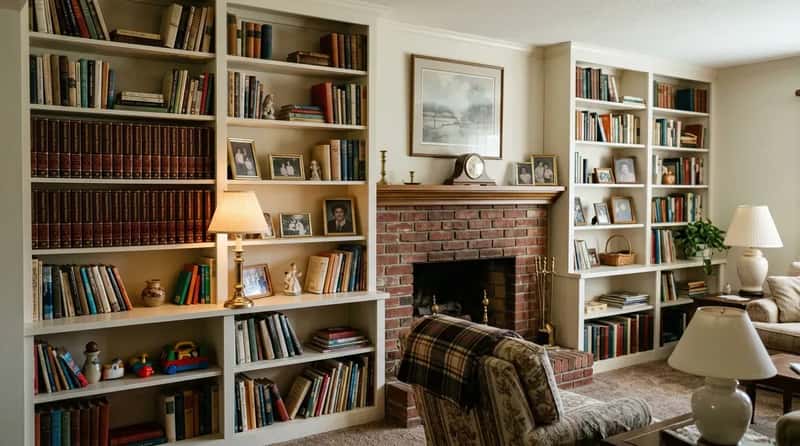
Built-in bookshelves flanking a fireplace, or running along an entire living room wall, were among the most coveted architectural details a 1980s home could have. They signaled permanence and investment – this was not a temporary arrangement but a deliberate statement. The shelves were typically built in painted wood or oak-finished MDF, immediately filled with books, family photos, decorative objects, and the occasional ceramic vase.
The World Book or Encyclopedia Britannica set occupied at least one full shelf, displayed in its matching cloth-bound volumes as proof that education was valued in this household. Beside it: framed school photos, a brass-based lamp, a ceramic figurine, and a few Reader’s Digest condensed books that nobody ever actually read. Built-in shelves turned the living room into something curated rather than improvised – the architectural equivalent of a résumé. Every homeowner wanted them. The ones who had them knew exactly what they meant.
#5 – The Brick Fireplace
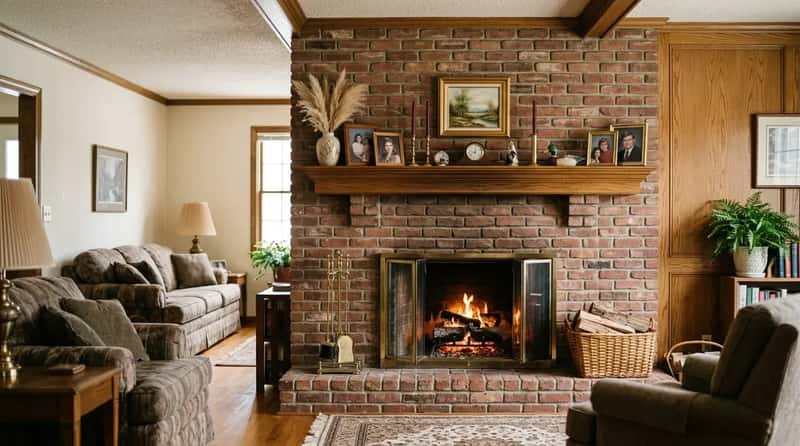
In the 1980s American living room, the fireplace wasn’t just a heat source – it was the room’s identity. A full brick fireplace, floor-to-ceiling or built into a feature wall, served as the natural focal point around which every other piece of furniture was arranged. Brass fireplace tools stood at attention beside it. A hearth rug anchored the seating. The mantel above was the most valuable display real estate in the entire house, and it was treated accordingly.
Brick fireplaces appeared in nearly half of all newly constructed single-family homes in the early 1980s, a rate that reflected both design preference and lingering anxiety from the oil crises of the ’70s. People wanted warmth they could control. They wanted the ritual of a fire – the crackle, the glow, the smell of wood smoke that turned a house into a home. The mantel became where family photos, ceramic vases, and seasonal decorations lived year-round. It was the room’s heartbeat, and everything else orbited around it.
#4 – The Overstuffed Suede or Velvet Sofa
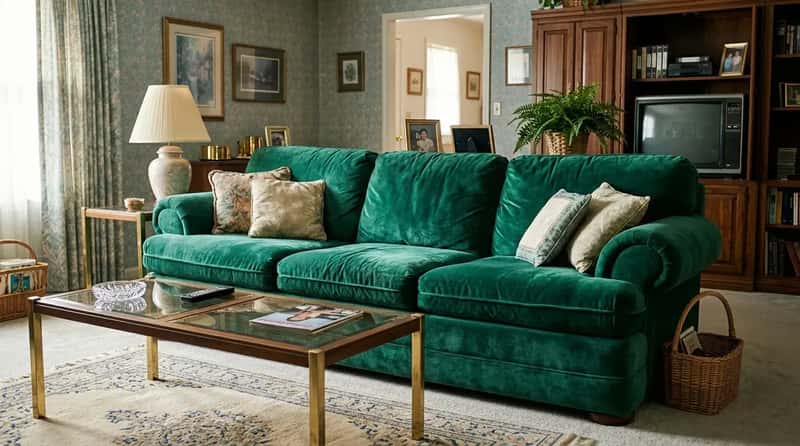
The 1980s embraced maximalism in furniture with full conviction, and nothing demonstrated that more directly than the overstuffed sofa. Deep, plush, and slightly squishy, the suede sofa felt like luxury without the cost of actual leather. Jewel-toned velvet went further – emerald green, sapphire blue, burgundy red – and both options told exactly the same story: this household does not apologize for comfort.
The overstuffed quality was entirely deliberate. Cushions were thick, seats were deep, and the whole structure seemed designed to swallow whoever sat in it. You didn’t perch on this sofa – you sank into it. Velvet sofas became a defining symbol of 1980s aspiration, associated with the decade’s embrace of luxe materials filtered down to a middle-class price point. They felt incredible. They still do, which is probably why velvet sofas never fully went away – and are currently having a full-throated comeback.
#3 – The VCR and Tape Library
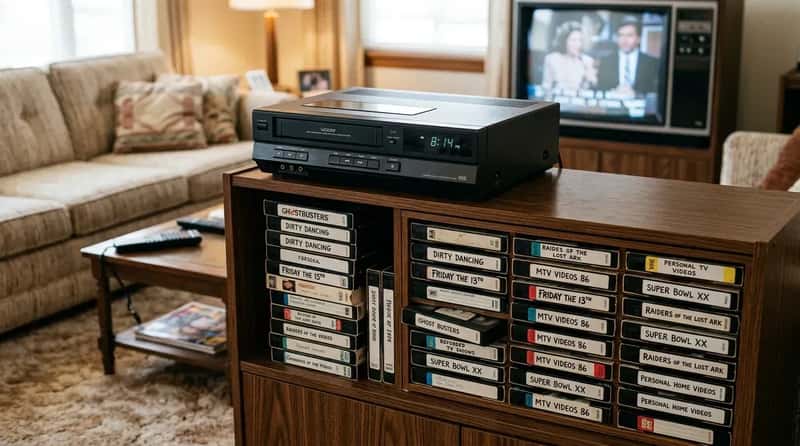
No single piece of technology changed the 1980s American living room more fundamentally than the VCR. In 1980, fewer than 1 percent of American homes had one in the living room. By 1987, ownership had reached 50 percent of U.S. households – and by late 1988, Nielsen reported that 62 percent of American households owned a VCR, fundamentally reorganizing how the living room worked. You could watch a movie on a Friday night without leaving the house. You could tape a TV show and watch it later. For the first time, you owned your entertainment – and you could prove it.
The VHS tape library that grew up around the VCR became its own piece of living room furniture. Dedicated tape storage racks – freestanding black plastic towers or shelving inserts inside the entertainment center – held the family’s collection. Blockbuster Video opened its first store in Dallas on October 19, 1985, and expanded rapidly from there, eventually operating thousands of locations across the country. All those tapes came home to the living room shelf. Movie night stopped being an outing and became a ritual. The living room was never the same again.
Why It Stands Out
- VCR ownership leaped from under 1% of U.S. homes in 1980 to 62% by late 1988
- Blockbuster’s first store opened October 19, 1985, in Dallas, Texas – with 8,000 tapes on day one
- The VHS format captured roughly 90% of the U.S. VCR market by 1987
- Dedicated VHS tape towers and wall-unit cabinet inserts became standard living room furniture
- The VCR was called “the hottest-selling consumer-electronics product of the 1980s”
#2 – The Honey Oak Wall-to-Wall Trim
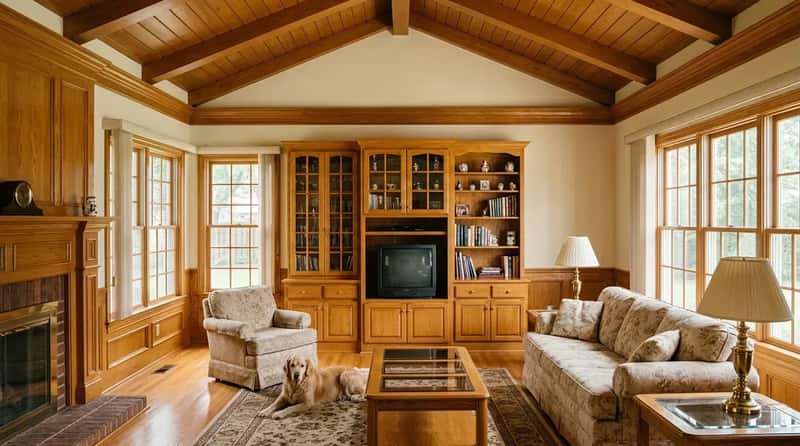
If there is one material that defines the 1980s American living room more than any surface finish, it is honey oak. It appeared on baseboards, door frames, window surrounds, stair railings, built-in shelving, cabinet faces, and – in the most committed applications – on the ceiling as exposed beams. The warm golden tone of natural oak felt rich, natural, and thoroughly modern by the standards of the early decade. It was everywhere, and it was chosen, not defaulted to.
Oak covered every surface in the most thoroughgoing 1980s interiors, and homeowners actively requested it and proudly showed it off. A living room with oak trim, an oak entertainment center, and oak hardwood floors represented tens of thousands of dollars in material investment and signaled permanence above all else. Today oak trim triggers a remodel reflex in buyers who want it gone immediately. But for a solid decade and a half, it was the single most reliable signal that an American family had built something real, something lasting, something genuinely worth coming home to.
#1 – The Family Portrait Above the Sofa
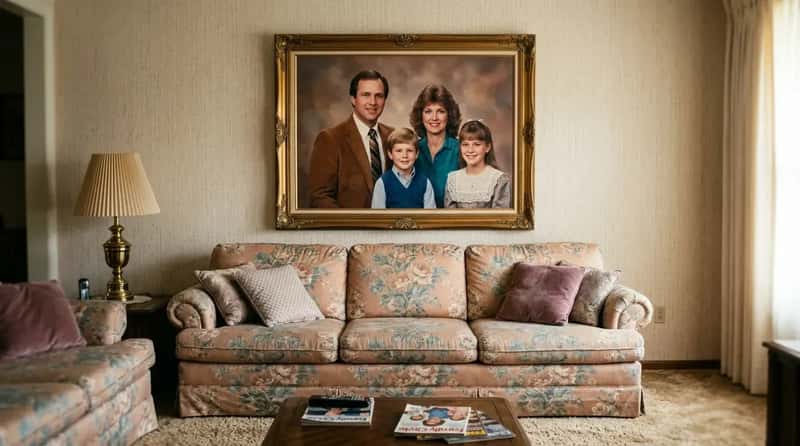
At the very center of the 1980s American living room was the formal family portrait – professionally photographed, gallery-framed, hung on the wall above the sofa in a position of absolute authority. This wasn’t a casual snapshot. It was a studio portrait with coordinated outfits, a professional background, and lighting designed to make every member of the family look like the best version of themselves. The portrait was the room’s thesis statement. It said: this is who we are. This is what we have built. Look at us.
The portrait session – at Sears, JCPenney, or a local studio – was a semi-annual event in millions of American households, and the resulting images were treated as heirlooms from the moment they came back from the lab. A gilded or dark wood frame, sometimes oval, sometimes rectangular with a wide mat, was hung at eye level above the sofa in the room’s most prominent position. Nothing else on this list carried more weight. Every other item – the brass lamp, the mauve carpet, the cathedral ceiling – served as a backdrop for this single image. The portrait served nothing but the truth: for that family, in that moment, the American Dream had arrived.
Scroll through all 29 of these features and you’re not just looking at furniture and fabric choices. You’re looking at a complete belief system about what home was supposed to mean – what it was supposed to prove, to the neighbors, to the extended family, and to yourselves. The 1980s living room was a stage, and every piece in it was a carefully chosen prop in the ongoing performance of American success. Some of these features aged beautifully. Others didn’t survive the decade’s hangover. But all of them were chosen with intention, by people who believed completely and without irony that the right living room could confirm what they’d worked so hard to become. Which ones did your family have?