
Imagine sitting down at a dinner party in 1975 and watching your host proudly carry out a molded tower of lime Jell-O packed with shrimp as the centerpiece dish. Guests leaned in. Applause, even. The 1970s dinner party was its own universe of culinary ambition – full of flaming desserts, cream-cheese sculptures, and canned-soup sauces with French names – and at the time, it all felt genuinely sophisticated. Hosts didn’t just feed people. They put on a show.
But almost nothing dates a decade faster than its food, and this list goes deep. A few of these dishes are obvious, but some will surprise you – either because they’ve quietly survived in disguise, or because they were stranger than you remembered. The later entries on this list are the ones that defined the era most completely, and number one is the dish that could stop a modern dinner party dead in its tracks.
#35 – Polynesian Chicken Salad
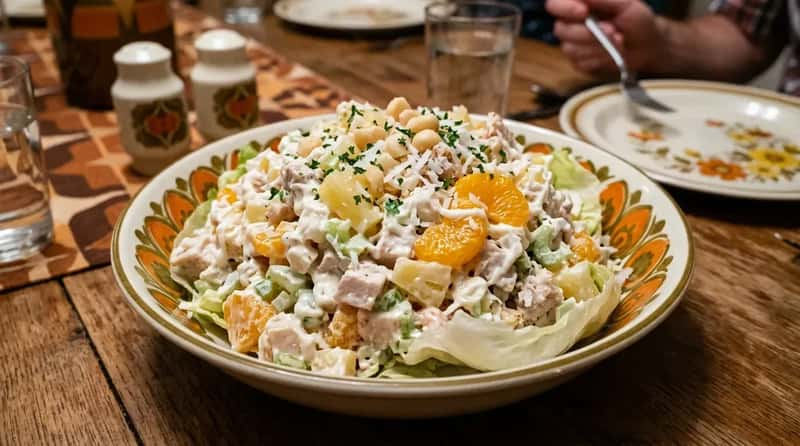
After decades of sad salads built on cold iceberg and flavorless tomatoes, 1970s home cooks discovered excitement in “exotic” ingredients – mandarin oranges, macadamia nuts, canned pineapple – all bound together with generous amounts of mayonnaise and sour cream, served on a few token lettuce leaves. The result was a mayo-heavy bowl that somehow got marketed as the healthy option on the menu.
Today’s dinner guests would clock the can of crushed pineapple and the quarter-cup of Hellmann’s immediately. It tasted fine, honestly – but it belongs in the same category as the avocado-green kitchen it was made in. The biggest offense wasn’t the flavor. It was calling it a salad.
#34 – Stuffed Celery with Cream Cheese
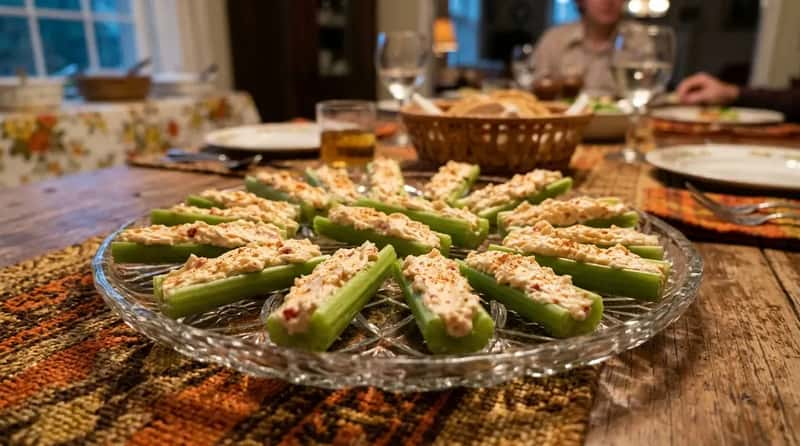
Stuffed celery was a relish-tray staple that showed up at virtually every 1970s dinner party across the country. Depression-era cookbooks first documented it as an economical yet presentable appetizer, and it carried that “dressed-up cheap” energy well into the following decades. The filling was typically a blob of cream cheese blended with pimento or a splash of Worcestershire – sometimes both.
It wasn’t bad. It was just deeply, profoundly beige in concept. Today, a platter of cream-cheese-stuffed celery sticks would be outshone by literally any supermarket charcuterie board. The bar has moved. Stuffed celery did not move with it.
At a Glance
- By the early 1970s, stuffed celery was a fixture at party platters and buffet tables nationwide
- Standard fillings: cream cheese, cheddar, crispy bacon, pimento, or olives
- By the late 1970s, a wave of globally inspired hors d’oeuvres made it look plain by comparison
- Modern equivalent: whipped ricotta with herbs on endive leaves – a completely different conversation
#33 – Party Rye Canapés
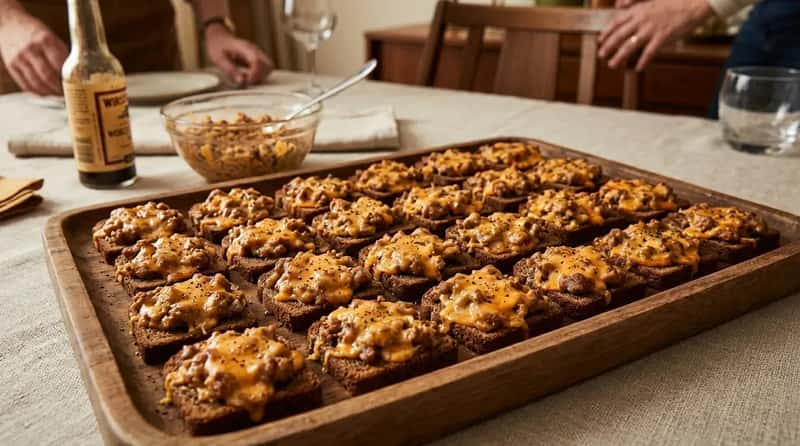
Party ryes were big in the 1970s, and for good reason – they were essentially mini pizzas on small squares of rye bread, highly customizable, easy to prep ahead, and perfect for grazing guests. The standard topping was a mixture of sausage, Velveeta, and Worcestershire sauce melted together and spread on the little squares before broiling. Finger food had never felt so effortless.
The fact that Velveeta was a primary ingredient in a “sophisticated” dinner party appetizer says everything about where 1970s food priorities stood. Today’s hosts are putting whipped ricotta and fig jam on crostini. A tray of processed cheese melted onto rye crackers wouldn’t survive the first scroll of the evening.
#32 – Ambrosia Salad
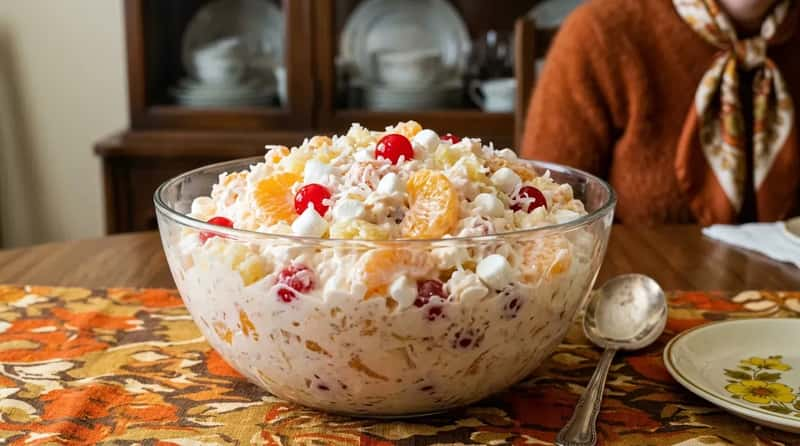
Ambrosia sat proudly in the “salad” column on the 1970s party menu, which tells you something about how loosely that word was being applied. The combination of canned mandarin oranges, shredded coconut, mini marshmallows, and Cool Whip stirred together in a bowl was genuinely festive-looking – colorful, fluffy, and sweet enough to double as dessert, which it essentially was.
When people think of fruit salad now, they picture something quite a bit closer to actual fruit. The marshmallow-and-Cool-Whip format reads today as a dessert in witness protection. Calling it a salad requires a confidence most modern hosts simply don’t have.
#31 – Chicken à la King
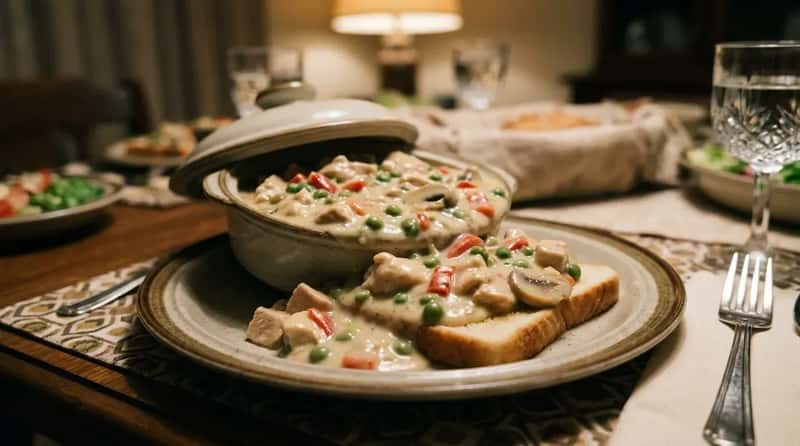
Chicken à la King dates back to the early 1900s, but it found renewed life in the 1970s thanks to packaged shortcuts – canned mushrooms, frozen peas, and a can of condensed cream of mushroom soup as the sauce base. Cubed chicken in a cream sauce with pimentos and peas, spooned over toast or egg noodles, felt refined to a generation of hosts who equated “in a sauce” with “elevated.”
The heavy reliance on condensed soup as the foundation of a dinner party entrée is what makes this dish such a perfect period piece. Today’s guests expect actual technique. A dish that’s essentially chicken in canned soup gravy ladled over toast is going to generate some polite but devastating questions at the table.
#30 – Hawaiian Cheese Log
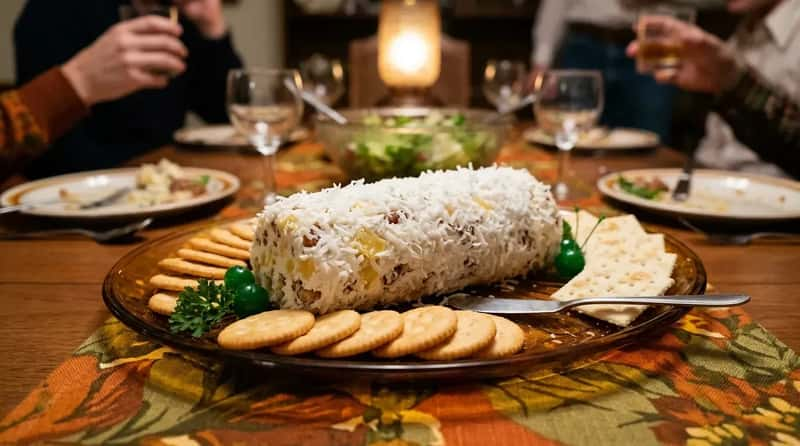
Mid-century America could not get enough of tropical themes, and the Hawaiian Cheese Log was the apex of that obsession. Cream cheese mixed with crushed pineapple and chopped nuts, rolled in shredded coconut, chilled, and presented on a platter with crackers – it took about 20 minutes to make and appeared in countless community cookbooks under various ambitious names. The logic was: it’s tropical, it’s cream cheese, it’s on a board. Dinner party gold.
The sweet-pineapple-meets-cream-cheese combination that felt adventurous in 1974 now just tastes confused. Modern guests navigating actual global cuisine are not going to be wowed by a log of cream cheese rolled in coconut. The hedgehog of appetizers, in more ways than one.
#29 – Stuffed Bell Peppers
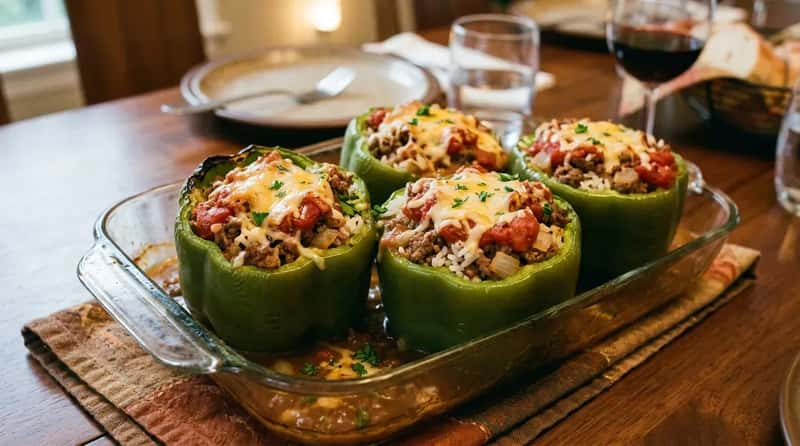
Stuffed bell peppers were a hearty, colorful dinner party staple – standing upright and filled to the brim with ground beef, rice, and canned tomatoes, they looked dramatic on the table and could be prepped ahead. For a generation of hosts cooking without the internet, a pan of stuffed peppers was a reliable showstopper that fed a crowd without much fuss.
Stuffed peppers haven’t disappeared, but they’ve lost their dinner-party status almost entirely. They’ve migrated from the elegant table to the weeknight meal-prep container. Bringing them out for company today signals either a shortage of ideas or a complete lack of concern about optics – which, honestly, might be its own kind of power move.
#28 – Tuna Noodle Casserole
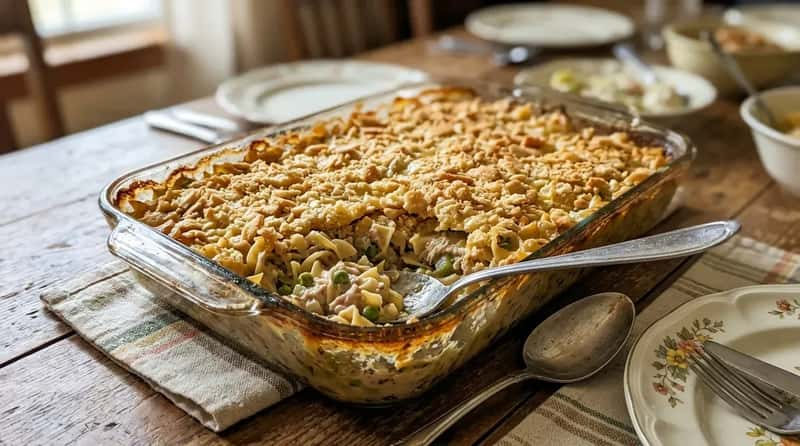
Tuna casserole could feed a large group with almost no effort, which made it a defining dish of 1970s kitchens and potluck-style gatherings. The formula – canned tuna, egg noodles, cream of mushroom soup, and a crushed cracker topping – was so universal it appeared in nearly every church cookbook and community pamphlet of the decade. Warm, filling, and deeply comforting.
The fact that a can of tuna baked into condensed soup could be the centerpiece of a dinner party shows just how much American entertaining has changed. Today this dish lives primarily as nostalgic comfort food and last-resort weeknight cooking. Serving it to guests you’ve actually invited over crosses a line that most people aren’t prepared to defend.
#27 – Clams Casino
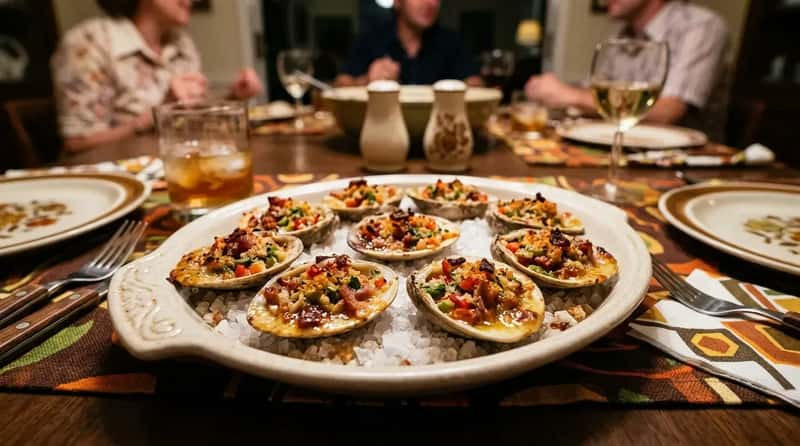
When the Narragansett Pier Casino introduced Clams Casino in the late 1800s, America’s wealthy immediately embraced it. Fresh littleneck clams topped with breadcrumbs, butter, garlic, parsley, bacon, and bell peppers, broiled to golden perfection – by the 1970s, this was the kind of appetizer that told your guests you’d done your homework. It signaled coastal sophistication, even in landlocked zip codes.
The problem today isn’t the flavor – clams casino is actually delicious. It’s the combination of labor intensity and very specific retro optics. Modern hosts prefer seafood starters either simple and pristine or inventively modern. A broiled clam dripping with butter and canned breadcrumbs splits the difference and pleases neither camp.
#26 – Canned Mushroom Soup Chicken Bake
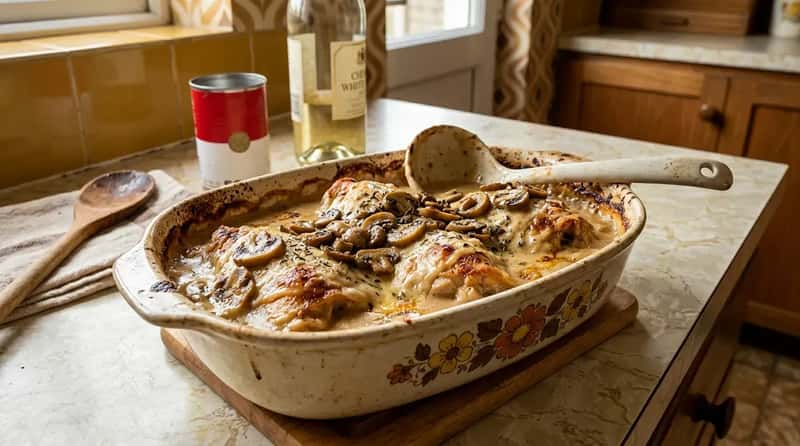
This dish barely had a name, which was fitting because it barely had a recipe. Chicken breasts laid in a baking dish, covered with a can of Campbell’s cream of mushroom soup thinned with white wine, topped with drained canned mushrooms, baked at 350°F until done. It was the dinner party workhorse of the decade – cheap, make-ahead, easy to scale, and requiring absolutely zero technique.
The entire dish was built around a can of condensed soup as the sauce, and that was not a secret anyone tried to hide. Today, opening a can of condensed soup as your main dinner party sauce would generate questions. The 1970s kitchen ran on convenience in a way that felt progressive then and reads as a shortcut now. A beautiful irony: the dish required no skill but still impressed.
Worth Knowing
- New inventions like slow cookers and microwaves were becoming household staples throughout the 1970s, fueling the convenience-food era
- Products like Hamburger Helper and Cup O’Noodles were marketed as time-saving hacks for the working household
- Campbell’s condensed soup appeared as a sauce base in dozens of mainstream 1970s dinner party recipes
- The “just add soup” shortcut felt modern and efficient – not lazy – to a generation raised on postwar convenience
#25 – Deviled Crab
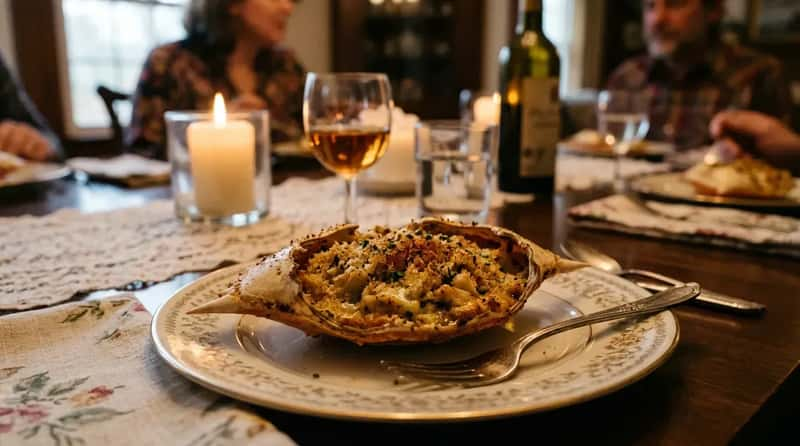
Resourceful coastal communities developed deviled crab in the late 19th century to stretch precious crabmeat while maintaining an elegant presentation. Lump crabmeat mixed with breadcrumbs, egg, mayonnaise, mustard, and seasonings – baked in crab shells or ramekins, often spiked with cayenne. By the 1970s it had gone fully mainstream, showing up at dinner parties inland as hosts reached for something that projected coastal sophistication.
The trouble with deviled crab today isn’t the concept – it’s the execution expectations. The dish’s popularity spread as refrigerated transport expanded seafood availability beyond the coasts, meaning a lot of inland cooks were making it with crabmeat that was decidedly not fresh. Today’s guests have opinions about sourcing and freshness that the 1970s version simply didn’t have to answer for.
#24 – Oysters Rockefeller
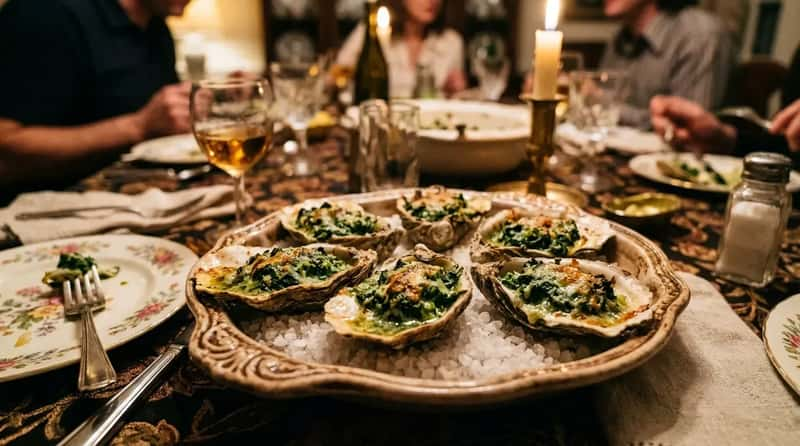
Chef Jules Alciatore created Oysters Rockefeller at Antoine’s Restaurant in New Orleans in 1899 as a response to a French snail shortage. Named after America’s wealthiest man, the dish featured oysters topped with a vibrant green mixture of spinach, herbs, butter, and breadcrumbs. The original recipe remains a closely guarded secret to this day. By the 1970s, every ambitious home cook had their own version ready for company.
Serving Oysters Rockefeller today is a bold statement – it projects a very specific “I own a tuxedo and my grandmother’s china” energy. The restaurant has served over four million orders since their creation. But as a home dinner party offering, the baked-spinach coating feels heavy where modern palates want clean, cold, and briny. It reads more as a period costume than an impressive choice.
#23 – Glazed Ham Loaf
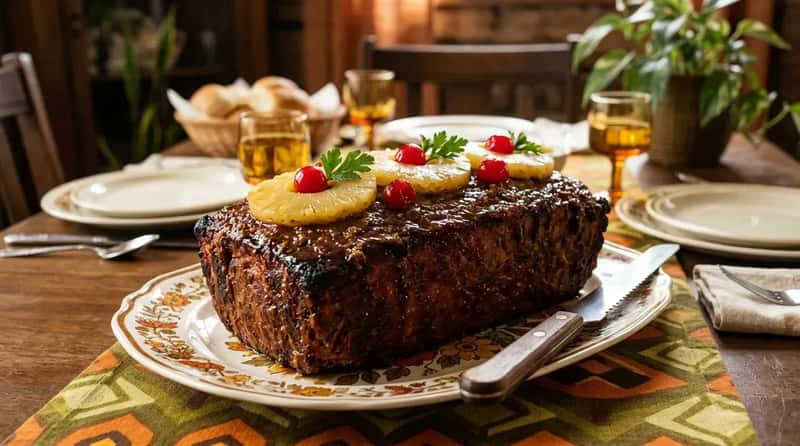
The glazed ham loaf was the meatloaf’s more socially ambitious cousin – ground ham mixed with ground pork, shaped into a loaf, and finished with a brown sugar and mustard glaze that turned the exterior a deep, mahogany brown. It looked genuinely dramatic on a 1970s buffet table: fragrant, glossy, the kind of centerpiece that made guests reach for a second plate.
Today that same dish lands somewhere between confusing and alarming for guests who’ve never encountered the concept. Ground ham, shaped into a loaf, glazed sweet – it sounds like something discovered in a binder labeled “Community Favorites” in a church basement, which is essentially what it was. The presentation hasn’t aged the way the hosts hoped.
#22 – Swedish Meatballs in Cream of Mushroom Sauce
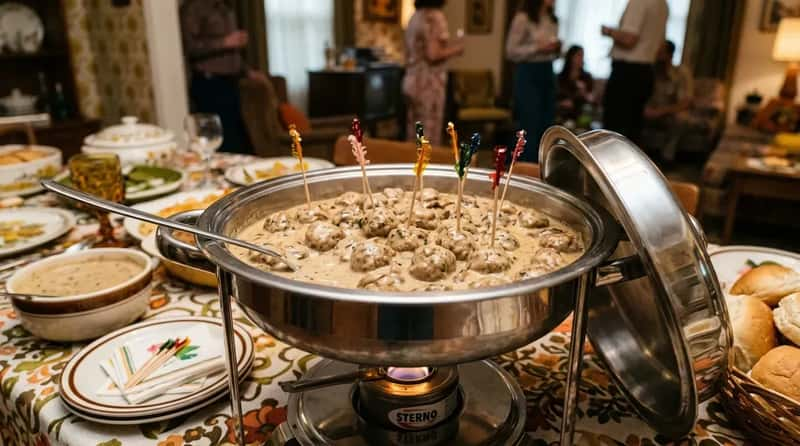
The distinctive blend of ground beef, pork, onions, allspice, and white pepper created an immediately recognizable aroma at 1970s gatherings. Convenience-minded hosts often substituted cream of mushroom soup for traditional gravy, served the meatballs with frilly toothpicks from chafing dishes, and called it a night. The chafing dish was the 1970s dinner party equivalent of the Instagram-ready tablescape – if it was hot and sitting in a silver vessel, it was elegant.
The meatballs themselves aren’t the problem. Real Swedish meatballs with proper gravy are genuinely excellent and having a moment. It’s the shortcut sauce – swapping a carefully built pan gravy for a can of condensed soup – that dates the dish completely. The flavor was there. The technique was not.
#21 – Pineapple Chicken
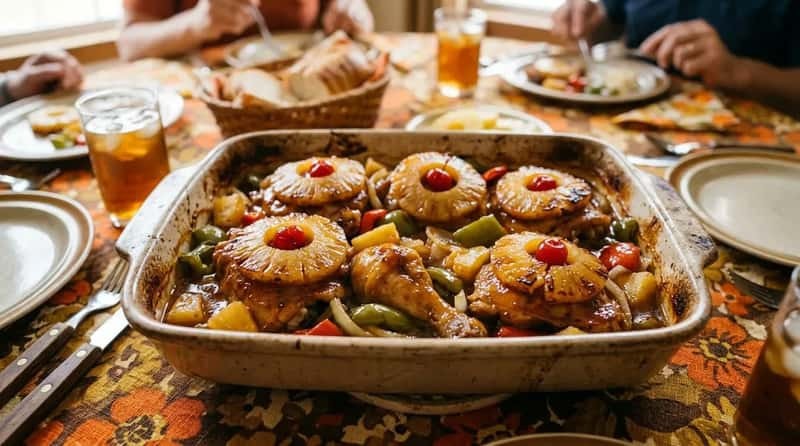
Pineapple chicken was the 1970s dinner party’s attempt at global cuisine without leaving the zip code. Chicken pieces combined with canned pineapple rings, brown sugar, soy sauce, and bell peppers, all baked in one pan. Pineapple on everything was the decade’s culinary thesis statement – tropical, sweet, and gesturing vaguely toward the wider world without committing to any specific cuisine.
The sweet-and-sour pineapple chicken formula that dazzled guests in 1972 has since been filed under “things your aunt still makes.” Today’s hosts reaching for fruit-and-chicken combinations are working with pomegranate molasses and preserved lemon. Canned pineapple rings baked onto a chicken thigh is a different conversation entirely – and one most modern dinner tables have quietly ended.
Quick Compare
- 1970s “exotic”: Canned pineapple rings, mandarin oranges, Polynesian themes from the grocery aisle
- 2020s “global”: Pomegranate molasses, preserved lemon, miso, harissa – actual world cuisines
- 1970s shortcut sauce: Brown sugar + soy sauce + a can of something
- 2020s shortcut sauce: Store-bought gochujang or jarred tahini – still a shortcut, but a traveled one
#20 – Cheese Ball with Chopped Nuts
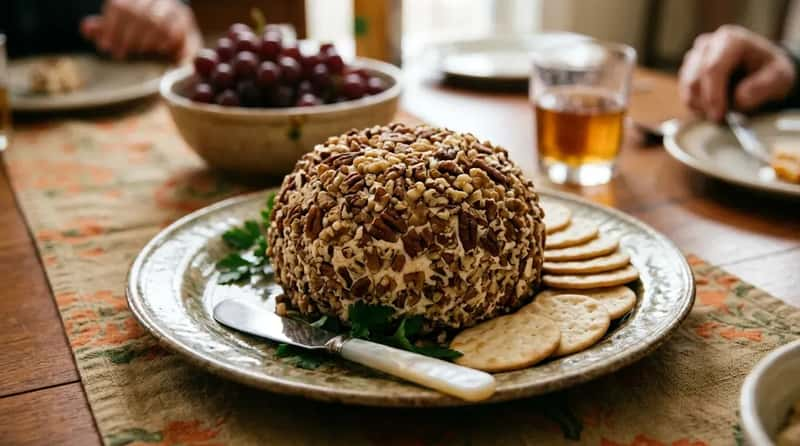
No 1970s party spread was complete without a cheese ball rolled in chopped nuts. The standard recipe: cream cheese mixed with sharp cheddar, Worcestershire, garlic powder, and sometimes dried beef, shaped into a ball and coated in pecans or walnuts. It hit peak popularity during the decade and appeared at everything from neighborhood potlucks to genuinely ambitious dinner parties without anyone questioning its place at the table.
The cheese ball still resurfaces at some family holiday gatherings, carried almost entirely by nostalgia. Bringing one to a modern dinner party is the food equivalent of showing up in a leisure suit – technically fine, but you’re going to need to own it hard. Most hosts have quietly retired the concept. The ones who haven’t know exactly what they’re doing.
#19 – Quiche Lorraine
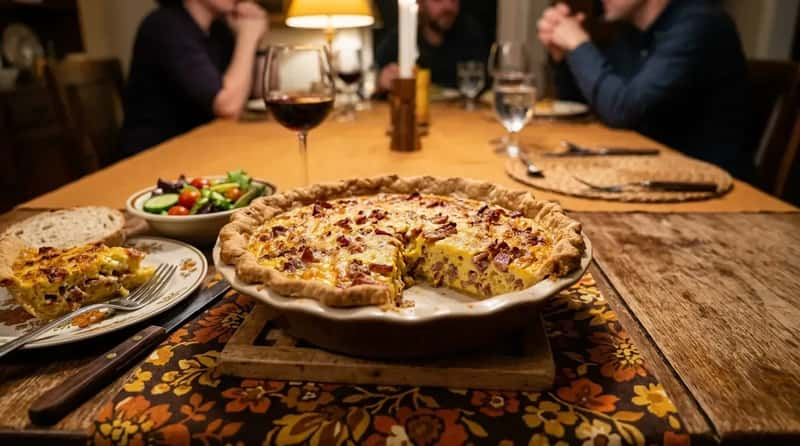
Quiche Lorraine brought a touch of European sophistication to 1970s kitchens. The savory egg, cream, cheese, and bacon filling in a pastry shell was originally French but became a fixture at North American brunches and dinner parties alike. Frozen pie crusts, which became widely available in the ’70s, made quiche accessible to home cooks who had no interest in making pastry from scratch.
Quiche isn’t dead, but it has completely lost its dinner party cachet. The 1982 book Real Men Don’t Eat Quiche was a cultural lightning rod for a reason – even then, the dish had become a symbol of a very specific, slightly mocked kind of aspiration. Today quiche is firmly brunch food. Serving it as a dinner party main in 2025 reads as charmingly retro at best, and a bit directionless at worst.
#18 – Beef Stroganoff with Canned Soup
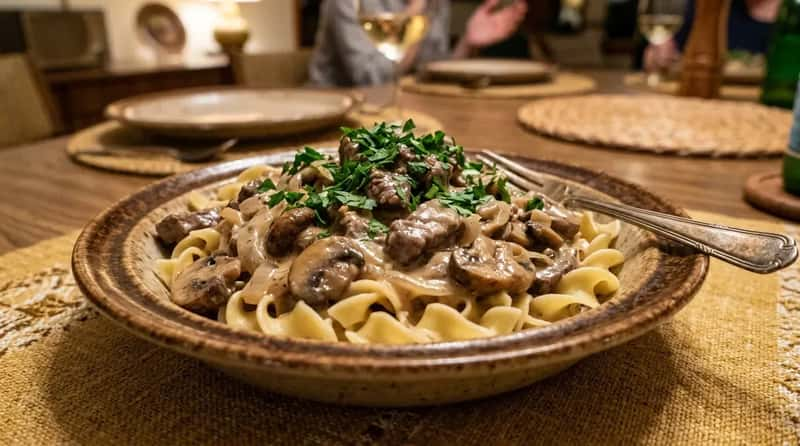
Beef Stroganoff, with roots in 19th-century Russia, became a star of the 1970s American dinner table. Tender strips of beef with mushrooms and onions simmered in a creamy sauce – it had genuine international flair, and the name alone made guests feel like they were eating something elevated. The problem was that most home cooks were building that “creamy sauce” out of a can of condensed cream of mushroom soup loosened with sour cream.
A properly made beef Stroganoff with actual beef stock and a real sour cream sauce is still a genuinely excellent dish. But the shortcut version – canned soup over egg noodles, labeled with a Russian name – is what turned it into a 1970s cliché. The gap between what it claimed to be and what it actually was is what dates it so thoroughly today.
#17 – Salmon Mousse Molded as a Fish
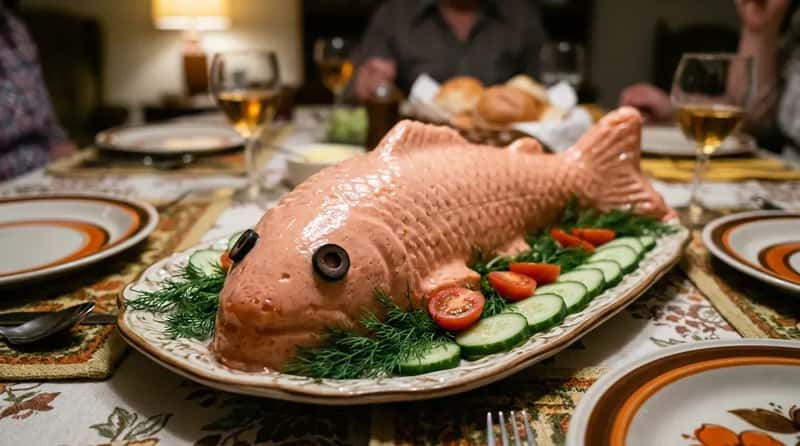
It seems like almost every cookbook from the 1970s contains a photograph of salmon mousse molded into the shape of a large fish, complete with sliced olive eyes staring back at you from the serving platter. It was a make-ahead centerpiece that doubled as table decoration – elegant in concept, deeply unsettling in execution. The sad irony is that salmon mousse itself is actually delicious.
The problem was never the flavor. It was the form. Molding food to look like the animal it came from is a specific kind of culinary performance that the modern dinner guest finds unsettling rather than impressive. There’s a reason food stylists stopped doing this around 1983. The olive eyes are haunting. They will always be haunting.
#16 – Rumaki
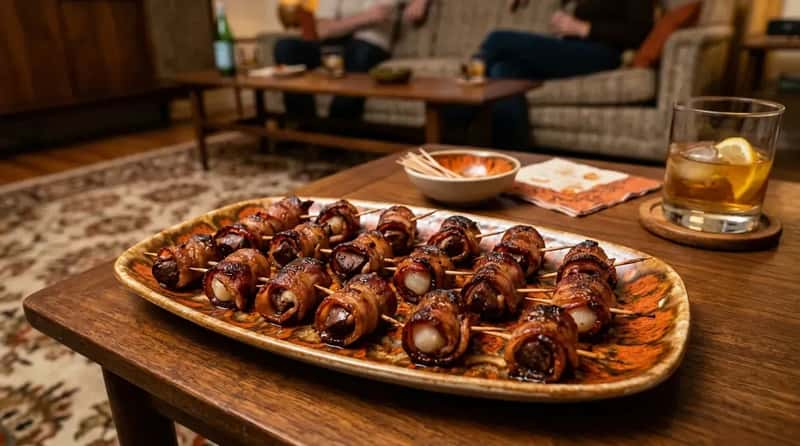
Chicken livers and water chestnuts marinated in soy sauce and brown sugar, wrapped in bacon, secured with a toothpick, and broiled until crispy – rumaki was one of the more eccentric appetizers at 1970s gatherings, and it was genuinely polarizing. Crispy on the outside, crunchy and velvety inside, bursting with sweet, salty, and earthy umami flavors. For the right guest, it was a revelation.
Despite being served at tiki-themed parties and presented as Polynesian, rumaki was actually invented in the United States – the first known record is from a 1941 menu at Don the Beachcomber in Palm Springs, later popularized by Trader Vic’s. The chicken liver component is the deal-breaker for most modern guests. Organ meat wrapped in bacon felt exotic in 1973 and reads as a hard sell in 2025.
#15 – Cocktail Wieners in Grape Jelly Sauce
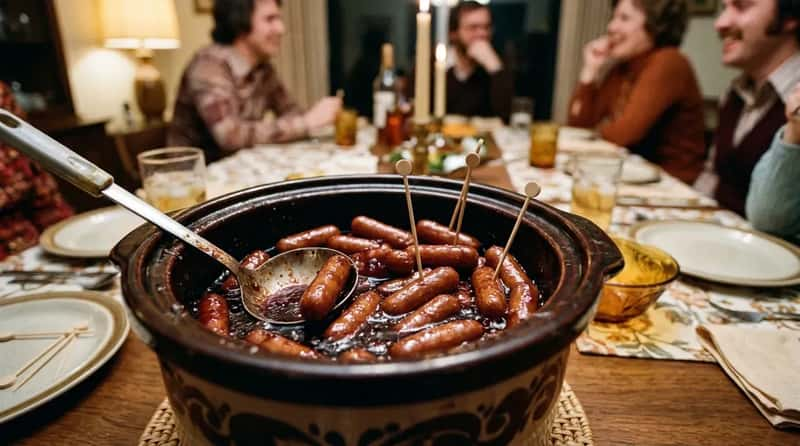
Sometimes served directly from a crockpot to keep them warm, 1970s cocktail wieners were typically glazed in one of two ways: a ketchup-vinegar-Worcestershire barbecue sauce, or the more infamous combination of grape jelly and chili sauce stirred together into a sticky, tangy glaze. The grape jelly version sounds like a mistake. It somehow worked. Guests ate them by the dozen.
The grape jelly sauce is the specific detail that separates this dish from general nostalgia into genuine bewilderment for anyone under 40. The sweet-acid combination does create a glaze that clings beautifully to the little sausages – the logic isn’t wrong. But explaining to a dinner guest that what they’re eating is a cocktail wiener in grape jelly requires a level of confidence that most modern hosts simply don’t have anymore.
#14 – Cheese Fondue
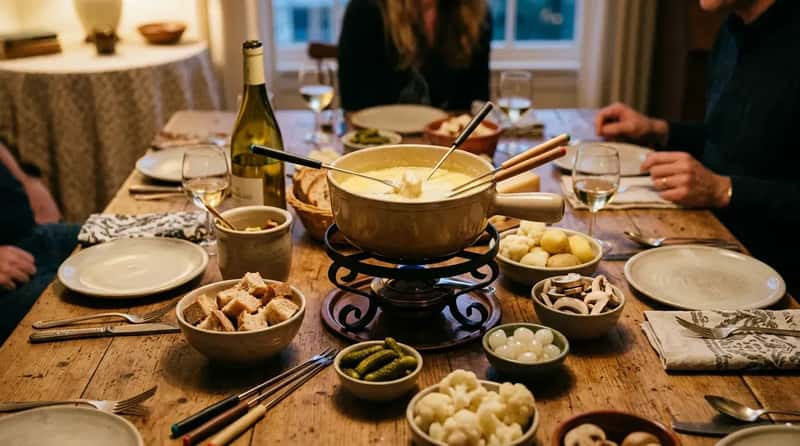
Few party foods captured the communal spirit of the 1970s quite like fondue. The Swiss dish made its American splash at the 1964 World’s Fair in New York, and within a decade, hip hosts were gathering friends around a pot of bubbling Gruyère spiked with white wine, long fondue forks in hand. It was interactive, theatrical, and required equipment that felt genuinely novel in a suburban kitchen.
Fondue faded partly because the Swiss Cheese Union’s aggressive promotional campaign – which helped make the dish a household name – eventually ran its course, and partly because the equipment is heavy, the cleanup is not fun, and the experience works better in theory than in a small apartment. The fondue pot is still lurking in a lot of kitchen cabinets across America. It just never quite makes it back to the table.
#13 – Watergate Salad
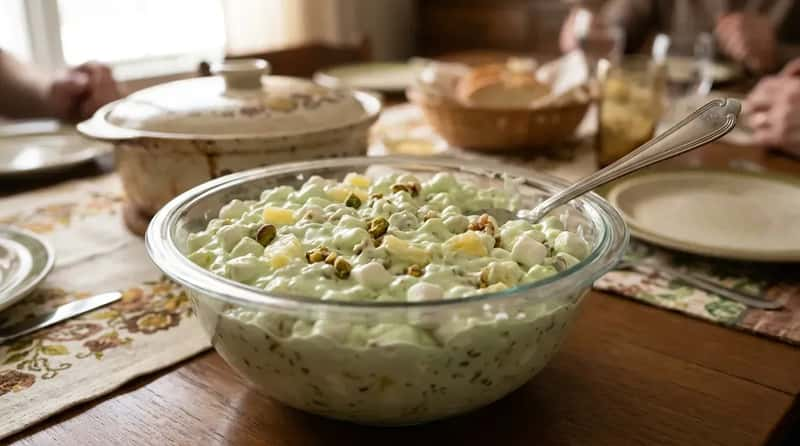
A Watergate salad is unlike any salad you’ve ever seen – no leaves, no dressing, no vegetables. Instead: pistachio pudding mix, mini marshmallows, canned crushed pineapple, chopped nuts, and Cool Whip stirred together into a creamy, pastel-green cloud. It was a big hit in the 1970s, though whether it was named after the Watergate Hotel or the scandal remains genuinely unresolved – the hotel itself never sold it.
The Watergate Salad is pistachio pudding mixed with Cool Whip and marshmallows, served in a bowl labeled “salad” with a straight face. It’s not unlikable so much as it’s deeply, conceptually confused. The color alone raises questions at a modern table. No one in 2025 wants to explain to their guests why the salad course is green and fluffy.
Fast Facts
- Watergate Salad’s true origin is still debated – the Watergate Hotel never officially claimed it
- Main ingredients: instant pistachio pudding mix, Cool Whip, mini marshmallows, canned pineapple, and walnuts
- It was also known as “Pistachio Delight” and “Green Stuff” at family gatherings across the Midwest
- Its pastel-green color came entirely from the pudding mix – zero actual pistachios required
- Ambrosia Salad followed the same logic: fruit plus Cool Whip plus marshmallows, called a salad with full confidence
#12 – Pigs in a Blanket (Hot Dog Edition)

The 1970s version of pigs in a blanket was specifically the full-size or cocktail hot dog rolled up in canned refrigerator crescent dough – the kind that came in the pressurized cardboard tube you popped open on the counter edge. Easy, cheap, and consumed by the trayful at gatherings that ranged from kids’ birthdays to actual adult dinner parties. Nobody questioned it. Everyone ate them.
A lot of the entertaining from this era leaned on convenience shortcuts partly because many hosts – usually women who had returned to the workforce – were still expected to put on a show while managing everything else. Pigs in a blanket have survived, but they’ve been demoted. They’re now children’s party food or ironic retro fare. Serving them earnestly at an adult dinner party is a statement, and not necessarily the one you want to make.
#11 – Pineapple Upside-Down Cake
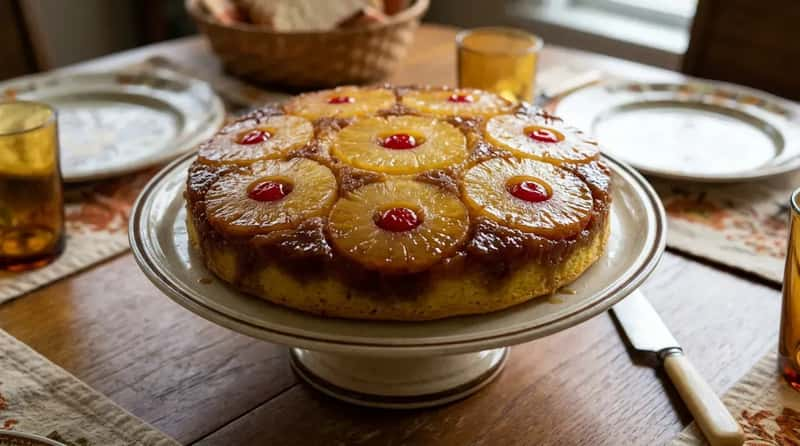
Canned pineapple rings and maraschino cherries arranged in a decorative pattern in the bottom of a buttered, brown-sugar-coated pan, topped with cake batter, baked, and then flipped to reveal the caramelized fruit on top – the reveal was practically a dinner party performance piece in itself. The cake absorbed the fruity juices during baking, and when it came out right, the presentation was genuinely beautiful.
Pineapple upside-down cake reads today as endearing rather than impressive. It’s the kind of thing your grandmother made, not what you’d bring out for guests you’re trying to impress. The tropical flair that made it feel festive in 1974 now makes it feel like a visit to a simpler time – nostalgic, warm, and firmly in the past.
#10 – Black Forest Cake
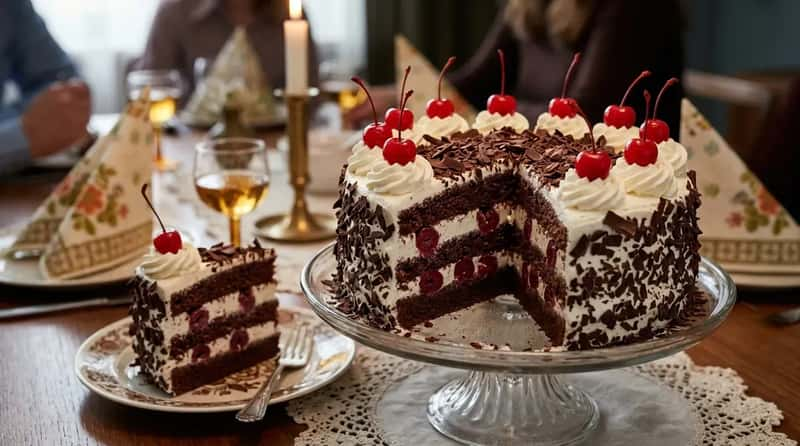
Originating in Germany and first documented in 1915, Black Forest cake exploded in American popularity during the 1970s. Rich layers of chocolate sponge soaked in kirsch, topped with whipped cream and maraschino cherries, occasionally stuffed with sour cherries between layers – it was genuinely decadent, and the combination of chocolate, cream, and boozy cherries felt luxurious in a way that matched the decade’s appetite for indulgence.
The kirsch-soaked layers and pile of maraschino cherries on top now read as unmistakably retro. The Black Forest cake had a specific cultural moment in the 1970s that it simply never repeated. You can still find it at German-American bakeries, and it still tastes good. But at a dinner party meant to impress in 2025, it signals nostalgia rather than ambition.
#9 – Tomato Aspic
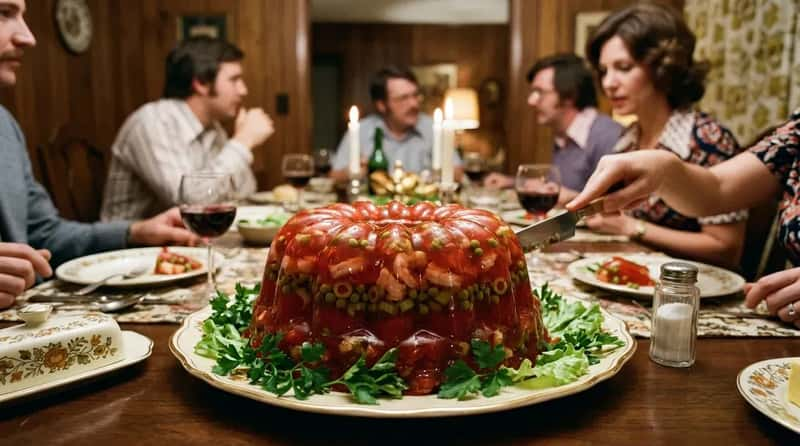
Mid-century home economists championed jellied tomato aspic as the ultimate demonstration of culinary skill and modern food technology. Tomato juice, unflavored gelatin, and seasonings molded into dramatic forms – sometimes with celery, olives, or shrimp suspended inside the crimson gelatin for maximum visual effect. Make-ahead, striking, and a reliable conversation starter. It was the Jell-O mold’s more grown-up, savory, deeply unsettling sibling.
Bringing out a wobbly mold of savory tomato gelatin with vegetables suspended inside it at a modern dinner party would stop the room. Not in a good way. The tomato aspic is a wobbly time capsule – a perfect artifact of an era fascinated by convenience foods, visual drama, and gelatin technology in roughly equal measure.
#8 – Savory Jell-O Molds
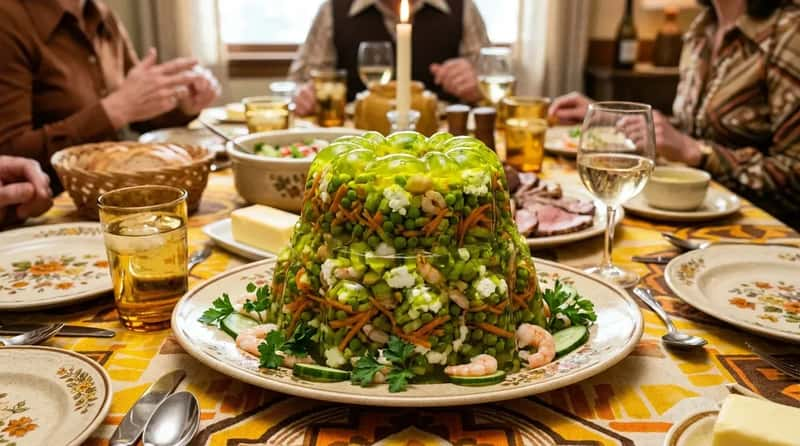
No retro dinner was complete without a Jell-O mold – bright, wobbly, and endlessly customizable. But where the sweet dessert versions get a nostalgic pass, the savory Jell-O mold occupied a category of its own. Suspended peas. Suspended carrots. Suspended shrimp. Cottage cheese and shredded vegetables locked inside lime-flavored gelatin, unmolded onto a platter, and served as a “salad” at the table.
A cucumber-and-grape lime Jell-O mold was a centerpiece, not an afterthought. The savory versions were considered the most sophisticated option on the table. The fact that a bowl of vegetables suspended in flavored gelatin was considered the pinnacle of dinner party presentation is the single most disorienting thing about 1970s food culture. It would not survive ten seconds on a modern table.
Worth Knowing
- Jell-O’s golden years peaked in the 1950s, but savory Jell-O cookbooks were still being published well into the 1970s
- Jell-O actually released savory flavors – celery, Italian salad, and seasoned tomato – which were discontinued by the mid-1970s as the fad collapsed
- By the mid-1970s, Jell-O pulled its savory varieties from stores entirely and refocused on dessert marketing
- Preparing a Jell-O mold was once a subtle status symbol: it required a refrigerator, which many households still didn’t own in the early postwar years
- Food historian Laura Shapiro described the legacy as “a once-loved dish safely congealed in the decorative mold of history”
#7 – Crêpes Suzette
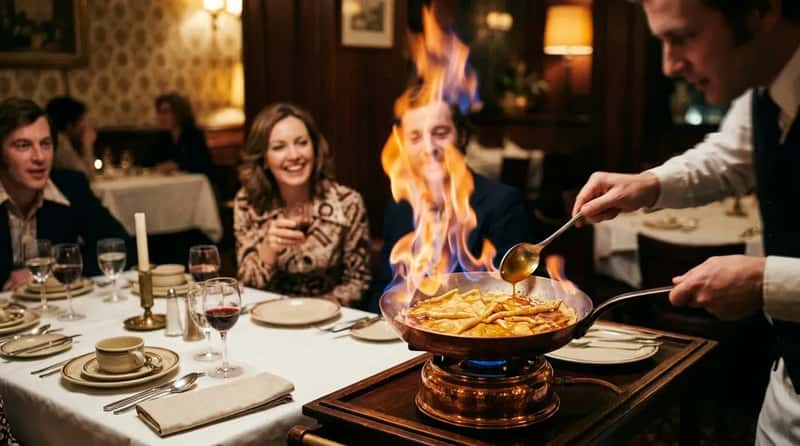
Not only is Crêpes Suzette full of genuinely delicious things – butter, fresh orange juice, Grand Marnier – but the dish isn’t complete without a tableside flambé. In the 1970s, setting your dessert on fire inches from your guests’ faces was considered the ultimate host flex. It combined drama, skill, open flame, and the very real possibility that something could go wrong, which only made it more thrilling.
Cooking is one of the greatest gifts you can give to those you love.
Julia Child
The tableside flambé fell from grace so completely that most people under 45 have never witnessed one in person. It requires the right pan, the right alcohol, the right confidence, and enough space that no one loses their eyebrows. In 2025, a host producing a pan of flaming crepes at a dinner party is either a trained chef or a liability. There is almost no middle ground.
#6 – Grasshopper Pie
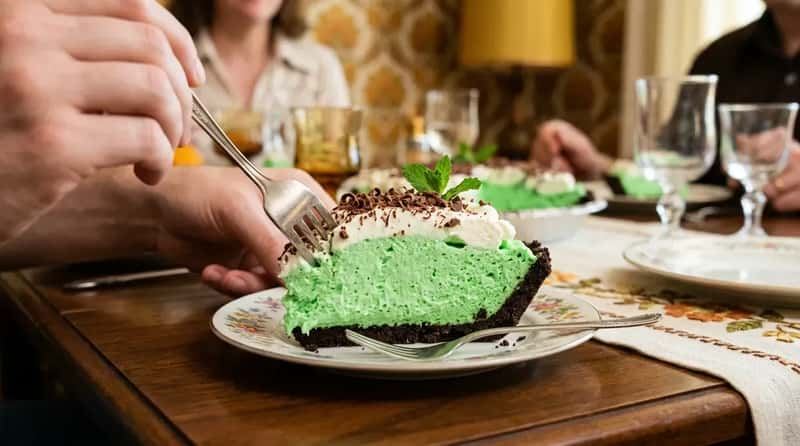
Neon green, crème de menthe-flavored, piled into a chocolate cookie-crumb crust – Grasshopper Pie was the dessert equivalent of the decade’s avocado green and harvest gold color palette. It was a no-bake pie named after the crème de menthe liqueur in the filling, which gave it a distinct minty flavor that paired genuinely well with the chocolate base. Light, fluffy, and eye-catching in the most 1970s way imaginable.
Grasshopper pie reached peak popularity in the late 1960s and held on through the ’70s before disappearing almost entirely from restaurant menus and dinner tables. The flavor is actually good. The visual is aggressively retro. The bright green color that made it festive in 1975 now makes modern guests pause to mentally run through what’s giving it that hue. The pause is never a good sign.
#5 – Baked Alaska
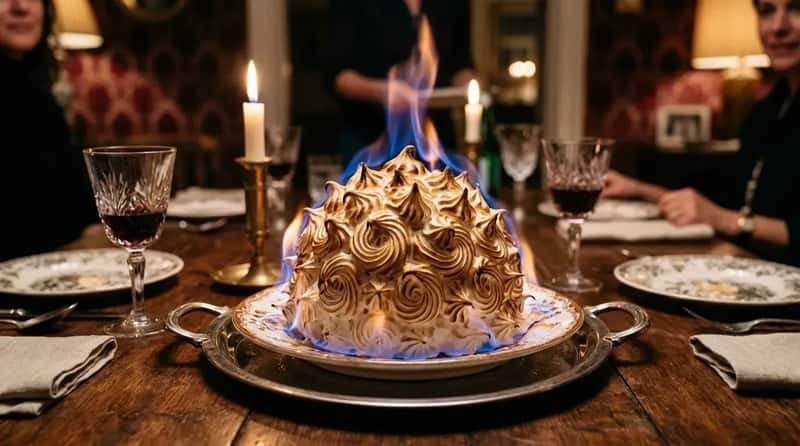
A base of cake covered by a dome of ice cream, draped in meringue, and then torched until the outside was golden while the ice cream inside stayed perfectly frozen – Baked Alaska was the 1970s dinner party finale. It originated in the 19th century but enjoyed a major revival in the decade, serving as the kind of dessert that required timing, technique, and genuine theatrical nerve to pull off for a table of guests.
The drama of bringing out a flaming meringue-coated dome left guests genuinely in awe. That’s not in question. What’s changed is the context – the commitment required is enormous, and the payoff now reads as theatrical in a way that only lands in a fine dining setting. In a home kitchen in 2025, it tips from impressive into exhausting. The legend of Baked Alaska is bigger than the dish itself has ever been.
Fast Facts
- Baked Alaska dates to the 19th century but hit a major American revival in the 1970s dinner party circuit
- The science: meringue is a poor heat conductor, insulating the ice cream inside even as the outside browns under the broiler or torch
- It was considered the ultimate host flex – right alongside tableside flambéed Crêpes Suzette
- Today it still appears in fine dining, but almost never in home kitchens – the risk-to-reward ratio has shifted entirely
#4 – Cheese and Pineapple Hedgehog
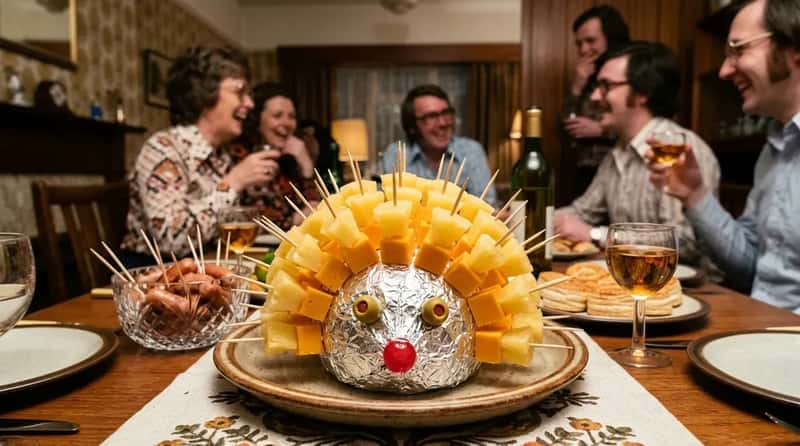
A foil-covered grapefruit or half-orange bristling with toothpicks, each skewering a cube of cheddar and a chunk of canned pineapple, with olive eyes and a glacé cherry nose – the cheese and pineapple hedgehog was a go-to appetizer for 1970s hosts who wanted something eye-catching without any actual cooking. It required no heat, no skill, and no recipe. It just required someone willing to stab cheese cubes into a citrus fruit for twenty minutes.
The cheese and pineapple hedgehog is the single most visually identifiable symbol of 1970s dinner party food. Before Pinterest, it was as creative as party presentation got in a lot of suburban kitchens. Today it would be served ironically or not at all – and anyone who brought one out without irony would immediately become the most interesting person at the party, for better or worse.
#3 – Cocktail Meatballs in Grape Jelly and Chili Sauce
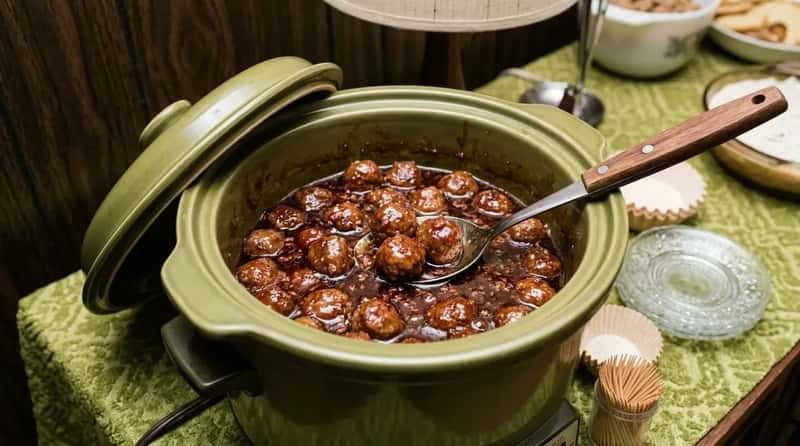
Sticky, sweet, and just a little bit mysterious – the most famous 1970s cocktail meatball called for a sauce made from equal parts grape jelly and Heinz chili sauce, simmered together until glossy and coating everything in a sweet-tangy glaze. The meatballs could be made ahead and kept warm in a slow cooker, making them the ultimate low-effort, high-consumption party food. And guests consumed them by the plateful.
The grape jelly and chili sauce combination is one of those recipes that sounds completely wrong on paper and somehow tastes right in practice. But serving cocktail meatballs at a dinner party today – particularly in grape jelly sauce – requires a level of ironic commitment that most hosts aren’t ready to sustain for an entire evening. The chafing dish full of grape jelly meatballs is the most quintessentially 1970s image in all of American food history, and everyone knows it.
#2 – Beef Bourguignon (Campbell’s Shortcut Version)
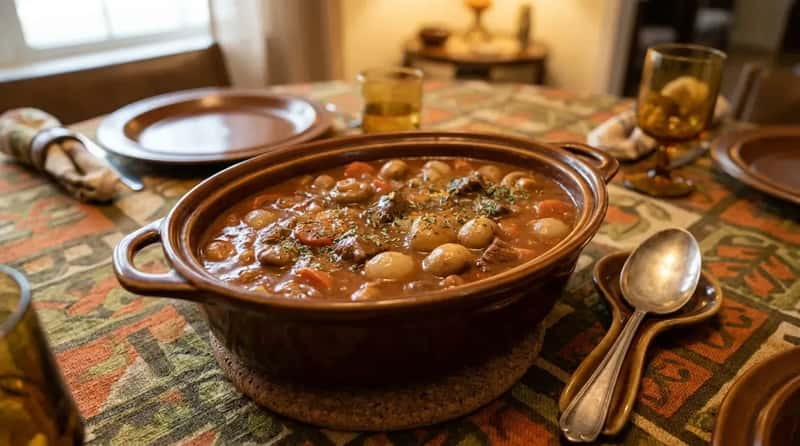
Real beef bourguignon – the proper Julia Child version, braised low and slow in actual Burgundy wine – is still a revered dish. But the 1970s dinner party version was a different creature entirely. The era’s shortcut substituted Campbell’s condensed soup for actual stock, used canned mushrooms in place of fresh, and then served the whole thing under a French name that made guests feel they were eating something elevated. The name did enormous heavy lifting.
The gap between what this dish claimed to be and what it actually was is what makes it such a perfect symbol of 1970s entertaining. The upwardly mobile set of that era embraced convenience food with a kind of Jetsons-style glamour – calling something “bourguignon” when it contained a can of condensed soup was performance art. Guests knew. Nobody said anything. That specific social contract has quietly expired, and there’s no renewing it.
#1 – The Full Savory Jell-O Salad Centerpiece
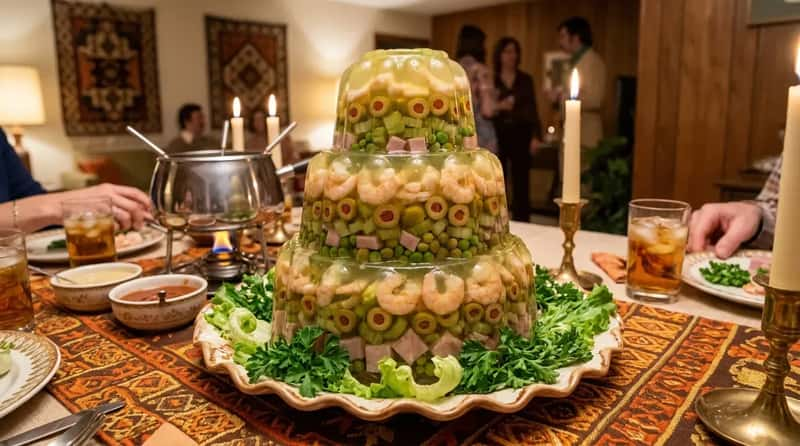
Nothing – not the hedgehog, not the grape jelly meatballs, not the flaming crêpes – captures the wild, swinging ambition of the 1970s dinner party table quite like the full savory Jell-O salad served as the centerpiece dish. It was a decade that gave us Julia Child’s Chicken Marbella and shrimp suspended in yellow Jell-O on the same cultural timeline. The savory Jell-O salad wasn’t a side dish or an afterthought. It was the statement piece. Shrimp locked in lemon gelatin. Ham cubes floating in tomato aspic. Vegetables sealed in lime Jell-O, unmolded tableside to actual applause.
Coffee tables lined with grape jelly meatballs, fondue pots bubbling in the center of the room, Jell-O salads considered an elegant touch – presentation was everything, and nobody blinked at skewers stuck into pineapples or cream cheese rolled in crushed nuts. The savory Jell-O centerpiece is the single dish that most completely summarizes a decade that confused novelty with sophistication, spectacle with skill, and wobble with elegance. It is the undisputed number one dish no modern dinner party table would survive. And yet – at the right 1970s table, surrounded by avocado-green curtains and the smell of fondue in the air – it must have looked absolutely magnificent.
It’s easy to laugh at the grape jelly meatballs and shrimp-in-Jell-O centerpieces. But there’s something genuinely worth respecting about that era of entertaining. Hosts tried hard. They cooked ahead. They used what they had and made it dramatic. The 1970s kitchen ran on conviction – the belief that if you committed to the dish, your guests would too. The food changed. The ambition behind it really hasn’t.