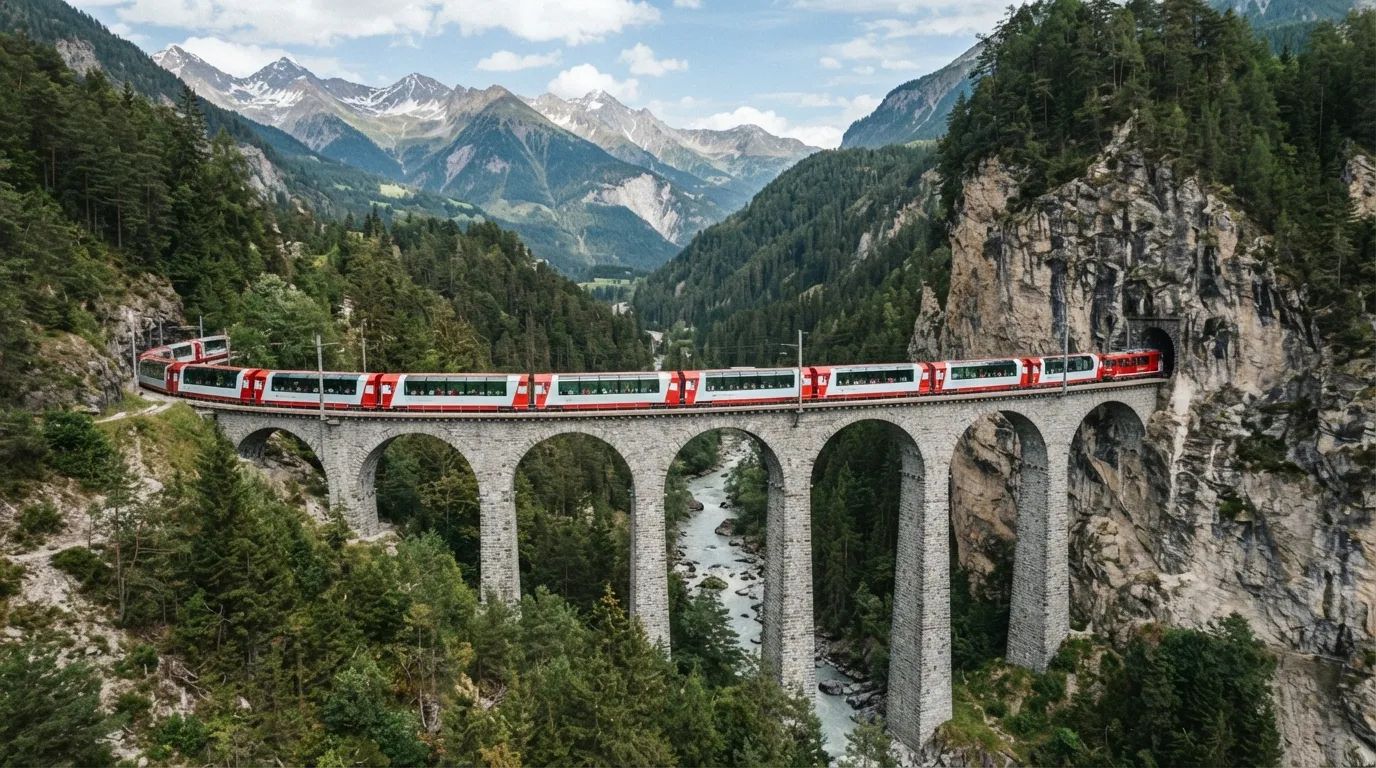
Switzerland is a country where the timetable is part of the attraction. Trains run on schedule, connect with boats and buses, and reach places that would take real effort to drive to. For visitors who’d rather watch the scenery than navigate mountain roads, the rail network handles most of the work.
Money matters too. The 2026 second class Swiss Travel Pass runs from CHF 254 for three days up to CHF 499 for fifteen days.[1] It covers trains, most private railways, PostBus and lake boats.[2] The five routes below show how far that kind of ticket can take you.
Glacier Express: Zermatt to St. Moritz
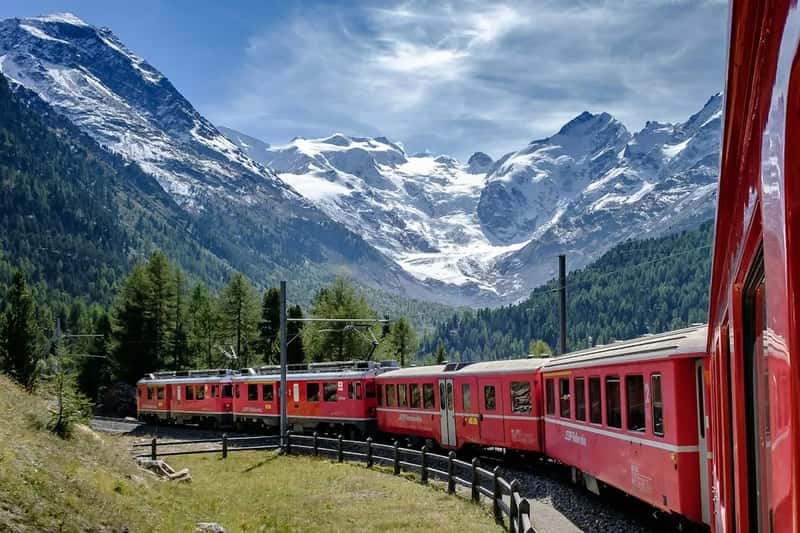
This is the classic. The journey covers 291 kilometres in roughly eight hours, crossing 291 bridges, passing through 91 tunnels and climbing to the Oberalp Pass at 2,033 metres.[3] You start near the Matterhorn and finish in the Engadin, or you can ride it in reverse. It’s slow on purpose, and that’s the appeal.
On the money side, the Swiss Travel Pass covers the base fare, but the seat reservation is still payable separately, and it’s mandatory on every seat.[3] One timing note for this autumn: the Glacier Express will not operate between 11 October and 4 December 2026.[4] A winter timetable then runs from 5 December 2026 to 7 May 2027.[5] If you’re reading this in mid October, plan for December or next summer.
Bernina Express: Chur to Tirano
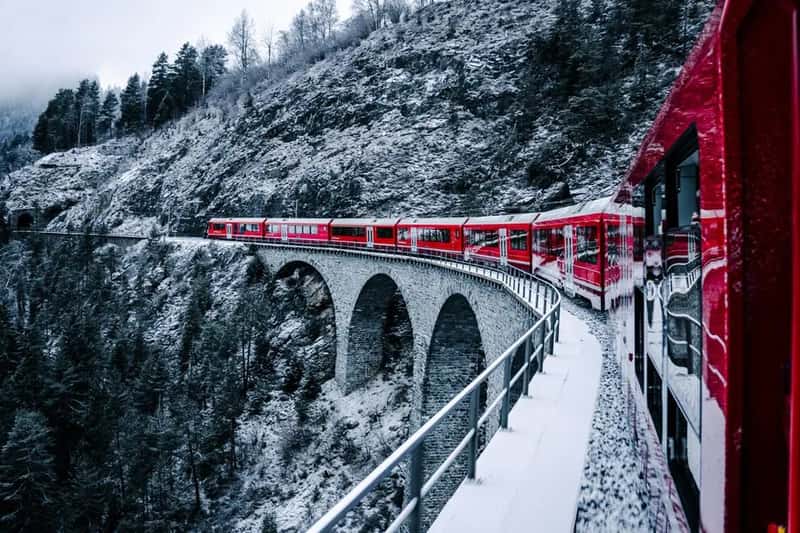
The Bernina Express crosses the Alps and ends in Italy. The trip takes about four hours on the UNESCO listed Rhaetian Railway, climbing to 2,253 metres without a rack railway.[6] Along the way you cross 196 bridges and pass through 55 tunnels, and you roll over the famous Landwasser Viaduct.[7] The Albula and Bernina lines have held UNESCO World Heritage status since July 2008.[7]
The Brusio Circular Viaduct is the showpiece in the south. It’s a 360 degree spiral that loops the train downward through the Valposchiavo.[6] A Swiss Travel Pass covers the full fare, and you pay only the mandatory seat reservation, listed at CHF 32 to 44.[6] Also worth knowing, trains 951 and 952 will be diverted via Vereina from 29 October to 13 November 2026 because of engineering works.[7]
GoldenPass Express: Montreux to Interlaken
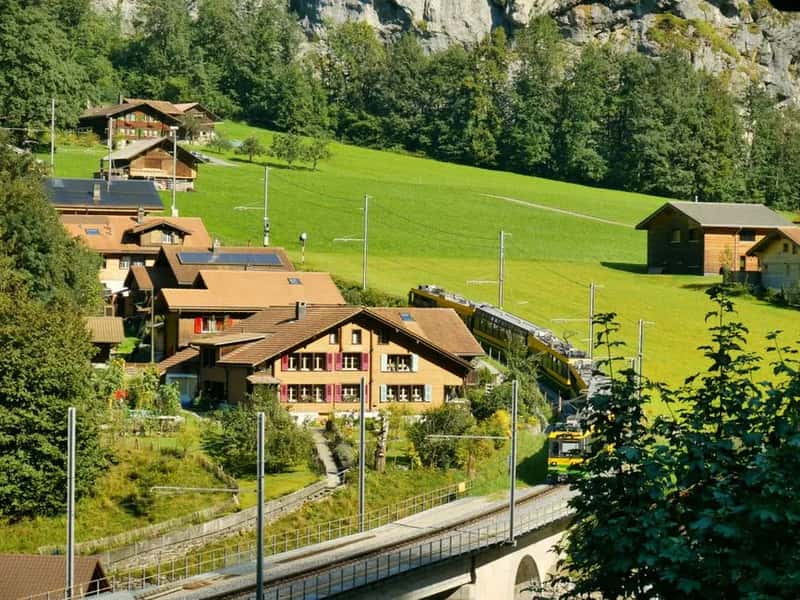
This route links Lake Geneva with the Bernese Oberland. The panoramic train runs from Interlaken via Gstaad, Château d’Oex and Montbovon to Montreux.[8] It began service on 11 December 2022, and the average journey time is about three hours and fifteen minutes.[9] It’s a relatively new idea built on an old one, since the plan to connect the two towns without a change of trains goes back more than a century.[10]
Cost is modest compared with the other headline trains. The standard fare between Montreux and Interlaken Ost is CHF 56 in second class and CHF 96 in first, and it’s free with a Swiss Travel Pass.[11] The panoramic train runs up to four times a day.[10] Seat reservations are a separate matter, so check them when you book.
Lucerne Interlaken Express: Over the Brünig Pass
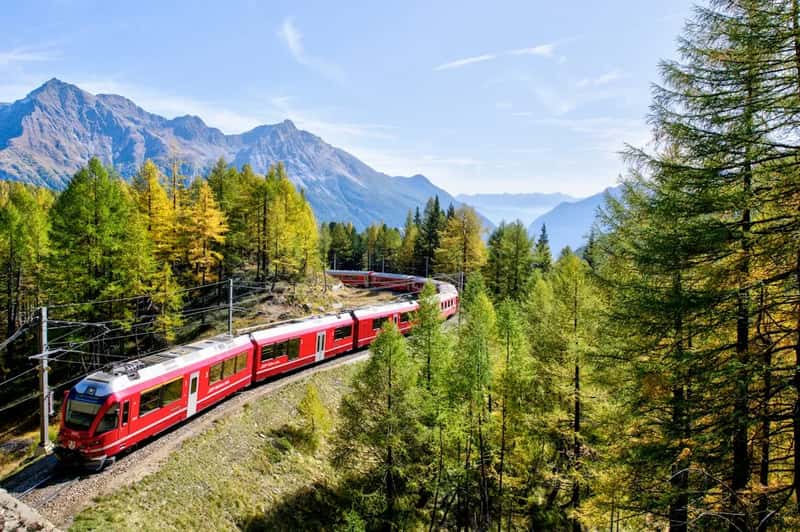
This one is easy to overlook, and it shouldn’t be. The Lucerne Interlaken Express crosses the Brünig Pass and links Interlaken with Lucerne in the heart of Central Switzerland.[12] The trip takes about two hours.[11] Trains leave Interlaken Ost hourly at four minutes past the hour, from early morning until evening.[11]
It pairs well with the GoldenPass, since it connects straight to that line in Interlaken.[13] Standard one way fares are CHF 34 in second class and CHF 58 in first.[11] First class has a panorama car.[14] Lucerne itself offers lakeside walks and a short ride to Mount Pilatus, so the end of the line is worth the time.
Gotthard Panorama Express: Lake Lucerne to the South
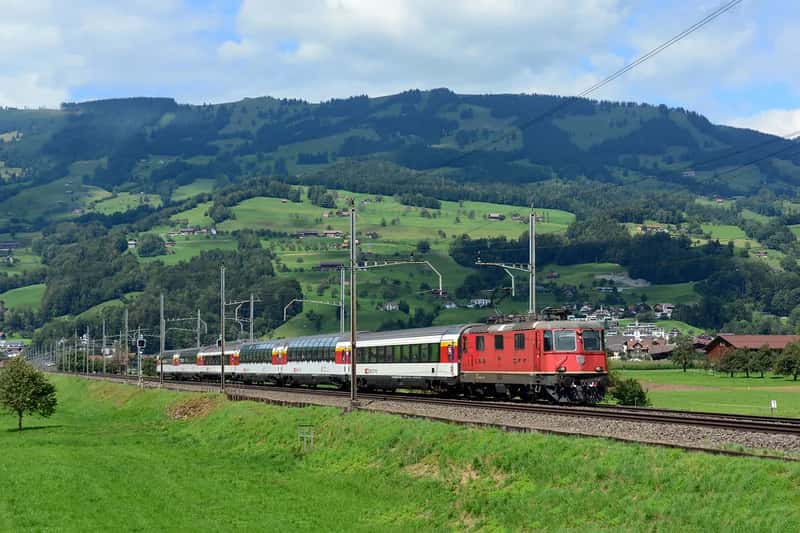
The Gotthard Panorama Express mixes a boat with a train. You sail across Lake Lucerne from Lucerne to Flüelen, then board a panoramic train on the historic Gotthard line toward Ticino. Lake boats are part of what a Swiss Travel Pass covers.[2] The service is seasonal and runs in the warmer months, so confirm current dates before building a trip around it.
The old mountain line is the reason to pick this over a fast connection. It climbs through spiral tunnels, and the little church at Wassen appears several times from different angles as the track gains height. Meanwhile, the Gotthard Base Tunnel, which opened in 2016 and is about 57 kilometres long, carries most express traffic underneath. Riding the old route means seeing the mountains the long way, then arriving in the palm lined south.