
Traveling throughout the Middle East and North Africa is often described as a journey through the origins of civilizations. Long before modern borders were drawn and political tensions defined the region in global headlines, these lands were home to some of the world’s earliest cities, empires, and cultural exchanges. Many of these archaeological sites throughout the Arabian Peninsula, the Levant, Anatolia, and North Africa are protected by UNESCO as World Heritage Sites, with ongoing conservation and renovation efforts. Yet beyond their grandeur and recognition as essential to humanity’s shared heritage, these sites offer more personal reflections and lessons to their visitors, should they choose to seek them out.
Exploring these 6 sites awakened me to the reality that there are marvelous places on the Earth that are often overshadowed by negative news headlines and media cycles, hiding their importance and impact from travel communities and academics alike. Seeing these sites in person transformed my understanding of ancient places and timelines into memories, turning names in a book into real moments that changed me and will hopefully change you, too.
1. Gobekli Tepe – The First Temple in the World
“This temple shouldn’t technically exist according to the story of human history we have now,” our guide exclaimed as we looked over the railing down at the temples built when whooly mammoths still roamed the Earth. Looking at the tall stone pillars and intricately carved animals, I couldn’t believe these were built around 9600 BC, when humans were expected to do nothing more than be hunter-gatherers, painting shapes in caves. Feeling the arid breeze of the Southeastern Turkish plains on my face, I closed my eyes to imagine what this exact spot was like at the time, with people of different nomadic groups coming together to build such a feat, which is believed to have also been the reason they began growing crops and kick-started the Neolithic revolution. The mystery of this temple will be unravelled with time, as humanity’s story is rewritten with every new excavation.

2. Petra – The Desert City
After a long walk through the narrow Siq in the desert of Southern Jordan, the towering façade of the Treasury comes into view. The sandstone canyon suddenly opens, revealing that the monumental architectural wonder was carved directly into the cliff face, its columns and doors rising high above the canyon floor. As you draw closer with each step along the dusty path, the architecture appears to be a blend of civilizations, with Greek, Roman, and Egyptian elements meshed into one.
Yet beyond the photo-worthy parts of the city lie far more intriguing details that reveal how the Nabateans constructed a thriving city in the desert. Venturing deeper into the ruins, small channels carved into the rock began to appear along the pathways. Water reservoirs and dams were scattered throughout the ruins. Instead of fighting against that stone, these ancient peoples decided to work with it, creating a system designed to perfection. Long before modern infrastructure, they built a city that connected Arabia, Africa, and the Mediterranean, where spices, frankincense, and coffee traveled on their way to spread across the world.

3. Jerash: One of the Best-Preserved Roman Cities in the World
Walking through the ruins of Jerash in northern Jordan, what immediately stood out to me was the scale of the city’s colonnaded streets and public spaces. Unlike many ancient sites that have survived only in fragments, Jerash is so well preserved that it feels like a true urban space, with streets, alleyways, homes, public buildings, baths, and theatres. Seeing Jerash in person shifted my perspective that Roman ruins are primarily centered in Europe. Growing up in Italy, I had the mindset that the closer an ancient city was to Rome, the more spectacular it must be. While, in reality, the empire stretched far greater lengths, leaving behind a trail of networks and cities that extend much further than we think of in classical antiquities.

4. Jericho – The Oldest Fortified City and Lowest City on Earth
Sitting on the shores of the Dead Sea in Palestine, this city holds a special place in human history as the world’s oldest continuously inhabited and fortified city. Driving through the town from the Dead Sea, there was an immediate sense of how ancient this place was, spotting the Neolithic walls that once fortified the city, also mentioned in Biblical stories and many tales. Seeing the homes right near the ancient walls and the people living here today made me realize how long people have been living here and their ties to the place. Archaeological excavations have revealed that settlements here date back over 10,000 years, making it one of the world’s oldest continuously inhabited centers. Over the millennia, this city has been at the heart of countless civilizations and has had a front-row seat at big historical events.
5. Baalbek – Second Largest Roman Temple on the Border of Syria
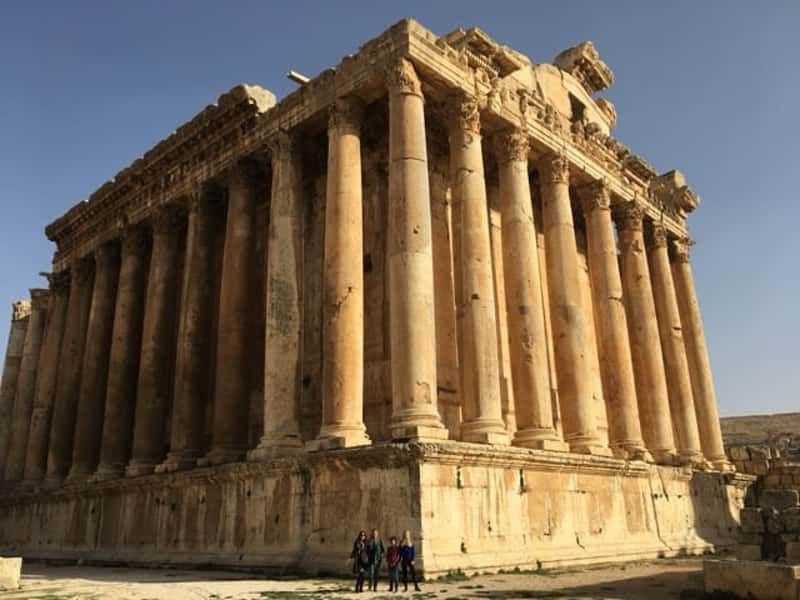
Standing in the shadow of the second-largest Roman temple in the world, with the Syrian border hills in the distance, I gasped at the view before me. Sitting in the Beqaa Valley in Lebanon, the ancient city of Baalbek is a masterpiece of Roman architecture that is hidden from the main tourist path. All around me, the city extended in every direction, its monumental ruins sitting scattered exactly as they were when they fell, hundreds of years ago. The Temple of Jupiter, where I now stood, was one of the largest ever built, with the stones that made up its base weighing about 800 tons each. Towering over 100ft into the air, its size was almost too mind-boggling to imagine. However, the Temple of Bacchus (pictured below) helps with the imagination, remaining almost completely intact. Itself also soaring over 100ft into the sky, it dwarves anyone who stands nearby.
6. Abu Simbel – The Jigsaw Puzzle Site
No matter how many astonishing sites there are to see in Egypt, Abu Simbel stands out as one of the most visually striking and unique. Sitting at the bottom of the country on the Nile, almost at the border with Sudan, this temple, carved directly into the rock, is tucked away in the desert, far from Egypt’s main cities and ancient capitals. Even in their time, this was a final frontier, a monument at the edge of their world and a powerful reminder to the Kushites to the south of Ramses II’s power.
Standing below the giant sitting statues of the Pharaoh himself, the temple feels as though it has been there forever – and yet its location is relatively new. Looking down at the Nile in front of it, I was amazed to realize it was originally built in what is now underwater, with the lake behind the new dam hiding it from view. And yet, UNESCO managed to disassemble the temple and relocate it, reassembling it perfectly and even aligning it with the solstices once again.

Conclusion
While many ancient European cities continue to attract visitors from around the globe, sites in the Middle East remain overshadowed by modern conflicts and geopolitical disputes. Yet each of these destinations reveals a powerful lesson about humanity’s history and where we came from. From ancient amphitheaters to evidence of human ingenuity and creativity, the Middle East is full of incredible sites to visit that will entirely rewrite what it means to experience the ancient world.