Most of the world offers new parents a handful of weeks off after a birth, and in the United States there isn’t even a guaranteed paid national program at all. Yet a small cluster of countries, mostly in Northern and Eastern Europe, have built systems where paid leave stretches well past a year when maternity, paternity, and parental benefits are added together. Some of these programs pay full salary for the early months and then taper to a lower flat rate, but the leave itself remains paid throughout, which is what sets these eight countries apart.
The list below looks at nations where the combined length of paid maternity, paternity, and parental leave adds up to more than 60 weeks. It’s worth noting that payment rates often shift partway through these long entitlements, so a country offering over a year of paid leave doesn’t always mean a year at full pay. Still, the sheer duration on offer in these places is remarkable compared to global norms.
1. Estonia

Estonia is widely considered the global leader[1] when it comes to supporting new parents financially. The country provides up to 82 weeks of combined maternity and parental leave, with 100% salary coverage for the first 20 weeks[2]. After that initial fully paid stretch, mothers can take 20 weeks of fully paid maternity leave followed by 62 weeks of optional “bonus” parental leave[3], which can be shared between parents or used by one of them until the child turns three.
What makes the Estonian model particularly generous is how the benefit is calculated. Payment is based on the parent’s actual average earnings rather than a flat government rate, which means higher earners keep a much larger share of their income than they would in many other long-leave countries. Some tallies put the total window of paid leave even higher, closer to 86 weeks, once smaller supplementary benefits are factored in. It’s a system built around the idea that a generous safety net during a child’s earliest years pays off in the long run for both families and the country’s shrinking population.
2. Hungary
Hungary combines a short, well-paid maternity leave with a very long, partially paid parental leave that together push total paid time off far beyond a year. New mothers get 24 weeks at 100%, plus two years of partially paid leave[4], and some estimates put the maximum stretch of leave, including lower-paid extensions, at up to 156 weeks (3 years)[4].
Hungary isn’t alone in offering this kind of marathon entitlement. Research from the OECD notes that four OECD countries (Czechia, Finland, Hungary, and the Slovak Republic) provide a statutory entitlement for two-and-a-half-years’ paid leave or more[5]. That places Hungary firmly among the handful of nations where a parent could realistically stay home, with some form of income support, for the majority of their child’s toddler years.
3. Czech Republic

The Czech system starts with a solid maternity benefit before rolling into one of the longest parental leave windows in Europe. Pregnant employees who have worked for 21 consecutive days are entitled to 28 weeks of paid leave in the Czech Republic[6], paid at a meaningful share of prior earnings rather than a token amount.
After that initial maternity period, Czech parents can draw on a parental allowance that stretches for years rather than months. The OECD groups Czechia among the small group of countries where a statutory entitlement for two-and-a-half-years’ paid leave or more[5] exists, and leave researchers classify it among the handful of “long leave” nations where continuous, job-protected time off can run for three years. The total paid amount is fixed by the state, but families get to choose whether to spread it out over a shorter or longer period, giving real flexibility to households with different needs.
4. Slovakia

Slovakia’s maternity leave alone already outpaces many countries’ entire parental leave programs. Pregnant employees who have worked for 60 consecutive days with the same employer are entitled to 34 weeks of paid leave as standard, and for a mono-maternal family, the maximum is 37 weeks, and for multiple births, the maximum is 43 weeks[6]. Payment during this period comes to a meaningful share of prior wages rather than a bare minimum stipend.
Once maternity leave ends, a flat-rate parental allowance kicks in and continues for years, not weeks. Slovakia sits alongside Czechia, Finland, and Hungary as one of the countries the OECD flags for offering a statutory entitlement for two-and-a-half-years’ paid leave or more[5]. Combined with the initial maternity period, that easily pushes the total well past 60 weeks of paid support, even though the later payments shrink to a modest fixed sum.
5. Finland
Finland’s approach leans into duration over generosity per week, and the numbers back that up clearly. According to OECD figures, payments across the 154.3-week paid parental and home care leave entitlement replace only 22.1% of average gross earnings[5]. That’s a strikingly long stretch of paid time, even if the wage replacement rate drops considerably compared to the country’s short-term benefits.
Finland’s home care leave option is a big part of why its total length stands out so much. With homecare leave lasting until the child’s third birthday, Finland provides the longest entitlements, while the average entitlement to parental and homecare leave in the OECD is 39 weeks[7]. In other words, Finnish families can access nearly four times the OECD average when every layer of paid leave is added together.
6. Lithuania
Lithuania blends a solid, fully paid maternity period with extended options that families can tailor to their own timeline. Lithuania offers 18 weeks at 100% pay, plus extended partial-pay options[4], and separate country comparisons show new parents in Lithuania get a generous 433 days leave, with 98 going to new mothers and 23 going to new fathers[8], leaving the rest shareable between them.
For families who want to stretch things out even further, Lithuania allows leave to run much longer at a reduced payment rate. Some comparisons list the maximum duration as up to 156 weeks, depending on the option chosen[4], which places Lithuania among the countries where a family could technically remain on some form of paid leave for nearly three years, provided they’re willing to accept a smaller monthly payment for the extended portion.
7. Sweden
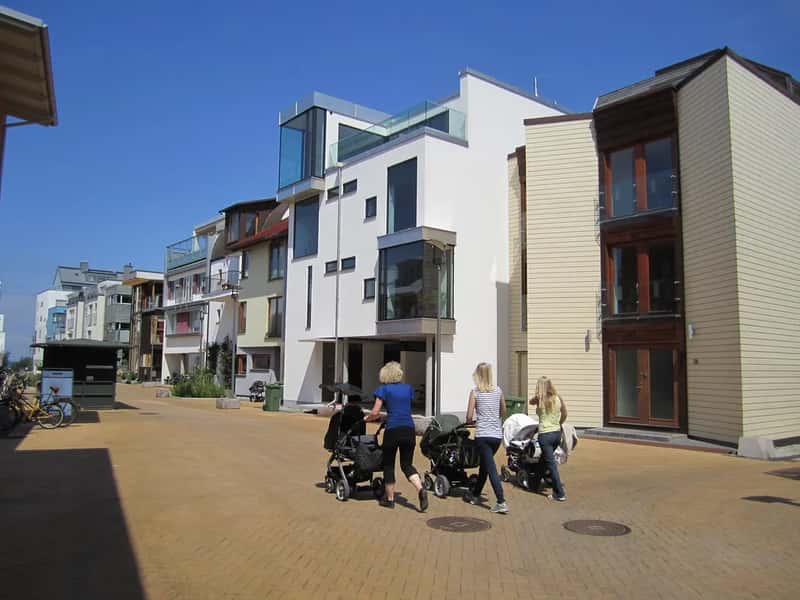
Sweden’s system is famous for its flexibility as much as its length. Swedish parents receive 480 days of paid parental leave per child, with each parent having 90 days reserved exclusively for them, and for 390 of these days, parents receive nearly 80% of their salary[9]. The remaining days are paid at a lower flat rate, but the leave stays paid from start to finish.
Converted into weeks, that 480-day allotment comes out to roughly 69 weeks of paid leave per child, comfortably clearing the 60-week mark. Researchers who study leave policy describe the Swedish model as sitting between short and long-leave systems, noting that paid leave is expressed in days to emphasise that it can be taken very flexibly, roughly equivalent to 18 months if taken continuously[10]. Parents can also stretch the calendar time further by working part-time while drawing partial benefits, something that isn’t possible in most other countries on this list.
8. Canada
Canada rounds out the list with a system built around choice between a shorter, better-paid option and a longer, lower-paid one. Families can pick 50 weeks at 55% or extended 76 weeks at 33%[4], combining maternity and parental employment insurance benefits into a single continuous claim.
The extended option is what pushes Canada firmly past the 60-week threshold. Some breakdowns of the program describe the maximum combined length as up to 78 weeks[4] once maternity and extended parental benefits are stacked together. Many Canadian employers also top up the government benefit for at least part of the leave, which softens the drop in income that comes with choosing the longer, lower-rate option.
Taken together, these eight countries show a clear pattern: the places offering the longest paid leave tend to be concentrated in Northern and Eastern Europe, with Canada standing out as something of an exception. Nearly all of them make a trade-off somewhere along the way, paying full or near-full salary for the first few months before shifting to a reduced or flat rate for the remainder. That structure lets governments fund very long entitlements without the cost becoming unsustainable, while still giving parents the security of guaranteed income and a job to return to.
What’s striking is how differently these countries define generosity. Estonia and Sweden lean toward flexibility and higher wage replacement, while Hungary, Czechia, Slovakia, and Lithuania favor sheer duration, even if it means smaller monthly payments toward the end. Finland sits somewhere in the middle, prioritizing length above almost everything else. However a family chooses to use it, the reality is that in these eight countries, parents have far more breathing room in a child’s early years than the vast majority of the world ever sees.