There’s a strange kind of fear that shows up before your brain has actually caught up to it. You’re seated, seatbelt fastened, maybe scrolling through a playlist, and your body has already started reacting to the flight like something is wrong. This isn’t dramatic movie-style panic. It’s quieter, sneakier, and often mistaken for something else entirely, like caffeine jitters or just being tired.
A year after a deadly collision in the sky above Washington, D.C., that killed 67 people, a new TPG/YouGov survey finds that even though a majority of U.S. air travelers think airline travel is generally safe, a whopping 74% admit to being not very, somewhat or very nervous when flying.[1] That’s a lot of people whose bodies are quietly reacting before they’ve even consciously labeled the feeling as fear. Here are nine of the most common physical signals that tend to show up first.
1. Your heart starts racing before your mind catches on

One of the earliest and most universal signs of fear is a heart that suddenly feels like it’s working overtime. Physiological symptoms of anxiety often include increased heart rate and palpitations.[2] This happens on a purely chemical level, long before a person consciously thinks “I’m scared of this flight.”
Racing heart or palpitations occur because adrenaline directly accelerates heart rate to pump blood to muscles faster.[3] On a plane, there’s nowhere for that extra blood flow to go, so the sensation just sits there, pounding away while you’re stuck in a middle seat with nowhere to run.
2. Sweaty palms show up out of nowhere

You might notice your hands feel clammy on the armrest even though the cabin isn’t particularly warm. Stress and anxiety can make you sweat more than usual, especially your palms, face, armpits and the soles of your feet.[4] It’s an oddly specific pattern, and it’s not random.
This is partly thanks to hormones like epinephrine and norepinephrine, which get a boost any time your body senses danger.[4] The body is essentially preparing for a threat that isn’t actually there, which is why the sweating can feel disproportionate to how “calm” you think you are on the outside.
3. Breathing gets shallow and fast

Fear has a way of hijacking something as automatic as breathing. Shortness of breath and rapid breathing are among the most common physiological symptoms tied to fear and anxiety.[2] On a flight, this often gets blamed on cabin pressure or dry air, when the real driver is the nervous system quietly ramping up.
This shift in breathing pattern is part of a larger, coordinated body response. Anxiety activates the sympathetic nervous system, the body’s fight-or-flight response, which is a full-body physiological state designed to prepare a person for physical survival.[3] Faster breathing is simply the body trying to get more oxygen to muscles that, in this case, have nowhere useful to go.
4. Muscles tighten without you noticing

Ever catch yourself gripping the armrest a little too hard, or realize your shoulders have crept up near your ears? Muscle tension is a very physical, very early tell. Physical anxiety symptoms commonly include muscle tension along with racing heart, chest tightness, and shortness of breath.[3]
This tightening is the body bracing itself, almost like preparing for impact even though nothing is actually happening. It’s one of those signals that people tend to notice in hindsight, after they unclench, rather than while it’s occurring. By the time your neck or jaw starts aching mid-flight, the tension has often been building for a while.
5. Your mouth goes dry

A dry mouth during a flight is easy to write off as dehydration from cabin air, but it’s also a textbook fear response. A dry mouth is listed among the physiological symptoms tied to fear and anxiety, alongside sweating, trembling, and tense muscles.[2]
This happens because the body redirects resources away from things it considers nonessential in a perceived emergency, and saliva production is one of them. It’s a small, almost forgettable symptom on its own, but paired with a few of the others on this list, it starts painting a clearer picture of what’s actually going on beneath the surface.
6. Your stomach turns before you feel “nervous”

Nausea and stomach upset are common but frequently misread, especially on a flight where turbulence or motion sickness are the easy default explanations. Nausea and upset stomach appear on the standard list of physiological fear symptoms.[2]
The gut is unusually sensitive to stress hormones, which is why so many people feel fear in their stomach before they feel it anywhere else. This can happen even on a perfectly smooth flight, which is often the clue that something psychological, not physical, is driving the discomfort.
7. Fingers and hands start tingling

A tingling or numb sensation in the hands or arms can be alarming, partly because people don’t usually associate it with fear. Tingling or numbness in the arms and legs is listed among common physiological fear responses.[2]
This tends to be tied to changes in breathing, since faster or shallower breaths can shift the balance of gases in the blood. It’s uncomfortable, sometimes even a little frightening in its own right, which can create a small feedback loop where the physical sensation makes the underlying fear feel more urgent.
8. Dizziness creeps in for no clear reason
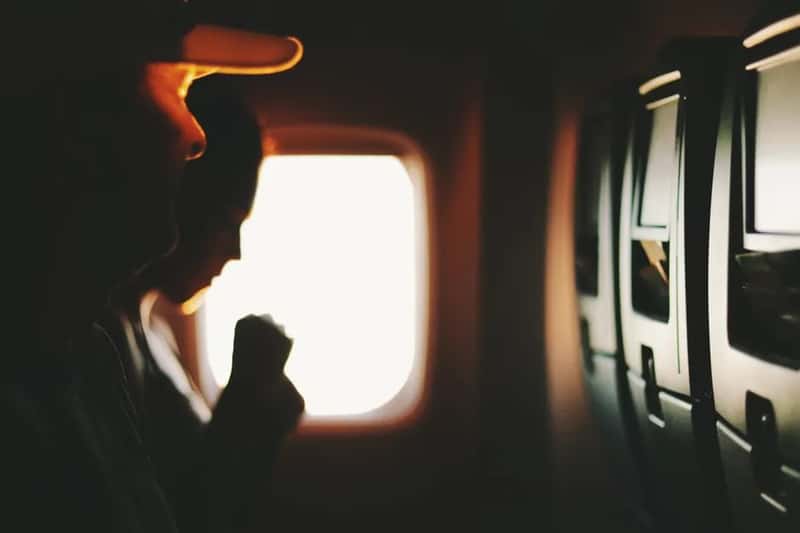
Feeling lightheaded or unsteady mid-flight is another symptom that gets blamed on everything except the actual cause. Dizziness and lightheadedness are recognized physiological symptoms of fear and anxiety.[2]
There’s a biological reason this happens during moments of fear. When the body is in a state of fear and panic, less blood goes to the brain, and as a result, thoughts become less rational and distorted by fear.[5] That combination, a foggy head and a slightly spinning sense of balance, can make an already tense flight feel more disorienting than it needs to be.
9. You freeze or go unusually still

Not every fear response is loud or visible. Sometimes the body’s answer to a perceived threat is to simply stop moving. When people perceive a situation as threatening, the body motivates them to react in one of three ways, running away, fending off an attack, or staying motionless to avoid detection.[5]
On a plane, running and fighting aren’t options, so freezing becomes the default. This can look like sitting rigidly still, avoiding eye contact with the window, or going quiet mid-conversation without meaning to. It’s easy to mistake for calm when it’s actually the opposite, a nervous system that has simply run out of other options.
These reactions are not signs of weakness or overreaction. They are the body doing exactly what it was built to do when it senses danger, even when the danger is only imagined. Recognizing them for what they are, physiological rather than purely emotional, is often the first useful step toward not letting them run the whole flight.