
Thinking of putting some roots down in one of South America’s most stable and diverse countries, Chile? Or have you just moved down? If you’re an English-speaking expat in Chile, you’re in good company. And let me tell you: You’ve made an amazing decision to live in this vibrant country. Once you learn the ropes, you’ll feel right at home.
Use this guide (and bookmark it for later) to understand everything you need to know about living in Chile as an English-speaking expat. I wish I had a guide like this when I first arrived, and now’s my chance to share everything I’ve learned with you!
Overview: Being an English-Speaking Expat in Chile
After relocating to Santiago, Chile, I was pleasantly surprised at how easy it was to meet other English speakers and get around with my (then) limited Spanish. Lucky for us, thousands of other English speakers live in Chile, and the country is a popular destination for expatriates. With a little courage and a lot of Google Translate, you can navigate Chile and enjoy the experience of living here to the fullest.

Living in Chile: The Basics
The RUT
Here in Chile, I found out quickly that you need a “RUT” (pronounced “root”) for lots of things. I survived for several months without one, on nothing but a tourist visa. But if you plan to be here permanently, you need one. I’ve had expat friends receive a “temporary RUT” while waiting for a visa, but I hear that they’re not 100% helpful; you may still have trouble renting apartments or opening a bank account.
Work
As I’ve come to find, the vast majority of Chilean companies will require that you speak Spanish. It is possible to work independently as an English speaker (e.g., as a digital nomad or remotely for a foreign company). I’ve been working remotely, entirely in English, for my English-speaking clients overseas.
Healthcare
Even if you don’t have insurance, healthcare in Chile is affordable. I had one health incident that led me to visit multiple specialists, and I received a slew of medical tests, which would’ve cost me tens of thousands in the U.S., but in Santiago? The total was under $1,000 (without using any insurance).
I only had trouble with healthcare in my first few months in Santiago because it can be tricky to find a specific type of provider who also speaks English. That said, every professional I visited was patient with my language restriction.
Best Neighborhoods for English-Speaking Expats
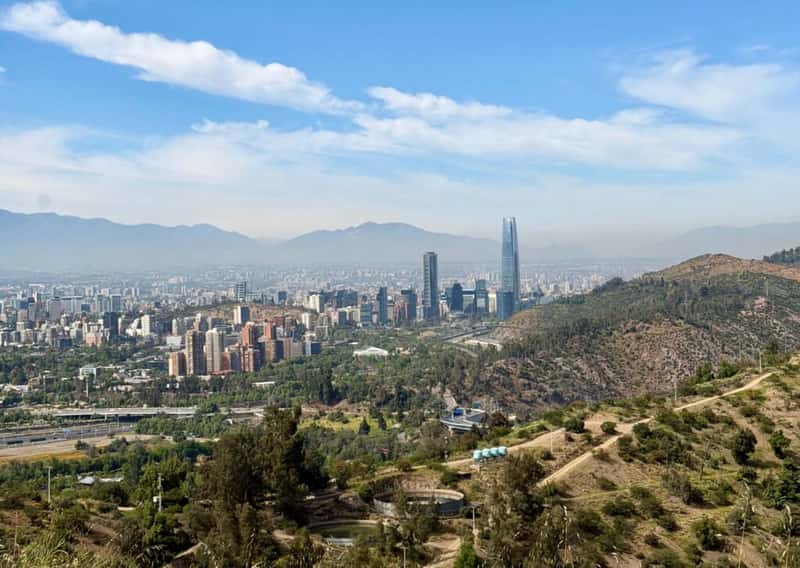
The largest English-speaking expat communities are located in the Santiago Metropolitan Region, which is part of the reason why I chose to live in Santiago.
Within Santiago, there are dozens of “comunas” (mini cities). In terms of safety, cleanliness, and proximity to fellow English speakers, these are the top-ranking comunas in the Metropolitan Region:
- Vitacura
- Las Condes
- Providencia
- Ñuñoa
Below you have additional top choices for English-speaking expats in other regions of Chile. From this list, I’ve visited and adored Viña del Mar and Pucón.
- Viña del Mar
- La Serena
- Pucón
- Puerto Varas
- Concepción
In less populated cities, it’ll be a bit tougher to find fellow English-speaking expats, but it’s always possible!
Phone Plans & Internet
I was surprised to learn that Chile has some of the best broadband speeds in the world, and the fastest in Latin America, which I’ve appreciated as a remote worker.
Don’t make this huge mistake that I made upon arrival: If you’re using a Chilean SIM card, you must register your phone’s IMEI with the Chilean government. It must be done within 30 days of your arrival in the country; after 30 days, your phone will be blocked from the phone networks.
Shopping: Supermarkets, Malls, & Ferias
The following are the biggest & best supermarkets to go to for groceries (the top three are my favorites). Most have up-to-date self-checkout, and when I first arrived in Santiago, I would switch the checkout machine’s language to English.
- Jumbo
- Lider (owned by Walmart)
- Unimarc
- Tottus
- Santa Isabel
There are multiple, gigantic, ultra-modern malls in several comunas in Santiago. Stepping inside many of these makes me feel as if I’ve been transported back to my previous home near Miami, FL.
- Costanera Center (located in Providencia)
- Mall Parque Arauco (located in Las Condes)
- Casacostanera (located in Vitacura)
- Mallplaza Los Dominicos (located in Las Condes)
- Cenco Portal La Dehesa (located in Lo Barnechea)
- Mall Sport (located in Las Condes)
- Alto Las Condes (located in Las Condes)
Lastly, you have ferias! These are mini farmers’ markets on local streets on certain days (e.g., Monday and Thursday each week). You might naturally stumble upon them (that’s how I find them) while you’re walking around your neighborhood. Otherwise, try asking the receptionist at your apartment building. I’ve found that ferias are cheaper than shopping at large supermarkets and often offer a much wider variety of fruits and vegetables.
How & Where to Learn Spanish
Learning Spanish will help you get around more easily and even open doors to new connections. I’ve (mostly) enjoyed the lengthy process of gradually improving my Spanish and connecting better with Chileans who speak limited English. I’ve found learning Chilean Spanish to be a valuable way to immerse myself in the culture.
Chilean Spanish differs greatly from Spanish in other countries. It took me some time to realize this, since I didn’t speak much Spanish anyway when I first arrived. But the Chilean dialect is a proud part of what makes Chile, Chile. Consider using an online platform like Preply (I found my Spanish teacher there) to get started with your Spanish learning.
Bonus Tips for Fresh-off-the-Plane Expats
Facebook Groups for Expats
Search for and join Facebook groups for expats or English-speakers in Chile. This tip was a lifesaver for me in the beginning. These groups offer a wealth of knowledge about your new country, and thousands of helpful (if not un poquito opinionated) people who’ve probably already dealt with whatever your question or issue is.
Get Social!
Why not put yourself out there and meet other expats? From my experience, it’s been helpful in terms of quieting some of the overwhelm that comes from moving to a new country. I’ve been to language exchanges (Santiago Speaks & Spanglish). I tried Timeleft (a social app where you can meet other English speakers). I set my dating apps and Bumble BFF to filter by English speakers. With a little effort and outreach, you can build a network of English speakers.
Earthquakes
Yes, they happen. In my first year living in Santiago, I felt two earthquakes myself, and was shocked to learn how frequent they are. They’re so normal that Chileans hardly bat an eye when they occur.
Overall, living in Santiago as an English-speaking expat might feel overwhelming at first, but once you learn your way around, you’ll begin to enjoy your time in this beautiful and diverse country. If you’re an expat in Chile, tell me, how has your experience been so far?