
Way back in 1946, the then British Prime Minister, Winston Churchill, gave a speech entitled The Sinews of Peace. Now, that speech has become timeless, although its more commonly know as the “Iron Curtain speech”. In it, he warned that a metaphorical iron curtain had descended across Europe. It ran, he said, from Trieste to Stettin (now Gdansk, Poland).

It was this which piqued my interest in Trieste. That, and its rather unusual geography. A quick glance at a map, and you could quite easily miss the fact that Trieste is in Italy. Too all intents, it doesn’t really belong there.
Why Trieste is Different
Trieste is something of a prisoner of said unusual geography. On a tiny slither of land wedged between Slovenia and the Adriatic Sea, Trieste where Italian and Balkan cultures collide.

For centuries, Trieste found itself under the control of the Roman and Venetian Empires. More recently, however, Trieste spent more than 500 years as part of the Austro-Hungarian Empire, giving it closer cultural ties with its neighbours to the north and east.
Another feature of Trieste’s past is its prominence as an international port. It was long a stopping off point for travellers leaving Europe for Asia. This made Trieste a favourite haunt for writers and artists; Irish novelist James Joyce lived in the city during two period of his life.

A City for Bar Hopping
I arrived in Trieste late on a Saturday evening and settled in for the half-hour train ride from the airport to Trieste Centrale. One thing smaller Italian airports always seem good at is connectivity and Trieste is no exception. Despite only seeing a dozen or so flights a day, there are trains to the city, as well as Venice and Milan all day long.
After fuelling up with the obligatory Neapolitan pizza, I set out for an evening wander through the city centre. Its grand whitewashed buildings looked even grander by night.
The streets running off Piazza Unita d’Italia, Trieste’s main square built mainly during the Habsburg period, were teeming with revellers and late night amblers. By no means is Trieste a party city, but it does know how to do nightlife. The sort where you can relax, hold conversations or people watch without disturbance. In other words, the best kind.

Via San Sebastiano is, by day, Trieste’s commercial hub. Dotted with boutique stores, boulangeries and cafes serving Aperol Spritz and paidine, by night it comes alive even more.
My walk back to the NH Hotel was a slow one. Purely for research purposes, I had to drop into the dozen-or-so tiny bars which line it. Each one couldn’t have been more different than the last; each with its own quirks and not a tacky sports bar or Irish pub in sight.

A Day of History
I had planned to start my day at Museo Telegrafico e Postale, a small, free museum devoted to the important role Trieste has played in postal services over the years. It wasn’t just passengers who traversed the world through the Port of Trieste, but freight, parcels and letters too. In the days of British India, every letter sent from the UK to India came through Trieste.

Unfortunately, the museum was closed, as was the quirky tramway to Opicina I’d hoped to ride on. I moved on to Plan B and sauntered along the Gulf of Trieste to the Piazza before turning inland and climbing what I can only describe as a small mountain to reach Castello San Giusto.

Built in the 14th century by the ruling Habsburgs, albeit at the expense of Trieste residents, Castello San Giusto now houses an impressive armoury and an exhibit on the city’s history.
Far more impressive though, are the views of the city and Adriatic spreading out below. I think I spent much longer admiring the view with a glass of Italian rosé at the al-fresco café-bar than I did exploring the exhibits.

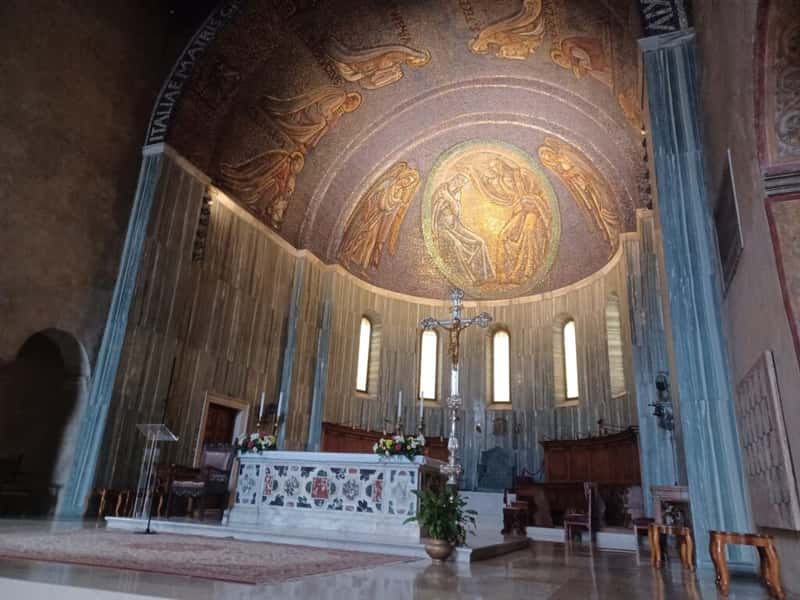
A few steps from the castle, I came across the Cathedrale di San Giusto Martire and went inside for a nosy around. Built in 1385, around the same time as the castle, on the site of a 6th century Roman monument, it contains the tombs of a family of claimants to the Spanish throne.
With my time in Trieste coming to a close, I staggered back down the pseudo-mountain, passing Roman relics on my way to Piazza della Borsa where the city’s Chamber of Commerce is built in the style of a Greek temple. My commercial endeavours were far more important though; it’s simply not right to leave Italy without a bottle of DOP olive oil or two.