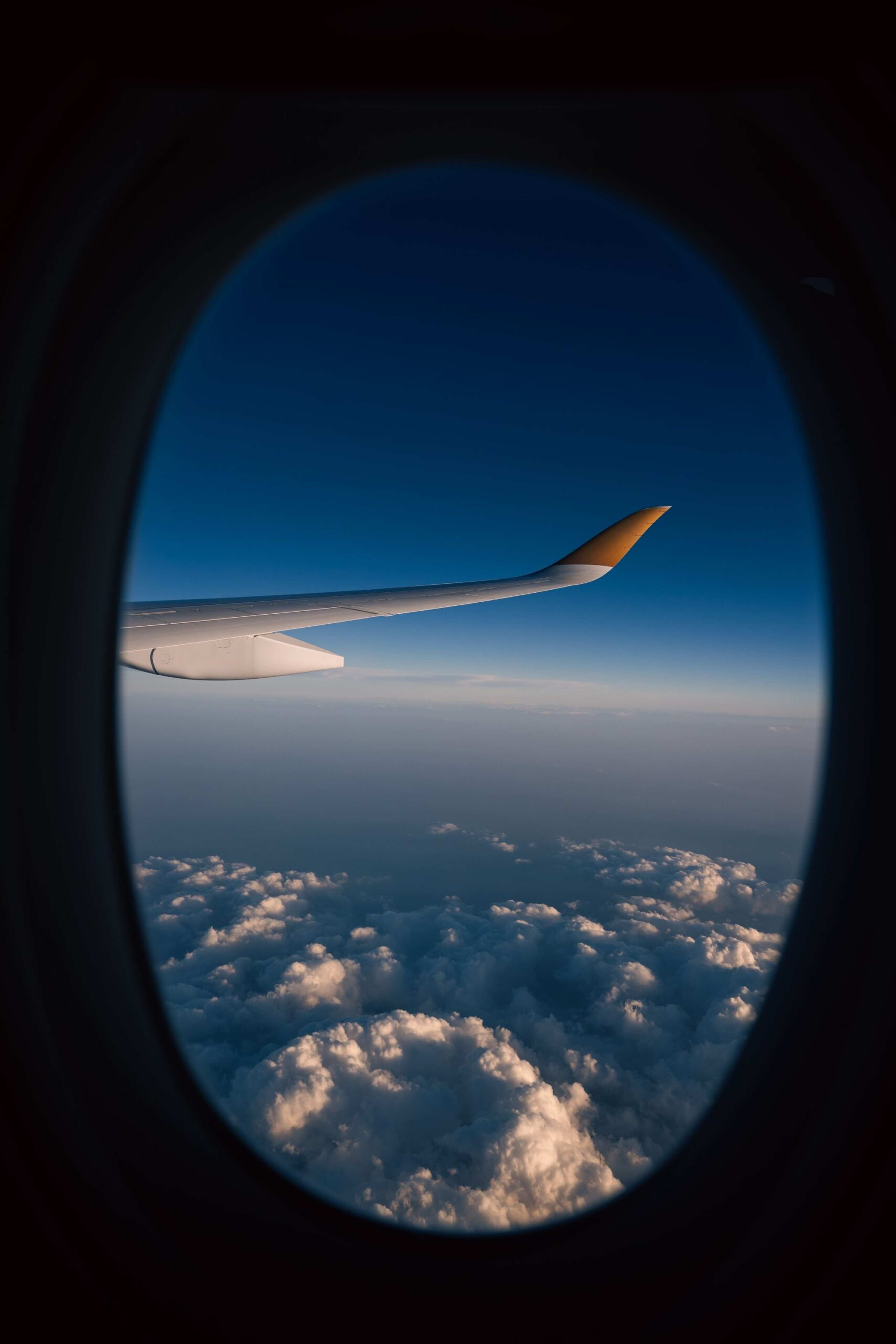
The gate is open. The flight is on time. The hotel upgraded you for free.
And something inside you is already waiting for the crash.
You scan the departure board. You check your bag. You check it again.
Nothing is wrong. That is exactly the problem.
There is a version of you that exists only in transit – the one who feels most alert, most alive, most real when the itinerary is fraying at the edges. When the taxi doesn’t show. When the connection is tight. When the room smells like old carpet and institutional soap. That version of you knows what to do with difficulty. What it doesn’t know – what it was never taught – is what to do with ease.
The smooth trip is not a trap. The quiet room is not a threat. The easy morning is not evidence that something terrible is being prepared just out of view. Hypervigilance isn’t a character flaw, but rather an intelligent response to life circumstances that may no longer serve you. It was the right response, once. In a different room. For a younger version of you who had no other tools. That version deserved better then. You deserve better now. And maybe – somewhere between the arrivals board and the first real breath of unfamiliar air – you’ll let yourself believe it.
1. The Wired Child

It started before you ever packed a bag.
You grew up in an environment where stillness was not safe. Where a quiet afternoon meant something was being planned in the next room. Where your parent’s good mood was data to be analyzed, not a gift to be received.
If hypervigilance is chronic or severe, it is usually a symptom of a deeper pattern – and it is strongly linked to childhood trauma, because as we grow up, our brains develop in a way that is directly responsive to our environment. Your brain wasn’t broken. It was brilliant. It learned the terrain of your home the way a cartographer maps a minefield – with obsessive precision and zero margin for error.
If you are this way, you likely grew up in a chaotic family where things were never emotionally stable – perhaps a parent struggled with addiction, or the household was defined by constant conflict.
The child you were learned one foundational truth: peace is not a destination. It is a pause before the next detonation.
And you carried that truth into every airport, hotel lobby, and sun-drenched vacation you’ve ever tried to enjoy.
2. The Nervous System That Never Clocked Out
Here is the thing about growing up in chaos.
The chaos doesn’t stay in the house you grew up in.
It moves with you. It books the same flights. It checks into the same rooms.
Emotional hypervigilance is a trauma-driven state of constant alertness where your mind and body remain on guard for emotional threat, even in safe situations. So when a trip runs smoothly – no delays, no drama, no logistical fires to extinguish – your nervous system doesn’t relax. It escalates. Because smooth is unfamiliar. Smooth is suspicious.
Your nervous system treats a quiet moment like the calm before the storm, keeping you in a chronic state of high alert even when you’re safe.
The taxi arrives on time. Your pulse quickens.
The hotel room is perfect. Your jaw tightens.
You are waiting for the sky to fall, because in your original home, the sky always did.
3. The Comfort Paradox
Comfort, for the chaos-raised traveler, is not a reward.
It is a red flag.
This is the Comfort Paradox: the very conditions designed to help you relax are the same conditions your body has been trained to distrust. Emotional hypervigilance keeps your nervous system braced for impact, even when no danger is present. While it may have once helped you stay safe, over time it can make rest difficult and trust feel risky.
Think about that for a moment.
Rest. Difficult.
You are on a balcony in Portugal. The wine is good. The view is absurd. And somewhere behind your sternum, a low-frequency alarm is quietly, persistently, inexplicably going off.
Hypervigilance can lead to chronic feelings of unease and mistrust. Individuals may struggle to relax, constantly anticipating danger even in safe environments.
The paradox isn’t that you don’t want comfort. It’s that your body was never given a map for what to do once you arrive there.
4. The Identity of the Fixer
When things go wrong on a trip, you become someone else entirely.
You become capable. You become necessary. You reroute. You negotiate. You hold everyone together in the passport line while the gate is closing and the toddler is crying and the shuttle driver doesn’t speak your language.
You are extraordinary in a crisis.
And you know it.
Hypervigilance is the result of coping in situations where you couldn’t solve the problem, but could only cope. Except somewhere along the way, coping became your identity. The fixer. The one who can handle it. The person the chaos made.
The trouble is, that identity has no script for a smooth check-in. It has no role to play when the luggage arrives first. It is simply your nervous system responding to change, pressure, and the unknown – and when there is no change, no pressure, and no unknown, the nervous system has nothing to grip.
So it manufactures a threat. It finds something. It always finds something.
5. The Transit State (A Personal Note)
I remember a trip to Lisbon.
Everything went right. Outrageously, almost offensively right. The flight was smooth. The apartment was beautiful. The city was warm in February in a way that felt like a personal favor from the universe.
On the third morning, I sat at a café with a coffee I didn’t deserve and felt – not gratitude – but a slow, creeping dread. I kept checking the door. I kept refreshing my email. I invented reasons to be anxious. A work thing. A vague interpersonal guilt. A nagging sense that I had forgotten something catastrophic.
Nothing was wrong. I was just unqualified for peace.
Here’s what most people don’t realize about hypervigilance: you can’t think your way out of it. You can read every article about anxiety, but understanding hypervigilance intellectually is different from feeling safe enough to let it go. It lives in your nervous system, not just your mind.
That morning in Lisbon, I wasn’t anxious about Lisbon. I was anxious about the version of myself that didn’t know how to exist without a problem to solve. I was anxious about who I was when everything was fine.
6. The Architecture of Anticipation
Your childhood home had a specific emotional architecture.
You learned its blueprints by survival. You knew which floorboards creaked in the hallway of a bad mood. You could read the barometric pressure of a room before you entered it. You could feel a fight forming three conversations before it arrived.
If you constantly scan conversations for hidden meaning, feel a rush of anxiety before conflict even begins, or read other people’s moods as a matter of survival, you may be experiencing emotional hypervigilance.
Now you do this in every new city. You read hotel lobbies like floor plans. You assess strangers like variables. You calculate exits before you sit down at the restaurant table.
Hypervigilance causes people to constantly scan their surroundings for threats of harm, even when they’re safe.
The travel itself is not the anxiety. The travel is just the newest room in a house your nervous system already knows how to haunt.
7. The Smooth Trip as Threat Assessment
When a trip is “too easy,” something specific happens neurologically.
The absence of anticipated difficulty reads as a gap in the data. And gaps in the data – to a brain raised on unpredictability – are not neutral. They are warnings. This ingrained state of vigilance may stem from a tumultuous domestic environment, past traumas, or emotionally unavailable parents. It is a setting that never got updated.
Many who are wired for hypervigilance as a child develop generalized anxiety disorder as an adult. The brain is always scanning for what-ifs, possible trouble.
A smooth trip is, paradoxically, more threatening than a difficult one. The difficult trip confirms your worldview. The smooth trip destabilizes it.
So you look for problems. You manufacture urgency. You over-research the restaurant, obsess over the translation app, refresh the weather forecast for a city where it has been sunny for six weeks straight.
You are not being neurotic. You are being faithful to the logic you were raised inside.
8. The Body Keeps the Itinerary
Your body is a record-keeper.
It logged every slammed door. Every too-quiet dinner. Every apology that came too late or not at all. Many people begin noticing growing physical symptoms tied to constant stress, such as headaches, digestive issues, chest tightness, or exhaustion.
These symptoms do not take vacations.
They are stowaways. They are in your carry-on, your checked luggage, your body itself. The jaw that clenches at 30,000 feet. The shoulders that refuse to drop even on the beach. The stomach that tightens when the itinerary is blank.
Your body is constantly scanning for threats, muscles are perpetually tense, and your fight-or-flight response is stuck in the “on” position.
The trip was supposed to be a break. But the body didn’t get the memo. It never does. Until you teach it – slowly, gently, with a great deal of patience – that this particular geography is actually safe. That no one is coming. That the stillness is not a setup.
9. The Exit Strategy Disguised as Wanderlust
Let’s be honest about something.
Some of us don’t travel to arrive somewhere. We travel to leave.
There is a version of constant movement that looks exactly like curiosity and adventurousness and a rich, examined life. And sometimes it is all of those things. But sometimes – if you grew up in a house where standing still meant getting hit – movement is just a more sophisticated version of the same old escape.
Travel anxiety is a form of anticipatory stress that shows up before or during travel. For some people, the idea of being far from home can be unsettling – but for others, home was the thing that was unsettling, and distance from it is the only way the nervous system knows to regulate itself.
The exit strategy becomes the identity. The perpetual traveler. The one who is always somewhere else.
And a smooth trip threatens that too. Because a smooth trip means you have to actually be there – present, arrived, nowhere left to escape to. Just you and the quiet and all the things the movement was supposed to outrun.
10. The Weight of Arriving
This is the heaviest one.
The real anxiety – the one underneath all the checking and rechecking and manufacturing of problems – is not about the trip at all.
It is about arriving.
Not at the hotel. Not at the destination. But at yourself. At a version of your life that is actually, genuinely, uncomplicated. In many ways, our childhood experiences provide a blueprint for our lives. Growing up in a predictable environment with loving caregivers teaches us that the world is a safe place. At the same time, negative childhood experiences can impact us deeply into adulthood.
If you were never given a blueprint for peace – if peace was always the setup, always the before – then arriving at it feels like a trap door.
Many people are walking around, stressed at level 10+, wanting less fear, anxiety, irritation, resistance, and tension, but cannot figure out how to make their bodies feel what their minds know.
That is the truest sentence about the chaos-raised traveler ever written. The mind knows. The body refuses to believe.
And so you keep waiting. You keep scanning. You keep finding the cloud in the blue sky because blue skies, in the house you grew up in, were always borrowed.
There is a particular grief in recognizing this pattern. It isn’t dramatic. It doesn’t arrive with a revelation or a cathartic moment in a foreign city. It arrives quietly, the way most important truths do – somewhere between the second glass of wine and the view you weren’t allowing yourself to fully see.
The grief is this: you missed things. You were there – in the cathedral, on the coast road, at the table with the good bread – and some part of you was also still back in that house, standing in the hallway, listening for footsteps. For individuals who have experienced childhood trauma, this heightened state of alertness often persists, shaping how they perceive and interact with the world.
Over time, the effects compound, making it difficult to break free from cycles of anxiety and exhaustion. You did not choose this. You were shaped by it. And the first act of healing is not fixing the pattern – it is simply recognizing it without contempt.
The gate is still open. The flight is still on time. And somewhere, if you’re willing to sit in it just a little longer, there is a silence that is not a warning. It is just silence. And it belongs to you.