The gate closes behind you. You exhale.
Not because you’ve arrived somewhere safe. Because you’ve left somewhere that wasn’t.
The engine hums. The wheels roll. Your shoulders drop two inches.
You don’t even notice it happening.
There’s a version of you that only exists in motion – loose-limbed, lighter, somehow more honest. And there’s the other version: the one standing in your own kitchen at 11 PM, skin buzzing, waiting for the next thing to go wrong. The identity gap between those two people is not a personality quirk. It is a wound with a very specific shape.
The Nervous System That Never Got the Memo
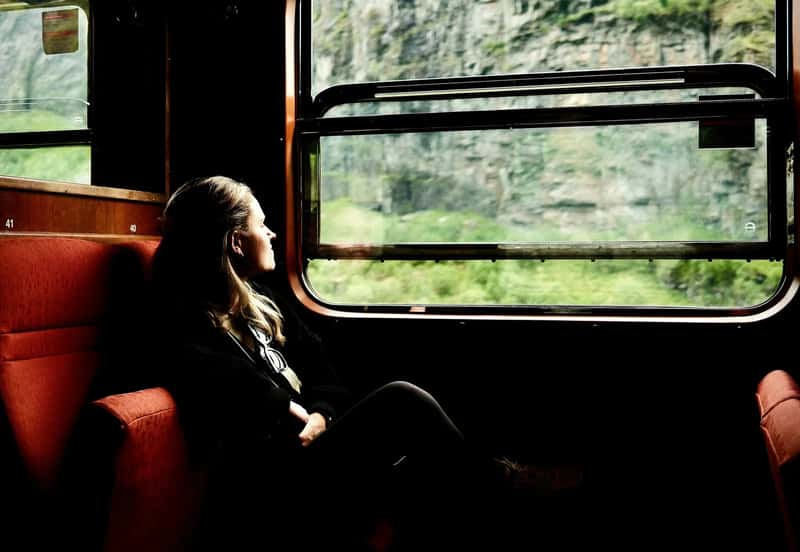
The nervous system has equated movement to safety, so stillness feels dangerous.
That’s not a metaphor. That’s neurobiology wearing your face.
When you endure chronic stress or childhood instability, your brain – specifically the amygdala – rewires itself for hypervigilance. You become an expert at reading micro-expressions and anticipating danger, but you lose the ability to rest.
The plane takes off. The train pulls from the station. Your brain gets a rare reprieve. Not because the world is safer up there. Because up there, no one can reach you yet. The threat hasn’t materialized. It’s still theoretical. And theoretical danger, for a nervous system raised on real chaos, is almost… peaceful.
This is the first lie you carry: that calm only lives in the in-between.
The Original Classroom
The lesson didn’t come from a textbook. It came from a house.
Family instability – divorce, separation, or frequent moves – creates environments where the absence of clear, consistent boundaries becomes the norm. What was acceptable one day might be grounds for punishment the next. This lack of predictable consequence leaves you feeling adrift, always questioning your place and understanding of what is expected.
You learned the house was a minefield. You learned stillness meant exposure. To be rooted in one place was to be findable. To be findable was to be vulnerable.
You learned to be a chameleon, adapting your behavior to the perceived, ever-changing demands of your environment. Your internal compass struggled to find true north.
So you kept moving. Physically when you could. Mentally when you couldn’t. Transit became a rehearsal for the only safety you’d ever known: the temporary kind.
The Sitting Duck Mythology
Somewhere deep in your operating system, a belief got hard-coded.
Stationary equals target.
Trauma can build slowly from constant pressure, emotional overwhelm, or unsafe environments. When stress is constant, your nervous system learns to live on high alert. After a while, these stress responses can start to feel like part of your identity.
This is where the sitting duck mythology is born. Not from a single dramatic event. From the slow, grinding accumulation of days where being still meant being caught. Where the quiet before the storm was the most terrifying silence of all.
Your nervous system protects you by helping you react to threats, then ideally returning to balance when the danger passes. But with prolonged stress, it forgets how to relax and starts to see the world as uncertain. Over time, your brain gets better at spotting threats, stops asking “Is this dangerous?” and starts assuming it probably is.
You didn’t invent paranoia. You inherited a very reasonable response to an unreasonable environment.
The Exit Strategy as Identity
You always know where the door is.
In every restaurant. Every relationship. Every city you’ve ever tried to call home.
You always want to make sure you have a way to escape, so you scan your environment for the closest exits.
This is not anxiety in the clinical brochure sense. This is a fully formed identity – the person who never fully unpacks. The person with the go-bag by the door, emotional and literal. The person who books the return flight before they’ve even landed.
This can be especially intense for those who were the “responsible one” growing up or who felt their worth depended on keeping the peace, anticipating others’ needs, or staying in constant motion. Over time, rest begins to feel like a threat to the identity we’ve carefully built, one rooted in usefulness and caretaking.
The exit strategy isn’t cowardice. It was the only architecture you knew how to build.
A Window Seat and a Quiet Confession
I need to stop here. Because this one is personal.
I have spent years booking the red-eye. Not because it’s cheaper. Because somewhere over the dark Atlantic at 3 AM, with the cabin quiet and strangers sleeping and no one able to call me, I finally exhale all the way down.
I used to call it being “a traveler.” It sounded romantic. Adventurous. It took a long time – and a therapist with a very calm voice – to understand what I was actually doing. I was running a loop. Chasing the only environment where my nervous system had ever been granted temporary parole.
The restlessness is rarely about silence itself. It’s about what silence finally lets you hear.
On that plane, there was nothing to hear. That was the whole point.
The Amygdala’s Frequent Flyer Program
Your brain has been collecting miles on threat detection for decades.
A 2023 study published in Nature Neuroscience highlighted how childhood trauma influences the long-term development of the prefrontal cortex. The study found that individuals with a history of childhood trauma show altered connectivity between the prefrontal cortex and the amygdala, leading to heightened states of hypervigilance even in non-threatening situations. This neural adaptation, while protective during childhood, can contribute to chronic stress and burnout in adulthood.
Transit gives the amygdala something useful to do. Monitor the aisle. Track the turbulence. Catalogue the exits. It feels like vigilance with a purpose – and a destination. That’s the seduction of it.
At home, the amygdala has nothing to scan. So it scans everything. The silence. The phone that hasn’t rung. The future arriving on schedule with its mouth full of problems. When the noise finally stops, many people don’t feel calm. They feel exposed. The mind, used to tiny dopamine hits every few seconds, starts to panic a little. It scans for danger in the only way it knows: “Where’s the next thing?”
Transit answers that question. Home does not.
The Temporary Identity
Who are you between cities? Who are you when no one knows your last name?
Lighter, probably. Less accountable to your own history. The person on the train has no unfinished arguments. No unread messages from the person they’ve been avoiding. No half-finished life sitting on a shelf collecting regret.
Kids who grow up in chaos may be attracted to it in their adult lives. Many who have experienced significant nervous system dysregulation in childhood may not know “how” to feel unless they are engaging in intense experiences that constantly push their physical, emotional, or mental faculties to their limits.
Transit is the consummate intense experience. It demands just enough from you – passport, bag, gate number – without demanding anything real. It offers the seductive illusion of a self that travels light. That isn’t burdened. That is, perpetually, about to arrive somewhere better.
The temporary identity is not who you are. It’s who you rest in when the real one gets too heavy.
What Stillness Actually Threatens
Here’s the part no one talks about at boarding gates.
Stillness doesn’t threaten your safety. It threatens your story.
Some people realize that their fear of silence is really a fear of hearing their own dissatisfaction, grief, or loneliness. Others discover they’re not actually addicted to stimulation – they’re addicted to avoiding certain questions: “Is this job still right for me?” “Why do I feel so behind?” “What do I actually want?”
And so the motion continues. City to city. Project to project. Relationship to relationship. The body in transit. The questions unanswered. It’s about what rises to the surface when we finally stop. When we’re constantly in motion, there’s no time to feel.
Being stationary isn’t the danger. Being stationary is where the real conversation starts. And some of us have been avoiding that conversation for a very, very long time.
The Survival Strategy That Overstayed Its Welcome
It worked once. That’s the problem with all good coping mechanisms.
These responses are not permanent flaws but learned patterns developed to survive challenging circumstances.
For those who grew up in chaotic or neglectful households, fear may have developed into hypervigilance – basically having a chronic high level of alertness and constant scanning for potential threats to wellbeing. As children, we may have conflated feeling hypervigilant with the ability to keep ourselves safe in the absence of a stable, calm, loving adult.
The child needed to keep moving to stay safe. That was real. That was true. The child was not wrong to learn that lesson. But the child grew up. The house is different now. The threat level has changed. Only the nervous system didn’t get the update.
The mind pops out thoughts that worked in the past, trying to keep you safe in similar ways that worked in childhood. It doesn’t have the answers or original solutions for the present moment in your adult life. It’s working from old, outdated programming from childhood when your nervous system and brain were still developing.
The survival strategy overstayed its welcome. But evicting it requires more than knowing that. It requires sitting very, very still.
The Quiet Country Nobody Visits
There is a place on the other side of constant motion that most transit-addicted people have never been.
It is not dramatic. There are no arrivals boards. No departure announcements. Nothing to track or board or optimize.
If we feel more anxious when things slow down, it doesn’t mean we’re broken. It means the nervous system has been working overtime to survive in a world that was unsafe for quiet rest.
Your nervous system needs to feel safe, not just understand what safety means. Healing starts by seeing stress responses as biological, not personal failures. You can’t think your way out of survival mode if your body feels under threat.
This is the heaviest truth in this entire piece. You cannot reason your way into stillness. Knowing the psychology doesn’t dissolve the biology. The body must be taught – slowly, gently, repeatedly – that the ground beneath your feet is not a trap door. That the room you’re sitting in is not a staging area for catastrophe. That being found does not mean being destroyed.
And that is the work. Not the travel. Not the next flight, the next city, the next beautifully temporary identity. The work is the Tuesday afternoon in your own apartment with nowhere to be and no emergency to manage, and learning – slowly, slowly – to survive that too.
The gate will always be there. The question is whether you’re running toward something or just away from the sound of your own quiet.
One day, the bravest thing you will ever do is stay.