There are Roman ruins that come with ticket queues, audio guides, and a steady hum of background noise. And then there’s Carsulae—a place so quietly spectacular that the first thing you notice is the silence. No crowds. No barriers telling you where to stand. Just a Roman city, wide open, resting in the Umbrian countryside as if it’s been waiting patiently for someone curious enough to show up.
How is it possible that so few people know about it? That’s exactly what I wanted to understand. And being there, walking through it almost alone, felt like the answer.
A Roman City Built to Be Passed Through
Carsulae was founded around the 3rd century BC along the Via Flaminia, one of the most important Roman roads connecting Rome to the Adriatic coast. This was not a remote outpost. It was a strategic stop, designed to serve travelers, merchants, soldiers, and administrators moving through central Italy.
At its peak, Carsulae had everything a proper Roman city should have: a forum, temples, an amphitheater, baths, arches, and a monumental road running straight through its heart. What it didn’t have were defensive walls. That detail alone says a lot. This was a city built in a time of confidence, when Rome felt stable enough not to worry too much about protection. Ironically, that same confidence may have contributed to its decline. Earthquakes, shifts in trade routes, and changing political priorities eventually emptied the city. Carsulae was abandoned rather than destroyed—and that’s precisely why it still feels so intact today.
Walking Through It Feels Unscripted

My family and I were literally the only people on site, and we couldn’t believe our luck. Experiencing an entire Roman city with zero disturbance felt like a privilege. The ancient paving stones of the Via Flaminia were still there under our feet, bearing the marks of chariots that passed over them for decades. Columns lied where they had fallen. Arches framed the landscape, clearly marking the beginning and end of what was once a thriving city. And we could enjoy all that in perfect solitude.
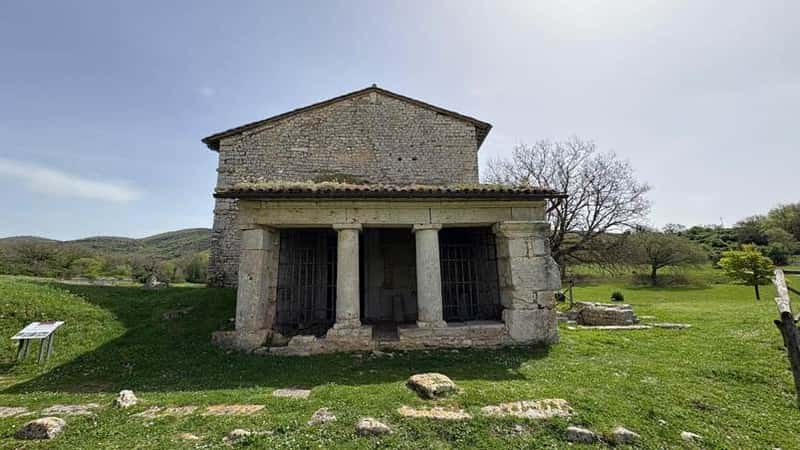
That moment—walking through the entry arch of Carsulae—struck me deeply. Roman sites always move me; they’re my passion and what truly makes me tick. But here, the feeling was sharper. Crossing from the area of the tombs outside the city into the space dedicated to civic life, games, and prayer, I could almost sense what a Roman citizen might have felt centuries ago. Please—take me back there now. We passed through the forum. The amphitheater appeared suddenly, modest in size but perfectly legible. Two temples stood side by side, still asserting their presence. It felt less like visiting ruins and more like stumbling into a Roman city that simply forgot to close.
Beauty Without Mediation

The surrounding landscape is inseparable from the experience. Rolling Umbrian hills, open sky, grass growing between stones—it all reinforces the idea that Carsulae didn’t end violently, but slowly dissolved back into the land.
From a design perspective, it’s incredibly elegant. Roman urban planning, stripped of spectacle, still works. And because there’s so little visual noise, you notice things you often miss elsewhere: alignments, distances, the relationship between public and private space. Carsulae rewards attention in a way few sites do. Oddly enough, it also feels contemporary. Not because it’s restored, but because it isn’t. There’s no attempt to turn it into an “experience.” You bring your own curiosity, your own pace, your own interpretation. In an age of over-curated heritage sites, Carsulae feels almost radical in its restraint. It trusts the visitor—and that trust completely changes the tone of the visit.
Practical Information
Where it is: Carsulae is in Umbria, near Terni, and is easily reachable by car.
How long to visit: 60–90 minutes is ideal, longer if you enjoy slow walking and photography.
Best time to go: Spring and early fall are perfect. Summer is doable but hot, with very little shade.
Crowds: Almost none. Even on weekends, it rarely feels busy.
Museum and cafè: Right at the entrance to Carsulae, there’s a small on-site museum—and it’s worth stopping in before or after wandering the ruins. It’s modest in size, but thoughtfully curated, and it does exactly what a good archaeological museum should do: it gives you just enough context to sharpen your eye without overwhelming you with information. Inside, you’ll find inscriptions, fragments of sculpture, architectural elements, and everyday objects recovered from the site. There is a small cafè with drinks and snacks.

Why You Should Go Out of Your Way for It
Carsulae isn’t famous. It won’t appear in your algorithm unless you actively look for it. And that’s exactly why it’s worth the detour. It’s Roman history without amplification. Archaeology without choreography. A place where the absence of people sharpens your sense of presence. More than that, it feels like a benchmark—the archetype of a Roman city. Everything else you’ve seen before, or will see after, somehow adds up to this.