

Thai food is excellent. Pad Thai, massaman curry, boat noodles, spicy pork belly, it’s all so bold, complex, and deeply satisfying. Fats and acids and coconut milk and carbs swirl together in colorful, deliberate combinations. Much better writers than I have already done justice to how good Thai food is.
What I don’t want to do here is add yet another ode to pad thai. Not because I think any less of it (I don’t) but because my food experience in Bangkok has ended up being about much more than Thai food alone. Let me explain.
Street-Level Culinary Density
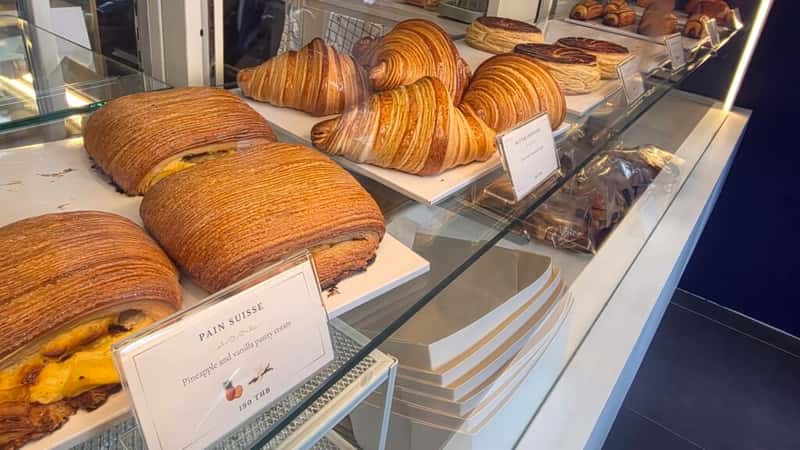
I want to start close to home, on my street in Ekkamai. Just the other day, a new French bakery opened called La Parisienne. I happened to walk past on its opening day after leaving my Muay Thai gym and, out of curiosity, picked up a small key lime tart. It was sharp and clean, the lime cutting through a smooth layer of cream.
I mention this because less than a week earlier, a small Japanese izakaya on that same street had closed. A little farther down is a local Thai boat noodle shop with plastic chairs, metal tables, and cups stacked for customers. Walk a bit more and you’ll pass American-style cheeseburgers, Lebanese shawarma, and whatever else has quietly taken root.
All of this exists within a few minutes’ walk. Ekkamai isn’t even the most culturally dense street in Bangkok. That’s what struck me most. These aren’t “special occasion” restaurants or novelty stops. They’re places I return to during the week without much thought or expense. The variety isn’t curated, it’s incidental and organic. And that density reshapes how you eat.

Why This Variety Exists
After digging a little, the reasons for this diversity become clearer. Bangkok has long been a regional hub for migration and trade. It hosted U.S. GIs during the Vietnam War, which left its own imprint, and Thailand has maintained deep relationships with Chinese, Japanese, Indian, and Muslim communities for generations.
What’s notable is that no single food culture dominates the landscape. Everything is present in varying degrees, depending on where you look. Local Thais enjoy shawarma just as readily as visitors seek out Thai food, and that overlap encourages experimentation. I’ve eaten xiao long bao at the same restaurant where I ordered a perfectly serviceable sandwich. These foods coexist so naturally with each other.

Food as a Reflection of Bangkok
As someone who enjoys food and cooking, I’ve made a point to explore as much as I can since moving here. Over time, I’ve found myself categorizing favorites by culture rather than by occasion. What keeps me coming back isn’t just the variety, but the consistency. The baseline quality is high, even at casual spots.
That consistency breeds curiosity. Liking Lebanese cheeseburgers made me want to learn more about Lebanese food. Japanese comfort dishes led me down similar paths. Meals stop being events and start becoming small acts of exploration.

Personal Reflection & Everyday Wonder
I should be clear: I still love Thai food. Massaman curry remains my favorite dish here. But Bangkok surprised me by expanding what “Thai food” meant in practice. It quietly became food in Thailand instead.
Living somewhere where that level of variety is effortless feels like a privilege. It’s also a reminder of how much richness diversity brings to everyday life. When multiple cultures share space without competing for dominance, everyone eats better. If you find yourself in Bangkok, eating across three cultures in a single day won’t feel impressive, it’ll feel completely normal. And that, more than anything, is what makes food here so exciting.