If you travel through southern Costa Rica—especially in the Diquís Delta—you may come across one of the most intriguing and least known artifacts in the Americas: large stone spheres, carved entirely by hand centuries ago with astonishing precision. Some are small enough to cradle, others weigh several tons, yet many of them are almost perfectly spherical, with an estimated accuracy of up to 98%. Seeing them in person is quietly disorienting. They sit there, calm and self-assured, as if daring you to explain them. Surprisingly few travelers know about them.
I first encountered one almost by accident in Uvita, on my way to go whale watching. It was sitting in a private garden, completely out of context—and somehow that felt appropriate. These spheres don’t fit neatly into simple narratives. They belong to Costa Rica, but they also seem to exist slightly outside of time, suspended between archaeology, design object, and unanswered question. The more you learn about them, the more they resist simplification, and that resistance is precisely what makes them so compelling.
What Are the Diquís Stone Spheres?
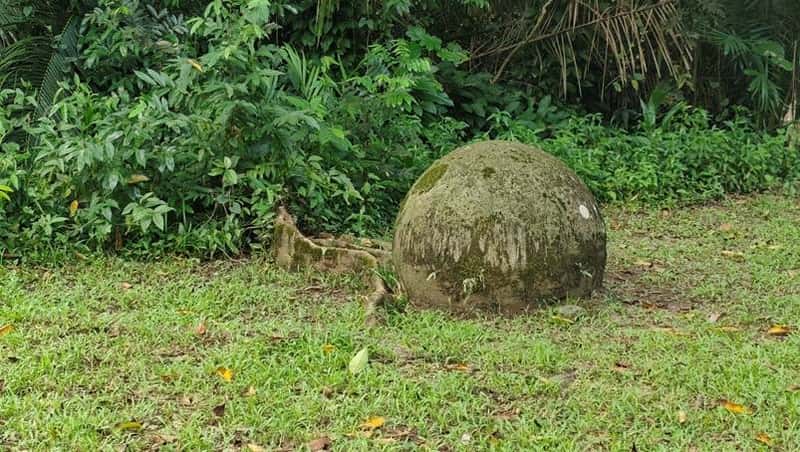
Known as the Diquís stone spheres, these objects were created by pre-Columbian societies in southern Costa Rica between roughly 300 and 1500 AD. They are associated with the ancestral cultures of the Diquís region, long before Spanish arrival. Carved mainly from granodiorite—a hard volcanic stone sourced miles away—they range from just a few inches in diameter to more than 6.5 feet.
What makes them extraordinary is not only their age, but their geometry. Achieving such near-perfect roundness without metal tools, modern measuring instruments, or written mathematical systems implies an advanced understanding of form, proportion, and patience. These were not decorative afterthoughts. They were intentional, labor-intensive creations that required planning, skill, and collective effort.
Precision Without Modern Tools
From a design perspective, the spheres are mesmerizing. Even today, creating a perfect sphere at that scale is far from trivial. Diquís artisans shaped them by pecking and grinding stone—likely using other stones and sand—then polishing the surface through repeated abrasion. No molds. No shortcuts.
This level of precision suggests that the act of making the sphere was as important as the finished object. The form itself—pure, closed, with no beginning or end—may have carried symbolic meaning related to cosmology, power, or social order. Their smoothness feels deliberate, almost meditative, as if the goal was not decoration, but mastery over matter.
Meaning, Power, and Open Questions
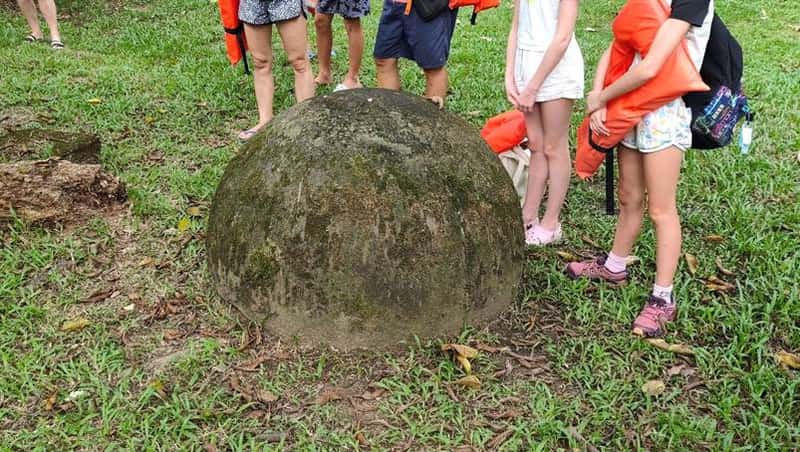
Despite decades of research, no definitive explanation exists for the spheres’ purpose. Some were found aligned with buildings or arranged in geometric patterns, hinting at ceremonial, political, or possibly astronomical functions. Others appear to have marked important places or served as symbols of authority for elite groups.
These spheres are a human achievement—rooted in local knowledge, social organization, and cultural meaning. Their mystery lies not in the impossible, but in how much was possible with ingenuity, time, and shared intention.
Where to See Them Today
Many spheres were displaced during the 20th century and moved to private gardens or public buildings, often stripped of their archaeological context. Today, the most meaningful place to see them is at Finca 6, an archaeological site and museum in the Osa region, where several spheres remain close to their original locations.
I haven’t been able to visit yet, but those who have describe it as a place where you clearly understand that the spheres were never meant to be isolated objects. They were part of a broader cultural landscape that included villages, agriculture, and social hierarchy.
A Cultural Encounter That Lingers
What struck me most is how contemporary these spheres feel. In an age obsessed with complexity and excess, their radical simplicity feels almost modern. No decoration, no narrative relief—just form. I’ve seen several of them at the Jade Museum in San José, and they could easily pass for works by a contemporary artist, perfectly at ease in a minimalist gallery.
Costa Rica is rightly celebrated for its biodiversity and dramatic landscapes, but for travelers like me, historical and cultural layers matter just as much. These stone spheres offered a different kind of wonder—one shaped slowly by human hands, guided by ideas we may never fully recover, but can still recognize as profoundly intelligent. Amid all the extraordinary nature, they added a grounding dimension that completed my experience of the country.