
Standing on the banks of the Chao Phraya River, the Grand Palace is not merely a tourist attraction; it is the spiritual and historical heart of Thailand. For over two centuries, this dazzling complex of gilded spires, intricate mosaics, and emerald-green tiles has served as the official residence of the Kings of Siam (and later Thailand).
Even as the world outside its high white walls has modernised into a sprawling megacity, the Grand Palace remains a bastion of Rattanakosin craftsmanship and royal tradition.
Whether you are a history buff, an architecture enthusiast, or a traveller looking to check off a “bucket list” destination, the Grand Palace is an essential experience.
A Legacy in Stone and Gold: History of the Palace

The story of the Grand Palace begins in 1782, when King Rama I, the founder of the Chakri Dynasty, ascended the throne. He decided to move the capital from Thonburi (on the west bank of the river) to the east bank at Bangkok, which offered better strategic protection.
The palace was modelled after the former royal palace in Ayutthaya, the ancient capital that had been destroyed by invaders. Originally built mostly of wood to save time, the palace was gradually rebuilt in masonry and expanded by successive kings.
It eventually grew into a “city within a city,” covering roughly 218,000 square meters and housing the royal court, the government administrative offices, and the kingdom’s most sacred temple.
While the current King, Rama X, resides at the Dusit Palace, the Grand Palace remains the site of major state ceremonies, coronations, and royal funerals.
Must-See Highlights
1. Wat Phra Kaew (The Temple of the Emerald Buddha)
Sitting in a corner of the palace grounds, the Emerald Buddha is arguably Thailand’s most sacred site. Unlike other temples, it does not house monks and is purely a place of worship for the monarchy and the public.
Despite the name, the statue is actually carved from a single piece of jade (or jasper), sitting high on a multi-tiered golden pedestal.
One of the most significant royal rituals involves the King personally changing the Buddha’s gold-cloth outfits three times a year to mark the summer, rainy, and winter seasons.
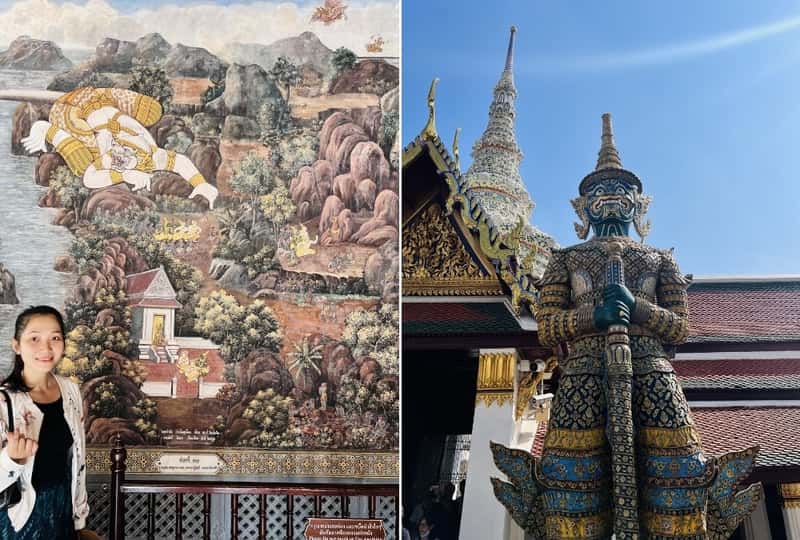
Surrounding the temple cloisters are 178 panels of vibrant murals depicting the Ramakien, Thailand’s national epic.
2. Chakri Maha Prasat Throne Hall

The Chakri Maha Prasat Throne Hall is a distinctive architectural hybrid built during the reign of King Rama V. Its lower structure is in the Italian Renaissance style, while the roof is topped with traditional Thai-style tiered spires. Local legend says the architect originally wanted a fully European dome, but the court insisted on Thai spires to maintain the palace’s identity.
3. Dusit Maha Prasat Throne Hall
This is a classic example of traditional Thai palace architecture. Built by King Rama I, it is used for the lying-in-state of kings and members of the royal family. Its perfect proportions and tiered roof are considered a masterpiece of the Rattanakosin era.
Essential Visitor Information (2026 Update)
Entrance Fees and Tickets
The Grand Palace is one of the more expensive attractions in Thailand, but the ticket includes several sites.
Price: 500 THB for foreigners (Thai citizens enter for free).
The ticket grants entry to the Grand Palace, Wat Phra Kaew, the Queen Sirikit Museum of Textiles, and usually includes a ticket to a Khon (masked dance) performance at the Sala Chalermkrung Royal Theatre.
How to Buy Ticket
On-site: You can buy tickets at the official booths near the Mani Nopparat Gate.
Online: I’ve been told that it’s highly recommended to buy tickets at least 24 hours in advance via the Official Grand Palace Website, as it allows you to skip the long ticket-purchase queue and use the “E-Gate” for faster entry.
However, we were recommended by a security guard to buy online as the ticket lines would supposedly be extremely long due to tours coming in, so after spending an hour trying to book tickets online to no success, we just made our way to the booths to be met with next to no one in line and got our tickets immediately. Maybe that extra hour made the difference, or maybe it isn’t as bad as they make it sound and just prefer you to buy online.
Opening Hours of The Grand Palace
The complex is open daily from 8:30 AM to 4:30 PM. However, the ticket office closes at 3:30 PM. It’s best to arrive exactly at 8:30 AM, as by 10:30 AM, the heat can be intense, and the tour buses are expected to arrive.
The Strict Dress Code

The Grand Palace is a sacred site, and the dress code is strictly enforced. Security will turn you away if you are not dressed appropriately, so make sure you have your shoulders and knees covered, regardless of gender.
Contrary to older myths, you can wear sandals or flip-flops, but your heels should generally have a strap. You must remove your shoes before entering the chapel of the Emerald Buddha.
Like most places in Thailand, even if you’ve forgotten about the dress code, there is always someone willing to sell you a light pair of elephant print pants somewhere close to the palace grounds.
How to Get There and Enter
Transportation
Located in the “Old City” (Phra Nakhon), the palace is not directly on the main BTS Skytrain lines, but it is still very accessible.
By Boat (The Best Way): Take the BTS Silom Line to Saphan Taksin Station, go to the pier, and board the Chao Phraya Express Boat (Orange Flag). Get off at Tha Chang Pier (N9). It’s a 5-minute walk from the pier to the main entrance.
By MRT (Subway): Take the MRT Blue Line to Sanam Chai Station. From there, it is about a 10–15 minute walk or a short tuk-tuk ride to the palace.
By Taxi/Grab: Simply set your destination to “Grand Palace.” Be aware that traffic in this area is notoriously heavy.
Entering the Complex
There is only one main entrance for tourists: the Mani Nopparat Gate on Na Phra Lan Road.
Beware of Scams! As you approach, you may encounter well-dressed locals telling you the palace is “closed for a royal ceremony” or “closed for lunch.” This is almost always a scam designed to get you into a tuk-tuk for a commissioned gem shop tour. Please ignore them and proceed directly to the gate to verify.
Tips for a Better Experience

Most of the palace courtyards are open-air and paved in stone, which reflects the sun’s heat, so bring a hat, an umbrella for shade, and plenty of water. You can rent an audio guide at the entrance for 200 THB, which provides excellent context you might otherwise miss.
Photos are allowed throughout the grounds but are strictly forbidden inside the building housing the Emerald Buddha. Since you are already in the area, plan to visit Wat Pho (The Reclining Buddha) immediately after, as it is only a 10-minute walk from the palace exit.
The Grand Palace is a place where Thailand’s past and present converge. While the crowds can be dense and the sun hot, the first glimpse of the Phra Siratana Chedi shimmering in the light makes every step of the journey worthwhile.