
I went to Bolivia to trek the Isla del Sol and Huayna Potosí, but once I arrived in La Paz, all I heard was talk of the famous snowy Salar de Uyuni. Bolivia’s massive 4,086-square-mile salt flat is ten hours from La Paz by bus, or an hour-long domestic flight from El Alto International Airport just outside La Paz. It’s absolutely worth the journey.

Statue at Salar de Uyuni, Image Credit: Elizabeth Lavis
Logistics from La Paz
If you’re short on time and want to save a little bit of cash, as I did, book your tour in La Paz and take the overnight bus down. You’ll wake up groggy, stiff, and chilly: buses in South America are notoriously cold, even in the summer, so bring plenty of layers for your adventure. The Salar de Uyuni is at the same altitude as La Paz, so if you’re acclimated there for a few days, you won’t feel the woozy effects of 3,656 meters.
The first thing I wanted when I arrived was a hot cup of coffee, and fortunately, there are plenty of small shops right on the main drag that open early. I found a decent breakfast and a strong cup of joe at the Guardian Coffee Shop, but you can also get your morning fix at ENSIS. Both open at 7 a.m.
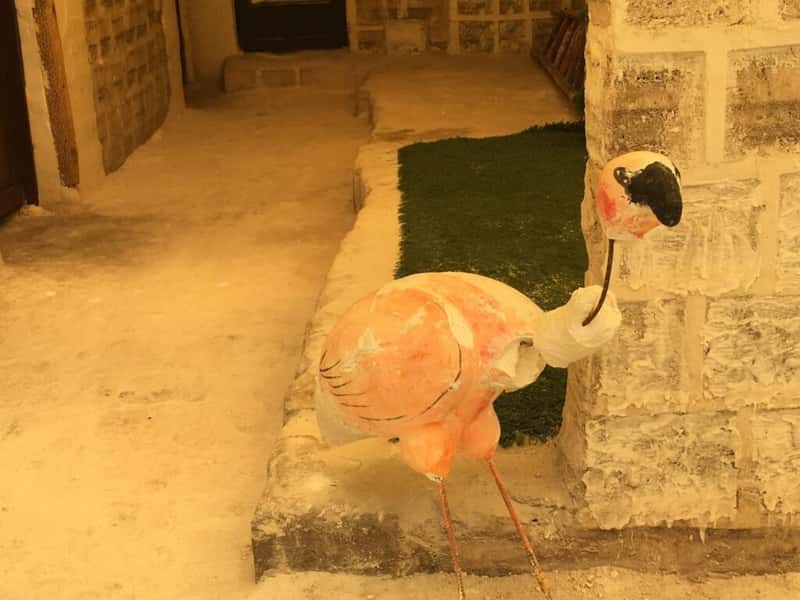
Flamingo Statue at the Salt Flats, Image Credit: Elizabeth Lavis
Setting Out Onto the Salt Flats
The massive flats are ten meters thick in some places, and the bleached vistas of lithium-rich salt act as a fabulous backdrop of optical illusions, especially when the wet surface creates a perfect mirror. Your guide will arrive with plenty of toys and props, ideal for creating that Insta-worthy optical illusion. We had a lot of fun playing with neon-orange Godzilla figurines and Matchbox cars.
Salar de Uyuni’s optical illusion magic comes from a combination of its glossy, mirrored effect, which erases the line between the earth and sky, making a massive, infinite canvas. Additionally, as the name suggests, the salt flats are completely flat, and there are no discernible features for miles in each direction. As such, you don’t have a focal point to determine how far or close something is.

Isla Incahausi, Image Credit: Elizabeth Lavis
Cacti Islands and Train Cemeteries
The endless salt flats are undeniably Salar de Uyuni’s biggest draw, but there’s also plenty of hiking afoot. Isla Incahuasi, or Cactus Island, was one of my favorite aspects of the trip, especially because of the rich contrast of verdant green cacti and salt flats. Plus, if you hike to the center hill on Cactus Island, you’ll get a panoramic view of the salt flats and get some incredible photographs.
The Cementerio de Trenes, or Train Cemetery, is a short drive from the salt flats on the outskirts of Uyuni. It’s a ghost town of salt-weathered, rusted trains, remnants of the days when Uyani used to be a massive mining town. It was solemn and a little creepy to wander through the abandoned hulks, but I’m very glad that I went.

Cementerio de Trenes, Image Credit: Elizabeth Lavis
Salar de Uyuni Lore
Officially, Bolivia’s marvelous salt flats were created over 40,000 years ago when an ancient salt lake evaporated, leaving behind a colossal deposit of minerals, but there’s also the colorful local lore. According to local Aymara legend, the salt flat was created when a giantess lost her child, and her breast milk mixed with tears, creating the salty, snowy flat.
However they were created, through a prehistoric lake evaporating or a grief-stricken giantess spilling her breast milk and tears, the Salar de Uyuni is one of Bolivia’s most awe-inspiring destinations. Have you visited this epic place? Please let us know below.