

Sailing down the Nile had always been on my bucket list since I was a child. If there was one thing no one could separate me from, it was the Egyptology encyclopedia. Like many who grew up in the 90s, I became fascinated with Egypt early on through this book. I was still learning to write grammatically correct sentences when I attempted to learn hieroglyphics from the Egyptian Book of the Dead and tried to understand why it took Howard Carter so long to find King Tutankhamun.
That interest never left. It followed me through my studies, eventually leading to degrees in anthropology and history. During the years I spent worldschooling with my family, my mother was determined to visit Egypt as much as possible, herself fascinated by its history, with dreams of becoming an archaeologist that faded into the background of “real life” but never fully disappeared.
The Magic of Egypt Is Felt Deep in Your Soul
There is a long-standing tradition of writers trying to explain Egypt to the outside. From Herodotus to Agatha Christie to modern films, the greatest minds and visionaries have attempted to capture what it feels like to experience the eternal river flowing north, the distant villages and donkey carts, the palms swaying against a backdrop of sand. For years, I had devoured books such as A Thousand Miles Up the Nile or meticulously analyzed the paintings of David Roberts, comparing and contrasting what remnants and future discoveries were still under the sand.
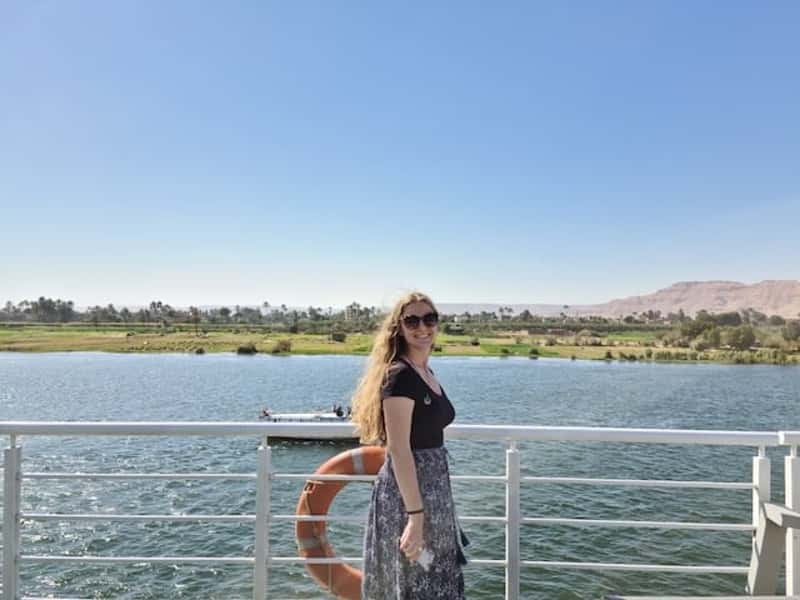
But standing there, 4 stories up on the ledge of a river cruise boat gliding along the river, I was also at a loss for words.
From the deck, the Nile stretched out in both directions, bordered by palms, reeds, and villages of clay homes. At times in the distance and at times along the shore, dunes and ocre-colored hills rose, dotted with archeological sites and faint outlines of tomb entrances. These small, symmetrical doorways were abundant along the 4-day journey and reminded me of the human activity that has shaped these lands for thousands of years. While their doors were now knocked down and their tombs raided long ago, these were meant to last an eternity, helping the souls of the dead reach the afterlife.
For those drawn to archaeology, history, or the vast literature encompassing adventures in Egypt, it carries a sense of mystery and familiarity. It felt like stepping into a version of Egypt that I thought existed only in ancient stories and Hollywood films, its landscapes having barely changed for thousands of years. At any moment, Indiana Jones could pop out along the horizon, searching for the next mythical artifact that will change the course of human history.
After taking two Nile cruises, here are the lessons I learned along the way. While I could bore you with the logistics or iteniraries, I would rather delve into what a cruise down the eternal river does to a traveler, and why Egypt has been shrouded in mysticism and fantasy for thousands of years. I hope to captivate the adventurous soul inside of you, the one that yearns to experience the gift of Egypt and its ancient temples firsthand.
1. Sailing Down the River Will Transport You Back in Time
Hearing the word cruise confused me at first. I tried to imagine an actual cruise ship on the Nile, but having visited Cairo once before, I knew that wasn’t possible. After a short stopover in the capital city and a quick domestic flight into the southern city of Aswan, I walked onto the wobbly dock with the boats towering above my head. Between 4-5 stories high, they were rectangular-shaped and decorated in gold vintage designs or modern aesthetics, each with its name plastered along the side. To reach our boat (my family and a few friends were with us), we had to walk through 3 others, each connected as a single walkway through their main lobbies. Stepping from boat to boat, I got a glimpse of the interiors, some old-fashioned and some redesigned, others intentionally created to transport visitors to the 1920s.
The highlight of the entire boat was the upper deck, where the Nile and the city of Aswan came into view.

2. You Will Sail Through 3000 Years of History in 4 Days – Get Ready
Looking at the list of archaeological sites to visit, I was genuinely shocked. How would we be able to do all of these? And how long do we have to sail between them? The cruise, which began in Aswan and ended in Luxor, would stop along the way at some of the most important archaeological sites in the country – places I could have spent days exploring, discovering hidden corners, and translating inscriptions on walls. As Amelia B. Edwards writes in A Thousand Miles in the Nile: “Still, the Nile is long, and life is short.”
Moving through thousands of years of history, the cruise focuses on monumental temples dotted between the two cities: Edfu, Esna, Kom Ombo, Philae in Aswan, and the great sites of Luxor. Each morning, I rose for another day of adventure, opening the shades of the cabin to find a few views. There were villages along the riverbank, farmland dissolving into the desert hills, and ruins scattered across the water’s edge. Some archaeological sites were right up against the docks, where we were greeted by crowds of vendors selling trinkets and textiles, ferociously persistent but good-humored. Others hold their own adventures to arrive, such as the horse-drawn carriage ride through the streets of the town.

3. Cultural Experiences Are Everywhere
“Are we going to get any cultural expereinces if we’re on a boat with other tourists?” I recall asking the guide, who later became a family friend after recurring visits.
“Absolutely!” I didn’t fully see what he meant.
Then Egyptian night came, when the whole ship was dressed in galabias and danced to Arabic music. Or the “pirates” who would pull alongside the boat and latch on, throwing clothing items up four floors to the top deck. On each visit, we had time to have tea, shop for trinkets through intensive bargaining, and connect with locals in broken English conversations.
4. Taking the Time to Appreciate the History
Even with my longstanding interest in Egyptian history I found myself lost in the sheer scale and historical knowledge of the temples. Moving quickly through the tours, whether rushing to meet the boat’s departure schedule or making way for other groups, I constantly wanted to push past the surface-level explanations. The Temple of Kom Ombo served as a hospital and healing center, Edfu showcases the architecture of the Greco-Egyptian period, and Philae holds a story more ancient than the Egyptian kingdoms themselves. Conducting research beforehand transformed my experience the second time around, giving me the space to wonder at the small architectural details and hieroglyphic meanings.

A Nile cruise
A Nile cruise will not leave you feeling like you understand Egypt; if anything, it does the opposite. Each Egyptian adventure has shown me just how much more there is to learn and understand about this land. But a Nile cruise is a excellent way to get a buffet sampler of the sites and sounds – and I can assure you that you will be leaving yearning for more.