The buffet opens at 7 AM.
You are down there at 6:52.
You tell yourself it’s efficiency. Practicality. A preference for quiet mornings.
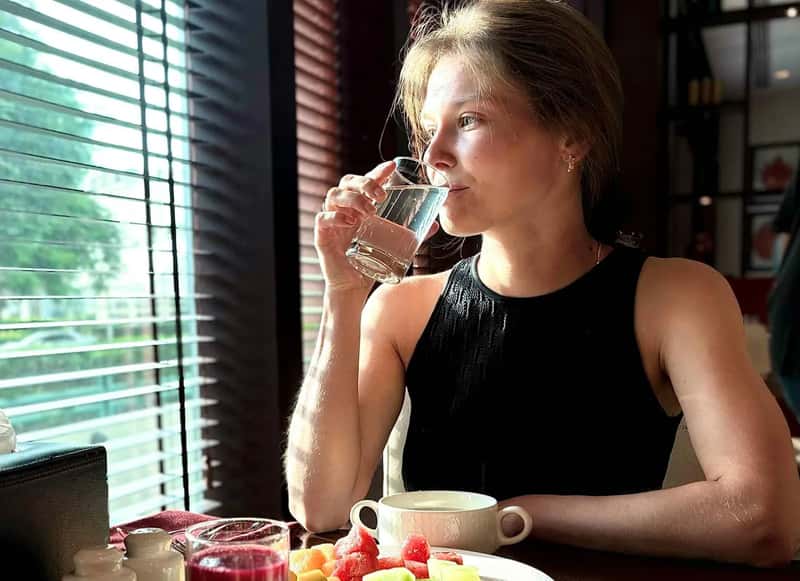
But the scrambled eggs are still cold. The orange juice hasn’t been poured yet. And you are already scanning the trays – counting, calculating, positioning – before the first other guest has even stirred from sleep.
This is not a breakfast preference. This is a memory playing out in real time. You can stand in front of a breakfast spread that covers twelve feet of table – fresh fruit, hot dishes, pastries restocked every twenty minutes – and still feel the low-grade urgency of someone who arrived too late and found nothing.
1. The Scarcity Blueprint
Every behavior has a blueprint underneath it.
Yours was drawn in a kitchen, years ago, in a house where things ran out.
Maybe it was literal – food that disappeared before you got there. Maybe it was emotional – attention that was rationed, affection that was conditional, safety that evaporated without warning. Individuals growing up in resource-scarce environments pay more attention to short-term benefits, forming what researchers call “fast strategies” – an orientation toward securing the present before the future dissolves.
That orientation doesn’t expire when childhood ends.
It travels with you. It checks into the hotel room. It sets the internal alarm for 6:48 AM, long before any conscious thought has formed. Childhood environment has a significant influence on individuals’ psychology and behaviors. Those who grow up in harsh environments with resource scarcity and uncertainty tend to develop impatience and prefer investing resources in the present rather than the future.
The buffet isn’t the point. The point is the blueprint. And blueprints don’t care where you are in the world – they only care that they’re followed.
2. The Wiring Nobody Talks About
Your nervous system was not born hypervigilant.
It was trained.
In many ways, our childhood experiences provide a blueprint for our lives. Growing up in a predictable environment with loving caregivers teaches us that the world is a safe place. Negative childhood experiences, like trauma, can impact us into adulthood. Children who survive abuse, neglect, and instability might, understandably, see the world as an unsafe place.
And an unsafe world demands early positioning.
It demands that you be the one who rises first. Who checks the fridge first. Who claims the good chair, the full plate, the last warm roll.
Being exposed to stressors during the developmental years of youth, when our brains are still forming emotional and regulatory systems, can shape the future in terms of worry and hypervigilance.
The wiring happens quietly. Efficiently. Without your knowledge or consent. And by the time you realize you’ve been operating from a threat-detection system built for a childhood home you no longer live in, you’ve already eaten your eggs alone.
3. The Speed Strategy
There is a particular kind of urgency that belongs only to people who learned early that hesitation has a cost.
You don’t linger. You don’t browse. You don’t wait to see what others are having.
You decide. You move. You secure.
Life history theory suggests that to cope with increased uncertainty and threatening situations encountered while growing up in a resource-scarce environment, individuals have to invest resources in the present, developing a short-sighted behavior pattern.
Short-sighted, in this context, is not an insult. It is an adaptation. It was the correct strategy once.
The problem is that travel – the hotel lobby, the airport terminal, the hostel common room – can look deceptively like scarcity. Limited seating. A finite buffet. A checkout time that doesn’t negotiate.
Resource scarcity induces a “scarcity mindset,” wherein attention narrows to focus on present needs, and when the environment mimics the scarcity of childhood, the old strategy deploys automatically.
Speed feels like control. But it is also the sound of an old alarm that nobody has silenced.
4. The Invisible Competition
Here is what nobody admits in the breakfast queue.
You are not competing with the other guests.
You are competing with a ghost version of your past self – the one who was too slow, too late, too trusting that there would be enough.
Scarcity preference is based on children’s fear of missing out an opportunity, especially when dealing with uncertainty or goods of unknown value in the presence of competitors.
The competitors, then and now, may not be real. But the fear is entirely real. It lives in the chest, just beneath the sternum. It is the quiet hum of a system still scanning for the moment things run out.
Watch yourself the next time a hotel breakfast is busy. Notice who you become. Notice the micro-calculations – the eye tracking the last croissant, the body angling toward the coffee machine before it’s socially appropriate.
That is not a breakfast habit. That is a survival memoir, written in movement.
5. The Recognition
I have a specific memory. A hostel in Porto, just after a red-eye from London.
I was down in the common room at 7:01, watching the breakfast spread with the focused attention of a person who had somewhere to be and someone to outrun. Nobody else was there. The bread was fresh. The table was full. There was, by any objective measure, enough.
And yet I took two portions of everything before anyone arrived.
It was only on the walk back upstairs – two plates, two coffees, ridiculous and alone – that I understood I wasn’t hungry. I was afraid. Specifically, I was afraid of the version of the morning where I got there and found only crumbs and the quiet confirmation that I had, once again, been too late.
Childhood deprivation increases daily stress, making garnering resources to deal with shock all the more difficult even when slack is available later in life.
The availability doesn’t rewire the fear. Only recognition begins to.
6. The Traveler’s Mask
Travel gives scarcity-trained people a magnificent disguise.
Being “an early riser” is practically a virtue on the road. Being “organized” and “ahead of the group” sounds like leadership. Being the first one at the gate, the first through customs, the first with a table – it all reads as competence.
Nobody sees the algorithm underneath.
Hypervigilance isn’t a choice or a failure of willpower. It’s your brain’s threat-response circuitry staying activated beyond conscious control.
The traveler’s mask is particularly seductive because it is socially rewarded. Your companions rely on you. You find the best table, the fastest line, the last available rental car. You are useful. You are competent. You are also, quietly, exhausted.
Living in a state of constant alertness takes an emotional toll. Irritability often surfaces because your nervous system is already stretched thin. Small frustrations feel bigger than they should. Emotional exhaustion sets in as you spend energy others don’t have to spend just to get through ordinary situations.
The mask fits well. That is the danger of it.
7. The Body Keeps the Score at the Buffet
There is a specific physical sensation that accompanies the resource-securing loop.
A slight tightening in the shoulders. A narrowing of the visual field. A forward lean that is almost imperceptible but entirely present.
The body is scanning. It has been scanning since you woke up.
Traumatic experiences can cause the mind and body to get stuck on “high alert,” even when you’re safe. Left untreated, chronic hypervigilance can affect a person’s mental and physical well-being and impact relationships and daily functioning.
And it shows up at breakfast. It shows up in the specific, practiced efficiency with which you navigate a buffet. In the way your hand reaches before your mind has consciously decided.
Emotional hypervigilance is a trauma-driven state of constant alertness where your mind and body remain on guard for emotional threat, even in safe situations.
Safe situations like a hotel in Barcelona. Like a guesthouse in Kyoto. Like a resort in Tenerife where the buffet, quite literally, wraps around the entire perimeter of the room and could feed a small city.
The body doesn’t know that. The body only knows what it learned a long time ago in a smaller, less forgiving room.
8. The Abundance Blindness
Here is the cruel irony of the scarcity loop.
It renders abundance invisible.
Scarcity produces an attentional shift towards the scarce resource and a cognitive load that triggers heuristic thinking; this affects social behaviour in various ways, depending on individual and contextual factors which can be transient or enduring.
The attentional shift is automatic. It doesn’t require logic. It doesn’t respond to logic. You can remind yourself – out loud, in your own voice – that there is enough. And the body will continue reaching.
Inducing imagination of childhood scarcity leads to overestimation – of how little there is, of how fast it will go, of how many people are competing for the same slice of the same finite resource.
The hotel is not your childhood home. But the nervous system hasn’t received that update yet. Abundance blindness is not a character flaw. It is a perceptual system built for a world that no longer exists.
9. The Identity of the Earliest Riser
At some point, the behavior became an identity.
You became “the person who is always prepared.” The one who has the plan. The one who never gets caught without options.
Personality features formed by early adversities may enable behaviors or cognitive-emotional functions which enhance the reproduction and/or survival of the individual under less advantageous conditions.
The identity is not entirely false. The preparedness is real. The competence is real. The ability to navigate uncertainty is a genuine, hard-won skill that emerged from genuinely hard conditions.
But the identity also contains a cost. A natural consequence of the trauma experienced as children is a range of behaviors and adaptive coping skills that no longer serve us well in our adult lives. These behaviors can disrupt the order of our lives in negative and limiting ways.
You are allowed to keep the skill. You are allowed to release the fear underneath it.
The earliest riser doesn’t have to be the most afraid person in the room. That distinction is optional now. It just doesn’t feel that way before the eggs are warm.
10. The Weight of Being First
There is something heavy about always being first.
Not first in the triumphant sense – not first across a finish line with people cheering. First in the lonely sense. First in an empty room. First in the pre-dawn quiet of a hotel corridor where the only sound is the distant hum of kitchen equipment and your own footsteps moving toward something you can’t quite name but absolutely cannot afford to miss.
There is a “safety lag” – the gap between what your thinking brain understands and what your nervous system believes.
Your thinking brain knows you are safe. Your thinking brain has read the reviews, confirmed the booking, landed the flight, checked in without incident. Everything, rationally, is fine.
Your nervous system believes otherwise. PTSD hypervigilance occurs because the brain has been conditioned by trauma to remain alert, even when it’s no longer necessary for survival. It believes in the version of the morning where something runs out. Where you are too late. Where the door closes before you reach it.
The weight of being first is the weight of that belief, carried across time zones, across continents, across every new city where you have tried – genuinely tried – to arrive somewhere new as a new person, only to find the old alarm going off at 6:48 again.
The question worth sitting with is not whether you should sleep in more, or take a later breakfast, or force yourself to wait until the room fills up. Those are behavioral adjustments. They do not reach far enough.
The deeper question is what you were protecting yourself from, all those years ago, in that first kitchen, in that first house, where something – food, attention, safety, love – was not reliably there when you reached for it. Because that kitchen is the room you keep returning to. The hotel, the hostel, the resort, the guesthouse – they are all that kitchen in different lighting, different cities, different languages, the same narrow urgency beneath your ribs.
Knowing this does not dissolve it. Recognition is not resolution. But there is something quietly significant in standing at a breakfast buffet – eggs warm, orange juice full, the room unhurried and generous – and noticing the old signal fire up, and then pausing, just for a moment, to let your thinking brain catch up with your nervous system. To look at the twelve feet of table. To look at the restocked pastries. To register, slowly and deliberately, that this is not that kitchen. That you are not that child. That, for right now, in this ordinary and abundant morning, there is more than enough – and that you, of all people, have more than earned the right to let it be easy.