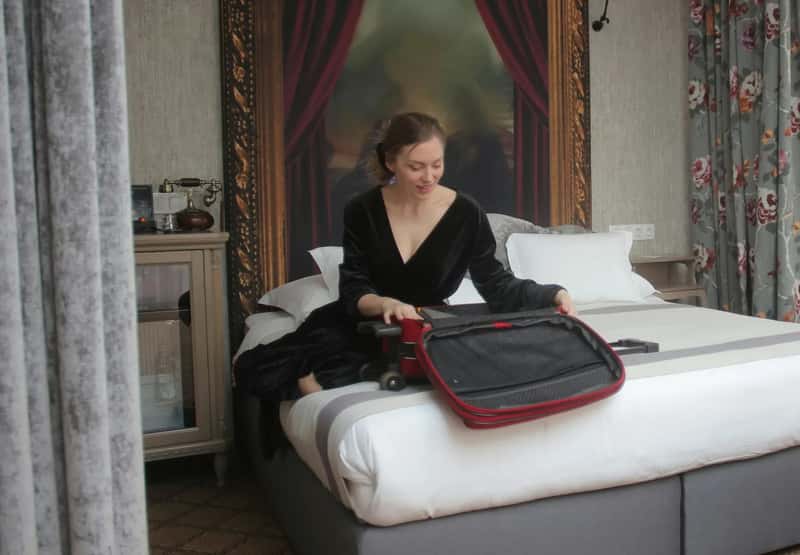
The hotel room smells like someone else’s life.
The sheets are crisp but foreign. The hangers rattle with a hollow metallic sound you don’t recognize.
Your suitcase sits in the corner like an accusation.
You should relax. That’s what you came here to do. But the zipper is still closed, and something in your chest won’t unknot until it isn’t.
Figuring out what to take, what to place where, and how to exist in a temporary space feels like “a quasi-existential question about how you want to feel and who you want to be.” We pretend we are breezy.
We pretend we are the kind of people who throw open curtains and fall onto beds and laugh. But some of us – the ones who are reading this right now – cannot settle until the suitcase is empty and everything has its place.
1. The Territorial Instinct
You walk in and you scan the room before you set anything down.
You note the drawer situation. The closet depth. Whether the hangers are the kind that actually slide off the rod or the kind they’ve bolted in to prevent theft.
This is not pickiness. This is reconnaissance.
The impulse to claim a space in a communal environment reflects a scarcity mindset and a desire to establish personal territory. At its core, it’s about control, not aesthetics. The room was occupied before you. It will be occupied after. But right now, in this sliver of time, it is supposed to be yours – and your nervous system knows the difference between “supposed to be” and actually feeling true.
Unpacking is the act of making the claim official.
You are not being difficult. You are being honest about what your body needs to downshift from high alert into something resembling rest. The suitcase represents transit. Open drawers represent arrival. And until you’ve arrived – really arrived – the vacation hasn’t started yet.
The territorial instinct isn’t aggressive. It’s ancient. It’s the part of you that knows: a body cannot relax in a space it hasn’t claimed.
2. The Anxiety Architect
You build systems because the alternative is chaos.
And chaos, for you, is not a vibe. It is a threat.
The very nature of travel is fundamentally tricky for people who have a hard time going with the flow – you are going somewhere new and different, where you won’t be able to predict or control everything. You already knew this before anyone put it into a clinical sentence. You felt it in your sternum the moment you booked the trip.
The Anxiety Architect doesn’t fret because they are weak. They fret because they are imaginative. They can see every possible version of events, including the ones where the charger is buried under a pile of unorganized clothes at 6 AM when the car is waiting.
Those who plan obsessively often seek to control everything to prevent any possible mishap – it’s a response to anxiety about the unknown, a need for absolute security.
Unpacking is the architecture of safety.
Every item placed in its assigned location is a small act of certainty inserted into an uncertain world. The toiletry bag on the left side of the sink. The shoes lined up beneath the window. The book on the nightstand, not lost somewhere in a dark zip compartment. These are not preferences. These are load-bearing walls.
3. The Identity Cartographer
Your things are not just things. They are coordinates.
They tell you, quietly, who you are when no one is watching and no context is provided. All the contents inside your suitcase inform how you travel down your own path – how you approach your job, how you problem-solve, how you make friends, and how you speak to strangers.
When everything stays zipped inside the bag, your identity stays zipped too.
There is something psychologically destabilizing about living out of a suitcase for days on end. Your objects are compressed, folded against each other, stripped of context. Your favorite shirt is just fabric in a dark cylinder. Your journal is just paper under pressure. Nothing has its relationship to space. Nothing has its meaning.
The Identity Cartographer unpacks because they need to map themselves onto the new terrain.
Most of us have a certain identity associated with our style and how we present ourselves, and depending on the type of trip, there may be a specific identity that is important to convey. To scatter your objects around a temporary room is to say: I was here. I am real. I exist even here, even now, even in a room that will forget me by Thursday.
4. The Routine Follower
You have a morning routine. You protect it like a secret.
Coffee before conversation. Phone after the first hour. A specific order to the bathroom shelf that makes the first thirty minutes of the day feel manageable instead of assaulting.
Travel dismantles the routine. The hotel bathroom is the wrong layout. The coffee is in a machine you don’t understand. The light comes in from the wrong angle.
When traveling, emotions can feel more polarized since we’re experiencing a stressful situation – stress levels increase because we’re not in our comfort zone, surrounded by different people in an unfamiliar environment.
Unpacking is how you rebuild the routine in a foreign geography.
You place the moisturizer on the left. The toothbrush on the right. The book at a specific angle to the lamp. And suddenly, the bathroom feels less like a stranger’s and more like a temporary annex of your real life. You like routine and familiarity. Your surroundings matter, and creating a temporary home base helps you feel grounded.
The Routine Architect isn’t rigid. They are simply someone who knows that stability is not found – it is built, every single morning, from scratch.
5. The Control Seeker
I remember a hotel room in a city I had traveled to alone for the first time. It was a good city. The kind with fog and old stone and restaurants that don’t take reservations. I should have been excited.
Instead, I stood at the foot of the bed for eleven minutes – I know because I checked the clock twice – unable to sit down until the suitcase was empty.
The hangers were wrong. The drawers were shallow. I reorganized them anyway.
What I know now is that I wasn’t being particular about the room. I was reclaiming the only variable I could actually influence. As Dr. Jean Kim, a psychiatrist and professor at George Washington University who has written on travel and mental health, puts it: “Unpacking, literally, is a way for people to get control of their surroundings.”
Travel is inherently out of control – and packing, or unpacking, becomes an attempt to nail down things that can’t be nailed down.
The Control Seeker is not a control freak in the pejorative sense. They are someone who has learned, perhaps through hard experience, that environments shape mood, and mood shapes everything else. To control the environment – even temporarily, even superficially – is to protect the interior. That is not neurosis. That is self-knowledge in action.
6. The Sensory Settler
Some people can sleep anywhere. On planes. On floors. In unfamiliar beds with unfamiliar pillow density and unfamiliar night sounds bleeding through the wall.
You are not those people.
You notice the smell of the room before you notice anything else. You notice the texture of the duvet. The way the air conditioner creates a specific low hum that will either become white noise or a form of water torture by 2 AM.
Your nervous system is finely tuned. This is not a flaw. It is the same sensitivity that makes you good at reading rooms, at noticing when someone is quietly off, at catching the detail everyone else missed.
There exists a subconscious desire to bring something of yourself and your life to a new place – it can make those who worry about venturing into the unknown feel safer and more secure when away from home.
The Sensory Settler unpacks because familiar objects recalibrate the sensory environment. Your own toiletry bag on the counter changes the smell of the bathroom. Your own cardigan draped over the chair softens the visual geometry of the room. You are not decorating. You are sedating your own nervous system, one familiar object at a time.
7. The Permanence Seeker
There is a specific sadness to impermanence that some people feel more acutely than others.
The checkout date printed on the card in the key envelope. The towels folded in that origami hotel style that no one in real life has ever replicated. The miniature shampoo that will outlast your stay.
Everything about the hotel room announces its own temporariness. And for the Permanence Seeker, that announcement is quietly devastating.
“Closing the suitcase feels like the door is officially closed on vacation” – a sentiment that reveals how much emotional weight we place on the state of our luggage. The reverse is equally true. An open, empty suitcase is a promise. It says: I am staying. At least for now. At least for tonight.
The Permanence Seeker unpacks not because they are naive about the checkout date, but because they need the fiction of rootedness to function. They need, even briefly, even falsely, to live as if this room is theirs.
The irony of travel is clear: we travel thousands of kilometres to stay exactly the same. The Permanence Seeker understands this on a cellular level and unpacks anyway – as a small, private act of resistance against the transience they cannot stop.
8. The Perfectionist in Transit
Your clothes are rolled, not folded. Or folded, not rolled. Whichever method you’ve committed to, it is the correct one, and you have opinions about people who do it differently.
The Perfectionist in Transit doesn’t unpack carelessly. They unpack with precision. The shirts go in the order they will be worn. The chargers are arranged by the outlet that makes the most ergonomic sense relative to the bed. The shoes face the same direction.
This kind of traveler is no-nonsense, organized, and doesn’t like much outside interference – they want to be in control of their own life, and they are smart, not fast to trust or confide in others.
The perfectionism is not about the clothes. It is about maintaining a standard in a standardless environment.
Home has rules you wrote. The hotel has rules written by someone who will never meet you. Unpacking with precision is how the Perfectionist rewrites the rulebook in real time. Every folded edge is a small assertion: I have standards. They travel with me. They apply here too. This room will conform to me, not the other way around. That kind of quiet insistence is not a flaw. It is a form of self-respect with luggage.
9. The Emotional Processor
Travel cracks people open. The distance from home, the altered routine, the unfamiliar faces – all of it strips away the layers of busyness we use to avoid feeling things.
Suddenly, in a quiet hotel room, you feel things you didn’t know you were carrying.
The Emotional Processor knows this. They feel it before the plane lands.
Unpacking right after arriving helps create a feeling of true rest – there is something about the act of emptying out, returning things to their place, and clearing space that brings a deep, quiet kind of peace.
The physical act of unpacking mirrors the psychological act of processing. You take things out one at a time. You give each thing its place. You create order from the compressed chaos of transit. And in doing so, you do to your internal state exactly what you are doing to the suitcase.
There are layers beneath the act of unpacking that go deeper than just the baggage – there is ownership, reflection, and healing. The Emotional Processor doesn’t just unpack their clothes. They unpack the week. The argument before departure. The deadline left unresolved. The relationship that needed tending. The suitcase empties. The mind, slowly, follows.
10. The Home-Builder
This is the deepest one. The one that sits at the bottom of all the others like ballast.
Some people carry home inside them easily. They can land anywhere and feel settled within minutes. The room is just a room. The bed is just a bed. They are the same person in every geography.
And then there are the Home-Builders.
The Home-Builder is someone for whom the concept of home is not a given. It is a practice. Something assembled carefully, every single time, from the objects and arrangements and rituals they carry with them. From the very beginning of life, the metaphorical suitcase we carry is filled by others – packed with the beliefs, values, and tools the people who raised us thought we would need. The Home-Builder has spent a lifetime learning to re-pack that suitcase on their own terms.
When they arrive in a temporary room and immediately begin to build – hanging clothes, lining up shoes, placing books at specific angles to lamps – they are not being obsessive.
They are practicing the most fundamental human skill there is.
The way we organize our surroundings is a reflection of our personality, our priorities, and our unique approach to life – and in a world full of chaos and unpredictability, this is one small way to assert control. For the Home-Builder, a hotel room is not a destination. It is raw material. They will make something of it. They always do. The checkout date is irrelevant. Right now, in this hour, in this light, with this arrangement of familiar objects in an unfamiliar space – they are home. Completely, impermanently, defiantly home.
There is something worth sitting with in all of this. The idea that the things we do automatically – the rituals that happen before we’ve even consciously decided to begin them – are not accidents of personality. They are responses. To history, to anxiety, to the particular texture of impermanence that modern life asks us to tolerate at an increasing volume.
To be someone who cannot relax until the suitcase is empty is to be someone who has thought carefully, even if wordlessly, about what it means to inhabit a space. Not just occupy it. Not just pass through it. But genuinely, briefly, humanly inhabit it. There is a dignity in that. A self-awareness that most people never have to name because they never feel the gap loudly enough to wonder about it.
The empty suitcase in the corner of the room is not a small thing. It is a completed act of translation – from stranger to resident, from visitor to self, from transit to arrival. You did not unpack your clothes. You unpacked your need for ground beneath your feet in a world that offers very little of it. And you did it quietly, practically, efficiently, the same way you do everything that matters most to you.
The room is yours now. Even if only until Thursday.