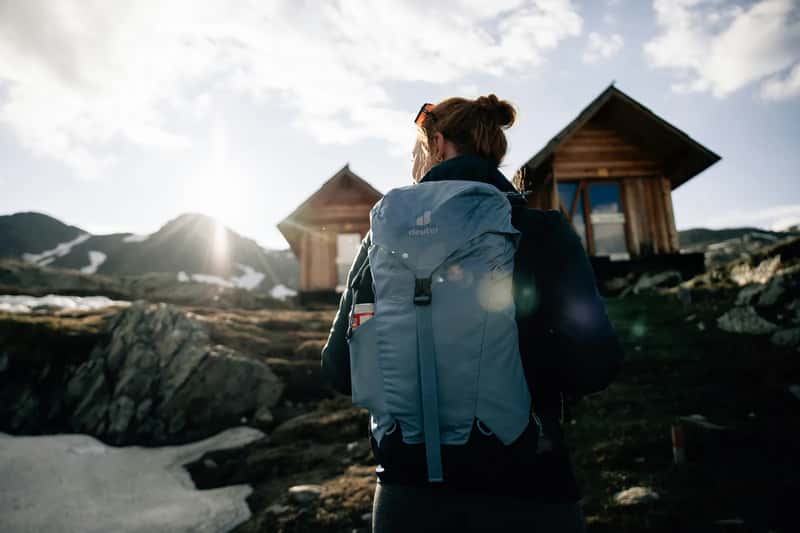
The lodge is silent at 3,200 meters.
You are not silent. Not yet.
But something underneath you – something biological and ancient – is beginning to exhale.
You have carried the weight of your ordinary life up a mountain. Your inbox. Your mortgage. The version of yourself your colleagues depend on. The version your family has memorized. And somewhere between the trailhead and this rough-hewn room with its single wool blanket and its view of nothing but cloud, you noticed something strange. You felt lighter. Not metaphorically. Literally. The air thinned. And so did everything else.
1. The Pressure You Can’t Name
Sea level is suffocating. Not physically – not for most of us. But psychologically, it is a compression chamber.
At sea level, you exist inside a dense ecosystem of expectation. Social. Professional. Familial. Digital. The pressure is ambient. You do not notice it the same way you do not notice the weight of the atmosphere pressing down on your shoulders at 14.7 pounds per square inch.
Until it’s gone.
Chronic low-level stress keeps the HPA axis activated, much like a motor that is idling too high for too long. The HPA axis – your hypothalamic-pituitary-adrenal stress highway – is the biological infrastructure of your modern anxiety. It runs quietly. Continuously. Burning cortisol like an engine that never gets switched off.
The mountain lodge is not a cure. It is a circuit breaker.
The strange peace you feel up there is not weakness. It is your body remembering what quiet feels like. That sensation – the one you’ve been chasing through vacations and wine and Sunday mornings – is simply your nervous system finding the brake pedal for the first time in months.
2. The Thin Air Hypothesis
There is a biological conversation happening between altitude and your brain that most people have never been told about.
High and extreme altitude environments, including their characteristic hypobaric hypoxic conditions, are powerful modulators of the human psychological state. This is not poetry. It is physiology. The moment you ascend, atmospheric pressure drops. Oxygen partial pressure decreases. Your body, suddenly operating in a chemically different world, is forced to redirect its attention.
It stops performing. It starts surviving.
The hypoxic response overlaps with the acute mental stress response that facilitates the fight-or-flight reaction – suggesting a link between the hypoxia response and mental stress, the mechanistic basis of which is currently poorly understood. In simpler terms: altitude and anxiety speak the same neurological language. They share circuitry.
And when altitude occupies that circuitry – when your body is focused on breathing and blood flow – there is simply less bandwidth left for dread. Less room for the low-grade hum of modern catastrophizing. The thin air hypothesis is this: the mountain doesn’t heal you. It just crowds out your demons with something more immediate.
3. The Neurotransmitter Shuffle
Your brain at altitude is a different brain. Chemically. Measurably.
It is likely that the direct effects of mild transient hypoxia on the brain are variations in the level of specific neurotransmitters. Because the synthesis of several neurotransmitters is oxygen dependent, abnormalities of neurotransmitter metabolism may mediate the early functional changes due to acute hypoxia.
Translation: the mountain reshuffles your neurochemistry without asking permission.
Serotonin. Dopamine. Norepinephrine. The molecules that govern mood, motivation, and meaning – they shift. Hypoxia can impact neurotransmitter synthesis, which is considered a fundamental cause of emotional disturbances. But here is the irony that science has not fully resolved: for many people – particularly those already living in a state of chronic cortisol overload – the disruption feels like relief.
When your baseline is saturated with stress hormones, a chemical disruption can register as peace. The mountain doesn’t give you serenity. It gives you a different kind of noise. And sometimes, different is enough.
4. The Sympathetic System Takes a Breath
Your sympathetic nervous system is your internal alarm. It is meant to fire in short, decisive bursts – a threat appears, adrenaline surges, you act, and then it quiets.
Modern life has broken this system.
The HPA axis relies on a series of hormonal signals to keep the sympathetic nervous system pressed down. If the brain continues to perceive something as dangerous, the hypothalamus releases corticotropin-releasing hormone, which travels to the pituitary gland, triggering the release of adrenocorticotropic hormone. This hormone travels to the adrenal glands, prompting them to release cortisol. The body thus stays revved up and on high alert.
The alarm never stops. It just changes pitch.
At altitude, your body’s threat-processing shifts from psychological to physiological. The threat becomes concrete – thin air, cold, unfamiliar terrain. And paradoxically, a concrete physical challenge can quiet a chronic psychological one. Your nervous system knows what to do with a mountain. It does not always know what to do with a quarterly review, a passive-aggressive email, or the quiet dread of being seen and found insufficient.
5. The First-Person Evidence
I remember the exact moment I understood this.
It was a lodge in the Dolomites, 2,100 meters. A room the size of a generous closet. No Wi-Fi. No mirror that wasn’t cracked. I had spent six months running at a pace that felt mandatory – the specific momentum of someone afraid to stop because stopping means accounting.
The first evening, I sat on the wooden steps outside and waited for my anxiety to find me. It always did. But that night it arrived late. Muted. Like a signal losing strength as the distance grows. My chest, which had been a clenched fist for months, opened a little. I was breathing differently – more deliberately, because the air demanded it. Breathing impacts our nervous system and our mental health; it’s all connected. I understood that sentence for the first time not as information but as sensation.
The mountain did not fix me. But it reminded me that I existed beneath the performance. That there was someone underneath the schedule. That the gap between who I was required to be and who I actually was could be measured – and it could breathe.
6. The Identity Vacuum
At altitude, your social identity loses signal.
You are not your job title up there. You are not your relationship status, your car, your neighborhood, or the carefully curated persona you’ve been building on digital platforms since the mid-2000s. The mountain lodge enforces a radical equality. Everyone is cold. Everyone is breathing hard. Everyone looks approximately the same in a base layer.
When we step out of our everyday environments and routines, we undergo a temporary rearrangement of our identities – one that lets us imagine other possibilities for ourselves. We can escape our at-home personas and live unbound, or widen our perspectives and make big-picture plans for future iterations of us.
This is not escapism. This is excavation.
The Identity Vacuum of altitude strips you of context. And when context collapses, something quieter underneath it rises. Not your best self or your worst self. Just your actual self – unperformed and unscheduled. Many people find this terrifying. Some find it the closest thing to peace they have ever known.
7. The Awe Architecture
There is a specific emotional technology deployed by mountain environments that no therapy office has fully replicated.
It is awe.
Awe promotes what psychologists call “self-transcendence,” a state in which individuals feel a part of something bigger than themselves. Awe can be understood as a “small self” experience – when we encounter something vast or beautiful, it evokes a sense of humility and interconnectedness.
The mountain is vast. Your problems are not.
This is not a dismissal of your problems. It is a recalibration of scale. Awe works on the nervous system like a reset – it temporarily suspends self-referential thinking, the relentless internal monologue that at sea level runs on a loop of evaluation, comparison, and low-grade catastrophe. The peaks do not ask you to think about yourself. They invite you to look outward. And for brains exhausted by inwardness, outwardness is the rarest luxury.
8. The Acclimatization Metaphor
The body does not immediately accept the mountain. It resists first.
Immediately upon ascent to high altitude, there is decreased blood oxygenation, which reduces the oxygen supply throughout the periphery and in the brain. With time the body compensates, at least in part, for the lack of oxygen with a variety of physiological responses and adjustments. In aggregate, this is termed acclimatization.
Acclimatization is a psychological metaphor wearing a physiological costume.
Every genuine transformation – in identity, in self-understanding, in the slow renegotiation of who you are – begins with a period of resistance. Headache. Disorientation. The body’s complaint against the new. The traveler who seeks peace in high altitude knows this instinctively. The first day is always the hardest. The air feels hostile. The silence feels loud. And then, gradually, the body learns. It makes more red blood cells. It deepens its breathing. It finds a way to thrive in the reduced atmosphere. Many people who live at high altitudes for extended periods often develop greater resilience to cognitive decline, even when performing mentally demanding tasks. The mountain trains you. But first, it unsettles you. That unsettling is not a problem. It is the point.
9. The Sea-Level Suffocation
Consider what you return to.
Sea level is loud in ways that altitude is not. It is loud with notification sounds and traffic patterns and the particular social noise of being known and therefore obligated. Traveling allows us to temporarily leave behind the stressors of our regular environment. Whether it’s the demands of work, household responsibilities, or other ongoing pressures, a change of scenery can provide the mental distance needed to relax and recharge. It’s not just about physical rest; it’s about giving your mind a break from the constant barrage of thoughts and worries that come with everyday life.
The sea-level self is a performance. Running continuously. Without intermission.
Chronic stress can lead to HPA axis dysfunction and cause consistently increased cortisol levels in your body. The irony of modern wellness culture is that we build elaborate, expensive architectures of recovery around a life we refuse to restructure. We meditate for ten minutes and then return to twelve hours of ambient emergency. We do breathwork at dawn and then spend the day in meetings designed to manufacture urgency. The mountain lodge is not a luxury. For many people, it is the only place where the performance is involuntarily suspended. Where the architecture of daily pressure – social, professional, digital – simply cannot follow.
10. The Descent and What It Costs
Coming down is the hardest part. And nobody talks about it.
The peace you found at altitude does not descend with you. It stays up there, thinning with distance, like a radio station you lose as you drive out of range. The lodge, the silence, the chemical quietude – they were never portable. The process involves navigating what sociologists call a “liminal state,” a transitional phase between fixed social identities. In this state, individuals are temporarily outside the normal constraints of their home culture, allowing them to experiment with new behaviors and self-definitions.
The descent forces the question the mountain let you avoid: what do I do with this clarity in a world designed to obscure it?
The answer is not another trip to another mountain, though the craving will be immediate and compelling. The answer is what you do in the valley with what the altitude showed you. Even local explorations can provide the psychological distance needed to gain perspective on your life and identity. The key lies not in the distance traveled but in the mental space created for self-discovery. The mountain is only the teacher. You are the lesson. And the lesson is this: beneath every performance, beneath every expectation and obligation and curated self – there is a person who was never lost. Only buried. Buried under the atmospheric weight of a life lived at sea level, at full pressure, without reprieve.
The lodge at 3,200 meters gave you nothing new. It simply removed enough of the old to let you feel the difference.
There is a specific grief that comes with descending from altitude. It arrives around the hairpin bend where the signal returns to your phone, where the first notification comes through, where the mountain becomes visible only in your rearview mirror and smaller with every kilometer. The grief is not for the place. It is for the version of yourself that existed there – lighter, quieter, more honest. A version that did not require maintenance.
The question worth sitting with – not answering, just holding – is not how to get back to the mountain. The question is why the mountain was necessary in the first place. Why did it take 3,200 meters and reduced atmospheric pressure to feel like yourself? What is it, exactly, that suffocates you at sea level? And is it something the air is doing, or something you agreed to carry?
The lodge is silent at 3,200 meters. And in that silence, for the first time in a long time, you could hear what you actually think.