The bus lurches forward.
Your suitcase disappears into the hold beneath you.
And something in your chest goes with it.
You smile at the stranger beside you. You stare out the smudged window. You perform calm like it’s a second language you learned too late in life.
But under the performance, there is a version of you gripping something invisible – a version that knows, with absolute certainty, that everything it needs to survive is currently out of reach.
1. The Suitcase Is Not a Suitcase
Let’s start with the hard truth.
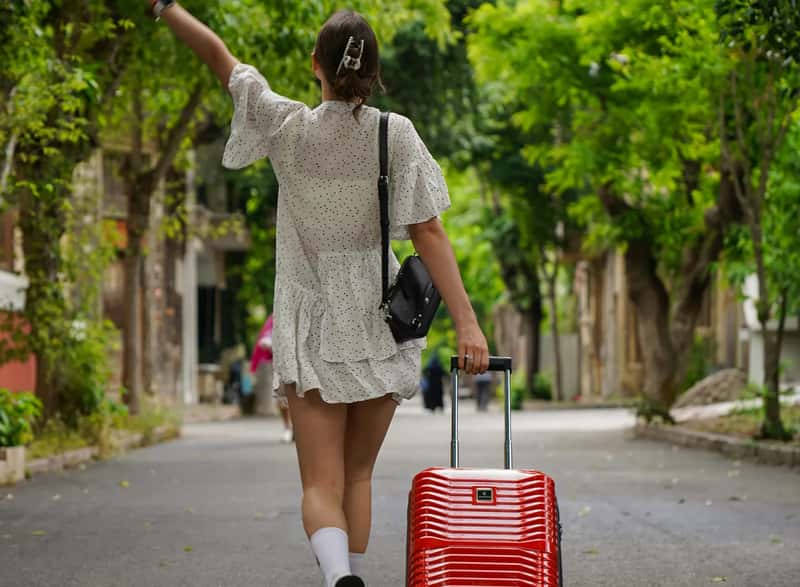
Your suitcase is not a collection of clothing and toiletries.
It is a portable self.
According to psychoanalyst Christian Richomme, “the suitcase becomes a transitional object: it holds not just items, but also our securities, our temporary identities.” That is not a metaphor. That is a clinical observation about what happens when a human being, stripped of their usual environment, pours their sense of self into a hard-shelled case on wheels.
In times of stress and uncertainty, possessions act like an anchor. They provide stability in a world that can sometimes feel chaotic and unpredictable.
When the bus swallows your bag, it isn’t taking your shirts. It is taking the anchor. And the anxiety that floods in behind it is not irrational. It is ancient. It is human. It is the alarm system of a creature who has learned that losing things sometimes means losing everything.
2. The Portable Fortress
We build walls wherever we go.
We just call them luggage.
For many, a heavy suitcase is a physical manifestation of high anxiety or a low threshold for uncertainty. If you feel the need to bring everything but the kitchen sink, you might be using your belongings as a portable fortress.
Think about what you actually pack. The “just in case” outfits. The backup charger for your backup charger. The medication you haven’t needed in three years. This habit often stems from a desire to compensate for future discomfort. We imagine ourselves in a foreign city, shivering or underdressed, and the mental image is so distressing that we add five pounds of “buffer” items to our luggage.
The fortress is real. And when it disappears into a cargo hold, you are left standing in open country with no walls and no roof and the wind going straight through you.
That feeling is not weakness. That feeling is the fortress reminding you of how much you needed it.
3. The Separation Anxiety You Never Outgrew
You thought you left this behind in childhood.
You did not.
Bowlby’s observation in Attachment and Loss is that all anxiety – or at least all neurotic anxiety – is in the last resort separation anxiety. Bowlby was talking about people. But the mechanism is identical when applied to objects that have been elevated to the status of people in your nervous system.
Neuroscience research has shown that when we form attachments to objects, the same areas of our brain activate as when we form connections with people. This explains why parting with seemingly insignificant items can trigger genuine emotional distress.
The bus pulls away. The brain fires the same signal it fired when your mother left the room. The intensity of that signal depends entirely on how many times, in your life, the room stayed empty too long.
4. The Control Equation
Travel is inherently a negotiation with powerlessness.
Most of us lose.
The very nature of travel is just fundamentally tricky for people who have a hard time going with the flow. You are going somewhere new and different, where you won’t be able to predict or control everything. If you’re someone who is used to a set routine, this kind of planning can be quite anxiety-provoking.
The suitcase is the one variable you thought you could control. You chose what went inside it. You organized it. You locked it. You labeled it. And now a stranger has slid it into a metal compartment and sealed the hatch and driven away with the only thing in this entire country that you selected, curated, and called yours.
Psychologists and travel experts suggest that the persistence of overpacking has more to do with psychology than logistics. Anxiety, attachment and past experiences all play a role. “Travelers often pack for their fears instead of their needs,” according to one security and travel expert.
You were never packing for the trip. You were packing against the uncertainty.
5. The Night Before Every Trip I’ve Ever Taken
I want to stop here for a moment.
Because I know this feeling from the inside.
The night before any significant journey, I don’t sleep. I check the bag. I re-check the bag. I move the same three items between the main compartment and the outer pocket, as though their location is a matter of survival. By 2 AM, I have repacked everything twice and convinced myself I’ve forgotten something I cannot name.
What I am actually doing – what I have always been doing – is trying to build certainty out of fabric and plastic and zipper teeth.
Travel is inherently out of control, and when we pack, we are trying to nail down things that can’t be nailed down. I read that once and had to put the article down. Because it was too accurate. Because it said in one sentence what I had been doing in the dark for years without the language to describe it.
The bag was never the problem. The need for the bag to be perfect was the problem. And that need had a long address, somewhere back in a childhood that demanded I be prepared for everything or suffer the consequences.
6. The Endowment Effect at 60 Mph
Here is a cognitive quirk that operates beautifully at highway speed.
The endowment effect is a psychological phenomenon where people give more value to items just because they own them. Owning items makes them extra special to a person and makes it hard to part with them because of this projected value. Those with the endowment effect may have anxiety or regret if they lose an item or donate it.
On the bus, the endowment effect goes into overdrive. Every item in that invisible bag becomes irreplaceable. The two-dollar face wash becomes an artifact. The backup sandals become heirlooms. The anxiety is not proportional to the actual value of the objects. It is proportional to the value you have quietly assigned them as stand-ins for stability.
The suitcase goes out of sight. The brain inflates its worth to match the panic. And suddenly you are grieving a bag that is still on the bus, three feet below you, perfectly intact.
7. The Immigrant Dream
There is a piece of research that stops me cold every time I encounter it.
In their book about migration and exile, researchers provide a way of looking at our strong attachment to objects and the effect of their loss. It brings attention to what importance the loss of the nonhuman environment means to an emigrant’s existence. That is why emigrants usually try to take with them as many as possible of their belongings. One given example is a dream of an emigrant woman about losing all her things, except her identity papers. In this way, she managed at least to hang on to knowing who she was.
Read that again. She lost everything. But she kept the papers. Because the papers said: I exist. I have a name. I am from somewhere.
Now ask yourself: when your suitcase disappears into the hold of a bus, what is it you are really afraid of losing? Is it the clothes? Or is it the proof of who you are when everything around you is unfamiliar?
8. The Safety Hoarding You Do in Motion
You don’t have to be stationary to hoard safety.
You can do it on the move. Many people do.
The thought process often goes like this: “If I keep this, I’m prepared for any situation that might arise.” This mindset can be especially strong in times of stress or transition, leading to what psychologists call “safety hoarding” – holding onto items as a form of emotional insurance.
Bringing along lots of belongings is a totally normal and reasonable response to the stress and uncertainty of travel. To soothe our innate fear of the unknown, we arm ourselves with familiar objects that can offer either practical value or psychological comfort.
The suitcase is your mobile insurance policy. When it vanishes from your line of sight, the policy lapses. And the uninsured self – raw, exposed, improvising – has to sit very still on a bus seat and pretend it is fine.
It is not fine. But it is survivable. That distinction matters more than you know.
9. The Identity in the Cargo Hold
What you wear tells a story.
What you pack tells a deeper one.
Emotional attachment to possessions plays a critical role in personal well-being and relationships. Many individuals see their belongings as extensions of their identity, perceiving the act of discarding items as equivalent to losing a part of themselves. This deep emotional connection can create feelings of security, especially for those grappling with loneliness or past traumas.
For psychoanalyst Christian Richomme, how we pack speaks volumes about “our way of living, loving, and protecting ourselves.” Packing isn’t just about filling a bag; it involves balancing the fear of forgetting something, the desire to do it right, and the stress of preparation.
In the cargo hold, right now, is the version of you that you planned. The outfits for the person you intended to be on this trip. The toiletries of the person who keeps it together. The books of the person who reads on vacation instead of just staring at the ceiling wondering if they made the right choice by leaving.
Losing the bag would not just be an inconvenience. It would be a casting change. Mid-trip. No rehearsal.
10. The Quiet Terror of Being Unequipped
This is where it gets heavy.
This is the point beneath all the other points.
A 2019 study on airport anxiety by Priority Pass found that the top five fears people had while travelling were: getting stuck on the way to the airport, losing baggage, missing boarding, losing a passport and delays. Losing baggage ranked second. Above missing the plane entirely. Think about that. People are more afraid of losing their things than of not getting where they’re going.
Because getting where you’re going means nothing if you arrive as no one.
Our things comfort us on cold nights, increase our confidence when we feel more insecure, and are the connection with the people and places we cherish. Possessions are a thread that binds our past to our present and our aspirations for the future. They are a record of our achievements, dreams and personal history.
The suitcase going out of sight is not a logistical problem. It is an existential one. It is the moment the self becomes theoretical. Unverified. Waiting in a cargo hold to be confirmed.
There is a particular kind of traveler who does not cry at airports. They cry in bus seats, silently, watching the road ahead, while somewhere below them, everything they packed with such careful intention rides in darkness, unwitnessed.
They are not afraid of losing their suitcase. They are afraid of discovering, in its absence, that they were never as solid as they thought. That the calm, capable person they became through years of quiet effort was, in part, stored in a bag. And bags can disappear. And what then? Who then?
The answer is: still you. Lighter, perhaps. More frightened than you’d prefer. But still the person who packed the bag in the first place, which means still the person who knows, somewhere underneath the panic, exactly what they need to survive.
The bus keeps moving. The hatch stays sealed. And maybe that is the whole practice – sitting with the sealed hatch, breathing through the not-knowing, remembering that you existed before you ever owned a suitcase worth worrying about.