The market smells like cardamom and rain-wet concrete.
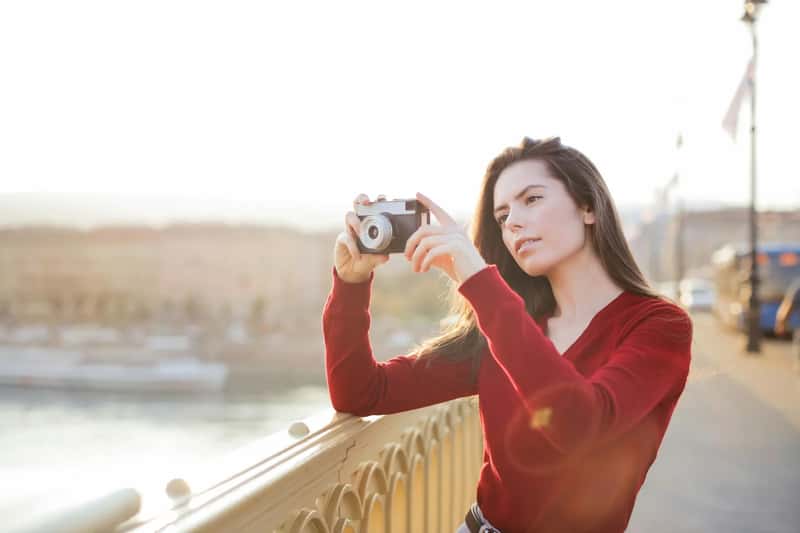
You raise your phone.
The smell disappears.
The moment – the real one – is already gone, replaced by a rectangle of light and the quiet, desperate hope that someone, somewhere, will double-tap their approval into existence.
This is the identity gap. The chasm between the person who actually stood in that market, heart half-open to the chaos of it, and the person who needed the world to know they were there. Between the self who travels and the self who performs traveling. One is fragile, uncertain, alive. The other is curated, compressed, and permanently online. Most of us have stopped asking which one is real. Most of us already know the answer and keep scrolling anyway.
1. The Performance Begins Before You Board
It starts in the planning phase. Not with maps or guidebooks.
With captions.
You are composing the post before you’ve packed the bag. You are already constructing an audience in your head – imagining their reactions, their envy, their admiration – before the plane has lifted off the tarmac.
Researchers conceptualize this as “performance-oriented sharing motivation” – an extrinsic psychological drive wherein tourists deliberately curate and present travel content to construct a desirable self-image and gain social validation.
The holiday is not the destination. The holiday is the version of yourself you want to broadcast from the destination.
That is a profound and exhausting distinction. It means you never truly arrive anywhere. You arrive at a set. You arrive at an opportunity. The place itself – its light, its noise, its strange human texture – becomes backdrop. You are the foreground. You are always the foreground.
And the tragedy is that you planned it this way.
2. The Dopamine Architecture
There is a chemical explanation for all of this, and it is not flattering.
The cycle of social media posting and validation affects the dopamine levels in your brain. Those boosts and drops build insecurity and force you to constantly be self-aware and conscious of how your travel compares to other people’s similar vacations.
You are not traveling. You are feeding a loop.
The notification is the reward. The likes are the drug. The “authentic” moment you hunted down in a cobblestone alley at golden hour was not for you. It was for the algorithm, and for the neurological hit that comes when the algorithm approves.
This is not weakness. This is architecture. The platforms are designed, deliberately and with enormous financial investment, to keep you performing. To keep you needing the next hit. Understanding this does not make the compulsion disappear. But it does name it. And naming it is the first dark mercy.
3. The Audience Consciousness Trap
Here is the insidious part. The audience is not always real.
Sometimes the audience is a phantom – a composite of people you half-know, people you want to impress, people who may not be watching at all. And still you perform for them.
Research from the University of Pennsylvania found that heavy social media users often experience what psychologists call “audience consciousness,” where every experience becomes a potential performance.
Audience consciousness is a haunting. You carry it like a second body. It sits behind your eyes at the temple ruins, at the night market, at the waterfall at the edge of the trail where nobody else has hiked.
It asks: How does this look?
Not: How does this feel?
The shift between those two questions is the entire distance between living and broadcasting. Most people in the grip of this compulsion have forgotten the feel question exists at all.
4. The Authenticity Paradox
You travel for authenticity. Every influencer, every travel brand, every algorithm-optimized listicle promises it to you.
But the moment you point a lens at it, authenticity recoils.
The widespread use of social media is reshaping both the purpose and practice of travel. Tourism is no longer solely about accumulating personal memories; it has increasingly become a “performance.”
And performance, by its very definition, requires an audience.
So you arrive in the place that promises the real and the raw, and you immediately begin the process of making it palatable for people who are not there. You soften its edges. You crop out the poverty, the litter, the discomfort. You apply a filter that makes the sky look like a painting rather than a sky.
What you post is not the place. It is your need projected onto the place. Authenticity relates to a state of being – tourists might be their true selves facilitated by touristic escape from traditional roles back home. But you cannot escape your roles if you carry your roles with you in your pocket, broadcasting them in real time.
5. The Moment I Put the Phone Down
I remember a morning in a fishing village I will not name here, because naming it feels like the beginning of a performance.
I had been photographing everything for four days. Every plate of food. Every doorway painted in colors I didn’t have words for. Every weathered face I thought the internet would find beautiful enough to validate.
On the fifth morning, my phone died. Completely. Battery gone, charger left at the previous guesthouse, two hours from anything.
And something strange happened. The village did not disappear. In fact, it arrived. The smell of the harbor became specific and overwhelming. A child laughed and the sound had a shape. An old man fixed a net and his hands were the most interesting thing I had seen in four days of looking.
I had been looking at everything. I had not been looking into anything.
That is the gap. That is exactly the gap.
6. The Memory Theft
Here is what the compulsion costs you beyond the present moment. It costs you the past.
Research from the Journal of Experimental Social Psychology found that taking photos during experiences can actually reduce our enjoyment and memory of those moments. We become so focused on documentation that we miss the actual experience.
The memory you are trying to preserve is being destroyed by the act of preserving it.
You will scroll back through those photographs one day – hundreds of them, thousands of them – and feel strangely hollow. Because the images are records of a performance, not records of a life. They prove you were there. They do not prove you felt anything. And somewhere in your nervous system, you know the difference.
The unrecorded moments are the ones that stay. The ones that arrive in your chest at 2 AM, unbidden and complete. The rain on the bus window. The conversation you had with a stranger whose name you never learned. These were not photographed. They could not be. They existed only in the first person.
7. The Social Comparison Engine
The compulsion to document is never truly about documentation. It is about position.
Social psychologist Leon Festinger’s theory of social comparison tells us that humans naturally evaluate themselves relative to others. But social media has turned this occasional tendency into a constant, exhausting marathon.
Every post is a bid. A quiet, desperate bid to be seen as the kind of person who has this kind of life.
This comparison trap is particularly vicious because we’re comparing our behind-the-scenes reality with everyone else’s highlight reel.
You are standing at the summit, lungs burning, genuinely moved – and the first thought is comparative. Did anyone else post this summit this week? Will mine be better? More interesting? More authentic?
The summit does not care. The summit was there before you arrived and will be there long after your post gets buried. The mountain is indifferent to your metrics. That indifference is a gift, if you can receive it.
8. The Exit Strategy That Isn’t
Some travelers believe that switching to a “better” relationship with documentation – posting less, posting more mindfully, posting only on Sundays – will solve the underlying problem.
It will not.
Because the problem is not the volume of posts. The problem is the orientation of the self. Psychologists advise approaching travel as a singular, in-the-moment experience rather than something with an audience for later. As one researcher notes, millennials and Gen-Z have gotten used to living life from both a first-person perspective and a third-person perspective of having others watch us live as it happens.
The third-person perspective is the thief. It is the invisible director who follows you everywhere, staging your life for an unseen camera. You can reduce the posting frequency and still live entirely in third person. You can be fully offline and still experience everything through the lens of how it would look if you were to share it.
The exit is not a posting schedule. The exit is a fundamental reorientation toward your own interior life as the primary audience for your experience.
9. The Identity Built on Sand
Travel, for many of us, has become the primary architecture of identity. Not who we are at home, at work, in the quiet hours – but who we are moving, arriving, exploring.
Postmodern tourists seek self-actualization through experiential authenticity, often mediated by their social identity affiliations. But when the self-actualization requires an external audience to be real, it is not actualization at all. It is theater.
An identity built on documented experiences is an identity that requires constant maintenance. Constant new content. Constant proof of existence. The moment you stop traveling – the moment you stop posting – the identity begins to dissolve.
That is a terrifying kind of fragility.
Younger consumers tend to be more attracted towards extraordinary and extreme experiences, whereas older consumers, who feel less of a need to negotiate their self-identity, tend to find value in everyday routines that reflect the lifestyle they have chosen. The hunger for extreme, sharable, validate-able experiences is not just a preference. It is a symptom of an identity that does not yet trust itself to be real without external confirmation.
10. The Unwitnessed Life
The heaviest truth is this: you are afraid that the unwitnessed moment does not count.
That the sunset no one saw you watching did not really happen. That the meal you ate alone without photographing it did not nourish you in any way that matters. That the grief you felt in a foreign city, the sudden inexplicable joy, the moment of absolute stillness at the edge of something vast – that none of it is real unless it is seen.
Psychologists have discovered that people who compulsively post everything online are often trapped in validation-seeking behaviors that rob them of genuine experiences and authentic connections.
This fear is ancient. Humans have always needed witnesses. It is not pathological to want to be seen. But somewhere between that ancient need and the architecture of the modern internet, something went wrong. The need became a dependency. The sharing became compulsive. The witness became an algorithm.
And the self – the actual self, the one with the cardamom smell still in its memory – got left behind at the airport.
There is a version of travel that asks nothing of the crowd. It does not perform. It does not compete. It moves through the world with the lights half-dimmed – present, porous, genuinely altered by what it encounters. It does not return with content. It returns with sediment. The slow, private accumulation of having actually been somewhere.
This version of travel is harder. It offers no immediate reward. The dopamine hit does not arrive. The comparison engine idles in silence. You are left alone with the experience itself, which is enormous and unfiltered and sometimes uncomfortable and yours in a way that a liked photograph can never be yours.
The question is not whether you should stop documenting. The question is whether you can sit with a moment long enough to let it become a memory before you turn it into content – and whether somewhere in the quiet interval between experiencing and sharing, you might find the person you were traveling to become all along.