You’re standing at the edge of something magnificent.
The sun is bleeding into the horizon. The air smells like salt and something older than memory.
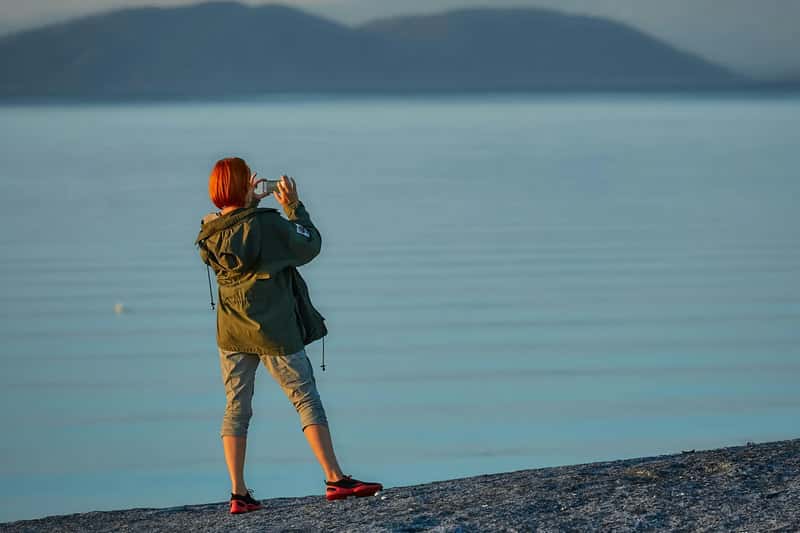
And your first move is to reach for your phone.
Not to feel it. Not to let it land. To capture it – to send it somewhere else before it has the chance to belong to you.
There is a name for this gap. The space between the person who arrived at the viewpoint and the person who immediately needed someone else to confirm that arriving was worth it. It’s the Identity Gap – the hairline fracture between who we perform ourselves to be and who we actually are when the Wi-Fi drops and the likes stop coming and it’s just us and the view and the terrifying silence of an unwitnessed moment.
The Shutter Reflex
You don’t decide to photograph first. It just happens.
The phone is already out. The lens is already framing. Your nervous system has been conditioned to mediate experience before it allows you to have it.
Research has found that taking photos with the intent of sharing increases self-presentational concern, which reduces enjoyment and genuine engagement with the travel experience. Read that again. The act of preparing the proof diminishes the thing being proven.
This isn’t about photography. Photography is beautiful. This is about the compulsion – the involuntary reach, the almost panicked need to document before you’ve even drawn a full breath of where you are.
The shutter reflex is your nervous system’s way of saying: I don’t trust this moment to count unless someone else sees it. It is anxiety wearing the costume of artistry. It is a small, quiet crisis dressed up as content creation. And the most unsettling part? Most people never notice they’re doing it at all.
The Borrowed Gaze
Somewhere along the way, you stopped seeing through your own eyes.
You started seeing through a lens calibrated by other people’s approval.
When you look at a landscape and your first instinct is to think about how it will read on a grid, you are not looking at the landscape. You are auditioning it. You are deciding, on behalf of an imagined audience, whether this moment deserves to exist.
According to social comparison theory, exposure to others’ content can implicitly trigger self-concept evaluations. What this means in practice is that you’ve absorbed thousands of other people’s curated realities until your own perception is filtered through their standards.
The borrowed gaze is exhausting because it is never truly satisfied. Every shot is evaluated not by whether it moved you, but by whether it will move them. You are perpetually outsourcing your sense of wonder. And wonder, borrowed from someone else’s imagination, goes flat within hours.
The Proof Addiction
The mountain wasn’t real until you posted it.
The meal didn’t happen until it was captioned. The sunset was provisional – pending approval.
This is proof addiction: the psychological loop where an experience feels incomplete until it is externally confirmed. Validation seeking is the tendency to rely on external validation, praise, or reassurance from others – whether through social media, loved ones, or other external sources – to feel secure or worthy. In plain language, it is when your sense of self-worth depends heavily on how others respond to you.
In travel, proof addiction is especially cruel because it inverts the entire purpose of going somewhere new. You leave to escape the familiar. But then you immediately re-anchor yourself to the familiar infrastructure of likes, comments, and the opinions of people who are sitting exactly where you left them. The mountain was supposed to change you. Instead, you changed the mountain into content.
And you left the same person you arrived as.
The Incomplete Present
There is a specific kind of dissociation that happens at beautiful places.
You are physically there. But you are also simultaneously nowhere – composing the caption in your head, planning the hashtags, imagining the responses.
Photo-taking evokes outward-focused perspectives that can take the individual away from the here and now, reducing mindfulness. The present tense becomes a transit lounge. Just a place you pass through on your way to posting.
The incomplete present is the most common form of modern grief that nobody talks about. You stood at the edge of something extraordinary, and you were somewhere else entirely. You will scroll past that photo later and feel a dim, confused ache – nostalgia for a moment you technically attended but never actually inhabited. The view was real. Your presence in it was not.
The Hollow Feed
I remember standing on a rooftop in Lisbon at dusk. The whole city was going amber and rust below me.
I took eleven photos before I took a single breath through my nose and just stood there.
By photo three, I had already started composing the caption. By photo seven, I was checking my signal. The city was right there – ancient, indifferent, magnificent – and I was already somewhere else, running a small internal PR campaign for a version of myself that looked like the kind of person who goes to Lisbon.
That version got twelve comments. The real version, the one who finally put the phone down and felt the warm stone of the balcony railing and smelled the river – she got nothing. She was entirely unwitnessed.
And that is the hollow feed. There is a painful disconnect that emerges when your online self receives praise and validation. The likes, comments, and followers might accumulate, but that success doesn’t transfer to your offline self-worth. You know the version being celebrated isn’t quite real. This creates a hollow feeling where external validation fails to nourish genuine self-esteem, leaving you feeling emptier despite apparent social success.
The Performance Fatigue
Somewhere around the third destination, traveling starts to feel like a second job.
The angles. The lighting. The authentic-but-not-too-authentic expression. The caption that sounds spontaneous but took forty minutes to write.
The constant pressure to maintain a fabricated image creates anxiety, as individuals fear their actual self will be seen as inadequate or unacceptable. On the road, this pressure is amplified by the sheer amount of raw, unfiltered experience constantly threatening to contradict your curated narrative.
Real travel is dirty. It is delayed trains and wrong turns and the kind of tired that makes you cry in airport bathrooms for no single reason. None of that fits the grid. So you perform relentlessly – suppressing the mess, amplifying the magic, until you arrive home more drained than when you left. The world saw a highlight reel. You lived the bloopers. And the gap between those two things is where performance fatigue breeds.
The Attachment Loop
The need to be seen before you can feel is not a travel problem. It is an attachment pattern.
It started long before you ever booked a flight.
If you struggled with early experiences or environments that were invalidating, it can lead to an excessive need for validation and difficulties trusting yourself. The phone, in this context, is not a device. It is a stand-in for every authority figure who once decided whether your experience was valid.
The attachment loop is the moment you realize that chasing signal on a mountainside in a foreign country is the same psychological motion as the child waiting for a nod of approval before deciding if they were happy. Some children face challenging experiences that result in low self-esteem or insecurity. As adults, they might find it hard to validate themselves. Because of this, they might persistently seek approval and turn to people-pleasing behaviors. The geography changes. The hunger does not.
The Curated Self in Motion
Travel has always been a place to try on new identities.
But there is a difference between genuine transformation and aggressive self-branding.
Online identity psychology reveals how digital self-presentation often diverges from authentic identity through self-enhancement behaviors, creating potential mental health impacts including anxiety and depression. When you travel, you are especially vulnerable to this divergence because you are already destabilized – out of your routine, outside of your context, stripped of the ordinary scaffolding that tells you who you are.
Into that destabilization, the curated self rushes in. It needs to be documented immediately, before the unfamiliar has a chance to actually change you. It fears real transformation because real transformation cannot be scheduled or captioned. The curated self in motion is a defense mechanism. It is the identity closing ranks against the very disruption that could have set it free.
The Exit Strategy
You never fully arrive because you are always already planning the departure.
The photograph is an exit strategy. It is how you escape the discomfort of being fully, vulnerably present in a moment that hasn’t been pre-approved by anyone.
For some, frequent reassurance seeking is addictive, almost like a drug. The likes and comments are a temporary fix. While they might feel better at the moment, the positive effects are usually short-lived because they come from others and not from within themselves.
The exit strategy is elegant in its sadness. You go to extraordinary lengths – crossing time zones, spending savings, navigating foreign languages – to arrive somewhere new, and then you immediately build a small door in the experience and slip back through it to the familiar economy of other people’s opinions. You went all that way to leave. The camera was never really a camera. It was always a way out.
The deepest level of self-validation comes with understanding why you’re feeling what you’re feeling, and how it fits into the larger context of your experiences, your history, and what your system has learned over time. That understanding does not arrive in a comment section. It does not accumulate in a grid. It waits for you in the quiet spaces between the photographs – in the moment after you lower the phone and before you raise it again.
That space. That breath. That is where you actually live.
The world will still be there when you put the camera down. The light will still fall the same way. The stone will still be warm. The river will still smell like something older than memory. None of it requires your documentation to be real. None of it needs an audience. It was magnificent before you arrived, and it will remain so long after you’ve gone.
You are allowed to have an experience that belongs only to you.