The hotel room smells like someone else’s choices.
You don’t know the street outside. You don’t know a single face in the lobby.
And yet – your notebook is full for the first time in months.
Your mind is running at a frequency it never reaches at home. Ideas arrive sideways. Sentences form before you can censor them. You feel, for the first time in a long time, like yourself.
There’s a word for the distance between who you are in your living room and who you become in a place that doesn’t know your name. Call it the Identity Gap. It’s the space between the self you’ve curated for everyone who watches you daily – your colleagues, your neighbors, your own bathroom mirror – and the self that surfaces when accountability dissolves. The self that sketches, writes, sings quietly to the ceiling, confesses things to a journal you’ll leave in the bedside drawer.
1. The Temporary Identity
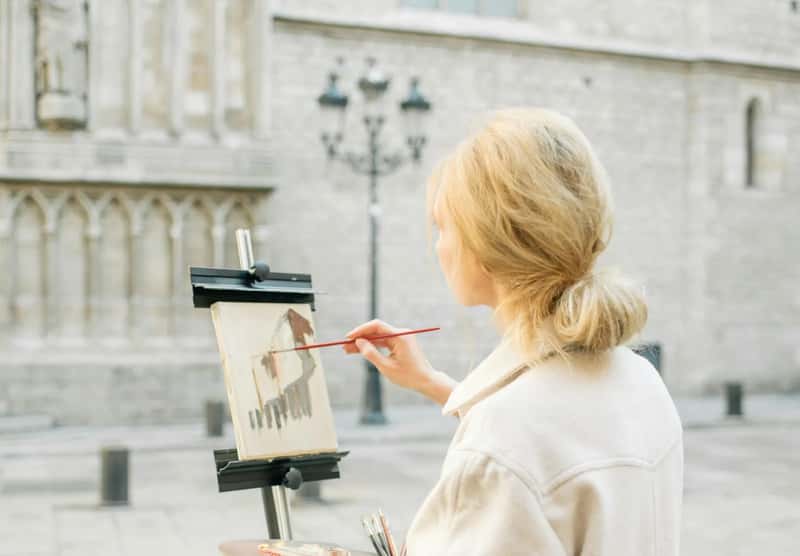
Every unfamiliar room is a soft reset.
When you step into a space you’ll never inhabit again – a rental apartment in a city you’re passing through, a train car at dusk, a conference hotel in a place you can’t pronounce – something structural shifts inside your psychology.
The performance stops.
At home, you are always “on.” You are the version of yourself that your neighbors recognize. The one your office colleagues have already filed under a category. The one your family needs you to be. That performance is exhausting in ways you’ve stopped noticing, the way you stop noticing traffic noise after living by a highway for a year.
Anonymity leads to a loss of internal restraints and self-identity. Conditions that increase anonymity serve to minimize concerns about evaluation by others and weaken normal controls based on guilt, shame, or fear. In a space you’ll never return to, those controls don’t dissolve – they simply become irrelevant. And in that irrelevance, something genuinely creative stirs.
The temporary identity isn’t a fake one. It may be the most real version you own.
2. The Shame Wall Mechanism
Shame is an architect.
It builds walls you don’t remember consenting to. Invisible partitions between what you want to make and what you’re willing to be seen making. Between the song you’d sing if no one were listening and the careful silence you maintain because someone always is.
When people feel watched, judged, or interrupted, they tend to default to safe, conventional thinking. When they feel free from observation, they’re more willing to take intellectual risks. That’s not a character flaw. That’s neurological architecture, built over years of social conditioning.
The Shame Wall is the reason your sketchbook stays empty at home but fills up on a delayed flight.
It’s the reason you write your best paragraphs on the Notes app in a foreign taxi, then delete them when you’re back in your own time zone.
The wall isn’t about laziness. It’s about exposure. At home, every creative act is a public one – witnessed, remembered, held against the identity you’ve already agreed to inhabit. In a temporary space, the ledger resets. There’s no one to remember the risk you took.
3. The Disinhibition Effect
Psychologist John Suler identified it precisely.
The “online disinhibition effect” explains how anonymity erodes our social filters, giving people a strange sense of permission to behave in ways they never would otherwise. Suler studied this in digital spaces, but the mechanism is older than the internet. It is, at its root, a spatial phenomenon – a response to the felt absence of consequence.
When no one knows your name, the calculus of risk changes entirely.
When we act anonymously, the social pressures that often guide our choices can weaken, leading to behaviors that might not align with our personal values or societal norms. But here’s the twist: sometimes those “personal values” were never actually yours. Sometimes they were borrowed. Inherited. Assigned.
The disinhibition effect in a temporary space doesn’t just lower your shame threshold. It reveals the gap between who you were told to be and who you’ve been quietly rehearsing in private.
That gap is where your best work lives.
4. The Watcher’s Absence
Most of the time, you are your own most relentless audience.
Psychologists call it self-monitoring – the internal surveillance system that runs a constant background check on your behavior, comparing what you’re doing against what others might think of it. Anonymity acts to minimize self-observation and evaluation, reduce concern for social evaluation, and weaken controls based on feelings of guilt, shame, fear, and commitment.
In a temporary space, that surveillance system powers down.
Not because you’ve become a different person. But because the audience has gone home.
There’s no one to update. No narrative to protect. No one who will bring up, at dinner six months from now, that you spent an afternoon writing terrible poetry in a motel in Ohio. The Watcher’s absence is the single greatest creative gift a space can offer you – and most people only find it by accident, in a place they didn’t plan to love.
5. The Personal Ledger
I remember the first time I noticed it.
I was sitting in the window seat of a rental apartment in Lisbon. I didn’t speak the language. I didn’t know the street name. My phone had no signal and the Wi-Fi password was written on a Post-it note I’d already misplaced. I had, by every metric, no audience.
I wrote for six hours without stopping.
Not because inspiration had finally descended from some creative heaven. But because for the first time in months, I was operating without the weight of my own accumulated identity. No one in that apartment building knew I was a person who worried about being seen as pretentious. No one knew my professional reputation, my failures, my carefully maintained image of someone who has it mostly together.
I was just a person with a window and a notebook. The ledger was blank. When people have adequate privacy, they gain the opportunity to reflect on their experiences, integrate information into meaningful patterns, and plan future actions without external scrutiny. This process is essential for creative problem-solving, original thinking, and any form of sustained cognitive effort.
The temporary space didn’t give me talent. It gave me permission.
6. The Deindividuation Paradox
Here is the paradox that psychology has wrestled with for decades.
The same mechanism that allows a person to become cruel in a crowd – the dissolution of individual identity – is the same mechanism that allows an artist to finally create something honest in an empty hotel room.
According to Zimbardo, factors leading to a state of deindividuation include anonymity, altered temporal perspective, and novel or unstructured situations. These are also, almost exactly, the conditions of being a stranger somewhere new.
Anonymity isn’t inherently dark. It’s neutral. It amplifies what’s already there.
People in anonymous settings tend to act on their natural disposition. Which means if your natural disposition is creative – suppressed, yes, but alive – then anonymity doesn’t create something new. It excavates something old. Something that’s been waiting patiently under the performance of your daily identity, listening for the moment the audience finally leaves.
7. The Novel Environment Signal
Your brain is a pattern machine.
At home, your environment has been fully indexed. Every corner carries a memory, an association, a task left undone. The kitchen is where you worry about money. The desk is where you stall. The bedroom is where you scroll instead of sleep. The familiar space is saturated with the weight of everything you’re supposed to be doing – and everything you’re afraid to start.
A new space has no index yet. Environmental psychology studies how places shape our ability to control who accesses our personal world, and why that control matters so much for well-being, creativity, and social functioning. A novel space offers no accumulated associations. No emotional debt. It is, neurologically speaking, a clean canvas.
The surge of creativity you feel in an unfamiliar room isn’t magic. It’s your brain encountering an environment that hasn’t yet been colonized by your own shame history. It’s firing on patterns it doesn’t yet know how to suppress.
The idea you had on the train didn’t arrive because you were on a train. It arrived because the train didn’t know what kind of thinker you’d decided you were.
8. The Social Identity Suspension
You carry more identities than you know.
Professional. Parent. Child. Reliable person. The one who doesn’t do things like that. These roles aren’t invented – they’re real, functional, even necessary. But they accumulate weight. And they operate as a silent censorship system on everything you might otherwise create.
Psychological safety describes an individual’s perception of the degree of interpersonal threat in the work environment. Individuals perform an implicit calculus to assess interpersonal risks associated with behaviors like asking questions or coming up with new ideas, because they may be regarded by others as ignorant, disruptive, or even incompetent.
In a temporary space, that implicit calculus doesn’t apply. You are not the person anyone here has pre-categorized. You can attempt the strange idea without it becoming part of your file. You can write the sentence that embarrasses you without anyone updating their mental model of who you are.
Deindividuation, where an individual’s sense of self is submerged within a group, offers a critical lens through which to view collective behavior. This psychological state is not merely about losing oneself in a crowd; it is about the shift from personal identity to social identity. In transit, that shift runs in reverse: you are briefly freed from social identity entirely, returned to something rawer and more willing.
9. The Fear of Being Found
Here is the darker architecture beneath all of this.
The surge of creativity you feel in a temporary space isn’t just about anonymity. It’s about the terror of permanence. At home, what you make can be held against you. It can be witnessed, judged, remembered. It joins the permanent record of who you are.
Fear of failure, criticism, and potential repercussions inhibits people from taking the interpersonal risks necessary for creativity and innovation. This fear doesn’t live in the abstract. It lives in your specific address. In the faces of the people who will still know your name tomorrow.
The temporary space has an escape clause built into its architecture. Whatever you make here can be left behind. The notebook stays. The painting stays. But you leave. You pack your bag, take the elevator, and walk back into a world where no one in the lobby will ever connect you to the person who spent three hours making something strange and honest and not quite finished.
The fear of being found is why so many people only create in transit. And why so few ever figure out how to bring the permission home with them.
10. The Passport to Your Own Interior
The hardest journey most people will ever attempt is not the one with a boarding pass.
It is the inward one. The decision to create without a guaranteed audience of approval. To make something that the version of you at home, surrounded by everyone who has already decided who you are, would never risk in the light of a familiar Tuesday afternoon.
Creativity thrives in conditions where people are allowed to roam free with unconventional thought and intellectual risks. Psychological safety creates this freedom through the diminution of fear from judgment or failure. But here’s what most creativity research, conducted in clean academic conditions, tends to overlook: sometimes that psychological safety isn’t built from trust in others. Sometimes it’s constructed entirely from the absence of them.
The temporary space is not a cure. It’s a diagnostic tool.
Privacy serves critical psychological functions: personal autonomy, emotional release, self-evaluation, and protected communication. Researcher Darhl Pedersen empirically identified five functions of privacy: contemplation, autonomy, rejuvenation, confiding, and creativity. What the unfamiliar room offers you is access to all five – simultaneously, suddenly, in a space that asks nothing of your history.
The creative person you become in a city you’ll never revisit is not a visitor. They are not a vacation version of yourself, indulged temporarily and then packed away with your toiletries. They are the person you are when the shame architecture has been dismantled, even briefly, even accidentally, by geography.
The real work – the work that comes after the insight – is to understand what specifically the temporary space gave you permission to do. Was it the absence of professional identity? The lack of a witness? The clean ledger of a room with no memory? Because once you can name what the anonymous space removes, you can begin the slower, harder, stranger practice of removing it yourself.
Not every person finds their interior self on a journey. Some find it in a corner of the apartment they’ve lived in for years – the moment they finally stopped performing for the ghost of every person who has ever watched them. The space was always there. What changed was the quality of the silence inside it.
Perhaps the real destination was never the city whose name you can barely pronounce. Perhaps it was always the version of you who arrives there first – notebook already open, shame wall already crumbling – waiting, with remarkable patience, for the rest of you to catch up.