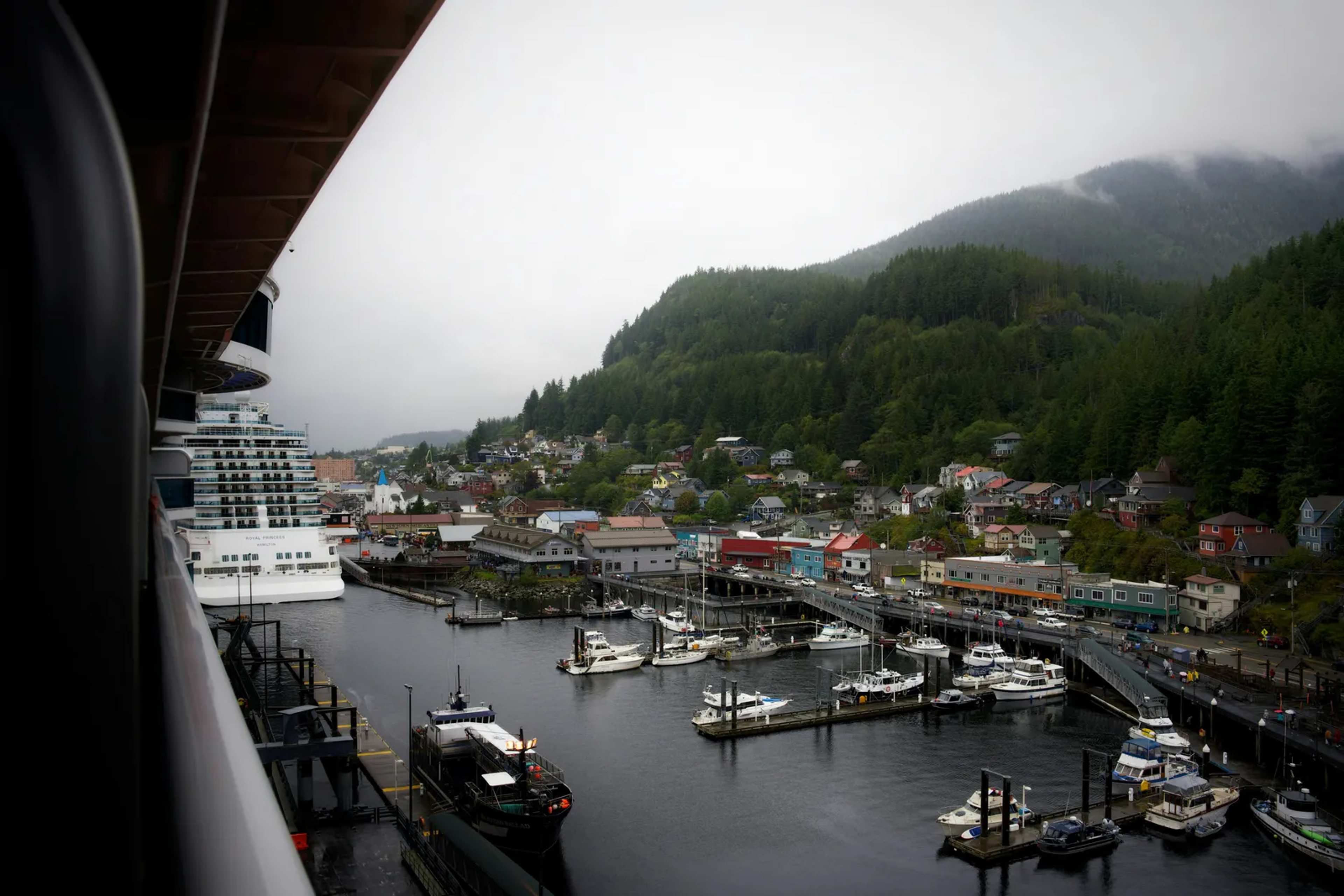
You open your laptop in a café in Lisbon.
You don’t speak the language. Nobody knows your name.
And for the first time in months – you write.
Not because the espresso is better. Not because the light is different, though it is. But because something in this room – in the low hum of strangers doing their own unknowable work – has quietly unshackled you from the version of yourself that lives back home.
There is a gap between who you perform yourself to be and who you actually are when no one is keeping score. There is a measurable psychological distance between the self you carry at home and the self that surfaces the moment you become a stranger in a strange place. At home, identity is a negotiated contract, renewed daily with everyone who has ever met you. On the road, that contract expires. What remains isn’t emptiness.
It’s creative oxygen.
1. The Body Double You Never Hired

Body doubling is working in the presence of another person who is also engaged in a task. It’s not collaboration – you’re not working on the same thing. It’s not accountability – they’re not checking on your progress. It’s simply parallel presence: two people doing their own work in shared space.
The strangers in that Lisbon café? They are your body doubles.
They didn’t sign up for it. They don’t know they’re doing it. And that’s precisely what makes it work.
Sometimes, even being around strangers who are also working can create a focused environment. But it’s all about where you choose to go. The best type of public spaces are the ones where people are working quietly – think a library or coffee shop. The quiet energy of people working around you can be motivating.
You didn’t need a productivity app. You needed a foreign city’s afternoon light and ten people who have never heard of you.
2. The Soft Contract of Shared Silence
There is a social agreement happening in that café, and it requires zero words.
Body doubling creates a soft social contract: “We’re both working right now.” This isn’t the pressure of a boss watching over your shoulder or a deadline looming. It’s the mild awareness that another person is engaged in productive activity, which makes it slightly easier to stay engaged yourself. The accountability isn’t about judgment. It’s about shared intention. Knowing someone else is in “work mode” normalizes being in work mode yourself.
No one is watching. No one is judging. No one is comparing this draft to your last one.
They are simply, beautifully, present.
And that presence is enough to anchor your wandering mind to the page.
3. The Costume You Wore at Home
Before the café. Before the departure gate. There was the version of you that existed at home.
Identity at home is not chosen. It is accumulated. It is the nickname your brother gave you at seven. The professional tone your first boss expected. The emotional role your family quietly assigned – the responsible one, the funny one, the difficult one. You did not audition for these parts. They were handed to you, and over time, they fit so well you forgot they were costumes.
The café doesn’t know about any of that.
The barista who slid your coffee across the counter has zero opinion on the project you abandoned in 2019. The man reading a newspaper three tables away carries no memory of your worst professional mistake. When someone does not know your past, your habits, or your social circle, there is a sense of freedom that naturally follows. There is no fear of your words being tied back to your identity in a meaningful way.
And in that freedom, something long dormant wakes up.
4. The Neuroscience of Novelty
The café is doing something to your brain that your home office never could.
Foreign environments often come with a rush of sensory data. The aroma of street food, the hum of a foreign language, the layout of a new city – all demand processing power. This sensory overload may sound stressful, but for many, it’s exhilarating. The brain becomes more responsive, more curious, and more likely to draw unusual connections between unrelated ideas – a hallmark of creativity.
Your old desk is a graveyard of associations.
The bills you haven’t opened. The ambient guilt of that unread email. When you’re home, you’re in a system of associations – your couch reminds you of chores, your street reminds you of yesterday’s conversation, your phone triggers work emails. It’s a mental feedback loop. Travel disrupts that loop by removing the associative triggers that tether you to old thoughts.
The foreign café has no such triggers. Every corner is clean. Every sound is new data. Your brain, forced to adapt, begins to connect things it never would have connected at home.
5. The Permission Slip I Found in Porto
I remember sitting in a narrow café in Porto – the kind with handwritten menus and tiles that look like they survived several centuries of difficult weather.
I had a manuscript I hadn’t touched in four months. Back home, opening the file felt like a confrontation with everything I’d failed to become. But in Porto, nobody knew I was failing. Nobody even knew I was trying. The man to my left was solving something mathematical, hunched and focused. The woman across from me was reading something that made her quietly laugh every few pages.
I opened the file. I wrote for three hours.
What I understand now is that Porto gave me body doubles who had no investment in my outcome. There is body doubling in the form of ambient companionship. When body doubling in a public location such as a café or library, the strangers acting as body doubles are likely unaware that someone is using them to focus. The anonymity wasn’t a void. It was a room with no mirrors. And in a room with no mirrors, you stop adjusting your expression and start doing the work.
6. The Polyvagal Safety Signal
Your nervous system is reading the room, even when you’re not.
Dr. Stephen Porges’ polyvagal theory links our physiological state to our psychological experiences. According to the theory, when individuals engage in body doubling, they experience a calming effect due to a shift from a state of hyperarousal (sympathetic state) or hypoarousal (dorsal state) to a state of calm engagement (ventral state). This shift allows for enhanced focus, concentration, and productivity.
The café, in its full sensory aliveness, signals something ancient in your nervous system: you are not alone, but you are not threatened. According to Polyvagal Theory, our physiological state and our psychological experiences are linked. When we feel safe and connected to others, we shift into a “social engagement” response. This response creates greater concentration and productivity.
Safety without scrutiny. Presence without performance. That is the peculiar alchemy of the foreign café.
Your body knew this before your mind caught up.
7. The Hawthorne Effect, Quietly Reversed
There is a psychological phenomenon called the Hawthorne Effect – a type of behavioral reactivity in which individuals modify an aspect of their behavior in response to their awareness of being observed. At home, in front of people who know your history, the observation is loaded. Your colleague remembers the presentation that went sideways. Your partner has an opinion on whether this project is worth your time.
In the foreign café, the observation is neutral. The strangers around you carry no prior data.
We’re hypersensitive to the presence of others and, of course, to what other people think of us. Body doubling turns that built-in spotlight into motivation, which we can leverage to drown out our equally human urge to procrastinate.
The key difference: these strangers’ opinions are blank. They are a spotless mirror. And in a spotless mirror, you finally see the work – not the worker’s reputation, not the history of past failures – just the work, right now, on the page.
8. The Tourist Identity and Its Creative License
Crossing a border activates something that staying home cannot.
Solo travel is considered an act of resistance to and freedom from social-cultural and political limitations, as well as an activity that brings increased self-awareness and renewed social identity.
Activating a tourist identity allows individuals to act more freely and expressively in ways consistent with that identity. The freedom is not trivial. It is constitutional. It is the right to walk into a room and decide, in real time, who enters.
Who enters matters enormously to the creative process.
The person who enters the Porto café is not the person who avoided the manuscript for four months. They are a writer in Porto. That reframe is not trivial psychology – it is a neurological permission structure. One of the most powerful ways that travel enhances creativity is by breaking us out of habitual patterns and forcing our brains to adapt. This kind of mental stretching, like navigating a new city, learning cultural norms, or problem-solving in unfamiliar settings, builds cognitive flexibility, a key ingredient in creative thinking.
9. Strangers Who Do Not Know Your Excuses
This is the cruelest and most liberating part of body doubling with strangers.
They don’t know that you usually work better in the morning. They don’t know that your creative block started after that particular incident, in that particular year. They don’t know you told someone last Tuesday that you’d have a draft by Friday.
Strangers provide stronger accountability – you’re less likely to scroll Instagram with a stranger watching – but may feel awkward initially. Platforms like Focusmate deliberately pair you with strangers, which many ADHD users find more effective precisely because the social dynamic discourages off-task behavior.
This is the café’s secret weapon, concentrated and potent in its foreignness.
Friendships come with history. Shared memories, past conflicts, emotional bonds, and unspoken understandings all play a role in how conversations unfold. Because of this, sharing something deeply personal with a friend can sometimes feel complicated. It might bring up old issues or create new tensions. With strangers, there is no emotional baggage. The interaction starts fresh and ends without complications.
Your excuses have nowhere to land.
So you work instead.
10. The Cost of Coming Home
Here is the heaviest truth in all of this.
The café worked. You wrote. You drew. You solved the thing you’d been circling for three seasons. The strangers did their part – their ambient, wordless, judgment-free part. You did yours. Something real was produced in that borrowed space between foreign walls.
And then you came home.
When your brain becomes accustomed to the dopamine hits of novelty, the predictable rhythms of home can feel mundane by comparison. This creates a psychological dependency on external stimulation for well-being. The desk is the same desk. The silence is the same silence. But you are not quite the same person, and the gap between who you were in the café and who you are required to be here – that gap is now visible in a way it wasn’t before. That visibility is uncomfortable. It is also, if you sit with it long enough, the most useful thing travel ever gave you.
Some benefits of body doubling include increasing the individual’s accountability and motivation, and decreasing feelings of isolation. It allows for subtle reinforcement to prevent procrastination and create consistency towards their goals. The question the returned traveler must eventually answer is not where to go next, but how to build a version of that café’s conditions right here – not by importing marble countertops or a Mediterranean latitude, but by reconstructing the essential psychological ingredient: a space in which the past has no seat at the table.
You don’t need to be in Lisbon. You need to be anonymous enough that the work can speak louder than the résumé you carry everywhere. You need body doubles who are indifferent to your story – not because the story doesn’t matter, but because the work, right now, matters more. That barista in Porto never asked you what you’d published before. They just handed you the coffee and went back to their own quiet business. And in that small, merciful disinterest, you found something you’d been looking for in every room you’d ever worked in.
The question isn’t whether you can recreate the foreign café.
The question is whether you’re finally ready to work without the audience of your own history watching over your shoulder.